LONDON — For half a century, the man in the tweed jacket told no one. Not his colleagues at the stock exchange, not his friends, not even his own son. Then, on a live Saturday evening broadcast in February 1988, the silence ended in front of millions of viewers who watched a 78-year-old retired stockbroker named Nicholas Winton discover that the woman seated beside him — a stranger he had been chatting with for several minutes — was one of the 669 Jewish children he had saved from the Nazis.
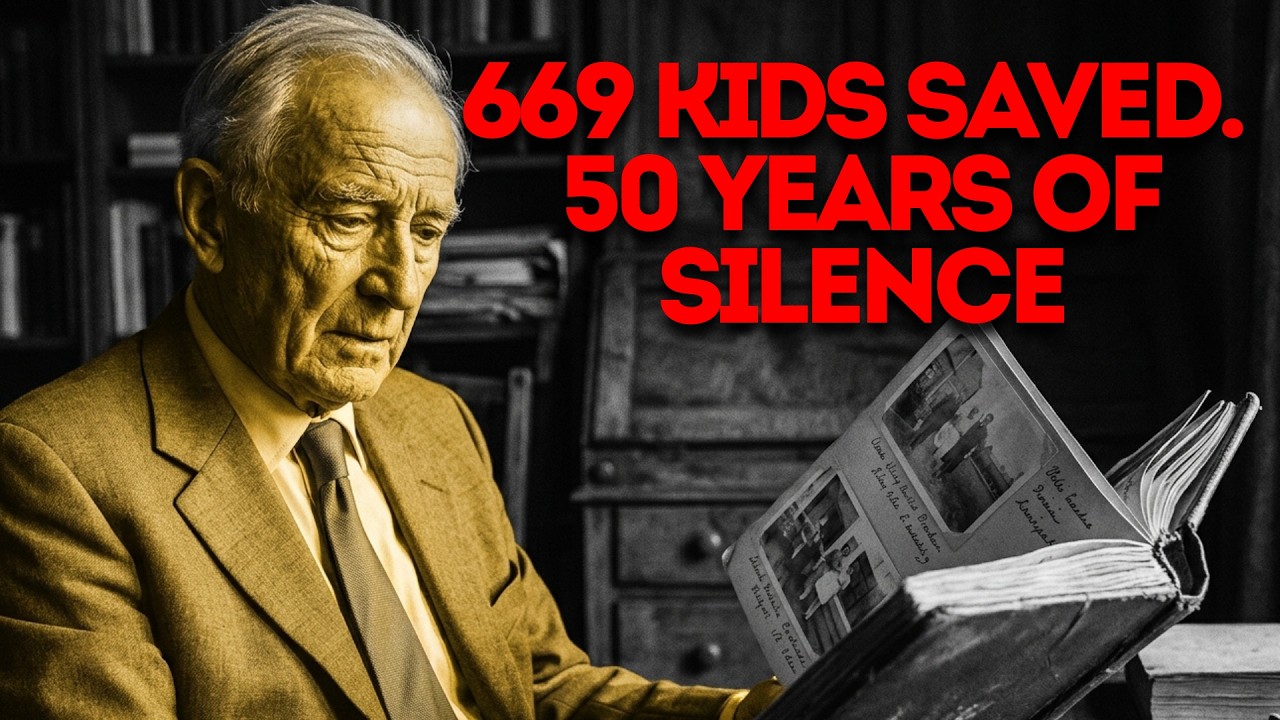
The revelation came on the BBC program “That’s Life,” hosted by Esther Rantzen, during what Winton believed was a simple segment about an old scrapbook. He had agreed to one framing and only one: a quiet chat about a leather-bound album his wife, Grete, had found in their attic earlier that year, its spine cracked, its pages crowded with fading photographs, typed names, travel permits, and letters gone the color of weak tea.
He did not know what waited three feet to his left. He did not know the room had been seated for weeks by researchers working from the names in that scrapbook, tracking electoral rolls, old addresses, married surnames, and phone directories. Letters went out.
Quiet calls were made. One by one, grown men and women in their fifties agreed to come to a television studio on a Saturday and say nothing about why.
They sat in ordinary chairs in ordinary rows, coats on their laps like everyone else, waiting for a cue Winton did not know existed. The studio lights were hot enough to prickle the back of his neck. Cables snaked across the floor between camera positions.
The audience murmured the way audiences do before a taping, programs in hand, someone coughing twice and apologizing for it.
Rantzen introduced him as a man with an interesting scrapbook. Winton settled into his chair the way a man settles in for a friendly chat about stamps or model trains. He did not scan the audience.
He had no reason to. Rows of strangers in wool coats, ordinary Saturday night faces, nothing to notice — except everything.
She asked him to open the album. He did, page by page, narrating the way he might narrate a holiday album. This child, that transport, a date, a name.
The room went quiet in the particular way a room goes quiet when it is holding something back. Then Rantzen asked a question that was not about the scrapbook at all.
Winton’s face changed before his mouth did. Something behind his eyes caught on a thought he had not finished having. A studio clock ticked somewhere off camera.
Nobody in the audience moved. His hand, resting on the open scrapbook, went still on the page. What was behind his eyes was not the BBC studio.
It was Prague. December 1938.
The road to that studio began with a piece of paper signed in Munich in September 1938 by Neville Chamberlain, Édouard Daladier, Adolf Hitler, and Benito Mussolini. A slice of Czechoslovakia called the Sudetenland changed hands without a single Czech representative in the room. Chamberlain flew home and told a crowd at the airport he had secured peace for their time.
The crowd cheered. The paper he waved for the cameras did not mention the people now living inside a border redrawn by men who never asked them anything.
German troops moved into the Sudetenland through October. Czech border defenses, built at considerable expense over the preceding years to face exactly this scenario, were surrendered without a shot fired, because the government in Prague had already been told by its allies that no shot would be answered. What was left of Czechoslovakia — squeezed, 𝓮𝔁𝓹𝓸𝓼𝓮𝓭, missing its fortified frontier — had months, not years, before the rest of it went the same way.
Nobody in Prague needed a briefing to understand that. They could read a map as well as anyone in London or Paris. Within weeks, the roads into Prague filled.
Sudeten German anti-fascists walked out of towns that no longer answered to Prague, carrying what fit in a suitcase. Jews from the annexed territory moved with them, reading the new signage correctly and leaving before anyone could stop them. Political dissidents, whose names already sat on Gestapo lists, moved fastest of all.
Prague’s population swelled by tens of thousands of people with nowhere assigned to put them. Camps went up on the city’s outskirts. Tents first, then huts, then more tents when the huts ran out.
Families slept in rows on straw, coats doubling as blankets, shoes lined up at the tent flap the way people line up shoes when they still believe the arrangement is temporary. Ration lines formed before dawn and did not shrink by dusk.
Relief workers handed out bread, tinned milk for the children, thin soup ladled from drums that steamed in the cold air and were empty long before the line was. Winter came early that year, and the wind off the Vltava did not care whose side of a map anyone was born on. Prague’s charities and relief committees, built for ordinary peacetime casework, buckled under the number of new arrivals.
Paperwork piled up faster than clerks could stamp it.
Every family in those camps wanted the same three things: a work permit, an exit visa, and proof that somebody somewhere would take them in. Most would get none of the three before the calendar ran out. And on the other side of the continent, in a stockbroker’s office in London, a man who was not yet Nicholas Winton was reading a letter that would change all of it.
He was born Nicholas George Wertheim, his birth certificate filed in London on May 19, 1909. His parents were German Jewish immigrants who anglicized the family name and had their son baptized, folding him into English respectability the way a great many immigrant families of that era did, quietly and without ceremony. By 1938, he worked the London Stock Exchange, wore a good overcoat, and had booked a skiing holiday in Switzerland for the Christmas season.
Nothing about his file marked him as a man about to do anything of note. Then a letter arrived from a friend named Martin Blake, working in Prague with a refugee relief committee. Blake asked Winton to skip the skiing and come see the camps for himself.
Winton canceled Switzerland. He did not record in anything that survives exactly why.
He arrived in Prague in December into a cold that London does not prepare a man for. He stepped off the train in his good overcoat, the one cut for a mild English winter, and it did almost nothing against a central European one. Wenceslas Square sat under a flat gray sky.
Trams ran. Cafes stayed open. The ordinary machinery of a European capital ground forward as if nothing had changed.
Three streets over, the camps told a different story entirely.

Winton walked through huts where children slept two and three to a cot. Their parents lined up outside relief offices trying to get exit papers before an occupation everyone in that city could already feel coming. He watched a woman fold a child’s coat with the exaggerated care of someone trying to keep her hands from shaking.
He watched a man read the same letter three times, as if a fourth reading might change what it said.
Nobody had to explain the arithmetic to him. Adults could sometimes get visas. Children mostly could not, because no country wanted to issue travel documents to a minor without a guardian already in place on the other end.
The parents in that line understood this better than anyone. They were not asking to save themselves.
Winton spent part of his intended holiday touring the camps with Blake, taking names, listening. Within days, the trip he thought would last a fortnight became something else. He did not go skiing.
He went to work. The operation started in a hotel room in Prague, its dimensions closer to a broom closet than an office. A single desk pushed against the wall.
A typewriter borrowed from somewhere. A growing stack of index cards with children’s names on them, written in a hand that got faster and less careful as the pile grew.
Word got out fast among the families in the camps that an Englishman was taking down names of children who might be got out. The line outside his hotel room door lengthened each morning before he had finished his coffee. Parents held photographs, birth certificates, anything with an official stamp on it that might help a case move faster.
He worked through the names methodically, in the manner of a man who spent his working life reading balance sheets rather than headlines.
A photograph clipped here. A date of birth recorded there. A note on any relative already settled in Britain.
A case number assigned in the same neat sequence he once used for stock ledgers. He could not run this from a hotel room forever, and he could not run Britain’s end of it from Prague at all. Within weeks, he handed the Prague operation to Trevor Chadwick, a school teacher willing to stay behind and manage the groundwork — the endless queues, the paperwork, the families arriving at dawn with a child and a suitcase and no other plan.
Chadwick inherited the index cards, the borrowed typewriter, and the line outside the door, along with the harder job of keeping local authorities cooperative as the political ground under Prague kept shifting week to week. Winton worked alongside Doreen Warriner, already running the British Committee for Refugees from Czechoslovakia out of a Prague office of her own, coordinating politically vetted adults out through more conventional channels while the question of the children remained entirely unsolved.
Between the two operations, a rough division of labor set in. Warriner’s office handled the adults whose names already sat on watch lists and could not wait. Chadwick and Winton’s growing card index handled the children nobody else had a mechanism for moving at all.
Then Winton returned to London — not to rest, but to turn a kitchen table in his mother’s flat into the other half of the operation.
The half that had to convince a government to let several hundred foreign children into the country, find a family willing to take each one in, and satisfy a list of Home Office conditions attached to every single case. He set up at the kitchen table each evening after his day at the exchange, sorting correspondence into piles by category: offers of foster homes, refusals, requests for more information, government forms half-filled, waiting on a signature he did not yet have the authority to give.
His mother pitched in, answering letters, keeping the piles from toppling. Neighbors thought it an odd way for a young stockbroker to spend his evenings. He had a stack of names.
He had no idea yet how many trains it would take to move them, or how little time was left before the roads out of Prague closed for good.
In London, a desk sat buried under paper. Foster family letters in one pile. Refusals in another.
A third pile nobody had sorted yet because there was no time. A stack of British pound notes sat under a paperweight, counted twice, waiting to be turned into a bond guarantee the moment a family signed. Fifty pounds per child.
That is what the Home Office demanded before it would let a single foreign minor cross the border — a guarantee against the cost of ever sending the child back.
Winton did not have that sum multiplied by the number of names on his index cards. Not close. He raised it anyway.
Family by family, favor by favor, advertisement by advertisement, placed in newspapers and synagogue newsletters and church bulletins asking a simple question: Will you take one in?
Photographs got matched to addresses. A boy from a Prague street to a vicarage in Surrey. A pair of sisters to a childless couple in Liverpool who asked specifically for two.
Every match became a folder. Every folder became a case number. Every case number became a seat on a train that did not exist yet.
Letters arrived by the sackful. Some offered a spare room and nothing else. Some came with conditions attached — an age range, a preference for a girl over a boy, a request that went unanswered because there was no time to be selective on the Prague end of the operation.
Winton answered what he could, discarded nothing, and kept working the stack after his mother had gone to bed and the exchange had been closed for hours. The bond money moved through committees, guarantors, and personal pledges — fifty pounds accumulating in fragments from people who would never meet the child their signature was about to save a seat for.
Then the ground under the whole operation moved. On March 15, 1939, German forces occupied what remained of Czechoslovakia. Prague woke up to tanks on its bridges and a new flag over the castle.
Whatever bureaucratic patience existed before that morning was gone by noon. The operation Chadwick and Warriner had been running out of borrowed offices now had to run under the direct nose of the Gestapo.
Every exit stamp had to pass a desk that did not exist in February. Every departure list got checked against watch lists that grew by the week. Some permits moved because a clerk was sympathetic.
Some moved because Chadwick had learned exactly which official wanted what in cash in an envelope before a signature appeared. None of it was written down where anyone could find it later.

Rubber stamps got sourced through contacts that are never named in any surviving letter. Typewritten forms were altered, retyped, and altered again to match whatever format the occupying authority was demanding that particular week. The rules changed without warning, and the operation changed with them, because stopping to argue about the rules was not an option anyone on the ground could afford.
The route out was fixed early and stayed fixed. Prague to the Dutch border by rail, across the Netherlands, a ferry from the Hook of Holland to Harwich, then the final leg into London. Eight separate trains would eventually run this line between March and August of 1939.
Six hundred and sixty-nine children would be on them by the time the line went dead.
Each departure started the same way. Families arrived at the Prague station before dawn. A child in one hand and a small case in the other.
A case packed, in most instances, by a parent who spent the night deciding what a person is allowed to take when they do not know if they are leaving for a year or forever. Nobody said that part out loud. There was a platform to get to and a train that would not wait.
Border checkpoints slowed everything down. Guards in uniform, swastika armbands sharp against the gray of the platform, worked through papers one child at a time. A stamp missing.
A name misspelled. A photograph that did not quite match a face that had grown three months older than the print. Any of it could pull a child out of the line.
Chadwick’s forged and half-forged permits were built to survive exactly this kind of scrutiny, and mostly they did. Mostly is the word that mattered. Nobody on either end of the line used it out loud.
Inside the carriages, the children traveled with a number pinned or hung around the neck, matching a number on a master list held in London and a duplicate held in Prague. Some carried a single photograph. Some carried nothing but the clothes on their backs and instructions memorized rather than written down, because a written instruction can be read by the wrong person at a checkpoint.
Older children were told to watch the younger ones. Nobody had to explain what that meant in practice.
The crossing itself ran by ferry from the Hook of Holland across open water to Harwich — a stretch of the journey with no checkpoints and no armbands, just gray sea and a boat rail children clung to before the coast of England showed up as a smudge on the horizon. For some of them, it was the first quiet hour since Prague.
In London, Winton met what trains he could at the station, though not every one of them. His day job at the exchange did not stop because a rescue operation needed him at Liverpool Street on a Tuesday afternoon. Foster families waited on platforms holding handwritten signs with names spelled the way an English clerk guessed they should be spelled.
Children stepped off the train into a language they did not speak, matched within the hour to strangers who had signed a form months earlier, promising a bed, food, and school fees.
Reporters occasionally showed up to photograph the arrivals. Winton avoided the camera when he could, more concerned with matching faces to folders than standing for a picture. There was always another train to plan before this one had finished unloading.
Some matches held for years. Some collapsed within weeks, and Winton had to find a second family fast, working the same stack of letters, the same synagogue bulletins, the same fifty-pound bond requirement, one failed placement at a time.
Siblings were sometimes split between two households on opposite ends of the country simply because no single family had room for both — an arrangement made in minutes on a station platform and lived with for years afterward. Behind every one of the eight trains sat the same machinery, rebuilt from nothing each time. Names collected in Prague under worsening conditions.
Money raised in London under a deadline nobody controlled. Permits pushed through a checkpoint system built specifically to stop this kind of movement. Nothing about it ran smoothly.
Nothing about it ran twice the same way.
By August, 669 children had crossed the checkpoint, the border, the Channel, and the platform at Liverpool Street. Eight trains. Eight departures.
Eight sets of foster families waiting under the same station clock with the same handwritten signs. Every one of them ran. Every one of them arrived.
A ninth train was already scheduled. The paperwork for 250 more children was already moving through Chadwick’s office in Prague, already stamped in places, already short a signature in others. Foster homes in England were already lined up and waiting.
Letters already answered. Bond money already counted out from beneath the same paperweight on the same London desk.
The calendar did not care that the operation was close to finished. It had its own deadline, and it was about to arrive first. On September 1, 1939, a platform in Prague stood reserved for the ninth transport.
Two hundred and fifty children on the master list, checked and rechecked against the eight lists that came before it. Foster placements confirmed in London. Bond money counted.
Exit permits stamped through the same channels that had moved every previous train out of the country without exception.
The same morning, German forces crossed into Poland. The invasion began before dawn along the length of the Polish frontier — armored columns, air units, a campaign planned for weeks and launched without a declaration first. Within hours, German authorities sealed the border crossings out of the former Czechoslovak territory.
Rail traffic scheduled to leave that day was halted by order. Freight schedules, passenger timetables, and the ninth transport’s paperwork were all filed under the same halt order, without distinction between categories.
Telephone lines between Prague and London remained open a while longer. Confirmation of the cancellation reached Winton’s office within the day, relayed through the same channels that had confirmed eight departures before it. No further detail accompanied the message.
There was nothing further to relay. The ninth train did not run.
No announcement was made to the families waiting at the platform. No official reason was posted. Two hundred and fifty children who had been told to say goodbye that morning were told instead to go home.
Luggage packed for a journey sat uncollected in hallways and on doorsteps across Prague, waiting for a train that had already been cancelled by a government decision made hundreds of miles away. The station clock kept time as it had the day before. The platform emptied.
 There was no whistle, because there was no departure to announce.
Two days later, on September 3, Britain and France declared war on Germany. The declaration followed the invasion of Poland. It did not follow the canceled train, which by then had already been struck from the schedule for two full days.
The border sealed on the first of September did not reopen. No further transport organized by Winton, Chadwick, or Warriner crossed it after that date. Diplomatic channels that had allowed eight trains to move through occupied territory closed along with the border.
The paperwork already prepared for the 250 children — permits, foster placements, matched case files sitting in a London office — became unusable within days, tied to a route that no longer existed. The foster families who had been waiting at English stations with handwritten name cards received no children and, in most cases, no further correspondence explaining why. Historical records do not provide a complete accounting of what happened to each of the 250 children on that final list.
It is believed that the overwhelming majority did not survive the war.
What is documented is the count that came before it. Eight trains. Six hundred and sixty-nine children.
A ninth train, fully prepared, that never left the platform. The operation that had moved a child out of occupied territory roughly every few days for six months stopped in a single morning — not because the system built to run it failed, but because the war it had been racing finally arrived first.
Winton returned to his ledger of case files in London. The folders for the 250 children remained where he left them. He did not destroy them.
He did not add to them either. There was nothing left to add. He went back to his job at the exchange the following Monday.
He said nothing about any of it. Not to colleagues. Not to most of his own family.
For the better part of fifty years.
The scrapbook sat in that attic from 1939, untouched, unmentioned, until Grete found it in 1988. Inside its covers: rows of typed names in fading ink, columns of numbers, small black-and-white photographs of children clipped to index cards, carbon copies of letters, a handful of official stamps pressed into paper that had gone soft with age. No captions explaining what any of it meant.
Just the record itself, kept the way a bookkeeper keeps a ledger.
Grete asked what it was. He went and told her in the plain voice he used for most things. Children.
A rescue operation he ran out of a Prague hotel room and a London kitchen table half a century earlier. He had not spoken of it in fifty years. His own son did not learn the scale of it until that scrapbook came down from the attic.
A historian who studied the album persuaded Winton to bring it onto Rantzen’s program to talk on camera about the children he helped move out of Czechoslovakia before the war closed the roads. Winton agreed to one framing and only one: a segment about a scrapbook, nothing more. He packed the album into a case, put on his good jacket, and told Grete he would be back by evening.
Back in the studio, Rantzen told him on air that the woman seated directly beside him — Vera Gissing, born Věra Diamantová in Czechoslovakia, one of the children on his list, one of the 669 — owed her life to him. Winton adjusted his glasses. It was a small, ordinary gesture, the kind a man makes to buy himself a second before he has to say something.
He looked at Vera properly for the first time all evening. Neither of them said very much. The studio did the talking for them, in the low rustle of an audience realizing together what it was watching.
That was the first episode. The second, broadcast days later, went further. Rantzen asked a single question to the room: Is there anyone else here tonight who owes their life to Nicholas Winton?
Would they please stand? Winton did not know what had been arranged. He had not been told the rows behind him were filled, one by one, with names traced out of his own scrapbook — the same kind of quiet legwork that once filled a hotel room in Prague, run this time by television researchers instead of a school teacher and a stockbroker’s mother.
Chairs scraped. People rose to their feet around him. Not all at once, but in a slow unfolding wave, one row catching the next.
He turned in his seat to look. The audience was already standing when he finished turning. He did not make a speech.
He removed his glasses again, folded them, and sat with them in his hand. The applause ran long. Nobody in that room needed it explained to them what fifty years of silence looks like once it ends.
Winton never gave interviews about the rescue beforehand because nobody had known to ask, and he had never once volunteered the answer himself. He never called himself a hero. The footage from that studio outlived its original broadcast by decades, resurfacing again and again on screens that did not exist in 1988, for audiences who were not alive to see it the first time it aired.
Nicholas Winton died on July 1, 2015, at the age of 106. By then, the world knew his name. An estimated 6,000 people are alive today because of the eight trains he organized and the 669 children who rode them.
The ninth train, and the 250 children who never boarded it, remain the part of the story he carried longest and spoke of least.
He stayed silent for fifty years. He never sought credit. He never asked for recognition.
And when the recognition finally came, on a live Saturday evening broadcast, it arrived not as an award or a medal but as a room full of strangers rising to their feet — the grown children of a rescue he had kept to himself, standing in ordinary chairs in ordinary rows, finally able to say the thing that had gone unsaid for half a century.