
ALEXANDRIA, Va. — The woman who lit George Washington’s fire every morning for more than three decades stood four feet from his deathbed on December 14, 1799, watched the first president of the United States draw his final breath, and then learned within weeks that the celebrated will freeing 123 enslaved people at Mount Vernon contained no freedom for her.
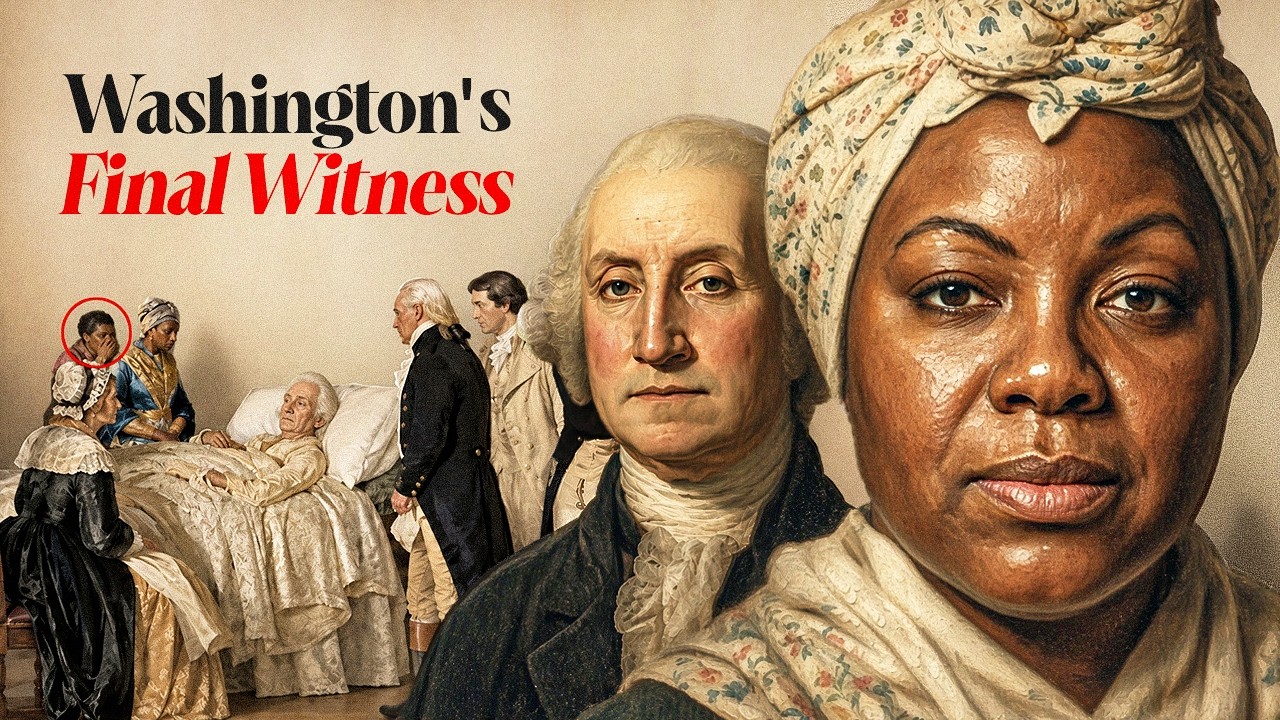
Her name was Caroline Branham. She was, by the laws of Virginia, not George Washington’s property to free. And the story of what she did with the one thing she still owned — her memory — has remained almost entirely absent from the national narrative of the man she served.
Newly reconstructed accounts of Branham’s life, drawn from Washington’s surviving papers, Mount Vernon plantation records, and 19th-century histories, place her at the center of the most consequential death in American history — and at the margins of its most celebrated act of emancipation.
Before sunrise on December 14, 1799, Branham crossed the dark yard from the servants’ hall, climbed the mansion’s back stairs, and knelt at the hearth in the room where George and Martha Washington slept. She struck the kindling. The man in the bed did not stir.
His breathing was heavy, labored, wrong. Three decades of lighting that fire had taught her the sound of an ordinary morning. This was not one.
She hurried to wake Martha Washington, who took one look at her husband and sent Branham running again — this time for Tobias Lear, the president’s private secretary, asleep two floors below.
Washington had ridden out the previous day in freezing rain to inspect his farms, returned late with wet hair and damp clothes, and sat through dinner rather than keep guests waiting. By morning he could barely speak above a whisper. Three doctors arrived on horseback through the rain.
He was bled repeatedly, a treatment standard to the era that modern medicine regards as likely harmful.
By afternoon, Washington understood he was dying. He thanked each physician and asked them plainly to stop. Near 10 p.
m. , he spoke his last words to Lear, asking that his body not be placed in the vault too quickly after death — a common fear of being buried alive. “Do you understand me?”
he asked. Lear said he did. “Tis well,” Washington replied.
He did not speak again.
In the room stood four enslaved people: Christopher Shields, Washington’s personal body servant, two house maids named Charlotte and Molly, and Caroline Branham, standing near the door. By Virginia law, all four were property. They had been called to witness the death of the man who legally owned them because no one else remained in the house who had not already been summoned.
Four days later, an enormous funeral procession moved through the grounds of Mount Vernon. Branham’s eldest son, 14-year-old Wilson, led a riderless horse behind the casket, its boots reversed in the stirrups — a tradition reserved for a fallen commander. Branham did not walk in that procession.
She stood back with the other enslaved people and watched it pass, present at the center of the moment and invisible within it.
Two weeks later, Washington’s will was read aloud. It ordered the freedom of roughly 123 people he owned outright — not upon his death, but upon Martha’s, so that families would not be split apart by an immediate sale. It was one of the only times in American history that a slaveholding founding father freed the people he enslaved by name, in writing, permanently.
Branham heard nothing that applied to her. Neither did her husband, Peter Hardiman, nor any of her children.
The reason had nothing to do with loyalty or service. It was a matter of law. When Martha Washington’s first husband, Daniel Parke Custis, died in 1757, more than half the enslaved people who would later live at Mount Vernon came into the marriage as part of Martha’s inheritance — legally known as dower property.
George Washington managed them, worked them, and lived alongside them for forty years, but he never owned them. Under Virginia law, dower property belonged to the Custis estate, meant eventually to pass to Martha’s grandchildren.
Branham was one of nearly 200 people trapped on that side of the line. Freedom was never Washington’s to give her in the first place.

On January 1, 1801, Martha Washington — reportedly uneasy at owning people who now had every reason to wish for her death sooner rather than later — freed Washington’s 123 by her own signature, a full year ahead of what the will required. Branham watched neighbors, cousins, and old friends walk free through the same gate she had swept every morning for two decades. Then she went back to work.
Martha died in 1802. Under Virginia’s dower slave law, Branham, her husband, and her children did not become free and did not stay at Mount Vernon. They became the legal property of Martha’s grandson, 20-year-old George Washington Parke Custis, divided along with nearly 200 other people the way land or livestock might be divided among heirs.
Within months, Branham and her family were moved eleven miles north to a new estate Custis was building on a hill above the Potomac. He called it Arlington House.
Custis had spent his childhood being raised, in effect, by George Washington, who took in Martha’s grandchildren as his own after their father’s early death. He idolized Washington’s memory almost to the point of obsession, filling Arlington with the first president’s furniture, books, portraits, and a tent used during the Revolutionary War. Branham arrived in 1802 as part of that legend’s furniture too — a woman who had personally witnessed the great man’s death, now living and working inside a monument built to celebrate him.
The work itself did not change much. A house needed its fires lit, its linens kept, its family dressed and fed, whether it belonged to George Washington or his wife’s grandson. What changed was everything around the work: a new house, a new set of rooms to learn in the dark, children of her own now old enough to help carry water and firewood, and a new owner not yet thirty years old.
Whether Peter Hardiman made that move with her is not entirely clear in the historical record. Mount Vernon’s own archivists note the uncertainty. What is documented is that Peter died sometime around 1811 or 1812 at Arlington House, ending a marriage that Virginia law had never recognized but that had lasted, by any honest measure, more than two decades.
Branham was left somewhere in her late forties, a widow with children ranging from young adults to small infants, still legally the property of a man she had known since he was a boy.
Around 1806, while still building a life at Arlington, Branham gave birth to her ninth and final child. She named her Lucy. According to one 19th-century account and research compiled for the exhibition “Lives Bound Together,” it was widely believed within the household — based on physical resemblance rather than any documented confession or record — that Lucy’s father was not Peter Hardiman but George Washington Parke Custis himself, the man who legally owned Branham.
No letter, diary entry, or legal document confirms this directly. It survives only as something people who lived at Arlington believed to be true, passed down as oral history. What can be said with certainty is simpler: Branham was an enslaved woman with no legal power to refuse anyone who owned her, and the child in question grew up inside a household where that fact was never spoken aloud, and never needed to be.
Custis, meanwhile, built his public reputation as the last living link to George Washington, giving speeches, writing memoirs of his adoptive grandfather, and hosting visitors eager to see Washington’s actual belongings arranged inside his home. History would remember him for more than a century chiefly for that devotion. The enslaved women and men who kept the shrine dusted, fed, and functioning rarely appeared in any of it.
By the late 1820s, Branham was in her sixties, still living at Arlington, still enslaved, having buried a husband and raised nine children while control over her life passed from George Washington’s management to Martha Washington’s ownership and finally to their grandsons. She had watched the man whose fire she once lit become a national legend. She had watched his will free 123 people who were not her.
She had watched her own children grow up owned by his grandson.
What she had never once been given in more than sixty years was a choice — a real one, with something at stake that was actually hers to make.
That was about to change.

Sometime in the late 1820s, a stranger came to Arlington House with a notebook and a specific purpose. His name was Jared Sparks, a historian, editor, and future president of Harvard University who had taken on the task of writing what would become one of the first serious biographies of George Washington.
Sparks understood that the most valuable witnesses to Washington’s life were not in any archive. They were the handful of people still living who had actually stood in the room when he died. Through Custis, Sparks arranged to speak with several of them.
One was Caroline Branham.
She was one of the last people alive, free or enslaved, who could describe from direct memory the exact final hours of the first president of the United States — what he said, who was in the room, how the doctors moved around him, the moment his breathing stopped. That memory, carried silently for nearly thirty years, was the single most valuable thing she possessed.
It was also, in a strange and bitter way, the only thing she had ever possessed that anyone with real power actually wanted from her.
The interview took place, according to accounts passed down afterward, in a small cabin at Arlington House. Nearby, a young grandson of Branham’s — a boy named Robert H. Robinson, only a few years old — played within sight of her feet as young children do while adults talk.
And somewhere in that conversation, an offer was made.
If Caroline would tell her account clearly and completely, the kind of detail a historian could actually use, young Robert would be freed.
In sixty years of bondage, no one had ever once asked Caroline Branham what she wanted or offered her anything in exchange for anything. She had been given orders, not choices. Now, for the first time in her life, someone was placing something of real value on the table — not for her own freedom, which by then was almost certainly no longer a possibility anyone was offering an elderly woman, but for her grandson.
She said yes.
Every other moment of her story had shown Branham enduring: lighting fires before dawn for thirty years, working through a president’s death with no say in what happened next, watching a will free 123 people who were not her, raising nine children under three different degrees of ownership without ever once being asked what she wanted. This moment was different. For the first time in the entire arc of her life, she was not simply absorbing what was done to her.
She was trading.
She had something someone wanted, and she used it, carefully and deliberately, for the one form of freedom actually within her reach — not her own, but her grandson’s.
So Caroline talked. She described the sound of Washington’s breathing on the morning of December 14th, the bleeding treatments through that long day, the room filling with people that evening, Martha at the foot of the bed, Tobias Lear close beside him, herself standing near the door with the others who had no choice about being there. The last words.
“Do you understand me?” “Tis well.”
She gave Jared Sparks the most complete, most human account of that night that existed anywhere outside the pages Tobias Lear himself had already written. Sparks used it. Decades of scholarship on Washington’s death would trace, in part, back to a conversation in a cabin at Arlington House with an enslaved woman whose own name barely survives in the footnotes.
Sparks’ biography of Washington, published not long after, became one of the standard accounts read by American schoolchildren and scholars for much of the 19th century. Its description of Washington’s final hours — calm, composed, at peace with his own death — helped cement the image of Washington that Americans still carry today. Caroline’s name appears nowhere in it.
Her memory does.

The promise was kept. Eventually. Robert H.
Robinson was freed in 1846 at the age of 21, exactly as had been arranged in that cabin nearly two decades earlier. He went on to become a minister. A library in Arlington today carries his name.
It is, by any honest measure, one of the only moments in this entire story where a promise made to an enslaved person by someone who owned her was actually kept in full — bought not with money, but with a memory Caroline had carried silently for almost thirty years.
Caroline herself gained nothing from the bargain. No freedom, no property, no name in Sparks’ published biography beyond a passing mention. What she gained was smaller and, in its own way, larger: the certainty, for the rest of her life, that one person she loved would walk free because of something only she, and no one else in that entire household, could give.
It would turn out to be the last great act of her life.
Caroline Branham did not live to see her grandson walk free. She died on March 13, 1843 — three years before Robert H. Robinson turned 21 and received the freedom she had bargained for in that small cabin at Arlington House.
Whatever assurance she carried in her final years, a promise from a man who had, at least this once, kept his word to an enslaved woman, she carried it without ever seeing it fulfilled. She simply had to trust that it would be.
What is known of her last years is thin. She remained at Arlington House, still enslaved, into her seventies — an old woman by the standards of her era, having outlived a husband and watched most of her children grow into adulthood, still owned by the same family that owned her.
She was buried at Christ Church in Alexandria, the same church where the Washington family had once kept a pew. In the burial register, a clerk recorded her death under a section heading that read simply “Burial of blacks.” No epitaph.
No headstone was ever raised to mark the spot. Not by the Custis family she had served for forty-one years. Not by descendants who could have afforded one.
Not by the nation whose first president she had personally watched take his last breath.
Today, no one can point to the exact ground where Caroline Branham rests.
The contrast is almost impossible to overstate. George Washington’s face appears on the one-dollar bill carried in millions of American wallets today. His home at Mount Vernon receives roughly a million visitors a year.
His birthday is a federal holiday. The will that freed 123 people is taught in classrooms as a landmark act of conscience.
Caroline Branham — who lit his fire every morning for a decade, who is named directly in his own handwriting, who stood four feet from him as he died, who later handed her only valuable possession, her memory, to a Harvard historian in exchange for a child’s freedom — has no marked grave, no portrait, no monument.
History remembers the man she served in extraordinary, exhaustive detail. It very nearly forgot her entirely.
And yet, not entirely. In Arlington, Virginia today, there is a public library named the Robert H. Robinson Library, built in part to remember the boy who was freed as a young child and grew up to become a minister, a free man, a full citizen of the country his grandmother had served in bondage.
His freedom exists today — documented, remembered, honored with his name on a building. It exists because of a bargain struck in a cabin nearly 200 years ago, when an elderly enslaved woman decided that the one thing she still owned, her own memory, was worth more to her than silence.
Caroline Branham lit fires for other people for more than sixty years. She was never once permitted to strike a flame for herself. But in the last real decision of her life, she found one small, precise place to spend the only power she had ever been allowed to hold.
And it worked.
That is not justice. Justice would have meant her own name on Washington’s will, her own freedom decades before her death, her own headstone standing today at Christ Church beside whatever markers survive nearby. What Caroline Branham got instead was smaller than justice, and it was still not nothing.
It was one grandson free, with his name on a library door. And a woman history almost erased, remembered today because someone finally chose to tell her story all the way to the end.