Inspectors discovered that the steel reinforcement embedded in the lower and mid-level floors of the Harmon Tower did not match the approved engineering specifications, a defect that rendered the $275 million high-rise unsafe for occupancy before it ever welcomed a single guest. The building was part of CityCenter, a colossal 67-acre development on the Las Vegas Strip that began construction in 2006 as the largest privately funded project in American history. MGM Resorts and its partner, Dubai World, commissioned the 400-room boutique hotel from the celebrated architect Norman Foster and his firm, Foster and Partners, to serve as an architectural centerpiece for the complex, which ultimately cost over $8. 5 billion to build.
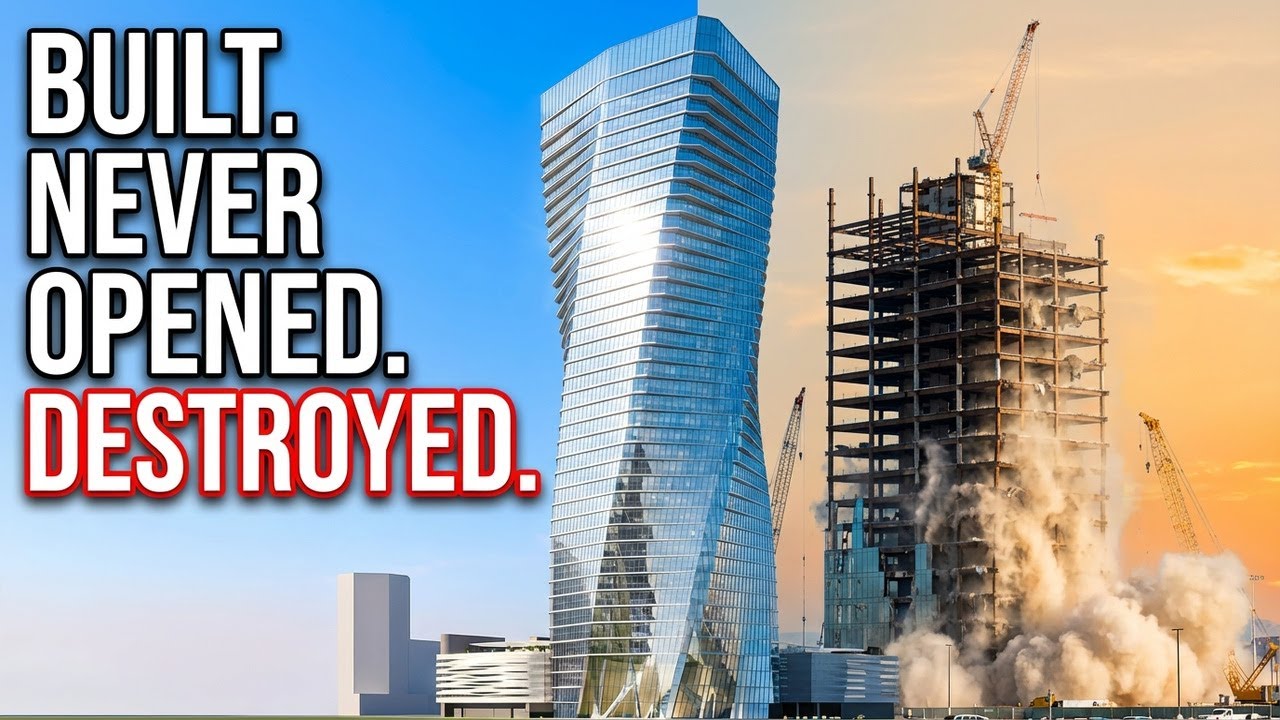
Foster designed the structure as a twisting glass tower meant to change shape depending on the viewer’s position, a deliberate departure from the conventional casino-resort aesthetic of the Strip. The design was intended to prove Las Vegas could embrace high design rather than pure spectacle. Construction progressed quickly, but in 2008, a county building inspector found that the rebar, the steel skeleton within the concrete, was incorrectly installed in the lower and mid-level floors. Independent engineering reports commissioned by MGM confirmed the tower was structurally compromised and could not be safely occupied or completed as designed, particularly given the seismic activity of the region.
Over $100 million had already been spent, and the entire project was effectively a loss before completion. MGM faced three options: demolish the building, attempt a costly and uncertain retrofit, or cut the tower down to a much shorter height, leaving a mutilated version of Foster’s design as a visible symbol of failure. In 2009, MGM filed suit against the general contractor, Perini Building Company, for negligence and breach of contract. Perini countersued, and the litigation eventually drew in Foster and Partners, the structural engineers, inspection firms, and various subcontractors.
Every party blamed another, and legal fees mounted as expert witnesses testified about rebar spacing and load tolerances. CityCenter opened on December 16, 2009, amid the worst economic collapse since the Great Depression, with Las Vegas devastated by crashing occupancy rates and MGM’s stock price falling from over $100 per share to under $10. Dubai World, the project’s 50% partner, was also forced to seek an emergency bailout from the Abu Dhabi government. The Harmon stood empty and condemned, looming over the operating resort complex.
MGM initially framed the delay as a technical evaluation, avoiding any public acknowledgment that the building had been declared unsafe. But the story spread through the industry, and by 2010, engineers were quietly preparing plans to either salvage the structure or remove it entirely. A traditional explosive implosion was impossible because the Harmon stood within 100 feet of occupied towers on three sides. A shock wave would have shattered glass and potentially compromised neighboring buildings.
MGM was left with only one practical approach: a slow, methodical process known as deconstruction. In 2012, MGM reached a confidential settlement with Perini, with reports suggesting a recovery of over $150 million. Separate settlements were reached with the architects and engineers, none of whom admitted fault. Non-disclosure agreements were signed, and the litigation quietly dissolved.
In January 2013, MGM made its final decision: the Harmon Tower would be dismantled. Beginning in the spring of 2014, workers removed the glass facade panel by panel and cut the steel frame apart section by section, carefully lowering each piece by crane to avoid endangering guests in the adjacent Aria and Vdara resorts. The process took the entire year. The total financial destruction was staggering.
Construction costs reached $275 million, demolition and removal added another $30 million, and legal fees across all parties exceeded $50 million. Combined with lost revenue for a hotel that never opened and years of interest on tied-up capital, the total loss attached to the Harmon Tower exceeded $400 million. By January 2015, the final piece of the building was gone. MGM graded the site flat, paved it over, and built a parking structure for approximately 500 cars.
No garden, no plaza, no memorial. Just asphalt. The rest of CityCenter eventually found its footing. Aria became one of the highest-grossing resorts on the Strip, and Crystals evolved into an ultra-luxury shopping destination.
But the vision of a unified urban campus was permanently diminished by the silence at its center. No one lost a license and no one faced criminal charges. The failure was distributed across so many parties and buried under so many confidential settlements that no single company was held fully accountable. Foster and Partners continued designing buildings globally, but the Harmon does not carry that legacy.
It no longer exists. The building was shipped away in waste containers, and most visitors to CityCenter today have no idea it was ever there. Buildings fail, projects go wrong, and engineers make errors.
But the real story of the Harmon is what happened after the failure: a city decided the easiest way to handle an expensive mistake was to make it cease to exist entirely, replacing a monumental work of architecture with a parking lot.