Mikhail Gorbachev died on August 30, 2022, in a Moscow clinic at the age of 91, and within hours the world fractured into two irreconcilable versions of the same man.
In Washington, London, Berlin and Brussels, flags fell to half-staff. Television networks cleared their evening schedules. Former presidents and prime ministers stepped before cameras with prepared statements and expressions that looked genuinely like grief.
They called him a visionary, a liberator, the man who ended the Cold War, the architect of a new world. The Nobel Committee issued a statement. Former Secretary of State James Baker described him as one of the great figures of the twentieth century.
German Chancellor Olaf Scholz said Europe owed him its unity. The world’s most powerful newspapers ran front-page tributes beside photographs of a younger Gorbachev, smiling, standing with Reagan, standing with Kohl, standing beside a world that seemed, for one brief moment, to be choosing peace.
In Moscow, Novosibirsk, Volgograd and Irkutsk, there was almost nothing. Russian state television mentioned the death in a brief segment. No national mourning was declared.
No special programming. No flags.
Vladimir Putin, who had governed Russia for more than two decades, did not attend the funeral. He sent a wreath. A wreath is the gesture you make when protocol requires acknowledgement but feeling requires distance.
The funeral itself was modest. There was no state ceremony of the kind Russia reserves for those it considers its genuine heroes. Several hundred people came.
The world’s cameras were there. The Kremlin was not.
Hold that contrast in your mind. The same man, the same death, the same life. Two reactions so opposite they seemed to describe two completely different human beings.
How can one man be simultaneously the greatest hero of the twentieth century and its greatest villain? How can one life be received as liberation by three hundred million Europeans and as catastrophe by three hundred million citizens of the former Soviet Union?
This is not a rhetorical question. It is the actual question, and it deserves an actual answer.
Before he died, Gorbachev gave an interview. He was already in poor health, already in the final chapter. A journalist, direct, perhaps sensing there was limited time for diplomatic circumlocution, asked him plainly: do you have any regrets?
Gorbachev paused. Then he answered with the calm of a man who had rehearsed the thought not for the interview but for himself alone, over many years.
“I did what I had to do,” he said. “And I regret nothing.”
Sit with that sentence. Here is a man under whose leadership the largest country on Earth dissolved. Here is a man under whose watch the savings of tens of millions of Soviet citizens effectively evaporated.
Doctors, engineers, teachers, factory workers, miners, scientists, people who had spent thirty and forty years building something they believed in, woke up in a new country with their credentials worth less, their pensions worth less, their certainty worth nothing.
The social contract they had signed, you give us your labor, your loyalty, your silence, and we will give you stability, was torn up. Not renegotiated. Torn up.
Millions lost their professional identities. Millions more lost their geographic identities, suddenly finding themselves citizens of a foreign country without ever crossing a border. Families were divided by new national boundaries.
The infrastructure of an entire civilization, hospitals, schools, research institutes, industrial complexes, began the long deterioration that would define the 1990s as one of the most painful decades in modern Russian history.
And the man at the center of all of it looked into a camera and said he regretted nothing. Either he was telling the truth, in which case we must understand what kind of conscience allows a man to feel that, or he was performing. And if he was performing, for whom was the performance intended?
The facts are not secret. They are simply rarely placed in the same room at the same time, in the same order, with the same question attached to all of them. What follows is drawn from the historical record, from documents that exist, and from statements made by people who were present.
Begin in a small village in the Stavropol region in 1931, when a boy named Mikhail was born into a family that, by every statistical measure of that era, should not have survived what was coming.
Mikhail Sergeyevich Gorbachev was born on March 2, 1931, in Privolnoye, Stavropol region, in the south of Russia. His father, Sergey Andreyevich, was a machine operator on the collective farm. His mother, Maria Panteleyevna, was a village woman in the fullest sense of that phrase.
On the surface, this is an entirely unremarkable origin story. The Soviet Union produced millions of boys from villages exactly like Privolnoye, boys who understood from their earliest years that the world was divided into those who gave orders and those who followed them.
Most of those boys stayed in their villages, or moved to nearby towns, or found work in regional factories. The system was not designed for mobility. It was designed for stability, which is another word, in certain contexts, for stasis.
So be precise about what is being claimed when we say Gorbachev rose from a Stavropol village to become General Secretary of the Communist Party of the Soviet Union. We are not saying he worked hard. We are not saying he was intelligent.
He almost certainly was both.
We are saying something more specific. The system he rose through was not designed to reward hard work and intelligence alone. It was designed to reward hard work and intelligence plus something else.
Something that does not appear on any official resume.
You cannot understand the Gorbachev family story without understanding what the 1930s actually meant in the Stavropol region. Not as a historical abstraction, but as a lived reality with a specific texture of danger that touched nearly every family in that landscape.
The collectivization drive of the early 1930s had restructured the entire agricultural economy of the Soviet South. Individual farms were consolidated into collective farms, and the process was not gentle.
Those who resisted, or were accused of resisting, faced a designation that carried enormous consequences. Kulak, a label applied to wealthier peasants, but in practice applied with remarkable flexibility to anyone who presented inconvenience to local administrators.
The Stavropol region was among the areas that experienced serious food shortages in 1932 and 1933. The causes are still debated by historians. Drought, unrealistic grain procurement quotas, the disruption caused by collectivization itself.
The human result was not debatable. People went hungry. Some died.
And then came 1937, the Great Terror. Stalin’s purge of the party, the military, the intelligentsia and vast sections of the general population is one of the most studied events of the twentieth century. The numbers are still contested.
The scale is not in serious dispute.
Hundreds of thousands were arrested, sentenced, sent to labor camps. Entire professional categories were decimated. The military officer corps was gutted.
Regional party structures turned upside down as denunciations cascaded. Each arrest generated new names, new accusations, new arrests.
In the countryside, the position of collective farm chairman was among the most 𝓮𝔁𝓹𝓸𝓼𝓮𝓭. The chairman was responsible for meeting production quotas set by planners in Moscow who had, in many cases, little realistic understanding of actual agricultural conditions.
If the harvest was poor and the quota was not met, the chairman could be accused of sabotage, of deliberate wrecking, of counterrevolutionary activity. If the harvest was good and the numbers exceeded expectations, a suspicious investigator might ask whether the previous numbers had been falsified, which was also a crime.
Historical research on the Stavropol region confirms what the general pattern would predict. Collective farm chairmen during the 1930s had, on average, tenures measured in months before replacement, transfer, or worse. The turnover was extraordinary.
The position was dangerous far beyond ordinary professional risk.
Gorbachev’s maternal grandfather, Pantelei Efimovich Gopkalo, was a collective farm chairman in Privolnoye during precisely this period. In 1937, at the absolute peak of the Great Terror, when the machinery of state suspicion was running at maximum intensity, Pantelei Gopkalo did not lose his position.
He did not face arrest. He did not disappear into the system that was consuming men in his exact situation across the entire country. He received the Order of Lenin.
The highest civilian honor in the Soviet Union. The decoration reserved for exceptional service to the state, awarded at a moment when the state was treating men in his position as potential enemies.
He may have been an excellent chairman. He may have been genuinely skilled at navigating the impossible terrain of Soviet agricultural administration. All of these things are possible.
But hold this fact alongside the statistical reality of what was happening to other men in his position.
What kind of protection, what kind of relationship, what kind of precisely calibrated positioning would have been necessary for a collective farm chairman in the Stavropol region to not merely survive 1937, but to be decorated in 1937? That is not ordinary luck. Ordinary luck is surviving.
Being decorated is something else.
Then came the war. Germany invaded the Soviet Union on June 22, 1941. By August 1942, the Wehrmacht had reached the Stavropol region.
The occupation lasted approximately six months, before Soviet forces retook the territory.
Six months of occupation, then liberation, then something the liberated population had learned to dread almost as much as occupation itself: the filtering process. The NKVD moved through the retaken territories and conducted systematic reviews of everyone who had remained behind during the German presence.
The logic was straightforward and brutal in its simplicity. You stayed, therefore you had contact with the occupiers, therefore you must be investigated. The burden of proof rested on the individual to demonstrate loyalty rather than on the state to demonstrate guilt.
Thousands of people across the occupied territories of the Soviet South were caught in this process. Many were sent to labor camps on the basis of evidence that would not survive serious scrutiny. The mere fact of having remained was sufficient in many cases to generate suspicion that permanently altered a person’s life.
Sergei Gorbachev, Mikhail’s father, had served in the Red Army and was at the front during the occupation. But the family remained in Privolnoye. Maria Gorbacheva and her son, Mikhail, then eleven years old, lived through the occupation in the village.
They were not touched by the post-liberation filtering process in any way that appears in any historical record. Once again, this is not impossible. Many families passed through the NKVD reviews without consequence.
But place this alongside the 1937 decoration and a pattern begins to take shape.
Not yet definitive. Not yet conclusive. But present.
A family that exists in environments of maximum institutional danger and emerges from each one not merely unharmed, but in some cases rewarded.
1948. Mikhail is seventeen years old. He works that summer with his father on the combine harvesting crew.
The harvest that year is exceptional, a record yield for the region. And for his participation, the seventeen-year-old receives the Order of the Red Banner of Labor. A state decoration for a teenager, for one summer’s harvest work.
Across the Soviet Union, men and women spent entire careers in agriculture, decades of labor under difficult conditions, often in far harsher regions than the relatively temperate Stavropol, without receiving state decoration.
The system of awards was hierarchical, political, and deeply tied to networks of recommendation and sponsorship. You did not receive a labor decoration at seventeen because you worked hard on a combine crew. You received it because someone with sufficient institutional authority chose to put your name forward.
Someone was paying attention to this family. The following year, 1949, Gorbachev applied to Moscow State University, specifically to the Faculty of Law, one of the most competitive programs in the Soviet educational system.
The competition was intense and the applicant pool was dominated by two categories: the children of party and government officials who had grown up in Moscow with access to educational resources unavailable in the provinces, and provincial students with outstanding academic records including gold medals from their secondary schools.
Gorbachev did not have a gold medal. He had a silver medal, good but not exceptional by the standards of the applicants he was competing against. He was from a rural village.
He had no obvious family connections to the Moscow establishment. He was admitted.
He arrived in Moscow in the autumn of 1949 and entered a world that would reshape him completely, though perhaps not in the ways the official biography suggests. And it was there, in the corridors and dormitories and lecture halls of Moscow State University, that he met the person who may have had more influence on everything that followed than any of the political patrons whose names appear in the history books.
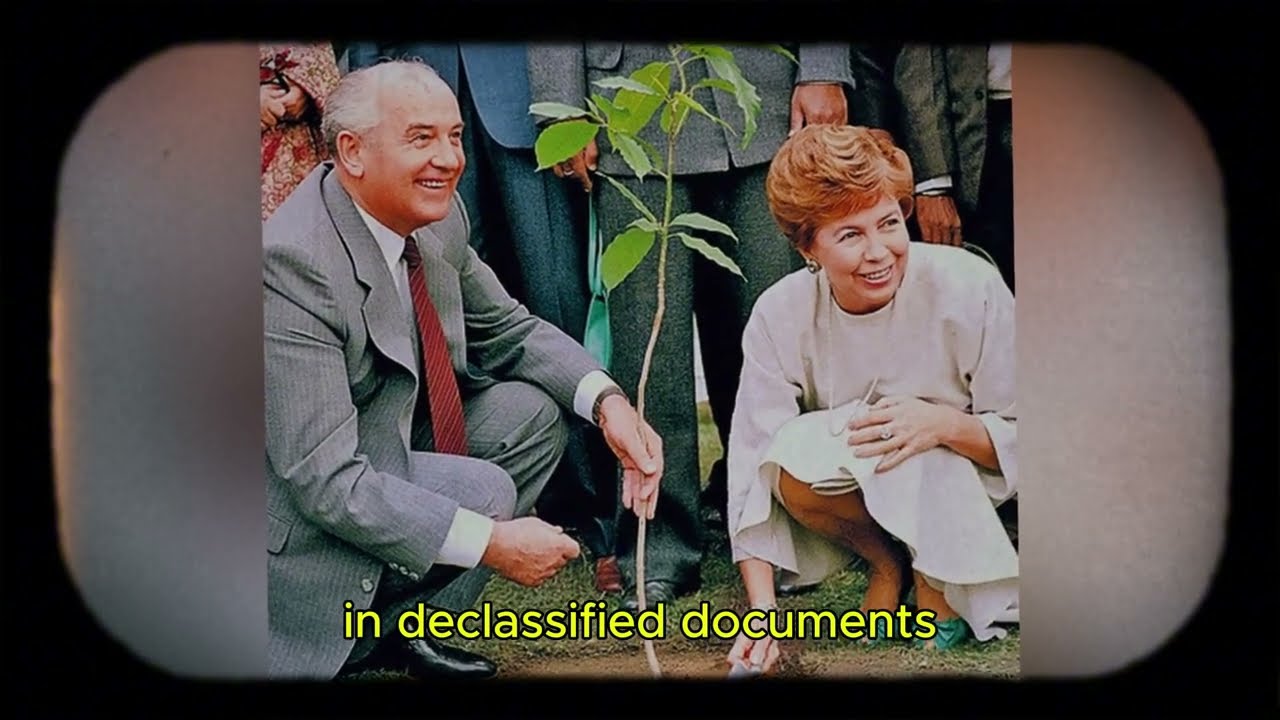
Her name was Raisa Maksimovna Titarenko. She was studying philosophy. And nothing, absolutely nothing, about Mikhail Gorbachev’s story can be properly understood without understanding her.
There is a moment in the career of every truly powerful person, a moment that official biographies tend to gloss over, to soften with vague language about merit and timing and historical necessity. When the question shifts from how talented is this person to who decided that this particular talent was the one worth cultivating.
In a closed system, talent is never enough by itself. In a democracy, imperfect, messy, corrupt in its own ways, talent at least has the theoretical option of making itself visible through public competition. In the Soviet Union of the 1950s and 1960s, none of those mechanisms existed.
The Communist Party of the Soviet Union was not a meritocracy. It was something more precise and more interesting than that. It was a sponsorship system dressed in the language of collective leadership and ideological correctness.
To advance, you needed someone above you in the hierarchy to place their institutional weight behind your name.
Raisa arrived at Moscow State University’s Faculty of Philosophy in the same year that Mikhail arrived at the Faculty of Law. She was from Siberia, from a railway engineer’s family, mobile, educated in the specific way that Soviet technical intelligentsia families were educated.
She was, by every account of people who knew her at university, exceptional. Not in the way that gets recorded in official documents, not through grades alone, though she was academically strong, but in the way that matters more, which is harder to quantify.
She had a quality of mind that moved laterally. She did not simply absorb the curriculum. She processed it, questioned it, connected it to things outside itself.
The Faculty of Philosophy in the early 1950s was, by Soviet standards, an unusually complex intellectual environment.
The official curriculum was Marxist-Leninist philosophy, dialectical materialism, historical materialism, the approved canon. But philosophy, even when constrained, tends to leak. Students who spent their days reading Hegel and Kant, even in carefully edited Soviet editions, were being 𝓮𝔁𝓹𝓸𝓼𝓮𝓭 to modes of thought that did not fit neatly into official categories.
Raisa read widely. Those who studied alongside her recalled that she had genuine interest in Western philosophical traditions, not as objects of critique, which was the approved relationship, but as serious intellectual interlocutors. She was curious about the world beyond Soviet borders in a way that was not, at that point, dangerous, but was notable.
She and Mikhail met, by most accounts, through the social networks of university life, the dormitories, the student clubs, the informal gatherings that were the real education in any university in any country in any era. They married in 1953, the same year Stalin died, one of those coincidences of timing that a novelist would be advised to avoid for fear of appearing too obvious.
What matters is not the romance. What matters is the intellectual dynamic. Every serious account of the Gorbachev marriage, from memoirs of people who knew them closely, from Raisa’s own writings, from the testimony of aides and advisers who worked with Mikhail during his years in power, converges on a single observation.
This was not a conventional Soviet political marriage in which the wife managed the household and appeared at official functions and otherwise remained invisible. Mikhail Sergeyevich talked to Raisa. He shared his thinking with her.
He asked for her opinion and he weighted it seriously. When he was uncertain, she was often the person he turned to first.
This was, in the context of Soviet political culture, genuinely unusual. The wives of Soviet leaders were, by tradition and by the implicit rules of the system, background figures. They did not have intellectual influence on policy.
They did not appear at diplomatic functions as active participants.
When Gorbachev became General Secretary in 1985, Raisa changed that entirely. She was present. She was visible.
She traveled with him to summits. She met with foreign dignitaries. She spoke with journalists.
Western observers found her fascinating, sophisticated, stylish in a way that no Soviet official’s wife had ever been publicly stylish, comfortable in international settings in a way that suggested something more than exposure to official Soviet culture.
Margaret Thatcher, who was not a woman given to easy admiration, said that Raisa was remarkable. Nancy Reagan, who was famously territorial about her position as a political spouse, reportedly found her a complicated presence for precisely that reason.
The question is not whether Raisa Gorbacheva was admirable. She almost certainly was. The question is what her influence represented in the context of her husband’s decision-making during the most consequential years of his leadership.
The people who were ideologically proximate to Western liberal ideas, who had genuine intellectual respect for Western institutions and Western ways of organizing society, who saw the Soviet system not as something to be reformed from within but as something to be fundamentally reconsidered, found in Raisa Gorbacheva a sympathetic interlocutor very close to the center of Soviet power.
That is not nothing. That is, in fact, quite significant.
After graduating in 1955, Gorbachev made a choice that his official biographers present as modest and perhaps even self-sacrificing. Instead of pursuing a career in Moscow, he returned to the Stavropol region.
The official narrative frames this as evidence of his groundedness, his connection to his roots, his lack of the metropolitan ambition that corrupted so many young Soviet lawyers and party functionaries. There is another way to read it.
Stavropol was not a retreat from ambition. It was, for someone with the right understanding of how Soviet power actually operated, a very intelligent strategic position. Here is why.
The Stavropol region contained within its borders one of the most important concentrations of therapeutic and recreational infrastructure in the entire Soviet Union. The mineral water spas of the northern Caucasus had been the premier resort destinations of the Russian elite since the nineteenth century.
In the Soviet period, they retained and amplified that function. The sanatoriums and rest houses of the Stavropol region served the uppermost tier of Soviet leadership: members of the Politburo, ministers, generals, senior officials of the KGB and the Ministry of Foreign Affairs.
These were not casual visits. Senior Soviet officials came for extended stays, weeks, sometimes longer, for medical treatment, rest, and the particular kind of semi-formal socializing that happened in resort environments where the rigid protocols of Moscow were slightly relaxed and conversations could be more candid than they would be in the capital.
The first secretary of the Stavropol regional party committee, which is what Gorbachev became in 1970 after fifteen years of steady regional advancement, had a formal protocol obligation in relation to these visitors. He was expected to meet them, to escort them, to be available for social interaction during their stays.
This was not optional and it was not incidental. It was a structural feature of the position. Which means that from 1970 onward, Mikhail Gorbachev had regular, sustained, semi-private access to the most powerful people in the Soviet Union outside of Moscow, in a relaxed setting, over extended periods of time.
Think about what that means in practice. A Politburo member away from the capital, taking the waters at Kislovodsk, in an environment slightly less formal than the Kremlin, meeting regularly with the intelligent, well-read, personally charming young first secretary who clearly had a sophisticated understanding of both the region’s problems and the country’s larger situation.
That is not a networking opportunity. That is a sustained audition.
Now come the three names that matter most. The first is Yuri Vladimirovich Andropov. Andropov served as chairman of the KGB from 1967 to 1982.
Fifteen years at the head of the Soviet intelligence and security apparatus.
He was, by the consensus of people who worked with him and against him, one of the most genuinely intelligent figures in the late Soviet leadership. He read widely, including Western literature. He was interested in economic reform.
He understood, perhaps better than anyone else in the Soviet leadership, the structural problems accumulating beneath the surface of official Soviet confidence.
Andropov vacationed regularly in the Stavropol region. He and Gorbachev met repeatedly over the years of Gorbachev’s regional leadership. By multiple accounts, including those of people close to Andropov during this period, he developed a genuine regard for Gorbachev.
He saw in the younger man something specific: a figure who combined an apparent party orthodoxy with a genuine capacity for flexible thinking, who was personally appealing without being threatening, who could be trusted to pursue reform without losing control of the process.
Andropov was, throughout the 1970s, building something. He was identifying and cultivating a network of younger officials who could, when the time came, move the Soviet system in a different direction. His model of reform was top-down, controlled, managed from within the security apparatus, which was, in his view, the only institution still capable of disciplined action.
He needed people he trusted in positions of influence. He needed people who were his in the specific sense that their advancement depended on his sponsorship. Gorbachev was, by every indication, one of those people.
The second name is Mikhail Andreyevich Suslov. Suslov is one of the most underappreciated figures in Soviet history, which is remarkable given how much power he actually held for how long.
He served as the chief ideologist of the Communist Party across multiple decades, through the Khrushchev and Brezhnev eras, and his influence on who advanced and who did not within the party was enormous. He was called the gray cardinal of the Kremlin, and the phrase was apt.
He operated without holding the top position, without being the public face of anything, but with a capacity to shape outcomes that exceeded that of many people who held formally superior titles. Suslov also vacationed in the Stavropol region. He also met with Gorbachev.
He also, at the critical moment when Gorbachev’s transfer to Moscow was being considered, provided support.
The third name is Andrei Andreyevich Gromyko. Gromyko served as Soviet Minister of Foreign Affairs for twenty-eight years, from 1957 to 1985, making him one of the longest-serving foreign ministers of any major power in the twentieth century.
He negotiated with every American president from Roosevelt to Reagan. He was present at nearly every significant diplomatic event of the Cold War era. He was someone whose opinion about a person carried extraordinary weight, not just within the Soviet system, but in the eyes of foreign governments who had learned over decades to pay attention to what Gromyko thought.
Gromyko came to Stavropol. Gromyko knew Gorbachev. And in March of 1985, when the Politburo gathered to choose a new general secretary following the death of Konstantin Chernenko, it was Andrei Gromyko who stood up and formally nominated Mikhail Gorbachev.
His speech on that occasion has been quoted many times, but one phrase in particular has stayed in the historical record. He said that Gorbachev had a nice smile but iron teeth. It is a curious phrase for a nomination speech.
It sounds like a warning dressed as a compliment, or a compliment dressed as a warning. Either way, it was Gromyko’s institutional weight that cleared the final path.
Now look at the timeline of Gorbachev’s ascent from Stavropol to the top of Soviet power, because the speed of it is, in its own way, a kind of argument.
1978: Gorbachev moves to Moscow as secretary of the Central Committee responsible for agriculture. He is forty-seven years old. This is already an extraordinary position for someone of his age and regional background.
1979: he becomes a candidate member of the Politburo. 1980: he becomes a full member of the Politburo at forty-nine years old.
The average age of his Politburo colleagues is over seventy. He is, by two decades, the youngest full member of the supreme governing body of the Soviet Union.
Then, and this is where the timeline becomes almost cinematic in its precision, three general secretaries die in rapid succession. Leonid Brezhnev dies in November 1982. Yuri Andropov, Gorbachev’s most important patron, dies in February 1984 after only fifteen months in power.
Konstantin Chernenko, already visibly unwell when selected, dies in March 1985 after thirteen months.
Three deaths in twenty-eight months. Three elderly, unwell men elevated to the top position and then gone. And waiting each time, younger, healthier, with his network intact and his sponsorship secured, was Mikhail Sergeyevich Gorbachev.
He was fifty-four years old when he became general secretary. In a leadership structure that had been dominated by men in their seventies and eighties, he looked like a different kind of human being entirely. He had the Soviet Union in his hands, and within six years, the Soviet Union would cease to exist.
The question, and it is the question that everything has been building toward, is whether what followed was the tragic, unintended consequence of genuine but flawed reform efforts, or whether the men who chose him and the institutions they represented had a clearer idea of the destination than the official history has ever been willing to say.
There is an old principle in engineering, simple, almost embarrassingly simple, but ignored with remarkable consistency by people who should know better. Before you remove a load-bearing wall, you need to know what it is holding up. Not what you think it is holding up.
Not what the original blueprints suggested it should be holding up. What it is actually holding up right now, in the specific building as it currently exists.
If you remove the wall without understanding the load, you do not get a more open floor plan. You get a collapse.
Gorbachev inherited a Soviet Union that was, by the mid-1980s, a deeply imperfect structure: economically strained, politically rigid, technologically falling behind the West in critical sectors, demographically aging, and carrying the enormous financial burden of military competition with the United States that was, in the long run, unsustainable at its current intensity.
None of that is in serious dispute. The historians most sympathetic to Gorbachev and the historians most critical of him agree on the diagnosis. The Soviet system had real, structural, serious problems that required serious attention.
The dispute is about what happened next.
The sympathetic version says Gorbachev tried to fix the problems. The problems were deeper than anyone understood. The reforms had unintended consequences that cascaded beyond anyone’s ability to control, and the collapse was a tragedy that no one planned and no one wanted.
The version this investigation is examining says something different. It says: look at the sequence. Look at the timing.
Look at what each reform actually did in practice, as opposed to what it was said to be doing. And then ask yourself whether the pattern of outcomes, not intentions, outcomes, is consistent with genuine reform efforts gone wrong, or consistent with something else.
Five steps. Six years. One outcome.
Step one: the anti-alcohol campaign, 1985. Gorbachev’s first major domestic initiative after becoming general secretary in March of 1985 was an anti-alcohol campaign. The stated rationale was straightforward and, in human terms, genuinely sympathetic.
Alcohol consumption in the Soviet Union was at catastrophic levels, causing enormous public health damage, reducing industrial productivity, and contributing to a demographic crisis of shortened male life expectancy that was, by international standards, extraordinary for a developed country. The goals were right. The problem was real.
On this nearly everyone agreed.
The implementation was a masterpiece of unintended consequences. Or, if you are asking the question this investigation is asking, a masterpiece of something else entirely.
Production of vodka and other alcoholic beverages was dramatically curtailed. State stores that had sold alcohol were closed or restricted. The price of available alcohol was raised substantially.
Vineyards in Georgia, Moldova and other wine-producing regions, vineyards that had in some cases been cultivated for generations, were ordered to be torn out.
The campaign was enforced through administrative pressure rather than through any genuine cultural or social infrastructure capable of addressing the underlying causes of heavy drinking. The results were immediate, significant, and almost entirely counterproductive.
The Soviet state budget had been substantially dependent on revenues from alcohol sales, a dependency that was well understood within the planning apparatus. When those revenues collapsed, the budget absorbed a blow measured in tens of billions of rubles.
Official estimates at the time suggested the annual revenue loss was in the range of thirty to forty billion rubles, in an economy already under strain, already showing the early signs of the structural imbalances that would become critical in the following years.
Meanwhile, what actually happened to alcohol consumption did not stop. It relocated. Home production of samogon, illegal distilled spirits, exploded across the country.
Sugar disappeared from store shelves, purchased in quantities that made no sense for legitimate domestic use, repurposed for home brewing.
The informal economy around alcohol expanded dramatically. The state lost the revenue. The public did not stop drinking.
And the government demonstrated, in its very first major domestic initiative, something deeply important: that it was capable of disrupting existing systems without replacing them with anything functional.
One failure, a serious one, but a failure that a charitable observer could attribute to poor planning and insufficient understanding of Soviet consumer behavior. A charitable observer would have to be charitable four more times.
Step two: glasnost and the architecture of doubt, 1986. The policy of glasnost, openness, was in principle one of the most intellectually interesting experiments in the history of authoritarian governance.
The argument was that the Soviet system had accumulated so many distortions, so many layers of official falsehood, so much institutional investment in maintaining fictions, that the only way to begin genuine reform was to allow the truth to surface. Allow the press to report more freely. Allow historians to examine the archives.
Allow citizens to hear, for the first time through official channels, acknowledgements of things they had known privately for decades.
It was a bold idea. And it had an internal logic that serious people could respect. But it also had a structural problem that should have been visible to anyone who thought carefully about it, and that becomes more visible the more carefully you examine the timeline.
Doubt, once introduced into a system that has derived its authority from certainty, does not distribute itself neatly. It does not stay confined to the specific falsehoods you have chosen to acknowledge. It spreads.
It moves laterally into territories you did not intend to open.
A citizen who learns for the first time through an official Soviet newspaper that the party had concealed the true scale of Stalinist repressions does not conclude: well, now I know the limits of the deception and I trust everything else. That citizen concludes something more general and more corrosive. What else have they been lying about?
That question, once it is in the air, cannot be recalled.
And then, in April of 1986, came Chernobyl. The explosion at the fourth reactor of the Chernobyl nuclear power plant on April 26, 1986, was a technological catastrophe of the first order. But its significance for the purposes of this investigation is not primarily technological.
Its significance is political.
The Soviet government’s initial response to Chernobyl was to do exactly what Soviet governments had always done. Minimize. Obscure.
Manage the information. Protect the official narrative at the expense of public safety.
The evacuation of Pripyat, the city closest to the plant, was delayed. Information about the actual scale of the event was withheld from the Soviet public and, critically, from neighboring countries whose populations were also being affected. The May Day celebrations in Kiev, downwind of the disaster, proceeded as planned while officials knew the air quality situation was serious.
This happened during glasnost. This happened while Gorbachev was publicly committed to a new era of openness. The gap between the stated policy and the actual behavior of the system during a genuine crisis told Soviet citizens something they could not un-know.
That the reflexes of the old system were still intact. That openness was a policy for normal times that evaporated the moment the stakes were high enough.
The combination of glasnost and Chernobyl did something specific and irreversible to Soviet public trust. It did not reduce it by a percentage point. It changed its fundamental character.
Before, citizens had lived within a kind of cynical accommodation with official falsehood. We know they lie. They know we know.
We all proceed anyway. After, something more active entered the picture. A genuine desire to know, combined with a genuine belief that the system was structurally incapable of telling the truth when it mattered.
That is not a political problem that reforms can solve. That is a legitimacy problem. And legitimacy, once genuinely damaged, does not recover through policy adjustments.
Step three: economic reform without an economy, 1987. By 1987, the problems created by the anti-alcohol campaign’s budget impact were combining with the pre-existing structural strains of the Soviet economy to create a situation that required serious economic intervention.
Gorbachev’s economic reform program, uskoreniye initially, then the broader reforms associated with perestroika, attempted to do something that in retrospect can be understood as one of the most technically difficult transitions in economic history.
Moving from a centrally planned economy to something more market-oriented while maintaining political stability, without a worked-out theoretical model for how to accomplish this, without a trained class of market economists who understood the actual mechanics of price signals and capital allocation, and without the institutional infrastructure that market economies required to function.
This is not a criticism of Gorbachev’s intentions. The reform challenge was genuinely immense even if every decision had been perfectly calibrated. The transition would have been painful.
But the decisions were not perfectly calibrated. They were, in several key respects, the worst possible combination.
Enough market liberalization to disrupt the planning system’s ability to coordinate production, but not enough to allow genuine market mechanisms to begin replacing that coordination. What this produced in practical terms was a vacuum.
In a functioning planned economy, the state determines what is produced, in what quantities, at what prices, and ensures that the distribution system moves goods from producers to consumers. The system is inefficient. It produces shortages in some areas and surpluses in others.
It responds poorly to changes in consumer preference. But it does, in its imperfect way, function. Goods reach people.
In a functioning market economy, prices do the coordination. When something is scarce, its price rises, which signals producers to make more of it, which eventually relieves the scarcity. The system is also imperfect, also produces inequalities and disruptions, but it does, in its way, function.
The Soviet economy of 1987 was neither. It was a planned economy with growing holes in the plan and a nascent market that did not yet have the tools to fill those holes.
State enterprises were given more autonomy, which they used rationally from their own perspective, to pursue their own interests rather than the planning targets that had organized production. But the interests they pursued were not subject to the discipline that genuine market competition would have imposed, because the market institutions did not yet exist.
Money began to decouple from goods. The money supply was not being reduced to match the reduction in available goods. Rubles accumulated in the banking system and in citizens’ savings accounts, not because people were wealthy, but because there was increasingly little to spend money on.
The shelves that had never been abundantly stocked became noticeably emptier. Queues lengthened. The informal economy expanded to fill the gaps that neither the plan nor the market was covering.
This is the moment when the Soviet economic experience began to shift from difficult to destabilizing. And it was, in important ways, a direct result of the particular combination of reforms chosen. Not reform itself, but this specific reform, implemented at this specific speed, in this specific sequence.
Step four: the party loses the wall, 1988. The Nineteenth All-Union Party Conference of June and July 1988 is, in the judgment of many historians, the moment when the Soviet system crossed a threshold from which there was no return.
Gorbachev used the conference to push through a fundamental restructuring of the Soviet political system. A new legislative body, the Congress of People’s Deputies, would be created with a significant portion of its seats filled through competitive elections. The relationship between party structures and state structures would be reorganized.
The concentration of power in the party apparatus would be deliberately diluted.
The stated rationale was democratization, bringing genuine popular participation into a system that had been, in practice, governed by a small self-selecting elite. This was presented, and in many respects genuinely intended, as a way of energizing the reform process by creating new centers of accountability outside the party hierarchy.
What it actually did, what it structurally, mechanically, inevitably did, was remove the organizing principle that held the Soviet system together without replacing it with anything capable of performing the same function.
The Communist Party of the Soviet Union was not merely a political organization. In the Soviet system, it was the connective tissue of the entire state. It provided the personnel for every significant administrative position at every level of government, from Moscow ministries to regional administrations to enterprise directors to collective farm chairmen.
It provided the communications network through which decisions moved from the center to the periphery. It provided the ideological framework, however contested internally, that gave officials across fifteen republics in eleven time zones a common language and a common set of reference points.
When you weaken that structure without having a replacement ready, without having built the legal institutions, the civil service infrastructure, the constitutional frameworks that would allow a post-party state to function, you do not create a more democratic system. You create a power vacuum. And power vacuums do not remain empty.
The republican party organizations across the Soviet Union had spent decades subordinated to Moscow. They had their own ambitions, their own networks, their own interests, interests that were not always identical to all-union interests.
When the center began to visibly weaken, when it became apparent that the rules were changing and the old system of accountability was dissolving, the republican elites began, cautiously at first, then with accelerating confidence, to explore what the new situation made possible.
The first public expressions of this were framed in terms of cultural and linguistic rights, demands for the recognition of national languages, for greater autonomy in cultural policy. These were, on the surface, reasonable requests that Gorbachev’s glasnost framework had created space for.
But underneath the cultural demands was something more structural: a test of whether the center would respond, whether the old mechanisms of control were still operative, whether the new language of sovereignty meant what it seemed to mean.
The center’s responses were hesitant, inconsistent, sometimes conciliatory, sometimes firm, in a pattern that communicated, above all, uncertainty. And uncertainty in a system built on the premise of central authority is the most destabilizing signal possible.
By the end of 1988, the first serious interethnic conflicts had begun in several regions of the Soviet Union. The party structures that would, in earlier years, have been the primary mechanism for managing and containing these situations, were themselves in the process of losing coherence. The center was simultaneously trying to liberalize and maintain control, a combination that satisfied neither goal.
Step five: the external signal, 1989. In February of 1989, the last Soviet military units withdrew from Afghanistan, completing a withdrawal process that had begun the previous year.
The war, which had lasted nearly a decade, had been costly in multiple dimensions: financially, in terms of military prestige, and in terms of the corrosive effect on Soviet society of a prolonged conflict whose purpose became increasingly difficult to articulate to the Soviet public.
The withdrawal itself was arguably the right decision. The war had not achieved its objectives and was not going to achieve them. Continuing it was simply accumulating costs without prospect of resolution.
But the manner of the withdrawal, and more importantly, what happened in Eastern Europe in the months that followed, sent a signal that resonated far beyond its immediate context.
Through the autumn of 1989, one after another, the communist governments of Eastern Europe fell. Poland, Hungary, East Germany, Czechoslovakia, Bulgaria, Romania. The political systems that the Soviet Union had installed and maintained in its buffer zone of satellite states collapsed across a period of months, and Moscow did not intervene.
This was, in historical terms, a fundamental departure. The Brezhnev Doctrine, the principle established after the Soviet intervention in Czechoslovakia in 1968, that the USSR would not permit socialist governments to be overthrown, had been the organizing principle of Soviet policy in Eastern Europe for two decades.
Every government in the region had conducted its affairs in the knowledge that this doctrine existed and would, if tested, be applied. When it became apparent in the autumn of 1989 that it would not be applied, that Moscow would watch as the Berlin Wall was dismantled and as communist governments negotiated their own peaceful departures from power, the signal that was sent was unmistakable.
It was received not only in Eastern Europe. It was received in the Soviet republics. It was received in the Soviet military.
It was received in every institution and every regional administration across the Soviet Union.
The message it carried was not subtle. The center was no longer willing or able to underwrite the existing order with the credibility of decisive action.
When that credibility is gone, when the implicit guarantee that the system enforces its own continuity is visibly withdrawn, the calculations of every actor in the system change simultaneously. Those who had been loyal out of conviction continued to be loyal. But a very large proportion of institutional loyalty in any system is not loyalty out of conviction.
It is loyalty based on a rational assessment of consequences. When the consequences visibly change, the loyalty changes with them.
One failure is an accident. Two failures suggest a problem. Three failures indicate something systemic.
Four failures in sequence, each one disabling a mechanism that the next reform depended on for success, begin to suggest something that the language of accident and incompetence cannot fully account for.
Five failures, each one accelerating the dynamic that was pulling the system toward dissolution, each one creating the conditions that made the next failure more severe and more difficult to reverse. Five failures of that kind, in that sequence, produced by a man of considerable intelligence who had been selected and cultivated by some of the most sophisticated operators in the Soviet system.
That is not a story about good intentions and bad luck. Or if it is, it is the most extraordinarily precise and consequential bad luck in the political history of the twentieth century.
March of 1991. The country still exists on the map. It still has a flag, a president, an army, a nuclear arsenal, and, crucially, a people.
And that people, when asked directly, when given the chance to speak with their own voice on a ballot, answered without hesitation.
The question on the referendum paper was simple, brutally simple, almost insultingly simple for a decision of such magnitude. It read: do you consider it necessary to preserve the Union of Soviet Socialist Republics as a renewed federation of equal sovereign republics in which the rights and freedoms of an individual of any nationality will be fully guaranteed?
76. 4 percent answered yes. Not a slim majority.
Not a hesitant lean. Nearly four out of every five citizens who cast a vote said: we want to stay together. Over 148 million people participated.
Nine of fifteen republics held the vote. The result was unambiguous. The result was a mandate.
But here is where history stops being a textbook and starts being something else entirely, because the people voted one way and the country ended the other.
Ask yourself what a mandate actually means in a democracy. A mandate means the leader follows the people’s expressed will. A mandate means the institutions protect the decision made at the ballot box.
A mandate means that when the question is existential, when the question is literally whether a nation continues to exist, no small group of officials should be able to override it with a private meeting and three signatures.
Ask yourself when was the last time you heard of a country being legally dissolved without a referendum on its dissolution. Because that is precisely what happened.
But first, before the end, there was one last scene, one last desperate convulsion of a system that could feel itself dying. August of 1991. While Gorbachev vacationed at his government residence in Foros, Crimea, a group of senior officials, members of his own government, his own inner circle, men he had appointed and trusted, formed the State Committee on the State of Emergency.
They called themselves the GKChP. They announced that Gorbachev was ill, that he was temporarily unable to perform his duties. They declared a state of emergency.
They sent military hardware into Moscow. The world held its breath.
For three days, the fate of the largest country on Earth appeared to hang in the air. Armored vehicles appeared on the streets of the capital. Citizens climbed on them.
Citizens argued with soldiers. Crowds gathered. A mood of defiant, almost theatrical resistance filled the city.
And Gorbachev, he was in Foros. He later claimed he was held there against his will, that the telephone lines were cut, that he had no means of communication. He said he refused to sign the emergency decree.
He said he waited. He waited for three days.
The GKChP collapsed not because of military strength or masterful statecraft on anyone’s part. It collapsed under the weight of its own indecision, its own incoherence. The men who staged it seemed to observers across the world deeply uncertain of what they were doing or why.
Within seventy-two hours, the attempt was over. Its organizers were arrested. Gorbachev flew back to Moscow.
He returned to the Kremlin. He stood at the microphone. But something had changed permanently while he was gone.
The center had not held, and now everyone knew it.
The Communist Party of the Soviet Union, the organization that had governed one-sixth of the planet’s surface for nearly seventy years, the institution through which every single major decision in this country had flowed for decades, was suspended, then banned. Its property was seized. Its files were frozen.
The party through which Gorbachev had climbed every single rung of his career, the party that had handed him the general secretaryship, the party that was the spine of the entire state, gone. Removed from the equation in a matter of days.
And Gorbachev, the man who led that party, who was its general secretary, did not resign in protest. Did not fight for its survival. Did not even appear to be particularly shocked.
He remained in position. He continued to exist as a kind of presidency with no ground beneath it, a man holding a title attached to a collapsing structure.
Republic after republic accelerated its declarations of sovereignty and independence. Latvia, Estonia and Lithuania had already been recognized as independent by the international community. Within days of the coup’s failure, Ukraine voted for independence in December with over ninety percent support.
The dominoes fell faster than anyone had calculated.
December of 1991. The Belavezha Pushcha, a government hunting lodge in the forests of Belarus. Three men: Boris Yeltsin representing Russia, Leonid Kravchuk representing Ukraine, Stanislav Shushkevich representing Belarus.
No cameras. No public announcement beforehand. No national debate.
No referendum. No international observers. No legal framework that clearly authorized what they were about to do.
They met. They talked. They signed a document.
The document declared in its very first article that the Union of Soviet Socialist Republics, as a subject of international law and geopolitical reality, ceased to exist.
Three signatures. Three men in a forest. And a state that had put the first human being into space, that had defeated the most formidable military machine Europe had ever produced, that had built cities in the permafrost and dug canals through deserts, that had fed and housed and educated hundreds of millions of people, that state was declared legally terminated.
Gorbachev was not invited to the meeting. He was not consulted. He was notified afterward by telephone, as if he were a middle manager being informed of a restructuring decision made above his pay grade.
He called it illegal. He called it unconstitutional. He expressed outrage.
Then he signed nothing to stop it. He contested nothing through any court. He filed no legal challenge.
He made speeches. He gave interviews. He expressed his feelings.
And then, on December 25, 1991, at seven minutes past seven in the evening, Moscow time, Mikhail Sergeyevich Gorbachev sat before a television camera and read a short statement. He was resigning.
Outside the Kremlin at that same hour, a red flag descended from the flagpole over the Senate building. It was replaced by the tricolor of the new Russian Federation. No war had been fought.
No battle had been lost. No invading army stood at the gates. No catastrophe of nature had erased a civilization.
No plague, no famine, no revolution in the streets.
Just a flag coming down. Just a man reading a statement at a desk. Just an end.
And now we come back to the question that opened this entire story. The question that has never really been answered, not cleanly, not satisfactorily, not in any way that would allow a reasonable person to close the book and walk away feeling settled. Who won?
Within months of the resignation, the honors began to arrive. The Nobel Peace Prize had already come in 1990. Then came the lecture invitations.
Universities in the United States, foundations in Germany, institutes across Europe and Japan. Fees reported in the hundreds of thousands of dollars per appearance.
A philanthropic foundation of his own, bearing his name, funded generously by Western donors. Books translated into dozens of languages. A feature film made about his life in Germany.
A commercial for a pizza chain. Yes, a pizza chain. Filmed in Moscow, in which he appears cheerful, comfortable, well-fed.
The man who presided over one of the largest geopolitical collapses in modern history had become, in the West, a celebrity, a symbol, an icon of courage.
And inside Russia, poll after poll, year after year, the number stayed consistent. Roughly seventy percent of Russian citizens identified Gorbachev as bearing primary responsibility for the disasters of the 1990s.
The poverty. The hyperinflation that turned lifelong savings into worthless paper overnight. The collapse of the social infrastructure: hospitals, schools, factories, pensions that millions of ordinary people had built their entire lives around.
The demographic catastrophe. The mortality spike. The children who grew up with nothing because everything had been swept away in a transition that no one voted for and no one fully understood until it was already over.
Two different worlds. Two completely different verdicts on the same man. The people who praised him most enthusiastically were, without exception, the people who benefited most from the outcome.
The expansion of NATO. The acquisition of new markets. The access to resources and territory that had previously been behind a wall.
The geopolitical victory of a generation, achieved without a single shot being fired at a major opponent.
And the people who condemned him most bitterly were, without exception, the people who paid the price.
So here is the last question, the one this entire investigation has been building toward, the one that every single fact, every single coincidence, every single decision and non-decision and missed opportunity in this story points directly at.
A man rises from nothing, or what appears to be nothing, through a system that should have been impossible to navigate without powerful, deliberate assistance. Every reform he touches turns to catastrophe. Not once.
Not twice. But with a consistency that defies statistical probability. A nation votes to survive and is dissolved anyway.
And the people who orchestrated the dissolution are celebrated, rewarded and enriched by the very parties who gained the most from it.
Was any of this the result of incompetence? Could one man, one genuinely well-meaning, genuinely idealistic, genuinely naive man, have simply made this many mistakes in this particular sequence, in this particular direction? Or was the countdown started long before anyone was told the clock was running?
The answer to that question is not in any school textbook. It is not in any official archive that has been made fully public. It may never be stated plainly in simple language by anyone with direct knowledge of it.
But the facts are there, laid out in sequence, visible to anyone willing to look without flinching. And you have just looked. What you decide to do with what you saw, that part belongs to you.