On the evening of February 17, 1949, Ellsworth Johnson arrived at a testimonial dinner in a Manhattan hotel ballroom, an occasion that would quietly upend the course of his life. He was 43 years old, a compact man with a stillness about him, known throughout Harlem by a childhood nickname and downtown by his full legal name. He came with a delegation of 11 respected community figures from uptown, including an attorney, an accountant, a minister, and several business owners. They had been invited by letter six weeks earlier to an event meant to honor neighborhood commerce, and Johnson had spent 20 years arranging to be in that room.
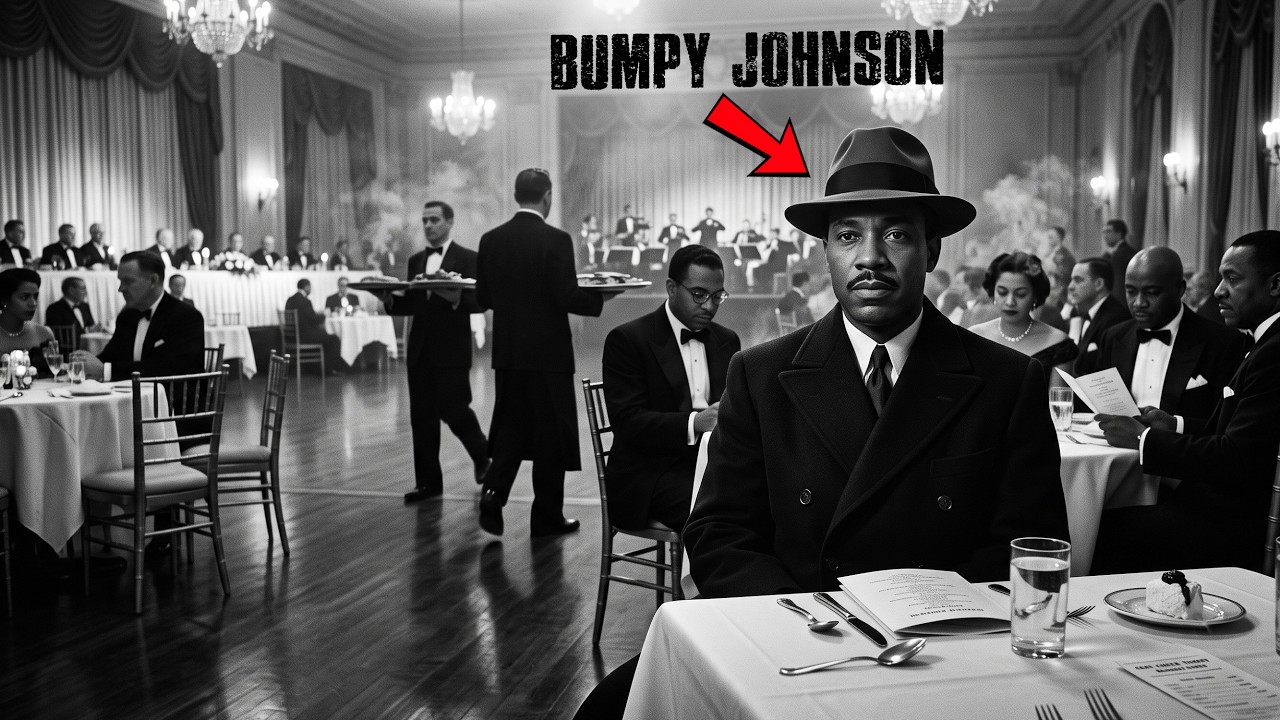
By that winter, Johnson had achieved everything he had set out to gain since arriving in Harlem from Charleston as a young man. The violence of the mid-1930s, when men had come uptown to take the numbers business by force, was long over. For more than a decade, disputes over debts, corners, and insults were settled through his quiet authority, and the settlements held because everyone involved understood who had made them. He had peace, standing, income, and the freedom to walk from 125th Street to 145th Street, greeted by his name on every block.
He had, by his own standards, everything he wanted. The ballroom held roughly 400 people, and the uptown delegation was seated at table 31, near the service doors on the kitchen side of the room. The printed program listed 11 neighborhood associations to be recognized. The Harlem delegation was not among them.
The accountant noticed first and passed the program to the attorney without comment. Soon after, a young staff member apologized, explaining that two reserved seats on the dais for the uptown delegation were no longer available due to a reorganization that afternoon. At 8:00, a photographer began arranging honorees for formal pictures. The uptown delegation was asked to wait in a narrow service corridor with a tile floor, stacked chairs, and a smell of grease.
They waited 18 minutes in the cold passage, the woman who owned the beauty shops standing the entire time to protect her dress. When they were brought back, the photographer had packed up. A staff member said the light was gone and a separate picture would be arranged later. None was.
The association president then delivered a 19-minute speech, reading the honor roll of 11 names, and offered a general thank-you to all present from every quarter of the city. The room applauded, and the applause included table 31. There was no confrontation, no raised voice, no single act that could be called an insult. Every slight had a reasonable explanation attached to it, delivered in advance with regret.
The seats had been reorganized. The light had gone. The program had been set at the printer weeks ago. Johnson did not react.
In a business where a public slight demanded an immediate answer, where silence was read as weakness, he sat with his hands flat on the tablecloth. He ate a little of the beef and none of the dessert. He answered questions about the weather in a level voice. When the young staff member returned to apologize again, Johnson thanked him and asked for the correct spelling of the association secretary’s name, writing it on the back of his program with a fountain pen.
The delegation left through the lobby at 10:20, collected their coats, and stood on West 44th Street in the cold. Two members voiced their anger, but Johnson said only that everyone should get home warm. He paid for the taxicabs and watched them go. Then he walked north on 6th Avenue, roughly 80 blocks to West 138th Street, taking the subway for the final stretch when his feet tired.
It took him close to two hours. He walked because he did not want to arrive anywhere before he had finished thinking. For 11 days afterward, he mentioned the dinner to no one. What occupied him instead was a question that had never troubled him before, and once it arrived, it never left.
He understood quickly why the slight had happened. The men on the dais had not organized the evening around him personally; most did not know who he was. What he had met downtown was not the familiar contempt of dangerous men, but something colder. The room was assembled around documents.
Bank officers controlled mortgage books backed by residential security maps that shaded Harlem as highest risk. Insurance underwriters set rates by district on outdated inspections. Wholesalers controlled credit terms. Licensing officials controlled the flow of paperwork.
None of those men would ever have to consider his opinion. His authority, which had taken 25 years to build and could settle disputes uptown in an afternoon, stopped at the edge of the district, and it stopped at the door of every institution that held a piece of paper. The second realization was worse. His power was entirely personal, carried in his own name, held in the fear and loyalty of people who knew him.
It had no charter, no bylaws, no audited books, no signature on any document filed anywhere. It could not be transferred or inherited. It existed only as long as he was alive, free, and present. And he was a man with a criminal record, many enemies, and a heart condition.
If he died tomorrow, he realized, the peace he had negotiated would last only until the news traveled, and then men would reach for what he had held, with guns, and the people who would pay would be the people at table 31 and their children. He had gotten everything he wanted and discovered that none of it could be left to anyone. The fear was not of the men on the dais. It was the recognition that he was the only load-bearing wall in a building full of people.
He chose the second path available to a man in that position: he began giving his power away deliberately, into structures that did not require him. He began by counting. The accountant who had sat at table 31 knew the actual financial life of the district better than any downtown bank officer. In a four-hour meeting on February 28, Johnson learned that very few district businesses kept books a bank would accept, that business owners paid between 40 and 70 percent more for fire insurance than comparable businesses elsewhere, and that money earned uptown was deposited downtown and lent out to build houses in places where the depositors were not permitted to live.
The district, he concluded, was financing its own exclusion. He found this useful, not outrageous. A supply line can be interrupted. The attorney came next.
He understood procedure: where a complaint goes, what form it must take, which agency has jurisdiction, what a department is obliged to answer in writing. He told Johnson that anger was worthless in an administrative proceeding, that documents were everything, and that change would require paper gathered in a uniform way over months. Johnson asked how long it would take. The attorney said a year.
Johnson said he would give it a year and a half. The most important conversation was with the minister, and the shortest. The church on Seventh Avenue had a congregation of more than 2,000, a building fund, and a respectability beyond argument. The minister asked one question: whether Johnson intended to have his own name on any of it.
Johnson said no. He would not be an officer, would not sign anything, would not appear at any hearing, would not speak to any newspaper, and would not attend a public meeting where a photographer might be present. The moment his name touched the effort, he said, it would become about his record instead of the mortgage book. The minister agreed, and the condition was kept for the entire duration.
The rest of the coalition was assembled over the following six weeks, each member chosen for a specific function. The insurance broker could formally request rate schedules and file complaints a department was legally obliged to answer. The woman who owned two beauty shops could move information through the district faster than any newspaper, and her employees carried the survey forms that would otherwise have been met with incomplete responses. The funeral director represented burial societies, the oldest continuous credit institutions in the district, proof that the neighborhood was creditworthy.
The union man knew how to run meetings and collect from people who did not want to pay. The newspaper business manager provided a permanent dated record that forced institutions to respond in writing. A woman in her sixties who had once reconciled the daily accounts of one of the largest numbers operations in Harlem designed the survey form, the collection routes, and the reconciliation procedure, and trained 40 volunteers. The strategy built over April and May had five parts.
The foundation was documentation. Every business that had applied for credit in the previous six years was visited and asked to complete a standard form recording the date, institution, officer, amount, security offered, deposit history, reason for refusal, and whether the refusal was in writing. Every form was signed by the owner and duplicated by hand, with copies stored in five separate locations. No single fire, burglary, or subpoena could destroy the record.
Economic pressure was second. Survey data indicated the district held nearly $4 million in accounts at branches that made virtually no loans back into the same blocks. No one was asked to withdraw anything at first. They were asked to open second accounts at institutions that would lend uptown, route new deposits there, and be prepared to move balances later.
A savings and loan on 125th Street and a newly chartered credit union needed exactly that volume. Social pressure was third, and the coalition made an unusual decision: they would publish numbers, not opinions. The newspaper would print tables of applications submitted, approved, refused, deposits held, loans made, and premiums paid, with no adjectives. An accusation invites a denial, the attorney argued, but a table of figures invites a correction, and a correction is a negotiation.
Legal and political pressure was fourth, designed as filings. The broker submitted a request for classification data. A petition for reinspection was supported by an inventory of buildings that had installed standpipes, replaced wiring, and corrected fire escapes. A complaint went to the state insurance department, a memorandum to the banking department, and copies to two assembly members.
Competition was the fifth instrument, and the one Johnson insisted on. The point, he said, was not to punish anyone. Resentment produces retaliation, and he had already seen what a war costs. The point was to make cooperation more profitable than exclusion.
Find one institution willing to lend on ordinary terms, send it the best applicants, make certain the loans performed, publish the loss rate, and let every competitor read that a rival was earning a return on business they had refused based on a colored map drawn in 1938. There was one more rule, stated at the first full meeting in the church basement in May and repeated at every meeting after. Nobody would threaten anyone. No shopkeeper would be pressured to sign.
No bank employee would be approached or followed. No property would be damaged. He said plainly: “The moment one person in this room does one thing that can be described in a courtroom as intimidation, everything on these tables becomes worthless and the people we are trying to help will be worse off than they were before. ”
The work began the last week of May 1949 and produced nothing visible for four months.
Volunteers were trained in groups of eight. The district was divided into 14 collection routes, each covered twice, four weeks apart, because many owners said no the first time and yes the second. Forms came in slowly: 91 in June, 206 in July. The rate improved when the beauty shop employees began carrying forms and again when the funeral director’s letter was read from four pulpits the same Sunday.
By the end of September, there were 783 completed forms covering 1943 to 1949. The tabulation took six weeks and produced a 31-page summary. Businesses in the district had submitted 642 applications for mortgage or commercial credit in six years. Fifty-eight had been approved, 41 of them by just two institutions.
Refusals were overwhelmingly verbal; only 94 applicants received any written reason. The most common reason given was that the property was in a declining area. In 119 cases, the applicant’s deposit balance at the refusing institution exceeded the amount of the loan requested. More than 100 people had been refused a loan by a bank holding more of their money than they were asking to borrow.
A parallel effort on fire insurance inventoried 61 buildings with photographs, receipts, and inspection records. The broker submitted his request for reinspection in August, received an acknowledgement in 11 days, and nothing further for two months, which the attorney had predicted precisely and which was entered into the record as a dated fact. The economic side moved quietly. By the end of November, 147 businesses, nine churches, two union locals, four lodges, and 11 burial societies had opened accounts at the savings and loan or credit union, redirecting a little over $1 million in annual deposit flow without a single account being formally closed.
A purchasing pool grew from nine grocers to 26, obtaining wholesale terms previously denied them. The newspaper published the first table in mid-October, listing institutions by name, applications received, approved, and deposits held, with a second table showing insurance premiums across four districts. A single sentence stated the data came from signed applicant statements available for inspection. The response was silence for 19 days.
Then a savings bank disputed two figures in writing. The newspaper printed the letter in full beside the corrected figures, which were worse for the bank. The exchange was attached to the memorandum filed with the banking department in November. An examiner requested a meeting.
The delegation attended. It produced a docket number, no commitment, and that was expected. Pressure came back. In late November, three businesses that had signed forms received city inspections within four days and were cited for conditions that had existed unremarked for years.
The attorney was asked about the association’s incorporation, which was in order. A detective questioned the accountant for 40 minutes. In January, the prepared-for thing happened: an officer of one institution let it be known through an intermediary that the effort was financed and directed by a man with a serious criminal record, and that this would be made public. The threat failed completely, for a reason designed 11 months earlier.
There was nothing to reveal. Johnson’s name appeared on no document, no account, no masthead, no minutes. He had not attended a public session or spoken to a reporter. The campaign’s costs had been paid out of dues from 416 member businesses at $2 a month, receipted, deposited, and audited.
The books had been independently examined in October. The survey forms were signed by 783 owners. The intermediary was told the association would welcome any public statement and would print it in full beside its response. Nothing further was heard.
By mid-January 1950, the situation had inverted. An institution that had refused 600 applications over six years was explaining its practice to a state examiner on someone else’s schedule, while its deposit base shrank and a competitor’s loan performance sat printed in a table. The power to say no without a reason had been dismantled, leaving an ordinary commercial problem with an ordinary solution. On January 10, an officer of a savings bank telephoned the attorney’s office.
Two officers came to the church basement on January 12, 1950. Coffee was served in cups from the church kitchen. Johnson was not in the building. The agreement, reduced to a signed memorandum three weeks later, was specific.
The bank would open a branch on 125th Street within the year, with a local advisory committee of five district residents who would review loan and mortgage applications. Every application from the district would receive a written decision within 30 days, and every refusal would state its reasons in writing. The bank would report quarterly to the association, which was free to publish the figures. Fifty-one previously refused applications would be reconsidered.
Of those, 34 were approved during 1950. The credit union opened on April 3, 1950, in a 20-by-14-foot room behind the church office, with a used safe and one paid employee. It opened with 490 members and just under $81,000 on deposit. Its first loan was $140 to a woman who needed a new hot water heater for her beauty shop, repaid in full in 11 weeks.
The insurance reinspection was granted in February. Inspectors examined 44 of the 61 inventoried buildings; 29 were reclassified, with average premium reductions of just over a fifth. For a restaurant operating on a margin of a few hundred dollars a month, that difference was the difference between staying open and not. Written refusals became routine, because once one institution committed to giving reasons in writing, a verbal refusal from another invited questions.
The survey form was requested by groups in Brooklyn and Newark within two years. The quarterly figures were published for the rest of the decade. The advisory committee met monthly for 11 years. The purchasing pool grew to 52 stores.
The credit union was still operating a decade and a half later. At a testimonial dinner in the winter of 1951, a delegation from the district was seated at table four, the association’s name printed in the program, its officers photographed. Johnson did not attend. He was not invited, and by then he had stopped thinking about the room on West 44th Street.
He was arrested in 1952 on a narcotics charge, convicted, and sent away for 11 years to a federal prison 3,000 miles from Seventh Avenue. During that time, he could not settle a dispute, could not make a telephone call that mattered, could not protect a single person. His power was suspended entirely, as though he had died. The association continued.
The credit union continued. The advisory committee met. The quarterly figures were published. None of it required him.
That was the entire point. He had understood it walking north on 6th Avenue on that February night: a man who is the only thing holding a neighborhood together has not built anything at all, but has merely postponed something. He came home in 1963 to a Harlem that had changed. The narcotics traffic that had arrived in his absence was more destructive than anything he had known in the 1930s, and he said so publicly and repeatedly.
But the small institutions were there. The branch was on 125th Street. The credit union was behind the church office, larger now. Men and women he had never met were serving on a committee reviewing mortgage applications from blocks that a map drawn in 1938 had colored red, under bylaws typed in a basement in the spring of 1949.
He died on July 7, 1968, of a heart attack at a table in a restaurant on Seventh Avenue, at the age of 62, in the middle of a conversation. The obituaries described him in the way obituaries describe such men, and they were not entirely wrong, and they were not remotely complete. None mentioned a merchants association, a survey form, a purchasing pool, or a credit union, because his name was on none of those things, and he had gone to considerable trouble over 19 years to keep it that way. What he did between the winter of 1949 and the spring of 1950 changed the district in a way that nothing he did before ever had, and it changed him more than it changed anyone.
The man who walked into that ballroom believed power was something you accumulated and held. The man who walked out understood that anything worth having has to be given away into a structure before it can last. The fear did not make him reach for a weapon or revenge.
It made him spend a year building things he would never be named in, run by people who would never need to ask his permission, according to rules written down on paper, so that a clerk in an office who had never heard of him would have to honor them anyway.