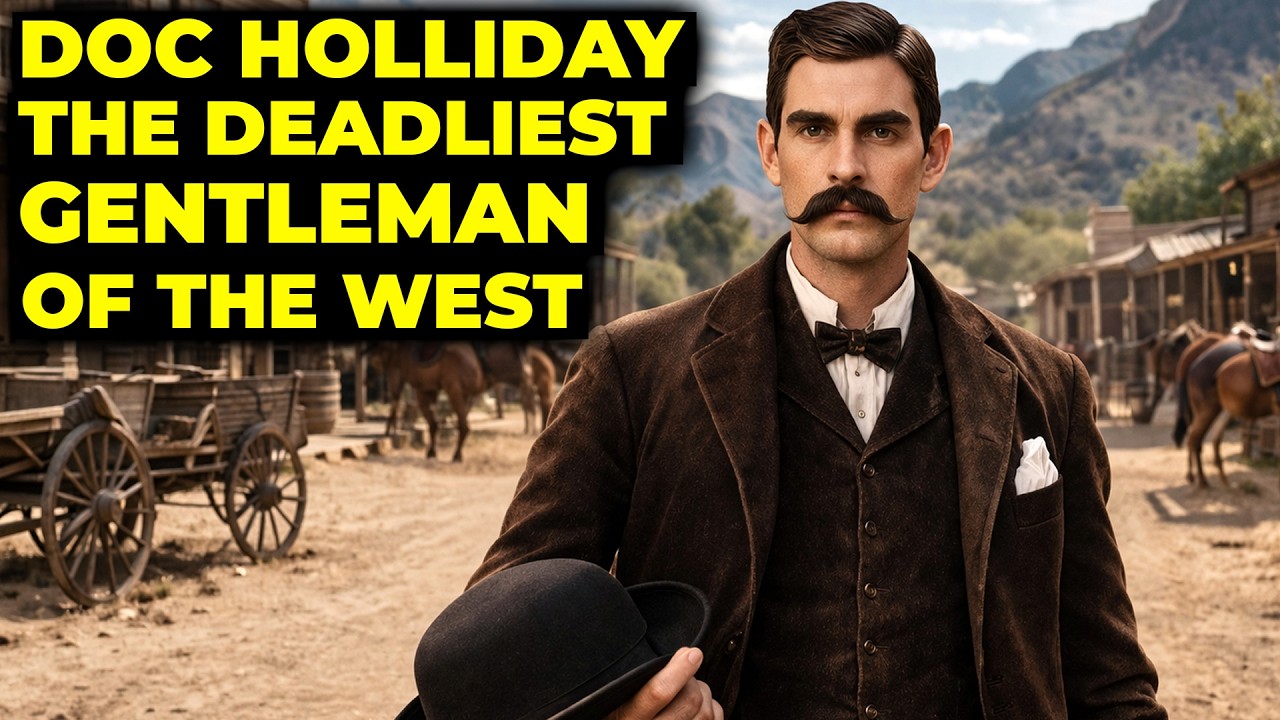
Doc Holliday is remembered as one of the Old West’s deadliest gentlemen, but the real story is far more complicated than the legend. Before Tombstone, before Wyatt Earp, and before the gunfighter reputation, he was John Henry Holliday, a trained dentist from Georgia whose life was reshaped by illness, gambling, and the violent world of the American frontier. He was born on August 14th, 1851,in Griffin, Georgia,into a family with real social standing. His father, Henry Burroughs Holliday, served as a major in the Civil War, and one relative was the physician Crawford Long.
The family moved to Bemiss, near Valdosta, in 1864. Two years later, his mother, Alice Jane McKey Holliday, died of tuberculosis, a loss that would shape the rest of his life. not only because it hit him during his mid-teens, but because the same disease would later define his own destiny. After Alice died, his father remarried, and the family moved again to Valdosta.
Rather than growing up as a rough kid destined for violence, Holliday started as a well-brought-up Southern boy in a family that expected him to become something respectable. That makes the later transformation all the more striking. It was a case of a trained, educated, socially polished young man being pushed by illness, money, and frontier life into a completely different kind of existence. in Valdosta, he attended the Valdosta Institute, where he studied rhetoric, grammar, mathematics, and languages.
That education helps explain his later reputation for being sharp, sarcastic, and verbally precise. At 19,he left Georgia and enrolled atthe Pennsylvania College of Dental Surgery in 1870, graduating in 1872. That is the plain fact behind his nickname. He really was a dentist.
After graduation, he returned to Georgia, practiced in Atlanta, and then opened his own practice in Griffin. If you pause there, nothing about his path suggests he was meant to become one of the best-known men of the American West. He was on a standard professional track, with family connections and a reason to believe he could build a quiet career. He did not leave dentistry because he was lazy or born for violence.
He left because his body began to fail him. chronic pulmonary tuberculosis changed his direction in the early 1870s. There was no dependable cure, and doctors often recommended movement to a drier climate. In 1873, after a short stay with relatives in Jonesboro, Holliday headed West.
That move was a medical decision, a survival decision, and the central turning point of his whole life. Without tuberculosis, he might have stayed in Georgia, practiced dentistry, and disappeared into ordinary regional history. Instead, illness pushed him toward frontier towns where a dentist with bad lungs could not make steady money but could find action at the gaming table. The disease also helps explain the contradiction at the center of his public image.
He could look refined and speak like an educated Southerner, yet end up living in saloons among gamblers, drovers, and fighters. The West did not cure him, but it turned him into somebody history would remember. he arrived in Dallas in September 1873,and at first practiced dentistry with John Seger. But Dallas was a frontier city, not a settled professional world, and he quickly built a second identity as a card player.
By 1875, he had been arrested after trading gunfire with a saloon owner. The charges were dropped, but the pattern was clear. He was being pulled into the culture of the frontier sporting life. Gambling demanded nerve, concentration, anda reputation strong enough to keep trouble away.
For a man who could read people quickly, the card table was not only a risk, it was a marketplace. A fearful reputation could be a form of insurance. Dallas is where the professional dentist and the frontier gambler began to merge into one complicated figure. after Dallas, Holliday moved through the frontier network instead of settling down.
He drifted in and out of Fort Griffin and Jacksboro in Texas, then through places like Pueblo, Denver, Cheyenne,and Deadwood before returning to the Southern Plains and later moving on to Dodge City. This was not random wandering. The West had circuits. Gamblers, drovers, lawmen, merchants, scouts, saloon operators, prostitutes,and outlaws followed money, cattle, mining booms, rail connections, military posts,and the seasons.
Fort Griffin gives a good example of the kind of place that shaped him,known as The Flat,one of the West’s wildest towns,filled with soldiers,buffalo hunters,drovers,gamblers,saloon girls,merchants,ranchers,and outlaws. Holliday was not drifting through empty scenery. He was moving through high-pressure contact zones where military force,cattle money,gambling,frontier justice,and rapid migration all met in the same few streets. It was there that he learned one of the hardest truths of the frontier economy.
A man could be respectable in one place and hunted in the next. He could be dealing cards at night and answering questions from a sheriff by morning. The figure who later shows up in Tombstone was already being formed on this circuit. He had learned how to move, how to read men, how to keep a seat at the table,and how to build a reputation strong enough to travel ahead of him.
somewhere along that route, Holliday met Mary Katherine Haroney, better known as Kate Elder or Big Nose Kate. The exact terms of their relationship stayed fuzzy,and even later sources disagree on whether they ever truly married, but what is clear is that she was his long-time companion. She traveled with him,and they sometimes presented themselves as husband and wife. They also fought, separated, reunited,and moved through the same hard towns together.
Kate was not a passive figure. She was educated,independent,and fully capable of surviving in the same frontier world. Their relationship also cuts against the myth that Holliday was some frozen, emotionally empty killer. He had attachments,and arguments,and somebody who knew him before Tombstone made him famous.
That does not soften therecord of his fights, but it does make him more human and more complicated. Their partnership was part partnership, part survival arrangement,and part genuine attachment all at once. So, when Holliday later appears beside the Earpsin Arizona, he arrives as a sick,educated gambler with a long-running,unstable partnership behind him and with a personal life that looked as unsettled as the towns he moved through
by the late 1870s, Holliday reached Dodge City, Kansas,one of the biggest cattle towns in the West. He once again tried to practice dentistry out of his rooms while supporting himself through gambling.
Wyatt Earp, meanwhile, was serving as assistant city marshal. According to later accounts, Holliday intervened in a dangerous situation involving Earp and rowdy cowboys in 1878,and Earp always insisted that Holliday had saved his life. Historians have pointed out that some of the best-known versions of that moment come from later recollections,rather than clean contemporary reporting. But even if the exact details remain blurry, the important fact is solid.
By the end of the Dodge City period, Holliday and Earp were close. That friendship would shape the rest of Holliday’s public life. Frontier life created strange alliances. Lawmen needed capable allies they trusted under pressure.
Gamblers needed friends with badges,influence,and staying power. Both men understood the value of a cool exterior,and both were drawn to places where money,risk,and reputation were always in motion. They did not meet across a clean moral line. They met inside the overlap of law,gambling,business,and violence.
Once that happened, Holliday was no longer just another sick gambler riding the Western circuit. He had attached himself to one of the most consequential friendships in frontier legend. That connection would pull him into Tombstoneand into history. before Tombstone, Holliday spent time in Las Vegas,New Mexico,in 1879,where he opened a saloon.
His record there included a deadly altercationin which he killed one man and wounded a bartender. That kind of episode fed his reputationand helped keep him moving. The farther west he went, the more his identity as a dentist faded behind the identity he had built at gaming tablesand in disputes. And yet, he never fully stopped being Doc.
From Las Vegas,the path toward Arizona openedbecause opportunityand friendship pointed in the same direction. Wyatt Earp was moving toward Tombstone,where a silver boom was creating chances for ambitious men. Holliday followed. That decision was practical.
Tombstone was young,rich,noisy,and full of movement,a boomtown in need of card rooms,gamblers,saloons,enforcers,teamsters,merchants,and all kinds of men who could work in unstable conditions. By the time he entered Arizona,the main pieces of his life were already in place. He was a Southernerwith strong mannersand real education,a trained dentist pushed away from his profession by disease,a professional gambler who had learned to protect himself with reputation, tied to Kate,and tied to Earp. Tombstone did not invent Doc Holliday.
It concentrated everything that had already been building for years. That is why the Arizona phase feels so explosive. It was the moment when all the earlier pieces finally collided in one famous place
when Holliday arrived in Tombstone around 1880,he stepped into one of the fastest-rising towns in the West. Silver had turned the place into a crowded,competitive business town trying to become something more orderly while still carrying the habits of the open frontier.
The Earps fit right into that contradiction. They worked in law enforcement at times,but they also had business interestsand gambling connections. Holliday fit it,too,fully tied into the same saloonand gaming world. Against them stood members of the faction usually called the Cowboys,a loose but dangerous network associated with rustling,robbery,and armed resistance to outside control.
In southeastern Arizona at that moment, calling someone a cowboy could mean more than simply saying he worked cattle. In practice,it often pointed to a rough faction that town boosters,merchants,and many lawmen treated as a threat. The conflict in Tombstone was not just lawmen versus random ranch hands. It was a struggle over who controlled a booming town,what kind of rules would apply there,and how to impose town order on men used to living heavily armed.
That pressure also explains the town ordinance about carrying deadly weapons. Men entering town were expected to check their guns. That is when things turned deadly fast. one of the most overlooked parts of the Tombstone story is the stagecoach robbery case in 1881.
Four masked men attempted a hold-up near Contention City,and in the process,a stage driver anda passenger were killed. Holliday’s name became tangled in the case,though the evidence against him was shaky. But in Tombstone, rumor could do almost as much damage as proof. Once Holliday was linked to a robberythat left two men dead,the accusation became political,personal,and explosive.
According toa modern summary in the New Georgia Encyclopedia, Ike Clanton belongedto the broader gang linked to the robbery,though it remains unclear whether he took part in the attack itself. A secret arrangement followed. Ike Clantonand Wyatt Earp were tied toa reward plan under which Ike would give upthe men responsibleand Wyatt would securethe Wells Fargo money partly in order to clear Holliday’s nameand strengthen his ownstanding as a lawman. It was not clean justice.
It was bargainingin a rough town where law,money,and survival overlapped. Once Ike Clanton started to believe thatthe EarpsandHolliday might exposethe arrangement,the feud sharpened. The build-up to the OK Corral fight was not just about a drunken argument. There was a deeper layer involving robbery,reward money,reputation,and the question of who was using whom.
For Holliday,the whole affair was especially dangerous becauseit touchedthe weakest point in his public image. He could survive being called violent. He could survive being called a gambler. But being branded a stage robber tied him directly to outright banditry
the immediate run-up to the gunfight shows how tense Tombstone had become.
On the night of October 25th,1881,Holliday and Ike Clanton quarreled. By the next morning,according to Judge Wells Spicer’s later findings,Ike Clanton was moving around Tombstone armed with a revolveranda Winchester rifle,publicly declaringthat the Earp brothersandHolliday had insulted himandthat he now meant to shoot themor fight them on sight. Those threats were communicatedto Virgil andWyatt Earp. The men who walked toward the fight were not casually wandering into a showdown.
They were reacting to a town already on edge,to threats already made,andto armed men violatingthe city’s weapons rules. Virgil Earp,as chief of police,had the duty to preservethe peaceand to arrestand disarm men carrying weaponsinside townwithout permission. That morning he had already arrestedand disarmed Ike Clantononce. Hot words followed,andWyatt clashedwith Tom McLaury.
Later that day,Virgil called on Wyatt andMorgan Earpand on Hollidayto help him arrestand disarmthe ClantonsandMcLaurys. Judge Spicer would later saythat involving WyattandHolliday was injudiciousand worthy of criticism,but he still concludedthat Virgil faceda real problemanda real obligation. Holliday’s own role is telling. He was not a sworn town officer, but he was brought inas temporary help becauseVirgil trusted himunder pressure.
He was sick,controversial,and dangerous. But he was also reliablein a crisis
the famous fightiscalledthe gunfightat the OK Corral,but that title is misleading. The shooting took placein a narrow vacant lot near therear entranceto the Corralon Fremont Street,between Fly’s boarding houseandphoto studioandtheHarwood house. This was not a wide-open street duel.
It wasasudden encounterin a tight area wheresmall reaction timeandoverlapping lines of fire turned deadlyalmost immediately. The Earp partymoved down Fremont Streetandencounteredthe armed group. Billy Claiborneand Ike Clanton fledonce the shooting startedor just beforeit fully broke open,while Billy Clantonand Frank and Tom McLaury stoodtheir ground. What happened next took less thana minute.
Oneof the strongest modernsummariesdescribesit asa fightof roughly30 secondswitharound30 shots fired. Whenthe smokecleared,Billy ClantonandTomandFrank McLaurywere dead. VirgilandMorgan Earpwere wounded. Hollidaywas grazed.
Wyatt Earpcame throughunhit. There is still disagreementover who firedfirstandexactlyhowtheopening secondunfolded,andthatuncertaintyhasnevergoneaway. But thereisno uncertaintyabouttheresult. Threemenonthercowboysidewerekilled,andtheeventbecamethe mostfamousgunfightinWesternhistory.
ForHolliday,thefightlockedinhispublicidentityforever. He waspartofafour-manarmedgroupinacompressedchaoticgunfight,andhewassubsequentlyarrestedandchargedwithmurderalongwiththeEarps. Whateverlaterstorytellersdidtoexaggerateor stylizehisrole,thelegalsystematthetime treatedhimasoneoftheprincipalactors
fourdaysafterthegunfight,HollidayandtheEarpsfacedmurdercharges,andthecasewentintoalongpreliminaryhearingbeforeJudgeWellsSpicer. Spicerreviewedweeksoftestimonyandultimatelyconcludedthatthedefendantswerejustified.
Buttherulingismoreinterestingthanasimpleacquittalsnarrative. HedidnotblesseverydecisiontheEarpsmade. In fact,hecriticizedVirgilEarpforthechoiceto callonWyattandHolliday,sayingitwasinjudiciousandcensurable. Atthesametime,heheldthatVirgilhada dutytoarrestanddisarmarmedmenwhohadbeenthreateningviolence,andthatunderthecircumstances,theapproachto thevacantlotwaslawful.
SpiceralsoemphasizedthatIkeClantonhadbeenthreateningtheEarpsandHolliday,andthatthedeadmenwerenot simplystandingtherelikeinnocentvictimspeacefullygivingup theirweapons. Heconcludedthatthedefendantswerefullyjustifiedincommittingthehomicidesasanactdoneinthedischargeofofficialduty. Therulingwasnotafairytalevindicationofnobleheroes. Itwasahard,practicaljudgmentinaviolent,territorialsetting.
Yetthetownremaineddeeplydivided,andmanypeoplecontinuedtoseetheEarpsandHollidayaskillersratherthanpeaceofficers. That splitinopinionisone reason thestorystayedalive. Thelegalrecordsaidonething,publice motionsaidthanother,andlaterwriterssteppedintothegap. FortheEarps,HollidayandtheEarpsfacedmurdercharges,andthecasewentintoalongpreliminaryhearingbeforeJudgeWellsSpicer.
Spicerreviewedweeksoftestimonyandultimatelyconcludedthatthedefendantswerejustified. Buttherulingismoreinterestingthanasimpleacquittalsnarrative. HedidnotblesseverydecisiontheEarpsmade. In fact,hecriticizedVirgilEarpforthechoiceto callonWyattandHolliday,sayingitwasinjudiciousandcensurable.
Atthesametime,heheldthatVirgilhada dutytoarrestanddisarmarmedmenwhohadbeenthreateningviolence,andthatunderthecircumstances,theapproachto tovacantlotwaslawful. SpiceralsoemphasizedthatIkeClantonhadbeenthreateningtheEarpsandHolliday,andthatthedeadmenwerenot simplystandingtherelikeinnocentvictimspeacefullygivingup theirweapons. Heconcludedthatthedefendantswerefullyjustifiedincommittingthehomicidesasanactdoneinthedischargeofofficialduty. Therulingwasnotafairytalevindicationofnobleheroes.
Itwasahard,practicaljudgmentinaviolent,territorialsetting. Yetthetownremaineddeeplydivided,andmanypeoplecontinuedtoseetheEarpsandHollidayaskillersratherthanpeaceofficers. That splitinopinionisone reason therestorystayedalive. Thelegalrecordsaidonething,publice motionsaidthanother,andlaterwriterssteppedintothegap.
FortheEarps,HollidayandtheEarpsfacedmurdercharges,andthecasewentintoalongpreliminaryhearingbeforeJudgeWellsSpicer. Spicerreviewedweeksoftestimonyandultimatelyconcludedthatthedefendantswerejustified. Buttherulingismoreinterestingthanasimpleacquittalsnarrative. HedidnotblesseverydecisiontheEarpsmade.
In fact,hecriticizedVirgilEarpforthechoiceto callonWyattandHolliday,sayingitwasinjudiciousandcensurable. Atthesametime,heheldthatVirgilhada dutytoarrestanddisarmarmedmenwhohadbeenthreateningviolence,andthatunderthecircumstances,theapproachto tovacantlotwaslawful. SpiceralsoemphasizedthatIkeClantonhadbeenthreateningtheEarpsandHolliday,andthatthedeadmenwerenot simplystandingtherelikeinnocentvictimspeacefullygivingup theirweapons. Heconcludedthatthedefendantswerefullyjustifiedincommittingthehomicidesasanactdoneinthedischargeofofficialduty.
Therulingwasnotafairytalevindicationofnobleheroes. Itwasahard,practicaljudgmentinaviolent,territorialsetting. Yetthetownremaineddeeplydivided,andmanypeoplecontinuedtoseetheEarpsandHollidayaskillersratherthanpeaceofficers. That splitinopinionisone reason therestorystayedalive.
Thelegalrecordsaidonething,publice motionsaidthanother,andlaterwriterssteppedintothegap
thegunfightdidnotsettleTombstone. If anything,itmadethetownevenmoredangerous. Near theendofDecember1881,VirgilEarpwasambushedandbadlywounded,withhisleftarmpermanentlydamaged. Then,in March1882,MorganEarpwas killed.
Thoseattackschangedthewholeemotionaltemperatureofthestory. Theconflictbecameacycleofrevenge. Oncemendecidedthatwarrants,hearings,andcountyofficerswouldnotsettlethings,privateviolencestoppedfeelinglikeabreakdownoforderandstartedfeelingliketheonlyorderavailable. Holliday,despitehishealthandhisincreasinglyheavylegend,stayedclosetoWyattthroughthisphase.
Thatloyaltyispartofwhy latergenerationsfoundhim socompelling. Hecouldberecklessandabrasive,buthealsoseemstohavebeen intenselydependablewherefriendshipwasconcerned. AndonceMorgandied,theroadaheadforHollidaynolongerledtowardstabilityoranyreturntoordinarylife. ItledtowardArizona’smostfamousmanhunt
inthewakeofMorganEarp’smurder,HollidayjoinedWyattEarpinwhatbecameknownastheVendettacampaign.
AccordingtothemodernsummaryintheNew GeorgiaEncyclopedia,HollidayjoinedWyattinaretaliatoryeffortthatresultedinthedeathofFrankStillwell,asuspectinMorgan’smurder. Whatfollowedwasnotacourtroomdrama. Itwasarmedpursuit. TheEarpgroupmovedasafederalposseforpartofthisphase,butfromtheperspectiveoftheirenemies,itlookedlikerevengeundercoloroflaw.
Hollidaydidnotstepback. HewentwithWyatt. By1882,hewasalreadyverysick,alreadywidelydislikedinsomecircles,andalreadycarryingenoughlegalrisktoruinanychanceofquietsurvival. Yethestayedinthefight.
AftertheStillwellkillingandthebroaderArizonachaosthatfollowed,HollidayandEarpfledtheterritorytogether. Hollidaywasarrestedin Denver2 monthslater,butColoradoauthoritiesrefusedtoextraditehimtoArizona,andeventuallyreleasedhim. BatMasterson,whowaslaterdescribedbytheTexas StateHistoricalAssociationasinstrumentalinpersuadingthegovernorofColorado topreventHolliday’sextradition,appearsheretoo. AnotherreminderthattheWestranonnetworksasmuchasonlaw.
BythetimeHollidayemergedfromthatepisode,theTombstoneyearswereeffectivelyover. Hehadcrossedthroughaccusation,gunfight,hearing,ambush,murder,posseaction,andinterstatelegaldanger. TheWesthadturnedhimfromawanderinggamblerintoanationalfigureofcontroversy. Yetwhatcamenextwasnottriumph.
Itwasdecline,movement,andthelongColoradoendingofamanwhohadoutlivedthemostfamousmomentsofhisownlegendbyonlyafewyears
afterArizona,HollidayspenttheremainderofhislifemostlyinColorado. Hishealthkeptfailing. Hestillgambledbecausegamblingwaswhatheknewandbecauseitremainedoneofthefewwayshecouldsupporthimself. InLeadville,heenteredanotherhigh-pressureminingtown.
Itwasaharshenvironmentforamanwithtuberculosis. Thinmountainairdidnotrepairdamagedlungs,andbythispoint,Hollidaywasno longertherelativelymobilefrontiergamblerof themid-1870s. Hewasanincreasinglyfragilemanlivingoffnerveandhabit. InLeadville,hegotintoanotherviolentdispute,thistimeinvolvingabartendernamedBillyAllen,fromwhomhehadborrowedmoneyandwhomhebelievedwasthreateninghim.
HollidayshotAlleninasaloonconfrontation. AllensurvivedandHollidaywasacquittedafteratrial. LocalLeadvillehistorystilltreatsthecaseasoneof thekeyepisodesofhisColoradoyears. EvenafterTombstone,Holliday’sreputationkeptproducingconflict.
Hewastoofamous,toosharp,tooeasilydrawnintodisputes,andtoousedtodefendinghimselfthroughintimidationor forcetofullstepoutofdanger. YetColoradostripsawaysomeof theglamourlaterfilmsadded. Thisisnotthephaseof aris inggunfighter. Itisthephaseofasickmanstilltryingtomakealiving,stillbeinghauntedbyoldenemiesandoldhabits,andstillsometimesforcedintodesperateconfrontations.
ThefartheryoufollowHollidaybeyondTombstone,thecleareritbecomesthathis lifewasnotasteadyclimbtowardmyth. Itwasanarrowingpathshapedbyillness,movement,diminishingoptions,andareputationhecouldneverfullycontrolonceithadspreadacrosstheWest
DocHollidayisoftendescribedasoneof thedeadliestmenof theWest,sometimeswithwildlyinflatedbodycountsattachedtohisname. Butmodernresearchershavespentyearscuttingthroughthosestories,andtheresultismuchlesssensational. Asonemodernhistorysummaryputsit,”Manyof thehighestnumbersarefanciful,andmanytalescreditedtoHollidaydonotholdupwhencheckedagainstcontemporarynewspapers,courtrecords,andsoliddocumentation.
“Somehistoriansarguethatonlyavery smallnumberofkillingscanbeconfidentlyassignedtohim. OtherstretchthenumberslightlyhigherdependingonhowtheyreadTombstone,LasVegas,Tucson,andlaterincidents. WhatalmostnobodyseriousacceptsanymoreistheoldimageofHollidaycasuallypilingupvictimsin everytownhepassedthrough. Washedangerous?
Yes. Washecapableof lethalviolence? Clearly. Didpeopleinhisowntimebelievehewasafastandnerve-stead ygunman?
Yes,manydid. Buthistoricalrecordsuggeststhathisdeadlyimagegrewfasterthanhisconfirmedkillcount. Intheworldofprofessionalgambling,fearcouldbeuseful. Areputationcouldpreventchallengesbeforetheystarted.
Athin,sicklymanwholookedphysicallyvulnerablehadeveryreasontole troughermenbelievehewas thewrongpersontotest. Them ythandthemanfed eachother. Hereallydidfight. Hereallydidstandinoneof themostfamousgunbattlesinWesternhistory.
Butrumor,newspaperexaggeration,andlaterfilmmakingturnedhimintosomethingevenlarger. Thatdoesnotmakehimharmless. Itmakeshimm oreinteresting. ThebestwaytounderstandHHollidayisnotasamanwhoserecordmatchesever ywildstory,butasamanwhosemanner,friendships,illness,intelligence,andsometimesviolencecreatedtheperfectconditionsforalegendtooutruntheevidence
EvenmenwhodislikedHollidayoftendescribedhiminwaysthatsethimapartfromthestandardimageofafrontierbrute.
ThereasongoesallthewaybacktoGeorgia. Hehadeducation,professionaltraining,andmannersshapedbyamoreformal culture. Britannicastillsummarizeshisearlylifebysayinghewasrearedin thegenteeltraditionof theOldSouth. Thatphraseisusefulbecauseitexplainswhyhecouldseemsodifferentfromothermenin thesame room.
Hespokelikeaneducatedman,carriedhimselflikesomeonewhohadonceaimedatalegitimateprofession,andkepttracesofthatworldevenwhenlivinginroominghousesandgamblinghalls. That splitisone reasonhelaterfascinatedwriterssomuch. DiseasepushedhimWest,Gamblingpaidhisbills,Violenceprotectedhisplace. Butnoneofthatfullyerasedtheearlyshapingofhischaracter.
A neatpolitemannercouldbedisarming. Asharp tonguecouldcutdeepercomingfromamanwhosoundedcontrolled. Holliday’simagewasnotbuiltonlyongunplay. Itwasbuiltoncontrast.
Hewasoftenphysicallyweak,especiallyastuberculosisadvanced,thatlikelymadehisreputationevenmoreimportant. Ifpeoplebelievedhewasfearlessandfast,theymightnevertestthelimitsofhisfailingbody. Foralotoffrontierobservers,thatcombinationwasmemorable. Italsohelps explainwhyfilmmakerskeptreturningtohim.
WyattEarp,forallhisfame,canbehardertodramatizebecauseheoftensealssealedoffanddistant. Holliday,bycontrast,comeswithcontradictionsalreadybuiltin. Heis thedentistwhobecomesagambler,thesickmanwhokeepswalkingintodanger,theeducatedSouthernerwholivesinsaloons,thefriendwhostaysloyallongafterthecostbecomesobvious. Thatisnotmovieinvention.
Thatis thebasicstructureofhislife. Themoviesonlyexaggeratedit
by1887,Holliday’stuberculosishadreacheditsfinalstage. HewenttoGlenwoodSprings,Colorado,hopingthelocalwatersmighthelphim. Theydidnot.
HediedthereonNovember8th,1887,attheageof36. Forallthesizeofhislegend,DocHollidaydiedyoung,sick,andfarfromtheGeorgialifehe’doncebeenpreparedtolive. Hisactivelifein theWesthadlastedonlyaboutadecadeandahalf. Thereasonitfeelslongeristhatlaterstorytellingkeptstretchingit.
TheNew GeorgiaEncyclopediamakesasharppointhere. HollidayandWyattEarpwerenotoriginallydimenovelsuperstarsin thewaysomeotherfrontiernameswere. Theirlegendwasshapedmuchmoreheavilyby20thcenturybiography,film,andtelevision. Inotherwords,theHollidaymostpeoplethinktheyknowis partlyahistoricalfigureandpartlyaproductofmodernmyth-making.
Thegunfightbecamethecenterpiece. Thelinesgotsharper. Thewitgotdrier. Thebodycountgotlarger.
Theillnessandlegaldetailsgotcompressedintostyle. Hollywoodkeptreturningtohimbecausehecoulddominateascenewithouteverneedingtodominatethewholeplot. Butthereasonthem ythworked sowellisthattherealmanalreadycontainedtherightingredients. Hewasbornprofessionally,struckbyadeadlydisease,drivenWest,tiedtofamousfriends,entangledwithoutlawsandlawmen,caughtinoneof themostfamousgunfightsinAmericanhistory,pursuedacrossstatelines,anddeadbeforemiddleage.
Thatis alreadyapowerfulstory. Thelegenddidnothavetoinventhimfromscratch. Itonlyhadtosimplifyhim. Ittookthefrontierprofessionalandtrimmedawaythepaperwork.
Ittookthesickmanandturnedhimintoaphilosopherof death. Ittookthegamblerwhosometimesfrightenedpeopleonpurposeandturnedhimintothepermanent,flawlessmasterof thesix-gun. Andmaybethatisthe mostusefulwaytounderstandDocHolliday. Therealfigureisnotsmallerthanthem yth.
Heisstrangerthanthem yth,hardertosort,andmuchmoretiedtotherealpressureof theAmericanfrontierthanthepolishedmovieversionusuallyallows