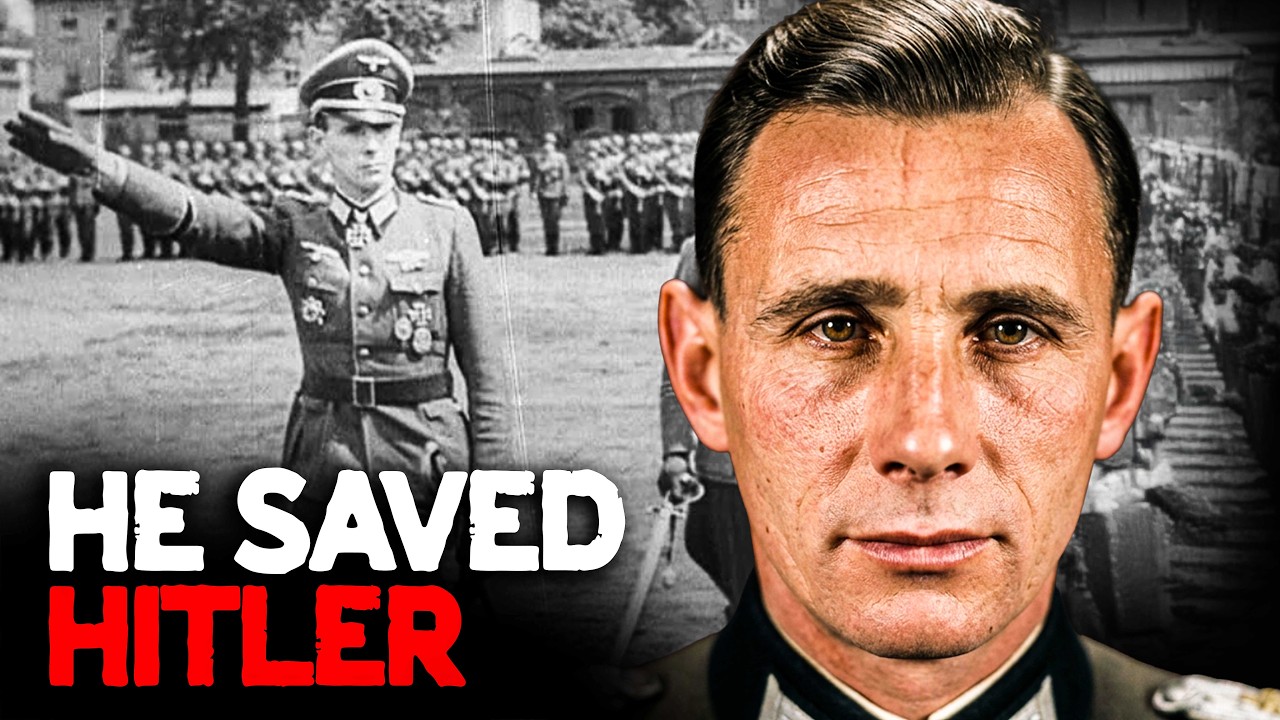
BERLIN — A single telephone call in the early evening of July 20, 1944, placed by a 31-year-old major who had been ordered to arrest the propaganda minister, ended the most ambitious attempt to overthrow Adolf Hitler and changed the course of the Second World War. The officer was Otto Ernst Remer, commander of the Berlin Guard Battalion, and his decision to verify his orders directly with the Führer doomed Operation Valkyrie within hours.
The bomb had gone off at 12:42 that afternoon inside Hitler’s fortified headquarters at the Wolf’s Lair in East Prussia. Colonel Claus von Stauffenberg, a decorated officer who had lost an eye, his right hand and two fingers of his left in North Africa, had placed a briefcase containing British-made plastic explosive beneath the oak conference table, excused himself, and flown back to Berlin convinced the dictator was dead.
 He was wrong. A single charge had detonated instead of two, and the heavy oak table leg absorbed the blast. Hitler survived with a burned arm, damaged eardrums and shredded trousers.
Four other men in the room died of their wounds. By the time Stauffenberg landed in Berlin, the regime he believed finished was already hunting his co-conspirators.
The conspirators had spent months quietly rewriting an existing Wehrmacht emergency plan known as Operation Valkyrie, designed to maintain internal order in the event of unrest. In their version, the Reserve Army would seize control of Germany after Hitler’s death, arrest SS and Gestapo leaders, and install a provisional government that would seek peace with the Western Allies.
The plan depended absolutely on one fact: Hitler had to be dead. When Remer’s battalion received orders to seal off the government quarter and arrest Propaganda Minister Joseph Goebbels, the young major hesitated. The official explanation — that the SS had assassinated Hitler and the army was preventing an SS coup — struck him as implausible.
Summoned to Goebbels’ residence, Remer was offered a telephone. Within moments he was speaking to Hitler himself. The voice was unmistakable.
The Führer promoted Remer on the spot to colonel, gave him authority over all military forces in Berlin, and ordered him to crush the revolt.
Remer acted with the efficiency of a soldier who had received orders from the highest authority he recognized. His troops surrounded the Bendlerblock, the Reserve Army headquarters where the conspirators had gathered. Officers who had wavered began switching sides.
Some helped make arrests. Others simply withdrew and waited.
Just before midnight, four men were shot by firing squad in the courtyard under the headlights of military vehicles: Stauffenberg, General Friedrich Olbricht, Colonel Albrecht Mertz von Quirnheim, and Stauffenberg’s adjutant, Lieutenant Werner von Haeften. Stauffenberg reportedly cried out, “Long live sacred Germany,” as the bullets struck him.
The reckoning that followed was blood-soaked. The Gestapo arrested hundreds. The People’s Court, presided over by the notorious Roland Freisler, turned trials into spectacles of humiliation.
 Defendants were denied belts and suspenders so their trousers sagged as they faced the cameras Hitler had ordered to record the proceedings for his personal viewing.
Field Marshal Erwin von Witzleben, General Erich Hoepner, General Helmuth Stieff, General Paul von Hase and others were hanged at Plötzensee prison on August 8, 1944, on thin wire nooses suspended from meat hooks — a method chosen personally by Hitler to maximize suffering and deny the condemned a soldier’s death.
Carl Friedrich Goerdeler, designated to become chancellor after the coup, was betrayed by a woman in East Prussia and hanged on February 2, 1945. Helmuth James von Moltke, the intellectual soul of the civilian resistance, was executed on January 23, 1945, after Freisler argued that his true crime was his Christianity.
Pastor Dietrich Bonhoeffer, who returned from safety in the United States in 1939 to share his country’s fate, was hanged at Flossenbürg on April 9, 1945, alongside Admiral Wilhelm Canaris and General Hans Oster — four weeks before Germany’s surrender, in an act of pure revenge as Allied forces closed in.
Henning von Tresckow, who had organized earlier assassination attempts, chose suicide in no man’s land on the Eastern Front rather than face capture. He told a fellow officer that the attempt had to be made regardless of success, because what mattered was demonstrating to the world that the German resistance had dared to act.
For Remer, the reward was swift. Hitler promoted him to major general in January 1945 and gave him command of the Führer Escort Brigade. He was wounded again in the war’s final battles.
Captured by Allied forces, he was released in 1947 and could have rebuilt a quiet civilian life in the new Federal Republic.
He chose a different path. In 1950 he co-founded the Socialist Reich Party, an explicitly neo-Nazi organization that denied Nazi war crimes and attacked the legitimacy of the new German democracy. In 1951 it won 11 percent of the vote in Lower Saxony state elections, alarming the government and the Allied powers.
In 1952, a German court ruled that the July 20 conspirators had not been traitors but had acted under a higher moral obligation, and sentenced Remer for publicly condemning them. That same year the Federal Constitutional Court banned his party — the first such ban in West German history.
 He never accepted the verdicts. Through the 1960s and 1970s he drifted deeper into Holocaust denial, distributing pamphlets that claimed the gas chambers were Allied fabrications. In 1992 a Munich court convicted him of incitement and sentenced him to 22 months in prison.
Rather than serve the term, he fled to Spain in 1993.
He settled in Marbella on the Costa del Sol, where Spanish authorities showed no interest in extraditing him for political speech offenses. He continued corresponding with neo-Nazi networks, granting interviews and maintaining to the end that Hitler had been a great leader betrayed by weak subordinates and that the Holocaust was a lie.
Otto Ernst Remer died in Marbella on October 4, 1997, at the age of 85. His death drew little attention in Germany. He was buried in Spain, far from the soil that had defined his life.
His criminal conviction remained outstanding, and his name appears on no public building or military barracks.
The contrast with how Germany remembers the men he stopped could hardly be sharper. The Bendlerblock, where Stauffenberg was shot, is now the German Resistance Memorial Center. Each July 20, a ceremony honors those who gave their lives opposing Hitler.
New Bundeswehr recruits traditionally swear their oaths in ceremonies invoking the conspirators’ example.
Klaus von Stauffenberg, once condemned as a traitor by men like Remer, is now recognized as a national hero. His face appears on commemorative stamps and coins. Streets, schools and barracks carry his name.
His wife Nina, arrested under the Nazi principle of Sippenhaft and held in Ravensbrück, survived the war and lived until 2006, dying at 92.
 The July 20 conspiracy remains unique in the history of the Second World War. It was an attempt by citizens of the aggressor nation — the nation that started the war and conducted the genocide — to overthrow their own government from within. The personal risks were enormous, the moral stakes arguably higher than any other resistance movement.
The final nine months of the war, from July 1944 to May 1945, were among the most destructive of the entire conflict. The death camps continued operating. The fighting consumed enormous numbers of lives on both sides.
Had the coup succeeded, historians argue, much of that might have been avoided.
Whether Remer bears responsibility for that prolongation is a question that resists easy answers. He was a soldier acting on what he believed was the clearest possible authority — the voice of his supreme commander. He was not a planner or a conspirator.
He was a man in a crisis, making an instant decision based on his training and values.
What is far less ambiguous is the second half of his life. His postwar career as a neo-Nazi activist and Holocaust denier represented a clear and deliberate choice, made freely over more than four decades in a democratic society with full access to the historical record, to continue serving the ideology of a regime that murdered millions.
That choice — not the telephone call — is the most important fact about Otto Remer. He had every opportunity to reflect, to acknowledge the moral complexity of his role, to contribute to the difficult work of understanding what had happened to Germany. He chose denial until the end, and then exile rather than accountability.
The men and women of the July 20 conspiracy were not perfect. Many had served the regime they ultimately opposed. Some were slow to recognize the full extent of its crimes.
But they made the choice, at the cost of their lives, to act on the conviction that there are limits to what any state can demand of its citizens.
They were, in the most meaningful sense, the other Germany — the Germany that existed as a possibility within the nightmare of the Third Reich, and that would eventually, imperfectly but genuinely, emerge from the ruins of 1945 to build a democracy that has become a model for how a nation confronts its darkest history.
Otto Remer stopped them on July 20, 1944. The consequences played out over the next nine months in blood and fire. The question of what Germany owes to those who chose resistance over compliance has never been fully resolved — and perhaps never will be.