PARIS — The Allied advance that had stunned the world came to a sudden, grinding halt in September 1944, not at the hands of Hitler’s armies but at the center of a bitter command feud that would define the career of one of the most powerful and least known American generals of World War II.
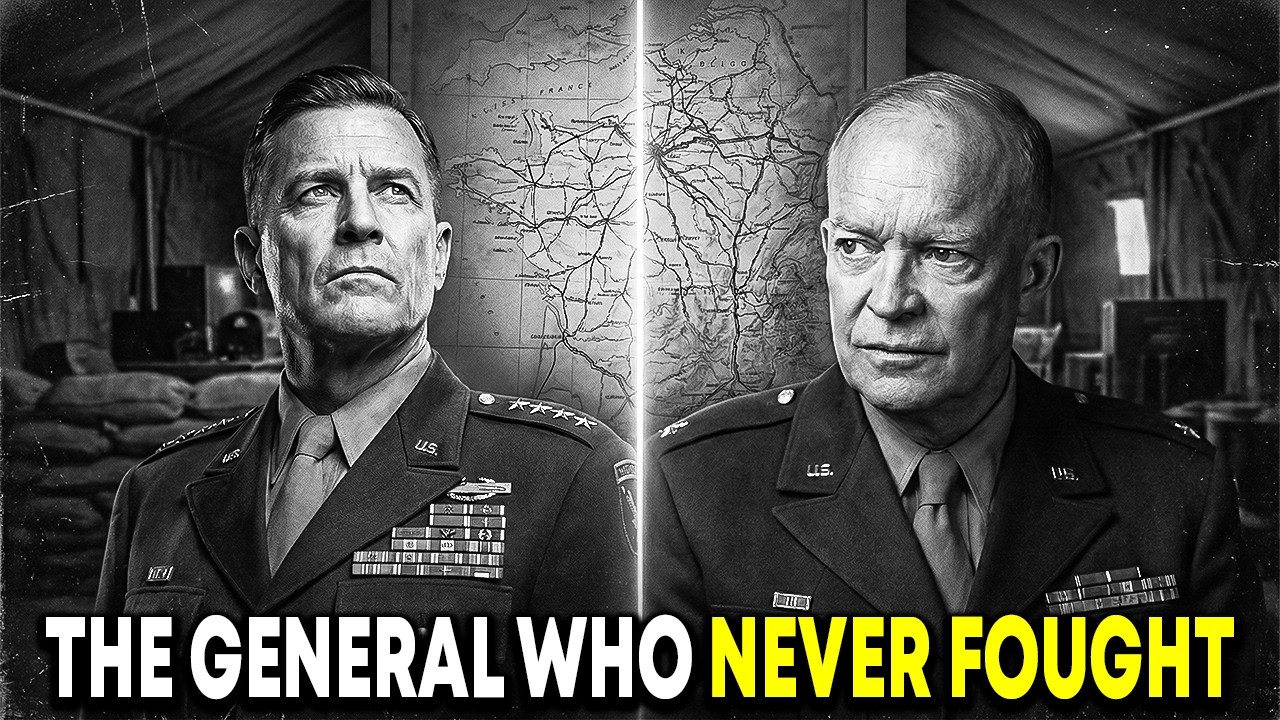
His name was John C. H. Lee, and at the height of his authority he commanded more than a million and a half personnel — a force larger than the entire armed forces of most nations — while never once leading a frontline unit into combat.
Lee ran the Communications Zone, known throughout the European theater as COMZ, the vast logistical machine responsible for receiving supplies shipped from the United States, moving them across the English Channel, clearing them through French ports, and pushing them forward to the fighting divisions.
For every soldier at the front, between four and seven men served behind him keeping him armed, fed, and operational. Lee commanded all of them.
His nickname, never spoken to his face, was “Jesus Christ Himself Lee” — a reference to his initials, JCH, and to a confidence in his own judgment that inspired some and infuriated many.
West Point trained, deeply religious, and impeccably turned out at all times, Lee believed with total sincerity that his organizational work carried a purpose beyond rank or recognition. That conviction drove him to remarkable achievements and made him one of the most divisive figures the U. S.
Army produced during the conflict.
The crisis came after General Omar Bradley’s forces broke through German lines near Saint-Lo in late July 1944 and General George Patton’s newly activated Third Army poured through the gap with stunning speed.
What had been a staged breakout from Normandy became a race across open country. The Germans were falling back as fast as they could move, and Patton was right behind them.
The problem was distance. Every mile of advance stretched supply lines another mile from the depots in Normandy. Patton’s armor ran on fuel.
His trucks ran on fuel. His men needed ammunition, rations, and equipment, all of it traveling hundreds of miles from the coast.
Lee’s answer was the Red Ball Express — a bold, almost unreasonable improvisation. He designated two parallel highways connecting Normandy supply depots to the advancing front. One carried loaded trucks forward, the other brought empty trucks back.
Civilian vehicles were cleared entirely. Convoys ran around the clock.
At its peak, nearly 6,000 vehicles rolled those highways every 24 hours. Trucks broke down constantly. Drivers pushed machines far beyond normal limits.
Maintenance schedules were abandoned in favor of momentum. The roads deteriorated under the weight of constant traffic.
But it worked. For six weeks, the Red Ball Express kept the advance alive, delivering fuel and ammunition to units that would otherwise have ground to a halt. Without Lee’s improvised highway operation, the most dramatic Allied advance of the war in Europe would have stopped weeks earlier.
 Then came the decision that would overshadow everything else.
Paris was liberated on August 25, 1944, ending four years of occupation. Eisenhower, watching the celebrations, understood that the city represented a logistical burden as much as a symbolic victory. It required food, fuel, and resources just to function — all of it diverted from the front.
He had considered bypassing Paris entirely to maintain momentum.
Within days of the liberation, Lee relocated his headquarters to the city. Significant portions of COMZ moved into Paris. Thousands of support personnel followed.
Officers occupied prominent hotels. Staff were accommodated in a standard of comfort that stood in stark contrast to conditions at the front.
The reaction from frontline commanders was swift and severe. Patton was furious. Bradley was coldly, precisely angry.
Officers throughout the combat formations felt the move reflected priorities fundamentally at odds with what the campaign required.
Transportation capacity spent moving COMZ into Paris was capacity that could not carry fuel or ammunition to the men who needed it. The symbolism was just as damaging as the practical cost.
Lee’s defenders pointed to genuine operational logic. Paris sat at the center of the French road and rail network. As a command location for managing supply lines across the entire theater, it offered real advantages.
The criticism, they argued, was partly tactical misunderstanding and partly institutional resentment toward a logistics command the combat generals had always viewed with suspicion.
His critics argued the decision was driven by something far simpler than operational necessity. As with most controversies of this kind, the complete truth likely contains something from both sides. But the damage to Lee’s standing was real, immediate, and lasting.
The Paris decision did not create the conflict between Lee and his peers. It brought into the open a tension that had been building for a long time.
Lee’s leadership approach was intensely top-down. He expected complete deference from subordinates and unambiguous cooperation from parallel commands. He did not naturally seek input or share decision-making.
In an alliance requiring constant coordination between American, British, and French elements, this style created ongoing difficulties at every level.
He had strained relationships with British logistics counterparts and difficult relationships with many of his own senior staff. Combat commanders felt his supply priorities did not always reflect frontline realities. Eisenhower’s own headquarters staff found him almost impossible to work with through standard channels.
There were concerns about the size of the organization he had built, a headquarters structure that seemed to grow in proportion to its distance from the fighting. There were questions about efficiency, about whether the ratio of support personnel to forward combat strength had drifted badly out of balance.
 By the autumn of 1944, the case for removing Lee had been made clearly and repeatedly by some of the most senior commanders in the theater. Bradley wanted him replaced. Patton wanted him replaced.
Several senior members of Eisenhower’s own staff had reached similar conclusions.
Eisenhower knew everything. And he kept Lee in place.
This is where the story becomes genuinely compelling. Eisenhower’s decision to retain Lee was not passive or accidental. It was a deliberate choice made in full knowledge of the arguments against it, and it reveals something important about how Eisenhower understood the war he was fighting.
Part of his reasoning was operational and straightforward. Removing the commander of an organization the size of COMZ in the middle of an active campaign carries enormous risk. Lee knew the systems.
He knew the personnel. He knew where things were and how the networks functioned. Replacing him at that moment risked organizational disruption with real consequences at the front.
But Eisenhower’s thinking went further. He was extraordinarily clear-eyed about what the mission actually required — not what was politically satisfying, not what his most vocal generals demanded, but what operational reality demanded.
The operational reality was that Lee’s organizational capacity was, despite everything, genuinely valuable. The man had flaws that were large and visible. He also had talents that were real and difficult to replace.
Eisenhower made a deliberate judgment that continuity in logistics command was worth the significant political cost of absorbing the anger of Bradley, Patton, and his own staff. It was not a popular decision. It was a considered one.
Whether it was the right call is something historians have debated for decades.
The winter of 1944 to 1945 brought the hardest period of the entire Western campaign. The German offensive through the Ardennes in December, the Battle of the Bulge, struck with a force that briefly put the entire Allied position under serious pressure.
Suddenly, every question about logistics efficiency, supply priorities, and organizational structure became a matter of immediate operational consequence.
COMZ performed under this pressure in ways that were both genuinely impressive and legitimately open to criticism. The infrastructure Lee had built, for all its scale and all the concerns about excess, ultimately delivered under the strain of the German offensive. Supplies reached the units that needed them.
The system held together when it needed to hold.
But the broader critiques of COMZ’s efficiency were never fully resolved. Post-war analysis suggested that the rear area support structure consumed a larger share of available resources than the operational situation truly required, and that the balance between support capacity and frontline strength had tilted in a direction that cost the campaign something real.
 Whether a different commander would have done meaningfully better — given the unprecedented scale of the challenge, the pace of the advance, and the complexity of running a multinational supply operation across a continent — remains genuinely open to debate.
The war in Europe ended in the spring of 1945. Lee’s career moved toward its close. The organization he had built was gradually wound down, and the controversies of the campaign faded into the broader story of Allied victory.
He never became a well-known figure. There is no popular image of John C. H.
Lee, no place in the mythology of the Second World War alongside commanders whose names became household words. His story never made it into the films or biographies that shaped how a generation understood the war.
And yet the record is there for those who look. Without the infrastructure he commanded, the war in Europe moves on a different timeline. The Red Ball Express, improvised under pressure and demanding the near impossible from the men and machines that ran it, kept the pursuit of retreating German forces alive at the precise moment when momentum was everything.
The systems that fed and armed and supplied millions of men across hundreds of miles of active campaign were his responsibility. On the fundamental measure of whether those armies were supplied well enough to keep fighting, the answer was yes.
History tends to remember the dramatic — the bold advance, the decisive engagement, the leader at the front of the column. The fuel in the tank, the round in the rifle, the road that made the advance possible: these things disappear into the background.
Lee understood that the background was the foundation. He was arrogant. He was genuinely difficult to work alongside.
He made decisions that created real problems for the campaign and real anger among colleagues who had every reason to push for his removal. He relocated to Paris when men at the front were enduring conditions he would never share.
But he also built something that worked at a scale never before attempted, under pressure that never relented. He kept the armies moving. And Eisenhower, the man who saw the whole picture more clearly than almost anyone around him, made the deliberate choice to keep him.
That judgment says something important about what large-scale operations actually demand, about the difference between the leader who is easy to admire and the leader the situation actually requires, and about how history is sometimes shaped not on the battlefield itself but in the enormous, unglamorous world that exists just behind it.
John C. H. Lee never received the recognition that came to the men whose armies he supplied.
No parade bore his name. No monument stands along the roads his convoys traveled. No place in popular memory marks the war he helped to win.
But somewhere on a French highway in the summer of 1944, 6,000 trucks rolled through the night, loaded with everything an army needed to keep moving, keep advancing, and keep the momentum of the greatest military campaign of the modern era alive for one more day.
He put them there.