ALGIERS, North Africa — Gen. Dwight D. Eisenhower faced the gravest command decision of the North African campaign in August 1943, not on a battlefield, but over a typewritten report describing how Lt.
Gen. George S. Patton Jr.
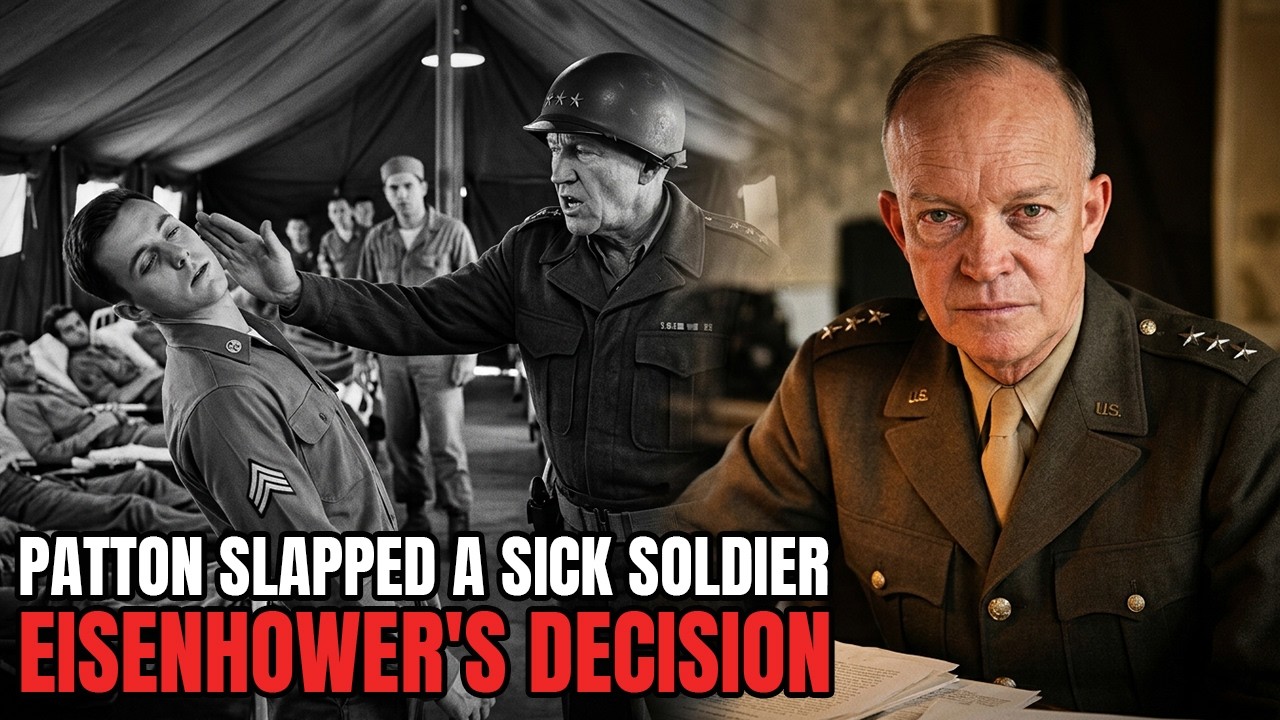 had slapped two hospitalized soldiers suffering from combat stress and malaria.
The incidents, which remained hidden from the American public for more than three months, have resurfaced as historians continue to examine how the Supreme Allied Commander balanced military necessity against accountability for the 𝓪𝓫𝓾𝓼𝓮 of sick and exhausted enlisted men.
According to Army medical records and investigative reports, Patton visited the 15th Evacuation Hospital near Nicosia, Sicily, on Aug. 3, 1943, and encountered Pvt. Charles Kuhl, a 26-year-old infantryman from Mishawaka, Indiana, who was sitting on the edge of his cot without visible wounds.
When Patton demanded to know what was wrong, Kuhl replied that he was nervous and could not take it anymore. Patton slapped him across the face with his gloves, grabbed him by the collar, dragged him from the tent and kicked him as they cleared the entrance, according to sworn statements from medical personnel who witnessed the scene.
Kuhl’s temperature, taken after Patton left, registered 102. 2 degrees. He had malaria.
His chart carried a diagnosis of psychoneurosis, what modern medicine recognizes as combat stress reaction, and he had been admitted by medical staff, not by his own request.
The assault did not end there. One week later, on Aug. 10, 1943, Patton entered the 93rd Evacuation Hospital near Santo Stefano and found Pvt.
Paul G. Bennett, a 21-year-old artilleryman from South Carolina with four years of service, shaking on his cot.
When Bennett said his nerves were gone and he could no longer stand the shelling, Patton shouted that Bennett ought to be lined up against a wall and shot. He pulled his pistol from its holster and waved it in the soldier’s face, then slapped him twice with an open palm in full view of the ward.
Col. Richard Arnest, the II Corps surgeon, learned of the incidents within hours and filed a formal report. Brig.
Gen. Frederick Bless, chief surgeon at Allied Headquarters, forwarded it directly to Eisenhower, who by then had commanded Allied forces in North Africa for nine months.
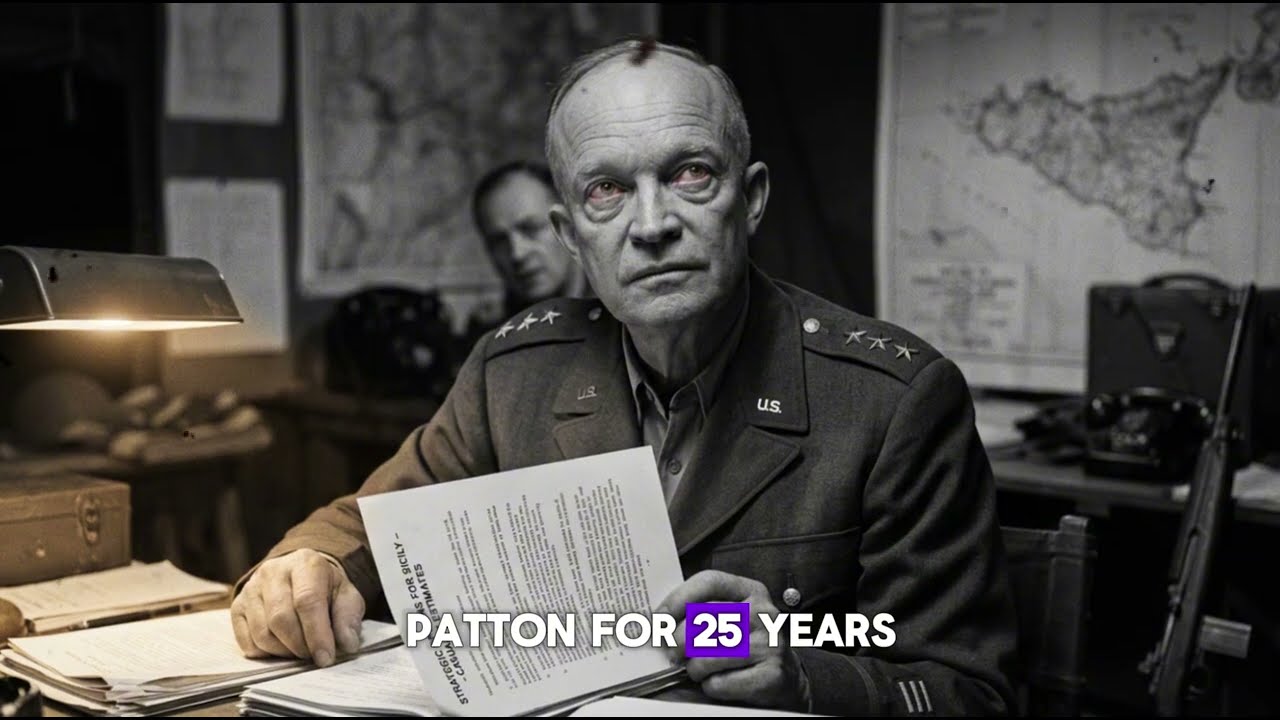
Eisenhower, a 52-year-old West Point graduate from Abilene, Kansas, had never led troops in combat. His expertise lay in holding together a fragile alliance, managing a voracious press corps and making the political calculations that battlefield commanders were never required to make.
He had also known Patton for 25 years. His aide, Harry Butcher, recorded that Eisenhower did not sleep for two nights after reading the report. On Aug.
 16, Lt. Col. Perrin Long submitted a comprehensive investigation drawn from interviews with hospital personnel present at both incidents.
The Long report was unambiguous. Patton had struck two enlisted men in field hospitals, and one had been demonstrably ill at the time of the assault. Eisenhower ordered the report sealed and wrote Patton a personal letter on Aug.
17, hand-delivered by Bless with the investigation attached.
The letter ran five paragraphs and represented the most carefully calibrated document Eisenhower had written since taking command. He acknowledged that firm and drastic measures were sometimes necessary, but wrote that this did not excuse brutality, 𝓪𝓫𝓾𝓼𝓮 of the sick, or exhibitions of uncontrollable temper in front of subordinates.
Eisenhower told Patton he had no intention of opening a formal investigation. Their correspondence would remain in his secret files. There would be no official reprimand on the record and no revocation of command, but the conditions were precise and left no room for interpretation.
He placed Patton’s continuation in command upon the understanding that incidents of this type would not be repeated. He strongly advised Patton to apologize personally to both soldiers, to the hospital staffs who witnessed the assaults and to the divisions concerned if there was any semblance of truth in the allegations.
That final clause, the reference to any semblance of truth, was the single concession to Patton’s dignity in an otherwise direct document. Eisenhower had read the Long report. He knew the truth was not in question.
The phrase was the diplomatic minimum required to allow Patton to apologize without formally admitting assault on the record.
Patton apologized, not immediately and not without resistance, but he did it. He traveled to Kuhl’s unit and spoke to the assembled men. He went to Bennett’s unit and told them he had done wrong.
The apologies were witnessed, reported up the chain of command and filed away.
For three months, nothing happened publicly. The correspondents covering Seventh Army had known almost immediately. Demaree Bess of the Saturday Evening Post assembled a full account from hospital witnesses within days of the second incident.
Merrill Mueller of NBC conducted his own interviews.
 Quentin Reynolds of Collier’s heard the full story from both of them. The three went to Eisenhower together. His aide told them before the meeting that the supreme commander had not slept for two nights worrying about the situation.
Eisenhower listened while Bess and Mueller described what the witnesses had told them.
Then he told them they had good stories and that there was no question of censorship involved. They were free to publish. Bess spoke for the group.
They had discussed it, he said, and their conclusion was that they were Americans first and correspondents second.
Every mother would think her son was next, Bess said. They were going to 𝓀𝒾𝓁𝓁 the story, and if any other correspondent broke it, they would deny it. Sixty American and British correspondents in Algeria and Sicily knew what had happened.
None of them published a word.
For three months, the story lived entirely in private correspondence, secret files and word of mouth among soldiers. That silence collapsed on Nov. 21, 1943, when radio broadcaster Drew Pearson, who had not been party to the gentlemen’s agreement, opened his weekly program on the Blue Network with the story.
Pearson had heard it from Ernest Cuneo, an Office of Strategic Services official and former journalist. He had cleared it with the office of censorship. He broadcast it anyway.
Eisenhower’s headquarters in Algiers released a statement saying Patton had never been reprimanded at any time by Eisenhower or by anybody else in the theater.
The statement was technically calibrated. Eisenhower’s August letter had been a private communication, not a formal reprimand, but it read to everyone who heard it as a denial of the substantive facts. Milton Bracker wrote in the New York Times that the statement disgusted everyone who heard it.
Thirty-six hours after Pearson’s broadcast, Eisenhower’s headquarters held a press conference. Merrill Mueller appeared at the podium and recounted the journalists’ original findings from August. The full story was finally on the record, and the official silence that had protected Patton for three months was broken beyond repair.
Patton remained in command. He received no formal reprimand. He was not court-martialed.
 He was not relieved. What he was was sidelined, kept out of operational command for seven months while Bradley, Eisenhower’s protege, led forces in the preparation for Overlord.
The Third Army, which would become the instrument of the breakout from Normandy and the drive across France, sat waiting for him. Eisenhower’s decision has been examined by historians across the eight decades since, and the core question remains whether he protected Patton for operational reasons or failed the army’s enlisted men.
Some historians argue that Eisenhower’s handling was correct under the operational conditions of 1943, that removing Patton mid-campaign would have sacrificed battlefield effectiveness for a principle, and that the private letter and mandatory apologies achieved the accountability the situation required without institutional damage.
They note that Patton’s subsequent conduct showed no repetition of the behavior. Others argue that the suppression of the incidents, both by Eisenhower and by the correspondents who chose national interest over accountability, allowed a commander who had physically assaulted two sick enlisted men to continue in authority over hundreds of thousands of soldiers.
They contend that the asymmetry, a general facing a private letter while the privates faced the incident itself, was not justice by any measurable standard. The two soldiers at the center of the 𝒶𝒻𝒻𝒶𝒾𝓇 returned home and lived quiet lives far from the monuments erected to the generals they served.
Kuhl returned to Mishawaka, Indiana, after the war and worked in the rubber industry like his father before him. He gave occasional interviews about the incident and was notably measured in his characterizations of Patton, saying more than once that he did not hold a grudge. He died in 1971.
Bennett came home to South Carolina. Less is on the record about his post-war life. He was more reluctant to speak publicly about what had happened.
He had been slapped twice, had a gun waved in his face and had been ordered removed from the ward by a general who told assembled medical staff he ought to be shot.
He had done nothing to invite any of it except tell the truth about what his nervous system had been doing to him. Patton died in December 1945, six months after the German surrender, from injuries sustained in a car accident near Mannheim.
He never expressed in writing that he believed the incidents had been anything other than a commander’s necessary intervention against cowardice. His diary entry from Aug. 10, 1943, the day of the second incident, describes the encounter with language that reveals how completely he had misread what he was looking at.
What is certain is that both Kuhl and Bennett survived the war, that Patton led the Third Army from Normandy to the Austrian border, that Eisenhower became the 34th president of the United States, and that two men who said they could not take it and were struck for saying so went home to Indiana and South Carolina and lived their lives without anyone building monuments to what they had endured.