SUPREME HEADQUARTERS, Allied Expeditionary Force — The four words moved through the corridors of SHAEF late last night in the low voice officers use when they are not certain they are allowed to say a thing out loud: Patton crossed last night.
Not the British. Not the greatest river assault ever assembled. Not the 3,000 guns waiting in the north with a full airborne corps standing by and the world’s press invited to watch.
A single American general, a handful of wooden boats, and a stretch of dark water nobody had been guarding.
What almost nobody in that building understood as they repeated it was this: the man who had just crossed the Rhine was a man the United States Congress had tried to strip of his rank. British newspapers had demanded his removal. American mothers had written to the War Department asking that he be sent home in disgrace.
Twice his own commanding officer had put the question on paper and seriously considered ending his career.
He should not have been in Germany at all that spring. He should have been retired, forgotten, a footnote from Sicily.
And when the anger came, when men in London wanted this American punished for what he had done to the plan, exactly one voice answered on his behalf. It did not belong to an American. It belonged to a 70-year-old Englishman with a cigar, and what he actually said had almost nothing to do with the Rhine.
The island smelled of dust and burning olivewood. In July of 1943, Sicily was the first piece of Hitler’s Europe that American boots had touched in real force, and the men who waited ashore found a country that seemed designed to punish them. Stone hills with no cover.
Roads that were really goat tracks worn into rock by 2,000 years of donkey traffic. Villages stacked along ridgelines where one German machine gun crew could hold a battalion in place for half a day and cost it 40 men.
The heat came down like a hand pressed flat on the back of the neck. Water was rationed. Malaria was everywhere.
Men dropped out of column with fevers that made them talk to people who were not there.
Into that landscape walked a 57-year-old American lieutenant general who had spent his entire life waiting for exactly this. George Smith Patton Jr. had been a soldier since before the First World War.
He had chased Pancho Villa across northern Mexico as a young lieutenant. He had commanded the first American tanks in the Argonne in 1918 and been shot through the thigh leading them.
He had spent the long empty years between the wars reading Caesar and Napoleon and Rommel in the original, riding horses, writing poetry that nobody wanted to publish, and waiting for the world to need him again. He was not a modest man. He wore ivory-handled revolvers on his hips because he liked the way they looked.
He believed, in a way that made educated men uncomfortable, that he had lived before as a soldier in other armies.
And in Sicily, for a little over five weeks, everything he believed about himself appeared to be true. The campaign had been planned as a British show. Sicily was to be taken by General Bernard Law Montgomery and his Eighth Army driving up the eastern coast toward the port city of Messina, with the Americans covering his flank.
Patton looked at the plan he had been handed — the plan that made him a flank guard for a British field marshal — and decided he would not accept it. What followed was not really a campaign. It was a race.
Patton took his Seventh Army west and then north across country that the planners had written off, driving his divisions on foot through mountains in temperatures that put hundreds of men in the aid stations.
On the 17th of August, 1943, American troops entered Messina. Montgomery’s men arrived a few hours later. Patton had won.
Thirty-eight days, and the first Allied conquest of European soil belonged to the Americans and to him.
He would have exactly two more weeks of being the most celebrated general in the United States Army. Because on the 3rd of August, while the race was still running, George Patton had stopped at a field hospital and in the space of about 90 seconds he had destroyed himself.
The 15th Evacuation Hospital sat outside the town of Nicosia in the middle of the island. Patton visited hospitals constantly. He would walk the rows of casualties, stop at each wounded man, sometimes pin a Purple Heart on the blanket himself, sometimes kneel down beside a boy who was dying and speak to him quietly.
He wept openly in those tents. That was real.
On that particular afternoon, he came down a row of wounded men and stopped in front of a private sitting hunched on a stool with no bandage anywhere on him. The soldier was from Mishawaka, Indiana, a small factory town on the St. Joseph River.
His name was Charles Herman Kuhl, and he belonged to the 26th Infantry Regiment. He had been in the line. He had been pulled out of it by a doctor.
Patton asked him where he was hurt. Kuhl told him the truth as he understood it. He said he was nervous.
He said — and the sentence has followed him through 80 years of history books — that he guessed he just could not take it.
What happened next took less time than it takes to read about it. Patton called him a coward. He struck the man across the face with his gloves.
He seized him by the collar, dragged him to the entrance of the tent, and shoved him out into the sunlight in front of the medical staff and the wounded. Then he went on with his day.
Here is the part the newsreels never carried. When the doctors examined Charles Kuhl afterward, they found that he was running a fever of 102. 2 degrees.
He had malaria. He had chronic dysentery. He was medically one of the sicker men in that tent.
The general had slapped a man for being sick.
Seven days later, he did it again. The 93rd Evacuation Hospital was near the coastal town of Santo Stefano. The soldier this time was an artilleryman named Paul Bennett from South Carolina, a gunner who had been in the field since March and had asked twice to be returned to his unit.
Bennett was dehydrated and feverish. He had watched a close friend torn open beside him a few days earlier and had not been right since.
Patton found him shaking on a cot. He shouted at him. He called him a yellow coward in front of the ward.
He said the man was a disgrace to the army and that he ought to be lined up against a wall and shot. And then, according to the officers and nurses who were standing there, Patton pulled one of his ivory-handled pistols and waved it in the sick man’s face.
The commanding officer of that hospital wrote it up. So did the nurses. So did the doctors.
The reports went up the chain and within a week they were sitting on the desk of the one man in the theater who could end Patton’s career with a signature.
General Dwight David Eisenhower was 52 years old and had known George Patton for a quarter of a century. They had served together at Camp Meade after the First World War, two young officers who had spent evenings taking a tank apart on a garage floor just to learn how it worked. Patton had been the senior man then, the glamorous one.
Eisenhower had been the quiet one nobody had heard of. Now the quiet one held the other man’s life in his hands.
Eisenhower did not want to lose Patton. He wrote privately that Patton was indispensable for the fighting that was still to come. But he also understood exactly what he was holding.
He wrote to Patton in a letter he did not put through official channels, telling him bluntly that his own personal conduct was the only thing that could destroy him. And then he did something that a great many people at the time thought was worse than removal. He ordered Patton to apologize — not privately, not on paper, in person, to Charles Kuhl, to Paul Bennett, to the doctors and the nurses who had watched, and then division by division to the assembled men of the Seventh Army.
For three months, the whole 𝒶𝒻𝒻𝒶𝒾𝓇 stayed buried. The reporters in Sicily knew. Every correspondent in the theater knew, and they agreed among themselves to sit on it because they believed the war mattered more.

Then on the 21st of November 1943, a Washington radio commentator named Drew Pearson went on the air in the United States and told the country everything. The reaction was not a controversy. It was a detonation.
Newspapers ran the story on front pages for a week. Editorial writers demanded Patton’s resignation. Letters flooded the War Department, thousands of them, many from mothers with sons in Italy, asking how a man who beat sick soldiers could be trusted with their children.
Members of Congress stood up and said out loud that any officer who struck an enlisted man should be stripped of his rank and sent home. In the House of Representatives, a resolution was discussed. The Senate held its own conversation about whether Patton should be confirmed for any future promotion at all.
And across the Atlantic, the British press picked it up and ran with it hard.
Eisenhower kept him. He kept him without a command, without an army, without a role, hanging in the air with no assignment. While Eisenhower decided what he was for, Patton spent the winter of 1943 going quietly out of his mind.
A general officer of the United States Army waking in a cold requisitioned house with nothing on the schedule. No morning briefing. No staff waiting in the hall with map cases.
The telephone did not ring, and every hour that it did not ring was another hour of somebody else’s war going on without him.
But the punishment Eisenhower had chosen — the humiliation, the sidelining, the long silence — had accidentally created something. It had left George Patton alive in uniform, unemployed, and available. And in five months, in a small English town nobody outside Cheshire had ever heard of, he would open his mouth again.
Knutsford is a market town in Cheshire in the northwest of England. Red brick, a cobbled square, a church, the kind of place where the same families have been buried in the same ground for 400 years. In the spring of 1944, it had also become one of the thousands of English towns that had been quietly overrun by young Americans.
On the 25th of April 1944, the women of Knutsford opened a welcome club for those Americans. The organizers asked a nearby American general if he might say a few words at the opening. They were told he would attend privately, that no press would be present, that he need not prepare anything.
The general was George Patton, and he had been in England for three months doing nothing. He arrived late. He tried to slip in at the back.
The women found him anyway, and pushed him toward the front of the room, and he stood up in front of perhaps 60 people, most of them middle-aged English ladies, and he spoke without a single note in his hand.
He said something to the effect that since it was the evident destiny of the British and the Americans to rule the world, the better the two peoples got to know each other, the better job they would do. That was it. That was the whole thing.
Sixty people in a village hall.
There was a reporter in the room. Within 24 hours, the sentence was in newspapers in London. And within 48, it was in newspapers across the United States.
And by then it had grown a second head, because in the versions that ran, Patton had named the British and the Americans and left out the Soviet Union.
The Soviet Union in April of 1944 was bleeding to death on the Eastern Front and killing more Germans than everybody else combined. Moscow noticed. Washington noticed that Moscow had noticed.
And so an off-the-cuff remark at a tea party in Cheshire became in the space of a weekend a diplomatic incident involving three of the four largest nations on Earth.
Six weeks. That is what stood between that village hall and the invasion of France.
On the 29th of April, Dwight Eisenhower sat down and wrote to General George Marshall, the chief of staff of the United States Army, the most respected soldier in America. It is one of the coldest documents of Eisenhower’s war. He told Marshall that Patton was unable to use reasonably good sense in all those matters where senior commanders must appreciate the effect of their own actions upon public opinion.
Then he asked Marshall what he wanted done.
Marshall wrote back and did the hardest thing a superior can do. He handed it back. He told Eisenhower that the decision was his, that he would support whatever he chose, and that Eisenhower must weigh it purely on military need.
No cover, no order to hide behind.
For several days in early May of 1944, the career of George Patton hung on one man’s arithmetic. And in the middle of those days, Eisenhower spoke to the prime minister of Great Britain about it.
Winston Churchill was 69 years old that spring. A man who had been a cavalry subaltern in the Sudan in the 1890s, had been captured and escaped in South Africa, had sent men to die at Gallipoli and carried it for the rest of his life, and had spent four years holding a country together with a voice and a cigar. He had also spent those four years watching newspapers turn small things into large ones, and had developed a considerable contempt for the process.
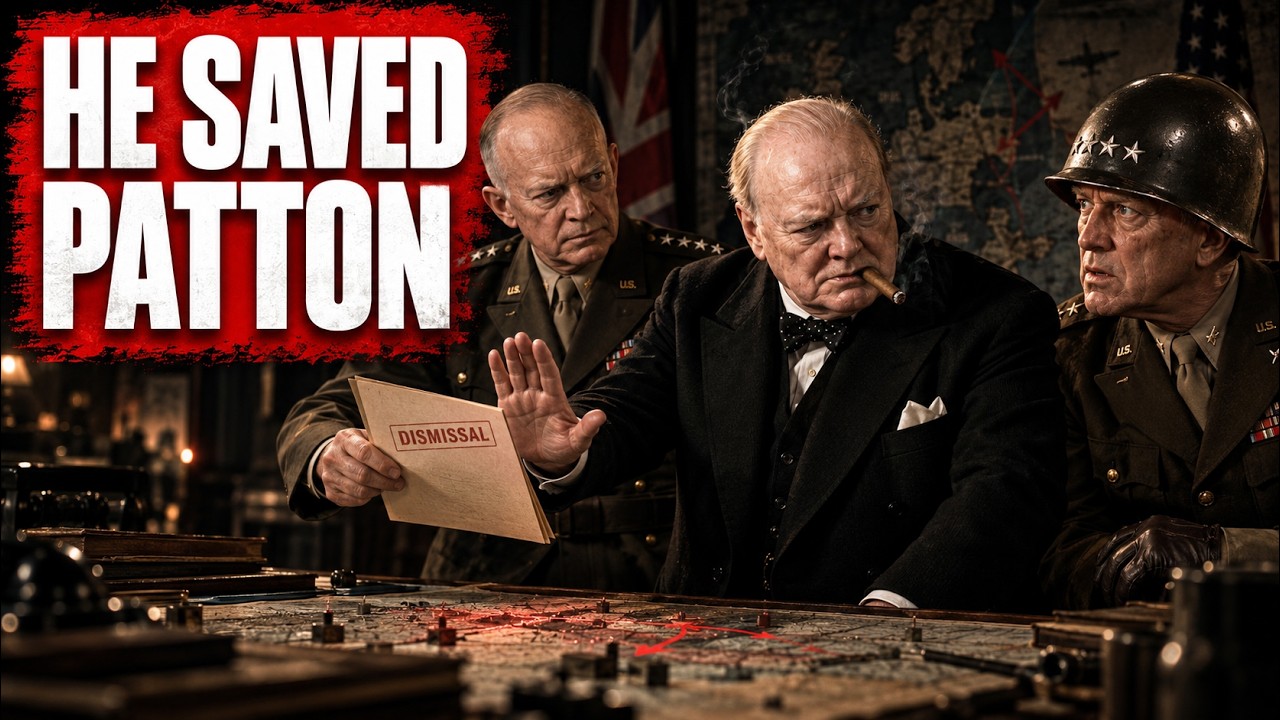
Patton recorded the outcome in his own handwriting. Eisenhower had raised the incident with the prime minister, and Churchill had told him that he could see nothing in it, because Patton had simply told the truth.
Consider the geometry of that for a moment. An American general had just insulted the Soviet Union, embarrassed the United States, and been paraded through the British press as a fool. The American papers wanted him gone.
American congressmen wanted him gone. And the man who waved it off — the man who told the Supreme Commander that there was no fire here worth putting out — was the head of the British government.
The first person in a position of real power to defend George Patton in front of Dwight Eisenhower was an Englishman.
Eisenhower kept him, but he kept him the way you keep a loaded weapon in a locked drawer. Patton would not command an army group. He would not lead the invasion.
He would not be told the date. He would be given something else entirely — command of an army that did not exist.
The First United States Army Group was one of the great inventions of the Second World War. On paper, it was enormous: a full army group of American and Canadian divisions masked in the southeast of England, poised to cross the narrowest part of the Channel and land at the Pas-de-Calais. It had a headquarters.
It had divisional patches. It had a signals network that filled the air over Kent with the radio traffic of tens of thousands of men.
On the ground, it was almost nothing. If you had walked into one of those Kentish fields on a wet morning in May, you would have seen a squadron of Sherman tanks parked under a hedge in a perfectly ordinary way — and you would have believed it completely until you got close enough to touch one and felt rubber give under your hand.
And at the top of it, walking through those fields in his polished helmet for the German reconnaissance aircraft that were carefully allowed through to photograph them, was the one American general the Germans took seriously. That was the point of him.
German intelligence had made an assessment of the Allied command that was almost entirely wrong except in one detail. They rated Patton the most dangerous field commander the Americans possessed. They had watched him in Tunisia and Sicily.
They knew the speed. They believed that when the real invasion came, the Allies would put their best man at the head of it. So when they saw Patton in Kent, they concluded that the blow would fall at Calais.
On the 6th of June 1944, the Allies landed in Normandy, 150 miles from where the German high command was looking. And for weeks after the landings, while the Allied divisions clawed at the hedgerows and the outcome was genuinely in doubt, the German 15th Army sat north of the Seine and did not move. It waited for Patton.
It waited for the real invasion. Divisions that could have destroyed the beachhead in June stayed in place through July, guarding a coastline against an army made of rubber and radio signals.

Here is the twist that nobody planned and nobody could have planned. The humiliation had done it. If Patton had been forgiven quickly, he would have been given a real command, and the Germans would have been able to see exactly where he was.
It was precisely because he had been disgraced, sidelined, and left standing in a field in Kent with nothing to do that he became the most effective lie in military history. Punishment had turned him into a weapon.
He was finally let off the leash on the 1st of August 1944, when his Third Army became operational in Normandy. What happened over the next four weeks is difficult to describe without sounding like exaggeration. Patton’s columns broke out through and simply kept going.
They covered ground at a rate that broke the army’s own planning assumptions. Supply officers could not find the front. On several occasions, Third Army headquarters did not know where its own lead elements were because they had driven off the edge of the available maps.
By the end of August, his tanks were over the Marne and driving toward the Moselle, and the German army in France was not retreating in any organized sense. It was coming apart. Patton believed and wrote that he could be through the West Wall and across the Rhine in a matter of weeks.
It never got the chance to be tested. Because at the end of August, the Third Army stopped — not because of the Germans. The Germans in front of him at that moment were fragments.
He stopped because his tanks had nothing to drink. The priority went north to Field Marshal Montgomery’s 21st Army Group. Patton’s fuel allocation was cut.
Then came the 16th of December 1944, and everything stopped mattering except one thing. Three German armies came out of the Ardennes forest in fog and snow into the thinnest part of the American line and tore a hole in it 50 miles wide. At Malmedy, prisoners were murdered in a field.
The town of Bastogne, the road junction the whole northern shoulder depended on, was encircled with a single airborne division inside it.
On the 19th of December, Eisenhower called his senior commanders to a cold stone barracks at Verdun. Eisenhower asked the only question that mattered: how fast could somebody hit the southern flank of the breakthrough? The answers came back in the language staff officers use when they want to sound competent.
Some spoke of weeks. Some spoke of the first days of January.
Patton said he could attack with three divisions in 48 hours. The room’s reaction is recorded in several accounts, and it was not admiration. It was closer to embarrassment.
Eisenhower himself pushed back and called the idea fatuous and warned him not to go in piecemeal and get chewed up.
What the room did not know was that Patton had already done the work. Two days earlier, watching the reports come in, he had sat down with his staff and had them draft three separate plans for exactly this. He excused himself from the table at Verdun, went to a telephone, said a single word to his headquarters, and an entire army began to turn.
The Third Army attacked on the 22nd of December, three days after the meeting. On the 26th of December, tanks of the 4th Armored Division punched through to Bastogne. It is by any measure the most remarkable feat of staff work performed by any American commander in the war.
It is also the moment where every one of Patton’s flaws became irrelevant.
And then 17 days later, Bernard Montgomery held a press conference. On the 7th of January 1945 at his headquarters, Montgomery met the press to explain what had occurred. He praised the American soldier.
He called their fighting quality magnificent. And then he described how he had been called in, how he had taken hold of the situation, how he had employed the whole available power of the British group of armies, how he had tidied up the front and headed off the enemy.
The American reaction was volcanic. Omar Bradley, the mildest senior American in Europe, went white. He told Eisenhower he could not serve under Montgomery, that he would resign first.
Patton, hearing it, told Bradley that if he resigned, he would resign with him. Two of the three American army commanders in Europe were, for a few days in January of 1945, seriously discussing walking out on the war.
Which brings us at last to a man standing up in the House of Commons. On the 18th of January 1945, 11 days after Montgomery’s press conference, Winston Churchill rose in Parliament to address the Ardennes fighting. He had every political reason to do the opposite of what he did.
Montgomery was Britain’s soldier, the hero of El Alamein, the most popular military figure in the country.
Churchill got up and dismantled it. He told the House that the Americans had engaged almost all the troops in that battle and had suffered almost all the losses. He told them that the British share had been modest, and he told them plainly not to overstate it.
And then he gave them the sentence that has outlived everyone who was in the chamber that day. He called it undoubtedly the greatest American battle of the war and said he believed it would be regarded as an ever-famous American victory.
The prime minister of Great Britain had stood up in the British Parliament and publicly taken the credit out of the hands of the most celebrated British general alive in order to give it back to the American soldiers who had paid for it.
Two months later, one of those American commanders would take a wooden boat across a river and hand Bernard Montgomery the worst morning of his professional life.
The Rhine is not a river the way American rivers are rivers. It comes down out of the Alps and runs north through the middle of Europe for more than 750 miles. For most of recorded history, it has been the line between one world and another.
At Oppenheim, south of the city of Mainz, it runs about 300 meters wide, fast and cold in March, with the mountain snowmelt in it, and dark enough at night that a man in a boat cannot see the far side.
By March of 1945, the Allied high command had concluded that crossing the Rhine would require the largest set-piece river assault since the ancient world, and the plan for it belonged to Field Marshal Bernard Montgomery. Operation Plunder had been building for weeks in the north near the town of Wesel. Thirty divisions.
Stockpiles of bridging equipment that had to be counted in acres. Three thousand guns registered and waiting. And behind all of it, an entire airborne corps ready to fly Operation Varsity the moment the crossing began.
Two hundred miles to the south, along a quiet bend of the same river, George Patton had spent two weeks doing something that nobody at Supreme Headquarters had bothered to ask about. He had been collecting boats — small wooden assault craft, outboard motors, pontoon sections, and treadway bridging brought forward on trucks at night and hidden in the towns behind the river.
His staff had been studying the eastern bank for days and had found something the planners in the north would have called impossible. There was almost nobody over there. The German units that should have been holding that stretch had been shattered west of the river in the fighting through the Palatinate, and what remained had been pulled north to face the obvious threat at Wesel.
The strongest natural barrier in Europe was being guarded at Oppenheim by fragments.
On the afternoon of the 22nd of March, Patton drove down to the bank himself. He was 59 years old. He stood in the open with the ivory-handled revolvers on his belt and looked across 300 meters of moving gray water at a country he had been trying to get into since 1942.
That night, the 5th Infantry Division went across. At 10:00 at night, the first men carried their boats down to the water. There was no artillery preparation.
That was the whole idea. Not a single gun fired, because a barrage is an announcement. And Patton had decided that the only advantage he had was that nobody on the far bank was expecting anything at all.
There was a full moon that night. The river was lit. The men going across could see each other, could see the boats ahead of them, could see the line of the eastern bank coming up.
And every one of them understood that if a single German machine gun crew on that bank was awake and paying attention, they would all be visible for the entire crossing.
They paddled. The men in the first wave later described the crossing in the same way over and over in interviews given decades apart. They said the worst part was the silence.
They said they kept waiting for it to start. It never started.

The first boats touched the eastern bank and the men went up the mud and into the trees and found almost nothing. A few startled sentries. A handful of prisoners taken in their blankets.
No flares. No searchlights. No fire.
By midnight, six battalions of American infantry were standing on the eastern shore of the Rhine. By dawn on the 23rd of March, the entire 5th Division was across, and elements of two more divisions were following it. By the end of that day, the Third Army had a bridgehead on German soil that nothing in the neighborhood could push back.
The cost of crossing the barrier that had stopped invasions for 2,000 years was about 28 men killed and wounded.
On the morning of the 23rd, Patton picked up the telephone in his command post and called Omar Bradley. Bradley wrote down the conversation in his memoirs, and it is one of the small, perfect scenes of the war.
Patton said: “Do not tell anyone, but I am across.” There was a pause on the other end of the line while a very careful man tried to work out whether he had heard what he thought he had heard. “Across what, George?”
“The Rhine. I have got a division over and elements of another. There are so few Germans around here they do not know it yet.”
Patton kept it under his hat for about six hours. By that afternoon, he was on the telephone again, and the tone had changed completely. Officers who were in the room remembered the voice coming through the receiver loud enough to hear across the tent.
“Brad, for God’s sake, tell the world we are across. I want the world to know Third Army made it before Monty starts.”
There it is. Every bit of it in one sentence. Not before the Germans collapse.
Not before the war ends. Before Monty starts.
The announcement went out. American newspapers ran it in the largest type they had. And on the night of the 23rd of March, while those headlines were being set, 3,000 guns opened up in the north, and Operation Plunder began.
And the greatest river assault ever mounted went into the history books as the second crossing of the Rhine.
On the 24th of March, Patton went to the river to collect what he considered owed to him. He walked out onto the treadway bridge his engineers had built, stopped in the middle of it above the moving water, in full view of his own soldiers and of the news cameras that had been thoughtfully invited, unbuttoned his trousers, and urinated into the Rhine. He looked at the men around him and said that he had been looking forward to that for a long time.
Then he crossed to the eastern bank and there he did the other thing, the thing that tells you more about him than the first. Stepping off onto German soil, he went down and came up with a handful of earth in his fist and held it out for the photographers in deliberate imitation of William the Conqueror, who was said to have fallen on the beach in England in 1066 and risen with both hands full of the country he had come to take.
That was Patton entire — the vulgar joke and the thousand-year-old reference, 90 seconds apart. Both of them performed for an audience. Both of them completely sincere.
While Patton was performing on that bridge, 200 miles to the north, the prime minister of Great Britain was already standing at the same river. Winston Churchill had insisted on being there over the objections of nearly everyone whose job it was to keep him alive. He was 70 years old.
He watched the airborne divisions of Operation Varsity go over on the 24th, hundreds of aircraft and gliders in broad daylight, and he stood on the western bank of the Rhine and looked across at Germany.
Then he turned to Dwight Eisenhower and said the thing he had come all that way to say: “My dear general, the German is whipped. We have got him. He is all through.”
That is the sentence. That is what Churchill actually said at the Rhine in March of 1945. And it is worth noticing who he said it to.
Not to Montgomery, whose operation he was standing in the middle of. Not to Patton, whose name was on every front page in America that week. He said it to the American who had spent two and a half years standing between those two men, absorbing the press conferences and the slapping scandals and the Knutsford 𝒶𝒻𝒻𝒶𝒾𝓇 and the resignation threats, keeping an alliance together that both of his most talented subordinates seemed determined to pull apart.
The alliance held. It had come closer to breaking in January than the public would learn for 30 years, and it held.
Six weeks later, on the 7th of May, 1945, Germany surrendered. George Patton had won his race, and there was nothing left to race toward. The peace did not suit him.
He was given occupation duties in Bavaria, a job made entirely of the one thing he had never in his life been able to do safely.
Within months, he had given an interview that caused another 𝒔𝒄𝒂𝓃𝒹𝒶𝓁 and cost him the command of the Third Army, the army he had built and driven from Normandy to Czechoslovakia. He was moved to a paper command and a desk.
On the 9th of December 1945, he was riding in the back of a staff car outside Mannheim on his way to shoot pheasant on a Sunday morning when the car collided with a truck at low speed. Nobody else in the vehicle was badly hurt. Patton was thrown forward and struck his head, and his neck was broken.
He lived 12 more days, paralyzed from the neck down, in a hospital in Heidelberg with his wife Beatrice beside him. He died on the 21st of December 1945. He was 60 years old.
He is buried in Luxembourg, in the American military cemetery at Hamm, in a grave at the head of 5,000 soldiers of the Third Army — most of them killed in the winter fighting he led them into in 1944.
So go back to the question this all started with. Who wanted George Patton fired? The answer is nearly everyone.
American newspapers wanted it in 1943. Members of the United States Congress wanted it. Thousands of American parents wanted it in writing.
British editorial writers wanted it in the spring of 1944, and twice his own Supreme Commander sat down with a blank sheet of paper and seriously considered giving it to them.
What the record does not show anywhere is Bernard Montgomery ever writing to London to demand it. That story has been repeated so many times it has become furniture. But it is not in Montgomery’s diaries.
It is not in Alan Brooke’s diaries, and it is not in the files of Supreme Headquarters. Montgomery did not need to ask for Patton’s removal. Half of America had already asked twice and been refused.
The man who spoke up for Patton when it mattered — the man who told Eisenhower that there was nothing in the Knutsford business worth a career, the man who stood up in Parliament in January of 1945 and handed the Ardennes back to the American soldiers who had bled for it — was not an American general or an American politician. He was the prime minister of the United Kingdom.
Which leaves one last thing worth sitting with. Every version of this story that gets told puts Churchill and Patton on opposite sides — the careful old Englishman against the reckless American cowboy. The documents say something different.
They say that at three separate moments when George Patton’s career was inches from ending, the voice that carried was Winston Churchill’s, and that Churchill defended him the way one gambler defends another.
They had more in common than either of them ever admitted out loud. Both had been cavalry officers when cavalry still meant horses. Both had been written off.
Both had been told by serious men holding serious files that they were finished. And both of them were standing on the Rhine in March of 1945.