For more than a century, Johnny Ringo’s death has remained one of the most fiercely debated mysteries of the American Old West. Popular legend insists he was killed in a secret duel with Doc Holliday, while other accounts point to Wyatt Earp or an unknown avenger. The official ruling, recorded in 1882, was suicide. Yet the case never closed in the public imagination because the inquest was rushed, the scene was confusing, and the stories that followed were built more on drama than on evidence.
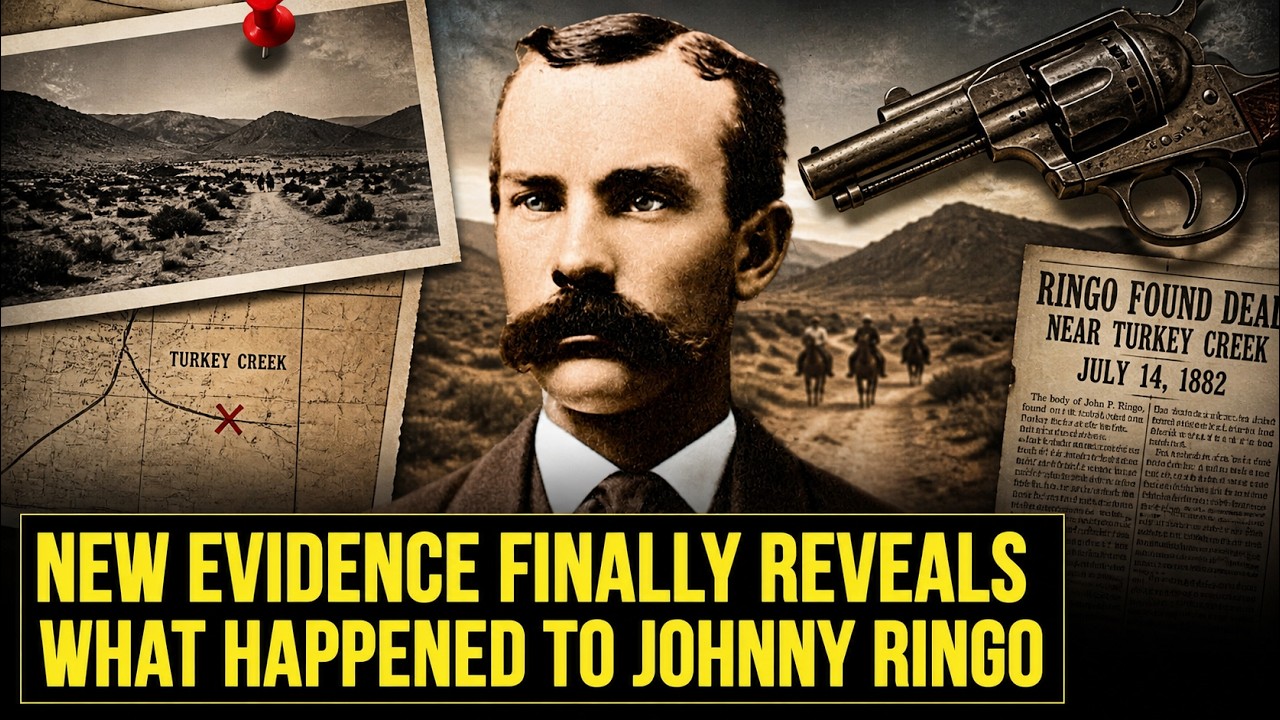
A closer look at the actual timeline, the witnesses, and the geography of southeastern Arizona paints a very different picture than the movies suggest. What emerges is not the story of a cinematic showdown, but the lonely end of a troubled man whose reputation grew faster than the facts that supported it. Johnny Ringo, born John Peters Ringo in Indiana in 1850, spent much of his youth moving across the frontier. His father died during the family’s journey west, a loss that later writers used to explain his darker reputation.
But the real record shows a rougher, more complicated life. Ringo was not the polished, college-educated killer of legend. There is no solid proof he had a higher education. What witnesses remembered was that he could read, had a serious manner, and sometimes quoted literature.
Over time, that modest detail grew into a larger myth, because the idea of an intelligent outlaw seemed more interesting than the truth of a man drifting between violent places. Ringo’s first major trouble came in Texas during the Mason County War, a local feud over cattle, vengeance, and loyalty. He was jailed for a murder case and later released. In a strange turn that reveals how blurry the line between lawman and outlaw could be on the frontier, he eventually became a constable in Texas.
A violent past did not bar a man from wearing a badge if the community considered him useful or loyal. By the time Ringo reached Arizona, he carried a name that made people pay attention. Tombstone in the early 1880s gave his reputation a larger stage. The Cochise County Cowboys were not a single organized gang but a loose network of ranch hands, cattle thieves, smugglers, and gamblers.
Ringo’s connection to that circle made him look like a central villain in later retellings, even when the direct evidence against him was thin. Ringo was not present at the gunfight near the OK Corral on October 26, 1881, but the aftermath pulled him deeper into the conflict. In January 1882, he and Doc Holliday nearly turned a street argument into a deadly confrontation before officers stepped in. That moment fed the later legend that the two men were destined for a final showdown, but history does not follow a film script.
The fact that two men hated each other does not mean they met again in secret. By the spring of 1882, the pressure on Ringo was real. Virgil Earp had been wounded, Morgan Earp had been killed, and Wyatt Earp’s Vendetta ride had spread violence beyond Tombstone. Ringo was tied to one of the most dangerous networks in the territory, a position that made him both feared and exposed.
The last days of Ringo’s life do not look like the clean ending people expect. In July 1882, he was seen drinking heavily around Tombstone. After the Fourth of July, he left town and moved through the mountains east of Tombstone. Deputy Billy Breakenridge later said he saw Ringo near South Pass in the Dragoon Mountains.
Ringo was in poor condition, and Breakenridge tried to persuade him to go back to a safer place, but Ringo refused. That sighting gives the story a grounded timeline and shows Ringo alive, unsteady, and moving away from town. The older version of the story often described Ringo trapped in a burning desert, far from water, abandoned by his horse. Newer research has weakened that account.
Turkey Creek was not an empty stretch of desert. It was close to a traveled road, close to water, and not far from a ranch. It was also the monsoon season, and the elevation made the area different from the low desert people imagine when they picture Arizona heat. This makes his death stranger, not simpler.
If he was near water and near people, the old explanation that he had no chance of survival does not hold up. But that does not automatically prove murder. A man who is exhausted, intoxicated, and separated from his horse can make decisions that look strange later. The details about his horse and clothing became a major reason people questioned the official story.
The horse was not right next to him when he was found, and the way his clothing was described felt off to later readers. But strange details are not the same as proof. Frontier scenes were not protected like modern crime scenes. People walked around, handled objects, made quick judgments, and wrote reports in plain language.
The men who investigated Ringo’s death were local men doing a practical job under rough conditions, not trained forensic investigators. The official ruling was suicide, or self-inflicted death. That wording was a frontier verdict based on the scene, Ringo’s recent behavior, and what local men believed most likely. Several things supported it.
Ringo had been drinking heavily and had been described as moody and fearful. People in the area reported hearing a single shot around the time he likely died. When his body was found the next day, there was no named suspect, no witness to an attack, and no immediate trail leading to a killer. For a coroner’s jury in 1882 Arizona Territory, that was enough.
But it is important to understand what that kind of jury was. This was not a modern medical investigation. There was no secure scene, no modern testing, no professional reconstruction, no clean chain of evidence, no detailed photography. The report was brief because the system was brief.
Local men were expected to make a practical decision and send it to the coroner. That does not make the verdict worthless, but it should not be treated like a modern case file. The strongest responsible reading is this: the official conclusion had real support, but the investigation left gaps. Those gaps gave later writers room to build bigger stories.
Some people look at the gaps and say they prove murder. That goes too far. In history, missing information is not the same as hidden information. Sometimes a record is thin because people were careless, because the system was weak, or because nobody expected the case to become famous more than a century later.
The most famous version of Ringo’s death is also one of the weakest historically. In popular culture, Doc Holliday and Johnny Ringo are treated as natural opposites, two dangerous men tied to Tombstone and destined to meet. The fictional duel between them gives the story a clean shape, but the real record does not support it. Around the time Ringo died, Doc Holliday was tied to Colorado by legal records and newspapers.
He also had legal danger hanging over him from the Earp Vendetta ride. A secret trip back into Arizona would have been risky and difficult, and there is no reliable contemporary report placing him at Turkey Creek. There is no solid eyewitness, no trustworthy confession, no court record. The Doc Holliday theory survives because it feels right as drama, not because it holds up as history.
The Wyatt Earp claim is more complicated because the motive looks stronger at first. Wyatt believed men connected to the Cowboys were responsible for the attacks on his brothers, and his Vendetta ride showed he was willing to use violence outside the courtroom. But the Wyatt claim has serious problems. Some of the best-known versions came through sources that were later heavily disputed.
The book *I Married Wyatt Earp* helped spread the idea that Wyatt and Doc returned to Arizona to confront Ringo, but the reliability of that book was seriously challenged. Glenn Boyer, the man behind it, could not satisfy critics about important source documents, and major researchers came to see parts of his work as a blend of fact, interpretation, and invention. Wyatt’s own later statements about frontier events were not always consistent, and by the time many of these stories were told, the Tombstone events had already become legend. The strongest argument for Wyatt is motive.
The strongest argument against him is the lack of reliable proof placing him at the scene. Motive can explain why a person might do something, but it cannot prove they did it. That is especially true in Tombstone history, where almost everyone had enemies and many men had reasons to lie, brag, or protect their side. Once the Doc Holliday and Wyatt Earp stories weaken, the mystery shifts toward a less famous question: could someone else have killed Johnny Ringo?
The answer is possible but not proven. Ringo had enemies from more than one chapter of his life. In Texas, he had been part of a violent feud. In Arizona, he moved among cowboys, gamblers, ranchers, and lawmen caught in unstable alliances.
Names such as Buckskin Frank Leslie and Michael O’Rourke have been suggested over the years, but these theories usually depend on late claims, weak timelines, or stories that appeared after the fact. No reliable witness identified a killer. No solid confession has held up. No court case followed.
That does not make murder impossible. It makes murder unproven. The evidence now points away from the clean stories people like most. Johnny Ringo almost certainly did not die in a formal duel with Doc Holliday.
The Wyatt Earp theory has motive, but it leans on disputed sources more than firm proof. The idea that Ringo was helpless in an empty desert is also too simple, because Turkey Creek was closer to a road, water, and people than many retellings admit. What remains is less dramatic but more believable. In July 1882, Ringo was moving through southeastern Arizona after a period of heavy drinking and personal decline.
He was last seen alive in poor condition. He ended up near Turkey Creek. Something happened there in the afternoon of July 13. People nearby heard a single shot.
The next day, Ringo was found dead, and the local coroner’s jury ruled it a self-inflicted death. Around that core record are the questions that kept the case alive. The horse, the boots, the rushed inquest, and Ringo’s many enemies all made the official answer feel incomplete. But incomplete does not mean false.
It means the case was handled the way many frontier cases were handled, quickly, locally, and without the tools modern people expect. The phrase “new evidence” can be misleading. There is no magic document that suddenly solves every detail. The real development is a closer reading of the old evidence, especially the geography, the timeline, the newspaper reporting, and the weakness of later legends.
That closer reading reveals what most likely happened, and what almost certainly did not happen. Ringo’s death was not the grand final gunfight that popular culture wanted. It was probably the lonely end of a man whose life had been shaped by feuds, alcohol, fear, and violence. The most responsible answer is that Johnny Ringo most likely died by his own hand, while the poor investigation and strange scene allowed murder theories to grow around him.
What the evidence finally reveals is not a secret duel or a hidden confession. It reveals that the most famous versions are weaker than the official record, and that the official record is strong enough to stand, but not perfect enough to silence every question.