WASHINGTON — On the same morning that German panzers rolled across the Polish border, President Franklin Roosevelt crossed out the names of 33 general officers who outranked the man he chose to lead the United States Army, setting in motion one of the most ruthless personnel purges in American military history.
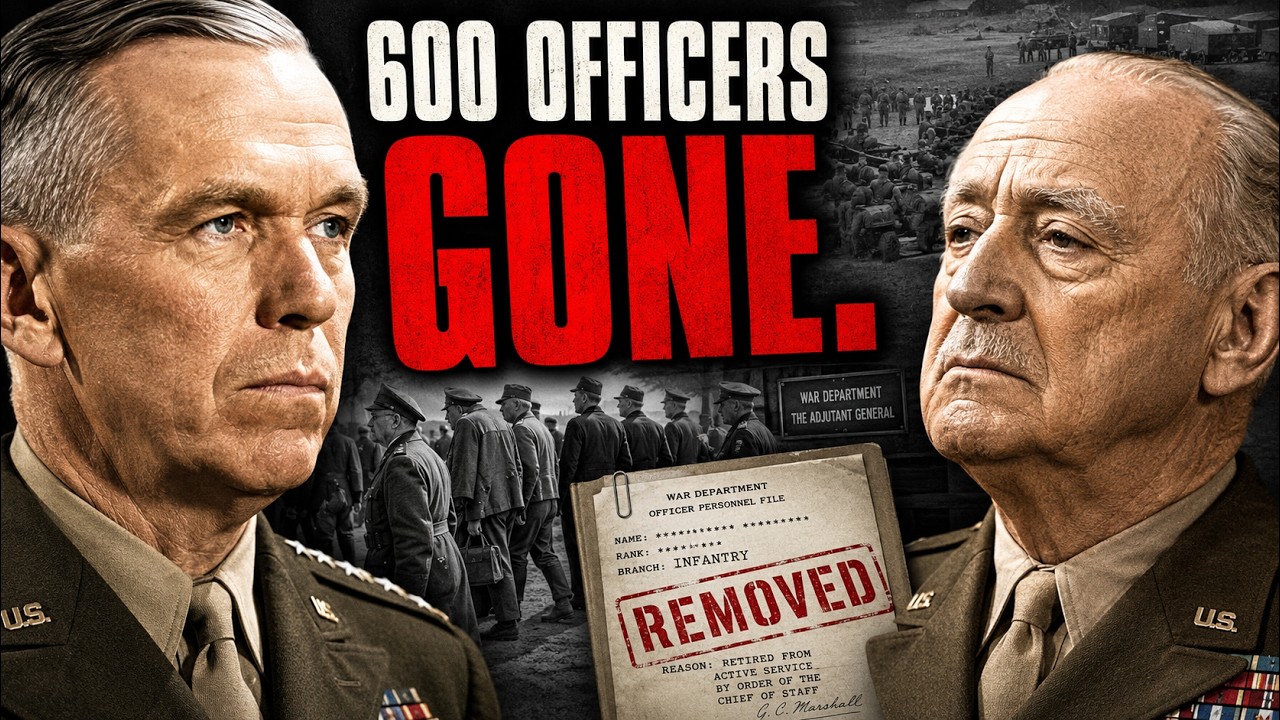
The man he selected was 58-year-old Brigadier General George Catlett Marshall, an officer so obscure that most of official Washington had never heard his name. He had never commanded troops in combat. He had spent his career behind desks, drafting doctrine and moving supplies.
And within hours of taking command on September 1, 1939, he inherited an army that ranked below Portugal in size.
What Marshall did next would turn hundreds of powerful men into his enemies and, by his own later accounting, force at least 600 officers out of the Army before the United States formally entered World War II.
The numbers he confronted were staggering in their inadequacy. The United States Army numbered roughly 190,000 men. Warehouses were stacked with World War I rifles.
Training exercises relied on trucks with the word “tank” painted on the side because there were not enough real tanks to go around. Soldiers drilled with wooden replicas standing in for rifles.
One officer summarized the force in a single unsparing phrase: “All bone and no muscle.”
Marshall believed war was coming. He believed the nation would need an army perhaps ten times larger than the one on the books. And he concluded, with a clarity that must have been physically uncomfortable, that the men who were supposed to build and lead it were largely incapable of the task.
The problem was structural. For decades, advancement in the Army had run almost entirely on seniority. Time and service, not talent, decided who moved up.
Officers could spend 15 years as captains and 20 years as majors, waiting for the men ahead of them to retire or die.
Marshall knew this reality intimately. During World War I, he held the temporary wartime rank of colonel, directing complex troop movements with real authority. When the war ended, he was demoted back to captain.
It took him 15 more years to become a colonel again through ordinary channels.
By 1939, more than a thousand officers with the age, experience, and ability to serve as lieutenant colonels were still wearing the rank of captain. The senior colonels who commanded regiments were in many cases men in their 60s who had learned their craft studying cavalry charges and static trench lines.
They did not understand blitzkrieg. They did not understand what it meant to coordinate tanks, dive bombers, and motorized infantry into a single fast-moving weapon capable of shattering a defensive line in hours instead of months.
Germany had just demonstrated exactly that kind of warfare in Poland, and the demonstration was terrifying in its speed. A nation with a substantial standing army collapsed in weeks. Cavalry was cut apart attempting to resist tanks with horses and sabers.
In October 1939, barely a month into the job, Marshall spoke to his staff with a bluntness that must have unsettled the room.
“The present general officers of the line are for the most part too old to command troops in battle under the terrific pressure of modern war,” he told them. “Most of them have their minds set in outmoded patterns and cannot change to meet the new conditions.”
These were not strangers. Many were men he had served alongside for 30 years. Men whose careers he had watched unfold since he was a young lieutenant.
Marshall was effectively telling Congress that a large share of his own officer corps would fail catastrophically the moment real fighting began.
He said it anyway.
The political cover he needed arrived in May 1940, when Germany launched its invasion of France. Panzer divisions crashed through the Ardennes forest, terrain French planners had considered impassible to large mechanized formations. France, which had held off Germany for four brutal years during World War I, collapsed in six weeks.
For members of Congress who had spent months politely nodding at Marshall’s warnings while doing little to fund them, the fall of France changed everything. If a modern, well-equipped European power could be broken that quickly, what would happen to an American army that trained with wooden rifles?
Congress moved with a speed unthinkable six months earlier. Buried inside the Second Supplemental National Defense Appropriation Act of 1940 was a provision that read like dry legislative housekeeping but carried the weight of an earthquake inside the officer corps. Seniority would no longer be the sole basis for promotion.
Marshall did not wait for the ink to dry. He established a board of six retired officers charged with reviewing the efficiency files of the Army’s aging colonels and generals. He placed General Malin Craig, his own predecessor as chief of staff, at its head.
Almost immediately, officers inside the War Department began referring to it as the “plucking board.” The name stuck because it was accurate.
Marshall’s instructions left no room for sentiment. “Critical times are upon us,” he told the board. “Only today’s performance matters.”
A distinguished record from World War I counted for nothing. Medals earned two decades earlier for genuine bravery under fire counted for nothing. If an officer could not answer one specific question — could this man lead soldiers in combat under the terrific pressure of modern mechanized warfare?
— his career in active command was effectively over.

In the first six months alone, 195 officers were removed from positions of active command. By the time the process wound down, several hundred colonels had been removed and well over a thousand officers across all ranks had been pushed out of positions where they might otherwise have been responsible for the lives of American soldiers.
Behind each number stood an individual man receiving individual news. A colonel who had spent three decades in uniform might receive a short formal letter informing him that his active command was being reassigned, effective within weeks. There was no public hearing, no opportunity to argue his case.
Some accepted the news with discipline, quietly packing up offices they had occupied for years. Others fought back through every channel available. Letters went to congressmen who owed old political debts.
Op-eds appeared in hometown newspapers describing loyal, decorated officers cast aside.
Veterans organizations wrote letters of protest. Newspaper columns accused Marshall of gutting the Army’s institutional memory. One widely circulated criticism claimed Marshall had gotten rid of “all the brains of the Army,” a line meant to wound.
Marshall read the criticism. Colleagues later said he never once responded publicly. He simply continued the work.
Not every officer near the danger zone of the age scale was removed. Colonel George Patton was 54 years old in 1940, squarely inside the range the board scrutinized most closely. On paper, he was exactly the kind of officer the reforms were designed to weed out.
But Patton was not tired. He had spent his own money and considerable personal effort studying the mechanics of tank warfare years before most of his peers took the subject seriously. His tactical instincts were sharp.
His aggression, which had occasionally gotten him into trouble, was precisely the quality modern armored warfare seemed to reward.
Patton stayed. The distinction mattered enormously. This was never simply an assault on older officers as a category.
It was an attempt to separate the men who could still adapt from the men who could not, regardless of the number on their birth certificate.
By June 1941, the Army looked almost unrecognizable. The nation’s first peacetime draft had pulled hundreds of thousands of young men into uniform. National Guard units from every state had been federalized.
Nearly a million men were under arms where fewer than 200,000 had stood less than two years before.
But Marshall understood that an army is not simply a count of bodies. It is a question of whether the men leading those bodies know what they are doing when the shooting starts. He had soldiers now.
He needed proof that his officers could lead them.
Lieutenant General Leslie McNair, Marshall’s director of training, proposed the solution: war games on a scale the Army had never attempted. Three major exercises were scheduled across the second half of 1941 — Tennessee in June, Louisiana in September, Carolina in November.
The Louisiana maneuvers dwarfed everything before them. Nearly half a million soldiers took part, more men under arms for a single training exercise than had existed in the entire Army barely two years earlier. Fifty thousand vehicles moved across unfamiliar terrain.
Thirty-two thousand horses were also present, a reminder that older cavalry traditions had not entirely disappeared.
Marshall’s instructions to McNair were blunt: “I want the mistakes made down in Louisiana, not over in Europe. And the only way to do this thing is to try it out, and if it doesn’t work, find out what we need to make it work.”
Unlike earlier, scripted exercises where the outcome was predetermined, the Louisiana maneuvers were designed to be genuinely open-ended. Neutral umpires graded performance based on what actually happened on the ground.
Lieutenant General Ben Lear commanded the Red Army. Lieutenant General Walter Krueger commanded the Blue Army. Krueger, in his early 60s, was among the first senior commanders to genuinely grasp the tactical possibilities of large-scale armored warfare rather than treating tanks as a novelty attached to traditional infantry formations.
Colonel George Patton commanded the 2nd Armored Division assigned to Krueger’s Blue Army. What he did in the exercise’s second phase became something close to legend within the Army almost immediately.
Blue Army orders called for an assault on Shreveport, defended by Lear’s Red forces in strong prepared positions. A conventional frontal assault would have been slow, costly, and exactly the kind of outdated thinking Marshall was trying to root out.
Patton chose something else entirely. He directed his armored division on a sweeping flanking maneuver that carried his tanks nearly 300 miles through East Texas, racing well outside the anticipated boundaries of the battlefield. When his tanks ran low on fuel, Patton bought gasoline directly from every country service station his columns passed, paying cash to keep his tanks rolling.
His reconnaissance elements seized part of Barksdale airfield, knocking out the Red Army’s ability to use air support in that sector. Then Patton’s tanks came roaring into Shreveport from the north, from a direction Lear’s forces had not adequately prepared to defend, while infantry and cavalry pressed the attack from the south.
Caught between two converging forces from unexpected directions, the Red Army found itself effectively surrounded. On September 28, with the climactic battle about to unfold, exercise headquarters halted the maneuver. The outcome was already beyond dispute.

Marshall and McNair observed everything with careful attention, taking detailed notes on which officers demonstrated genuine tactical creativity under pressure, which ones froze when circumstances shifted, and which ones proved capable of coordinating complex operations across vast distances.
Colonel Dwight Eisenhower served as chief of staff for Krueger’s Third Army throughout the exercise. His performance drew attention almost immediately, not only from Marshall’s observers but from journalists covering the maneuvers.
CBS correspondent Eric Sevareid told listeners that Eisenhower “made more sense than any of the rest of them.” Drew Pearson, among the most widely read political journalists in the country, wrote that Eisenhower had personally conceived and directed the strategy that routed Lear’s Red Army, crediting him with what Pearson called a “steel trap mind.”
It was a remarkable amount of national press attention for a man who under the old seniority rules might have remained a lieutenant colonel for another decade simply waiting his turn. Marshall noted the name.
Lieutenant Colonel Omar Bradley performed capably during the same exercises. Lieutenant Colonel Mark Clark, who had helped plan significant portions of the exercise, reportedly relied at one point on nothing more sophisticated than a civilian gas station road map to work through logistics. Colonel Joseph Stilwell had already impressed observers during earlier exercises with a fast-moving armored column that behaved nothing like the slow, methodical formations most senior officers still favored.
None of these men were the senior generals who had dominated the top of the Army’s command structure just two years earlier. They were younger officers, several still holding the rank of colonel or lieutenant colonel, men who seemed to understand modern warfare almost instinctively.
Two years earlier, under the old seniority rules, most of these names would have remained buried in personnel files for another decade. The Louisiana maneuvers delivered exactly the validation Marshall had been gambling on.
On December 7, 1941, just over two months after the maneuvers concluded, Japanese aircraft struck Pearl Harbor. The United States was suddenly and unambiguously at war on a global scale. The Army Marshall had spent more than two years rebuilding would now face the exact test it had been preparing for all along.
Within two weeks of the attack, Marshall’s system was operating with the ruthless speed he had spent two years building into it. Admiral Husband Kimmel and Lieutenant General Walter Short, the two commanders responsible for the defense of the naval base, were relieved of their posts. Major General Frederick Martin, who had overseen air defenses in the region, was removed alongside them.
There was no lengthy institutional debate about seniority or decades of prior service. Failure at this scale ended careers immediately, exactly as Marshall’s efficiency boards had already been treating failure for two years.
The pattern repeated itself across every theater. When Lieutenant General George Kenney took command of Army Air Forces operations in the Pacific in mid-1942, one of his first acts was removing five generals he judged inadequate, along with roughly 40 colonels and lieutenant colonels.
By Marshall’s own later estimate, at least 600 officers had been forced out of the Army before the United States formally entered the war. The process continued throughout the conflict. Whenever a commander failed under the pressure of actual combat, Marshall’s system moved to replace him.
The temporary wartime promotion system Marshall helped establish worked as a mirror image of the removal process, offering nearly unlimited advancement to officers who produced results under pressure.
Eisenhower’s advancement was perhaps the most dramatic illustration. Barely weeks after his performance in Louisiana drew national press attention, he was promoted to Brigadier General in October 1941. Within months of Pearl Harbor, Marshall brought him to Washington to help direct Army war plans at the highest level.
By late 1942, Eisenhower commanded all United States forces in the European theater, overseeing Operation Torch, the invasion of North Africa. The following year brought Operation Husky, the invasion of Sicily. By June 1944, Eisenhower commanded Operation Overlord, the Normandy Invasion, the largest amphibious military operation ever attempted in human history.
In less than five years, Eisenhower rose from Lieutenant Colonel to five-star general, commanding millions of Allied soldiers across an entire theater of war. Under the seniority system Marshall dismantled, such a rise would have been simply impossible.
Omar Bradley rose to command American ground forces in Normandy, directing the breakout from the beachhead that eventually shattered German defenses across northern France. Patton commanded the Third Army, driving across France with a speed and aggression that made him, by most accounts, the American general German commanders feared most on the Western Front.
Stilwell commanded Allied forces across the brutal China-Burma-India theater. Mark Clark, who had once planned exercise logistics with little more than a civilian road map, commanded the Fifth Army through the grinding Italian campaign.
Each of these men owed his position in some direct and traceable way to a chief of staff willing to dismantle a comfortable, familiar system and replace it with one built entirely around merit.
The numbers told the story more plainly than any single officer’s career could. When Marshall took command on September 1, 1939, the Army numbered roughly 190,000 soldiers. By 1945, that same army had grown to approximately 8,300,000 men, an expansion of more than 40 times its original size in under six years.
That force fought and defeated Nazi Germany and Imperial Japan simultaneously across North Africa, Italy, France, Belgium, and Germany in one theater, and across the Philippines and dozens of Pacific islands in another. It succeeded in no small part because the men leading it at every level had been selected for their demonstrated ability to adapt under pressure rather than for how patiently they had waited their turn.
The praise that followed Marshall by the war’s end reflected just how thoroughly his approach had been vindicated. The British chiefs of staff described him as “the architect and builder of the finest and most powerful army in the nation’s history.” Winston Churchill, not a man given to loose praise of American military leadership, called him “the organizer of victory.”

President Harry Truman, reflecting on the war years afterward, said simply that Marshall was “the man who won the war,” a judgment other historians have debated in its particulars but rarely disputed in its essential spirit.
What made Marshall’s approach work was never simply the act of removing officers, nor simply the act of promoting talented ones. Both halves mattered, but the deeper insight sat underneath them. Marshall understood that the tools of warfare could change faster than an institution’s comfortable habits were prepared to follow.
An army that clung to seniority over ability in a moment of rapid technological and tactical change was not merely inefficient. It was choosing to lose.
Germany had already demonstrated this lesson in 1939 and 1940, reinventing the basic grammar of land warfare around speed, shock, and the close coordination of tanks, aircraft, and infantry. Poland fell in weeks. France fell in six.
The methods that had defined the previous war simply did not function against this new approach.
Marshall had watched this dynamic play out once before during World War I, when he had seen firsthand how outdated tactics and inadequate planning cost American soldiers their lives in engagements that better preparation might have avoided entirely. That experience shaped his uncompromising insistence two decades later that the Army could not afford to repeat the same mistake on a vastly larger scale.
After the war ended, Marshall did not retreat into comfortable retirement. President Truman asked him to serve as Secretary of State. In 1947, Marshall proposed what would become known as the European Recovery Program, though history would remember it simply as the Marshall Plan.
The initiative poured American resources into rebuilding the shattered economies of Western Europe, creating the stable, prosperous conditions that allowed fragile post-war democracies to survive rather than collapse into the political extremism that had helped produce the war in the first place.
For this work, Marshall received the Nobel Peace Prize in 1953, the only professional army general in history to be so honored. A striking coda to a career that had begun with the deliberately unglamorous, often thankless work of firing hundreds of his own colleagues.
But Marshall’s most enduring legacy was never really the Marshall Plan. It was the underlying principle that had guided his conduct as chief of staff from his very first weeks in office: the conviction that positions of genuine consequence should be filled by the people demonstrably best equipped to succeed in them, not simply by the people who had been waiting the longest for their turn.
That ability should outweigh seniority. That measurable results should outweigh accumulated time in service. That any institution’s long-term survival ultimately depends on its willingness to remove people who cannot adapt to changing circumstances and to promote, often ahead of schedule and against considerable internal resistance, the people who genuinely can.
The lesson Marshall taught during those tense, uncertain years beginning in 1939 remains strikingly relevant well beyond the specific context of military command. Organizations of every kind face constant pressure to change. Technology evolves.
Methods that worked well under one set of conditions stop working when those conditions shift.
Leaders who thrived under earlier circumstances are not automatically equipped to handle the new ones, no matter how distinguished their prior record might be. The choice, as Marshall understood it, was rarely comfortable and rarely popular in the moment it had to be made: adapt, or eventually be replaced by circumstances that do not wait for permission.
Marshall made the difficult choice in 1939 when making it meant alienating friends, angering powerful allies in Congress, and absorbing sustained public criticism for what many called an unjust and needlessly brutal purge of loyal, experienced officers.
He removed the men who could not lead a modern army into a modern war. He promoted, often well ahead of where the old rules would ever have permitted, the ones who could. When the ultimate test finally arrived at Pearl Harbor, and in the years of brutal fighting that followed, the army he had rebuilt from something smaller than Portugal’s was ready for it.
The officers he had chosen delivered victory across every theater the war eventually reached. From the beaches of Normandy to the banks of the Rhine. From the deserts of North Africa to the ruins of Berlin.
From the jungles of Guadalcanal to the deck of a battleship anchored in Tokyo Bay.
It is worth remembering that none of this unfolded as a single dramatic moment of triumph. There was no ceremony marking the point at which the plucking board’s work could be declared a success. The vindication arrived slowly, campaign by campaign, spread across six years and three continents.
Marshall himself remained largely uninterested in claiming credit. He had never been building a legacy for its own sake. He had been trying, from his very first anxious weeks in office, to prevent a repeat of the kind of unnecessary bloodshed he had witnessed firsthand as a younger officer.
By that narrower, harder measure, the years of controversial removals and unpopular promotions had done exactly what he intended them to do. The men he passed over, the hundreds of colonels and generals whose careers ended in the cold language of an efficiency board’s letter, mostly faded from public memory.
Few of them ever spoke publicly about what happened. History rarely offers a tidy accounting of the ordinary careers quietly sacrificed to make room for the extraordinary ones that followed. Marshall’s reforms were no exception.
What survived instead was the system itself, the underlying principle that outlasted any individual officer’s personal disappointment, still shaping how the United States military selects its leaders generations after the last colonel Marshall’s board removed had passed from the scene entirely.
On September 1, 1939, Franklin Roosevelt made a decision that stunned the Army’s entire senior leadership, reaching past dozens of more senior officers to select a 58-year-old brigadier general who had never commanded troops in actual combat, a man most of official Washington had never heard of.
Roosevelt chose George Marshall. And Marshall spent the six years that followed proving through hundreds of individually painful decisions that genuine ability mattered more than accumulated seniority, that demonstrated results mattered more than institutional credentials, and that an organization’s willingness to change when change becomes unavoidable often determines in the end whether it survives at all.