After years on the road, the funeral procession of Philip of Castile finally reached Tortosa in February 1507. It had set out from Burgos, more than 150 kilometers away, after the first Habsburg king of Castile died on September 25, 1506. Philip had been proclaimed king just months earlier before he succumbed to a sudden illness that sparked rumors of poisoning orchestrated by his father-in-law, Ferdinand of Aragon. On his deathbed, Philip asked his wife, Joanna of Castile, to grant him one final wish.
Over their ten-year marriage, Joanna had given him five children and the unexpected promise of the Spanish throne. Philip insisted that he be buried in Granada, the last Muslim kingdom on the Iberian Peninsula to be conquered during the reign of Joanna’s parents, Isabella and Ferdinand, the famed Catholic Monarchs who initiated the unification of Spain. Granada was also where Isabella herself had been buried two years earlier. If Philip could not live as a king, he would at least die as one.
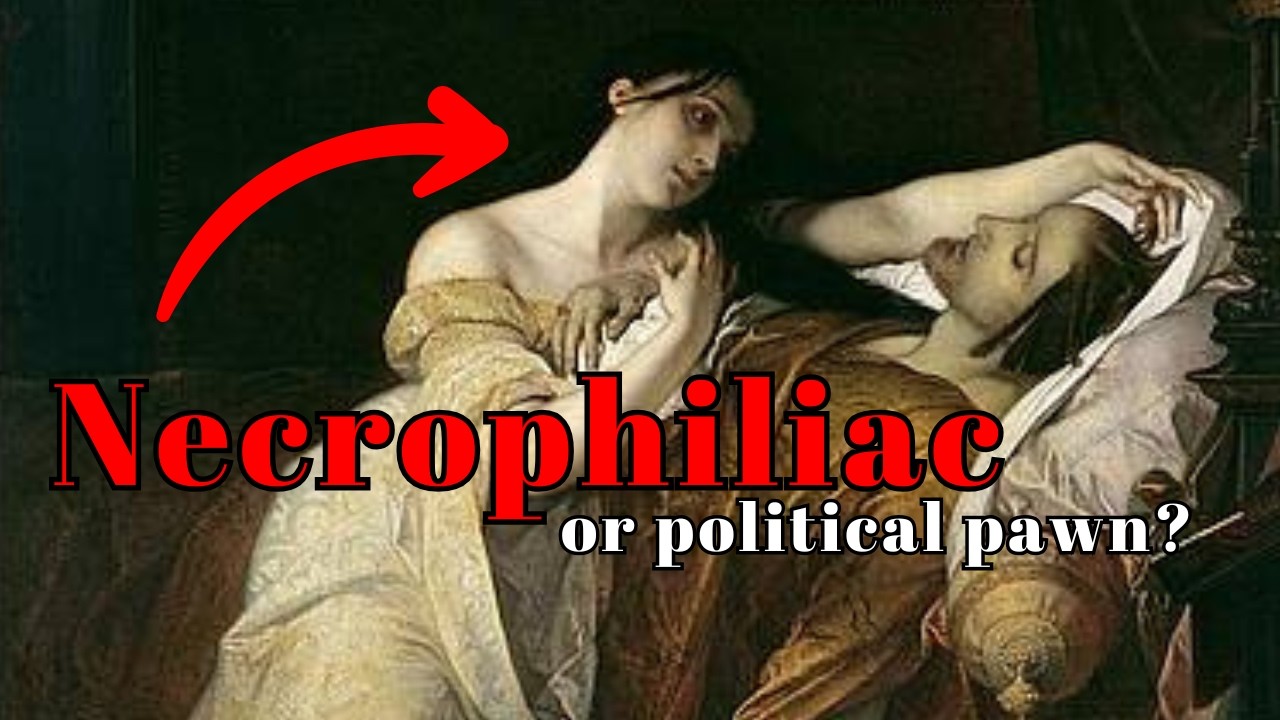
Joanna traveled alongside her husband’s decaying body for years. According to contemporary accounts, she was so grief-stricken by Philip’s sudden death that she would not part with his corpse. She reportedly had Philip’s body brought with her everywhere, from the dining table to her bed. During travel days, she would regularly have Philip’s coffin opened so that she could kiss her one true love.
The funeral procession was ordered to travel only at night because Joanna supposedly refused to let any other woman lay eyes on her dead husband. The image of the Castilian queen driven completely mad by the death of her husband spread like wildfire, and her father, Ferdinand, still the king of Aragon, could not have been more pleased. How could this mad woman ever run a kingdom? Although Ferdinand and Philip had already colluded with one another to keep Joanna away from power, it was only when she arrived at Tortosa in 1507 that her fate was sealed.
Joanna would never leave the city again. Born on November 6, 1479, as the third surviving child of the Catholic Monarchs Isabella and Ferdinand, it could never have been expected that Joanna would one day become queen, let alone the first to rule, at least nominally, a unified Spain. In fact, the understanding of Spain as a unified entity did not even exist when Joanna was born. At the time Isabella and Ferdinand ascended their respective thrones, the Iberian Peninsula comprised the independent kingdoms of Castile, Aragon, Navarre, Portugal, and Granada.
By the end of Ferdinand’s reign in 1516, all of the kingdoms except Portugal were united under one crown. Castile and Aragon had been dynastically unified through Isabella and Ferdinand’s marriage in 1469. Islamic Granada was captured in 1492, and Spanish Navarre was annexed in 1512. Even so, the understanding of Spain as an independent nation-state would not emerge until the early 19th century.
Although the Christian takeover of Muslim Spain seemed complete with the capture of Granada, to Isabella and Ferdinand, military conquest was not enough. In March 1492, they issued the Alhambra Decree, which forced Spanish Jews to renounce their faith and convert to Catholicism or leave the country. The decree was proclaimed against the backdrop of the Spanish Inquisition, a religious court established in 1478 by Isabella and Ferdinand and authorized by the Pope to impose Catholic hegemony across the Spanish kingdoms. Those suspected of heresy, especially Jews and Muslims who had previously converted to Catholicism, were tried by church tribunals before they could then be tortured and executed.
Amid this violent pursuit of religious hegemony, Spain was entering what would be remembered as its golden age. Isabella and Ferdinand made sure their children were well educated. While their only son, John, was set to inherit their kingdoms, their daughters Joanna, Isabella, Maria, and Catherine were trained for marriage. The Spanish princesses were taught French, Latin, and the major languages spoken across the Iberian Peninsula.
Joanna also studied mathematics, history, grammar, philosophy, and law, and by all accounts, she excelled academically. She was also taught court etiquette, dance, horse riding, drawing, music, and needlework. It was the French King Charles VIII’s invasion of Italy to claim the throne of Naples in 1494 that provoked the arrangement of a double marriage agreement between the Catholic Monarchs and the Holy Roman Emperor Maximilian I. The Spanish-Habsburg alliance was designed to bolster both courts’ defenses against France and the feared French domination of Italy.
The Spanish heir John married Maximilian’s daughter Margaret in 1496, and Joanna was betrothed to Philip, the only son of Maximilian and his first wife Mary of Burgundy. Joanna set out from Spain in late 1496, accompanied by the same fleet that would return to Spain months later carrying John’s bride and Philip’s sister Margaret. Joanna met Philip for the first time in Belgium on October 18, and the two were so enamored with one another that the wedding was brought forward. Joanna’s chaplain blessed the union in a private ceremony, and the official wedding took place just two days later on October 20, 1496.
Despite the marriage’s seemingly auspicious beginning and the six children Joanna would eventually give birth to, their relationship would quickly come undone. Just months into their marriage, Philip had dismissed the vast majority of Joanna’s entourage, leaving the Spanish princess in a foreign court in near complete isolation. It is said that Philip was unfaithful, cruel, and controlling, and that Joanna was violently jealous, hacking off the hair of mistresses, going on hunger strikes, refusing to bathe, and flying into unpredictable rages. But these erratic moods only attracted real public attention when Philip saw his path to the Spanish throne.
In just three years, Spain’s line of succession had been completely rocked. Isabella and Ferdinand’s only son, John, died in 1497 at just 19, and his wife Margaret of Austria gave birth to a stillborn girl just six months later. Their eldest daughter Isabella died during childbirth in 1498, and while her son Miguel survived the birth, he died just before his second birthday in 1500. Suddenly, Joanna was the heir to the Aragonese and Castilian thrones.
Although Philip and Joanna spent more than a year in Spain with their court in 1502 to receive homage as the new heirs, they returned to the Burgundian Netherlands when they received the news that Joanna’s mother Isabella had died on November 26, 1504. Now Philip was desperate to stake his claim in Castile. Before her death, Isabella had been well aware of Philip’s dream of a Spain that could be completely absorbed into the Habsburg Empire. Anticipating Philip’s power grab, Isabella’s will stated that Joanna herself would be the “true queen and natural lady” of Castile, with Philip acting as consort.
The 1505 Concord of Salamanca agreed that Ferdinand, Philip, and Joanna would govern Castile together. But a clause was soon added that because of Joanna’s mental instability, Philip would have to lead in his wife’s stead. Earlier that year, Spain’s parliament, the Cortes, had been told, likely by Ferdinand, that Joanna was becoming more and more unstable. Soon the government was told of “infirmities and sufferings, which for the sake of Joanna’s honor, are not expressed.
”
In their haste to get back to Spain after Isabella’s death, Philip and Joanna ended up shipwrecked off the coast of England. They were forced to take shelter at the palace of Henry VIII and were only permitted to leave once they agreed to a defense pact and a trade deal with the English crown. It was also the last time Joanna would lay eyes on her youngest sister, Catherine, who was still living in England four years after the death of her first husband, Prince Arthur, and three years before her marriage to England’s King Henry VIII. In accordance with Isabella’s will, Ferdinand had been acting as regent of Castile while Joanna was away.
But Philip feared that his father-in-law would attempt a complete takeover of what he saw as his Castilian lands. Soon, though, Ferdinand and Philip conspired to have Joanna officially declared mentally unfit to rule. Eventually, Ferdinand abandoned his claims to Castile and returned to Aragon, leaving Philip, who already had the backing of the nobility, to govern on Joanna’s behalf. Ferdinand had married his great-niece Germaine de Foix in 1505 and spent the remainder of his life trying to produce an heir to the throne of Aragon.
Germaine did give birth to a son named John in March 1509, but the newborn died just hours later. Although the Spanish Parliament did formally swear allegiance to the new king and queen of Castile, Philip and Joanna, in 1506, their co-rulership would not last long. In September, while visiting Burgos, Philip suddenly fell ill. Doctors were called, but the Castilian king lost consciousness and died at just 28 on September 25, 1506.
While Philip’s death is now generally believed to have been caused by typhoid fever or the plague, rumors abounded that Ferdinand had had him poisoned. Pregnant and more vulnerable than ever, Joanna was distraught. By this time, she had already given birth to five children: Eleanor in November 1498, Charles in February 1500, Isabella in July 1501, Ferdinand in March 1503, and Mary in September 1505. While Eleanor, Charles, Isabella, and Mary were sent to be raised by their paternal aunt Margaret of Austria, the guardianship of Ferdinand was taken on by his grandfather and namesake Ferdinand of Aragon.
All of Philip and Joanna’s children would one day become either emperors or queens, and the elder son Charles, the future Holy Roman Emperor, had been named the Castilian heir. To grant Philip’s dying wish and to shore up Charles’s claims to the Spanish throne, Joanna began the pilgrimage to Granada to bury Philip among Castilian royalty. A regency council was set up to rule on Joanna’s behalf, and without consulting the nominal queen herself, Ferdinand was placed at its head. By Christmas Eve 1506, an ornate coffin was being carried into the village of Torquemada.
The heavily pregnant Joanna, wearing a black habit and standing in front of the procession, announced that Torquemada would be the village where she gave birth for the final time. Joanna’s fourth child, Catherine, the future queen of Portugal, was born on January 14, 1507. Although rumors spread that the reason Joanna was traveling with her husband’s corpse was because she did not believe Philip was actually dead, Joanna was allowed to raise Catherine almost on her own, which may not have been the case if she had been truly mad. After spending several months recovering in the village, the funeral procession set out to the city of Tortosa.
But as soon as they arrived, Ferdinand, now the administrator of Castile, had Joanna and her infant daughter Catherine imprisoned in the city’s royal palace. Ferdinand dismissed Joanna’s entire entourage and appointed a guardian who was answerable only to him. Ferdinand died on January 23, 1516, resigned to the fact that he would never halt the Habsburg succession. With the death of her father, Joanna’s inheritance now included Castile and Aragon, Spain’s territories in the Americas, and the Aragonese kingdoms of Naples, Sicily, and Sardinia.
Since she was still confined at Tortosa, her son Charles, now Charles I of Spain, became a joint monarch, at least in name, alongside his imprisoned mother. But even the news of Ferdinand’s passing was kept from Joanna, who was told that her father was still alive for years after his death. Whether or not Joanna did in fact struggle with her mental health before her confinement, it is undeniable that the treatment she faced at Tortosa would have had a detrimental psychological effect. Joanna was kept in near complete isolation.
When her children Charles and Eleanor visited Joanna in 1517 to secure the authorization that would allow Charles to rule in his mother’s stead, it was decided by Charles that her confinement would continue, and he ordered that “no person shall speak with her majesty, for no good could come from it. ”
Joanna’s main guardian during her confinement wrote to Charles that “torture would in many respects be a service and a good thing rendered to her highness; persons who are in her frame of mind require it. ” One of Ferdinand’s servants who was sent to keep an eye on Joanna even claimed that he had only subjected the queen to a type of torture where the shoulders are lifted by rope and weights are attached to the feet because she was refusing to eat and would have starved herself to death if she was not tortured. It was a grim existence, and in 1525 Joanna found herself truly alone when her youngest daughter Catherine was taken away to marry John III of Portugal.
While Philip’s remains were initially kept in the church of Santa Clara close to the Tortosa palace, by 1525 Charles had his father’s body transferred to Granada in a secret ceremony that was hidden from Joanna. Philip was buried in the royal chapel of Granada alongside Isabella and Ferdinand. Joanna remained confined in the royal palace of Tortosa for the rest of her life. She lived through the coronation of her first son as Holy Roman Emperor, the death of her daughter Isabella, and a failed Castilian rebellion in favor of Joanna herself.
Joanna died on April 12, 1555, at the age of 75, in the same palace where she had spent the last four decades. She was buried alongside her parents and her husband in the Royal Chapel of Granada.