
Buckingham Palace served formal notice on October 30, 2025, requiring the surrender of the Royal Lodge lease and stripping Prince Andrew of his ducal title, but the three-paragraph statement that ended one of the most extraordinary domestic arrangements in modern royal history did not mention the woman who had lived inside those walls for seventeen years.
Sarah Ferguson, the Duchess of York, was not named. She was not addressed. She was not, in the constitutional grammar of the monarchy, a party to the arrangement at all.
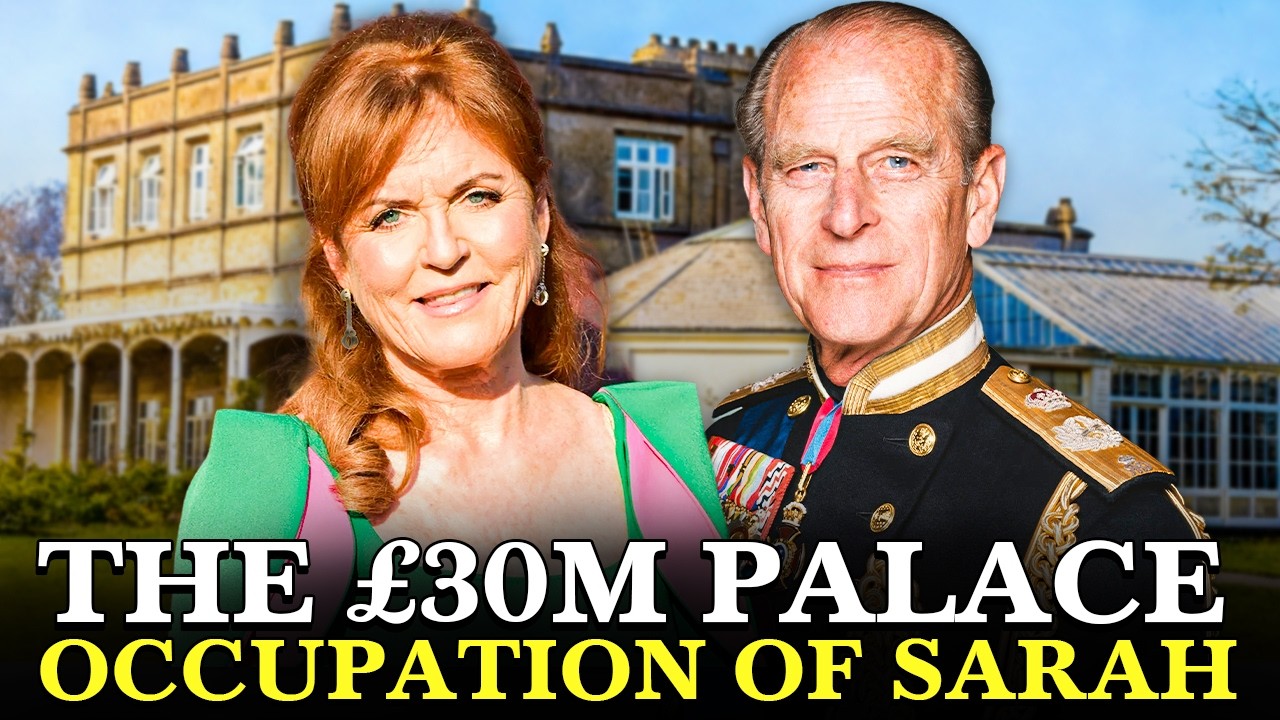 Yet the surrender of the lease at Royal Lodge meant her displacement as surely as it meant Andrew’s. The house in Windsor Great Park, a thirty-room residence set within ninety-eight acres, had been her home since 2008. It was where she had raised her daughters, hosted their weddings, and built the domestic foundation of a post-divorce survival that had outlasted every attempt to erase her.
The statement said Andrew would henceforth be known as Andrew Mountbatten-Windsor. It said he would move to alternative private accommodation. It said nothing about the woman who had called herself a guest for seventeen years, with such regularity that the word had become its own form of dark irony.
Royal Lodge carries the weight of Windsor memory. It was used by the Duke and Duchess of York, the future George VI and Queen Elizabeth, in the 1930s. After the King’s death, it became the Queen Mother’s Windsor residence for roughly fifty years.
She died there on March 30, 2002, at the age of 101.
Her coffin was carried from the house she had occupied for half a century. What she left behind was not merely a building. It was a vessel of meaning, every room carrying the residue of a particular kind of royal domesticity, maternal and conservative, built on the unspoken assumption that certain women held families together by occupying the right rooms in the right houses at the right time.
Prince Andrew took a seventy-five-year lease on Royal Lodge in 2003. The terms were extraordinary by any standard outside the Crown Estate’s private arrangements with members of the royal family. A one-off payment of one million pounds.
A reported obligation to spend seven and a half million on refurbishment. An annual peppercorn rent on a property valued at roughly thirty million pounds.
He moved in during 2003 and 2004. The refurbishment was extensive. The house was modernized, extended, made grand in the way that Andrew understood grandeur.
Not austere, not self-denying, but scaled to the life he believed was his by right.
From the outside, the arrangement looked like a straightforward piece of royal property succession. The Queen Mother’s favorite grandson stepping into the Queen Mother’s favorite house. A quiet transfer within the family.
But the arrangement was never straightforward. It depended on a set of assumptions that were already beginning to erode. That Andrew’s royal status would remain intact.
That his financial position would remain stable. That the institution would continue to treat the lease as a private family matter rather than a public question about privilege.
None of those assumptions would survive the next two decades. In 2003, they felt permanent. That is what made the trap.
Within five years, the woman who would make the house most controversial had moved in. Sarah Ferguson, divorced since 1996, stripped of her royal highness style, and publicly repositioned as one of the monarchy’s most visible embarrassments, took up residence at Royal Lodge in 2008.
She described herself in the careful language she had learned to deploy around royal matters as a guest. Just a guest. A very lucky guest.
But she was not a guest. She was a permanent domestic presence in one of the Crown’s most symbolically charged houses, living with a man she had divorced twelve years earlier, raising daughters who were fifth and sixth in line to the throne, and occupying a space that the institution had never invited her to fill.
From that point, what had looked temporary became structural. The divorced couple were no longer simply co-parenting from adjacent lives. They were sharing a grand royal house, and in doing so, they were making visible a fact the monarchy preferred to keep invisible.
That the attempt to expel Sarah Ferguson from the family had failed. She had not been let back in. She had simply never fully left.
And the house, the Queen Mother’s house, the house that carried half a century of Windsor domestic mythology, had become the physical proof.
Financially, the York position was always more precarious than the public image allowed. Their status was enormous. Their independent money was less so.
Andrew’s Royal Lodge deal looked aristocratic, but it depended entirely on a Crown Estate arrangement that existed at the pleasure of the institution.
Sarah’s post-divorce finances were publicly presented as humiliatingly small in comparison with Diana’s settlement. A reported five hundred thousand pounds per year and a one and a half million pound trust for the daughters, set against Diana’s seventeen million.
That disparity was not merely financial. It was a measure of institutional value. A calculation of what each woman was worth to the system and what the system would pay to be rid of her.
From the very beginning, then, the York branch of the House of Windsor was sustained by proximity, housing, title, and maternal tolerance, not by a solid independent fortune. And that made exile both easier to threaten and harder to enforce, because the family could always withdraw the arrangements, but the person living inside them had nowhere else to go.
That domestic arrangement cannot be understood without the code it was defying. The code belonged to Prince Philip.
Philip, Duke of Edinburgh, was not the protagonist of this story, but he was its superego, the embodiment of a set of values that the House of Windsor had elevated into something close to doctrine. Stoicism. Containment.
Service performed without complaint and without visible mess.
A visceral, class-inflicted disgust at emotional incontinence, at the spectacle of private failure made public, at anyone who brought the family’s name into disrepute through weakness rather than design.
Philip had married into the monarchy himself. He had surrendered his own name, his Greek and Danish titles, and his naval career to the demands of his wife’s position, and had done so with a discipline that he expected others to match.
He was not a man who forgave easily. He was a man for whom certain failures of conduct were not errors to be corrected, but stains that could not be removed.
And by every account that filtered through palace briefings, staff memoirs, and decades of press reporting, Philip’s judgment of Sarah Ferguson, once it hardened after the events of 1992, was total. He could not bear to be in the same room as her.
Whether one takes those accounts as a literal description or as an index of the wider family climate, the dramatic truth is the same. Sarah became the kind of woman that the Philip Windsor code most despises. A woman who had made private chaos visible, who had let the body and its appetites be photographed, who had turned royal intimacy into tabloid sport.
In an institution that could survive sorrow, betrayal, even cruelty, so long as it remained hidden, the unforgivable sin was exposure. And Sarah had been 𝓮𝔁𝓹𝓸𝓼𝓮𝓭.
Queen Elizabeth II occupied the counterweight position. Where Philip was severity, the Queen was shelter. Where Philip drew lines, the Queen left doors ajar.
Her role in the York story was never dramatic. She did not confront, did not issue ultimatums, did not stage the kind of emotional reckoning that resolves a crisis. Her role was structural.
She was the reason that the family continued to function around wounds that were never fully healed.
The quiet maternal presence that allowed contradictions to coexist because addressing them would have required a directness the Queen did not practice. She remained attached to Andrew. Attached in the way that mothers of difficult sons remain attached, not through approval, but through an inability to sever what cannot be repaired.
She tolerated Sarah’s proximity. She presided over a world in which her former daughter-in-law was never fully restored to favor, yet never fully cast into the outer darkness. The trust fund for the daughters, the continued invitations to certain family gatherings, the practical tolerance of Sarah’s appearances at the margins of royal life.
All of these belong to the Queen’s register, maternal management rather than reform. She did not fix the problem of the Yorks. She made space around it, and that strategy, quiet, non-confrontational, built on the hope that time and avoidance would wear down what direct action might inflame, would hold for as long as she lived.
It would not survive her.
The Queen Mother mattered differently, and her importance grew after she was gone. In life, she had been the matriarch of Royal Lodge, the woman whose domestic authority gave the house its meaning. In death, she became the reason the house was available and the ghost whose presence made it impossible to treat the property as ordinary real estate.
Her dying at Royal Lodge in 2002 transformed the house from an occupied royal residence into a chamber of inheritance, a space charged with the memory of a woman who had spent fifty years embodying a very specific idea of what a royal household should be.
When Andrew moved in, he was not merely taking a lease. He was inheriting a model of domestic monarchy, and when Sarah later joined him, she was stepping into the role the Queen Mother had defined. The woman at the center of a royal home without possessing any of the institutional authority, the public respect, or the marital status that had made that position sustainable.
She had the house. She did not have the legitimacy. That gap would define everything that followed.
There was also Diana. She does not belong to this family, but she belongs inescapably to this story because Sarah Ferguson’s entire public trajectory took place in Diana’s shadow, and the shadow shaped the punishment.
They had been friends before they were both royal, part of the same Sloane Ranger social circle, young women from the kind of English backgrounds that orbited the monarchy without quite belonging to it. They entered the family within five years of each other. Diana in 1981, Sarah in 1986.
They were compared relentlessly in beauty, in behavior, in suffering, in the size of their divorce settlements. And the comparison was never kind to Sarah. Diana was tragic, Sarah was comic.
Diana was the wronged princess, Sarah was the embarrassing duchess.
Diana’s pain was elevated into national mythology. Sarah’s pain was flattened into tabloid farce and remained there for decades.
That asymmetry mattered enormously. It meant that when Sarah’s own humiliation arrived, the public consumed it not as a tragedy to be mourned, but as a spectacle to be enjoyed. It meant that the institution could afford to be harsher with Sarah because the public would not protest.
And it meant that Sarah’s later survival, her refusal to vanish, her improbable persistence inside the very system that had tried to erase her, was achieved without the sympathy that had cushioned Diana’s memory and would never be extended to her.
On July 23, 1986, Prince Andrew married Sarah Ferguson at Westminster Abbey. He was twenty-six years old. She was twenty-six.
He was created Duke of York on his wedding day, a title that carried the echo of a previous Duke of York who had become George VI.
The ceremony was grand, traditional, and watched by an estimated five hundred million people worldwide. The occasion generated what the British press called Fergie fever, and for a brief genuine period, the warmth was real.
Here was a royal bride who laughed in public, who touched her husband with visible affection, who seemed to bring something the institution had not known it needed. Informality without rebellion, energy without the tortured intensity that was already defining the Wales marriage.
The Yorks in the summer of 1986 looked like the monarchy’s easier, sunnier branch. Less burdened, less performative, a couple who, against the odds of institutional life, appeared to actually like each other.
The early years of the marriage should be understood as genuinely alive because without that aliveness at the beginning, the later destruction carries no ache. The York household was built around Sarah’s warmth and Andrew’s confidence, a marriage between a woman who needed connection and a man who assumed the world would arrange itself around his comfort.
 Beatrice arrived on August 8, 1988. Eugenie followed on March 23, 1990. The daughters completed the picture, and for a time the picture held.
The public saw a young royal family that appeared more human, more tactile, more relaxed than the senior Windsors.
But the very traits that made the public love Sarah, the warmth, the openness, the need for connection, the refusal to perform dignified suffering, were the same traits that inside the institution were beginning to register as warnings.
She talked too freely. She moved too loosely. She was too visible, too physical, too eager.
She touched people when she greeted them, not just the formal handshake, but actual warmth, actual contact.
Everything about her was bodily, present, unfiltered in a way that made the institution nervous because the monarchy’s deepest survival mechanism was the management of visibility, and Sarah could not be managed.
The palace saw a woman who could not be contained by the role she had married into. Courtiers worried. Briefings 𝓵𝓮𝓪𝓴𝓮𝓭.
The word unsuitable began to appear in the kind of newspaper columns that function as semi-official communication channels between Buckingham Palace and the public.
And the press, which had spent four years building her up with genuine affection, was already sharpening its instruments for the next phase. There is a rhythm to the British tabloid relationship with royal women. Adoration, then scrutiny, then punishment.
By the late 1980s, Sarah was entering the second stage without understanding what was coming.
On March 19, 1992, Buckingham Palace announced the separation of the Duke and Duchess of York. The statement was brief and carefully worded, designed to acknowledge a fact while giving away nothing about the feeling behind it.
The language was administrative. The reality was wreckage, not the sudden, dramatic wreckage of a single betrayal, but the slow structural failure of a marriage that had been emptying for years and had finally been acknowledged as empty.
The timing was catastrophic, but not because of anything Sarah had done. 1992 was already shaping into the worst year of the Queen’s reign. Princess Anne’s divorce from Captain Mark Phillips had been finalized that April.
The Prince and Princess of Wales were in the terminal phase of their own public disintegration.
Andrew Morton’s biography of Diana, serialized in the Sunday Times in June, would detonate the last fiction of a functioning Wales marriage. And in November, a fire would rip through the state apartments at Windsor Castle, damaging more than one hundred rooms and producing a restoration bill of thirty-six and a half million pounds.
The Queen would later call it her annus horribilis, and the phrase entered the language because it captured something the country already felt, that the fairy tale had collapsed and the people inside it were no better at managing their private lives than anyone else.
Into that atmosphere of institutional vulnerability came the photographs.
In August 1992, Sarah was on holiday in the South of France with her daughters and with John Bryan, an American financial advisor who had entered her life through the overlapping worlds of money, social access, and the kind of male attention that presented itself as professional help and became personal entanglement.
They were staying at a villa near Saint-Tropez. The children were there. Staff were there.
And a photographer, working with a telephoto lens from a distance that made consent irrelevant, was capturing images that would reshape Sarah Ferguson’s public identity for the rest of her life.
The photographs were published in the Daily Mirror on August 20, 1992. They showed Sarah and Bryan in intimate physical contact by the swimming pool. The most widely reproduced image showed Bryan appearing to kiss or suck Sarah’s toes as she reclined, semi-undressed in the sun.
The children were visible in some of the frames. The images were not explicit in the legal sense. No prosecution was ever brought.
But they were devastating in the social sense because they violated every code that the British class system applied to the behavior of women in positions of public trust.
The morning the pictures broke, the royal family was at Balmoral. That detail matters because Balmoral is the monarchy at its most private. The Scottish Highlands estate where the family gathers each August, away from the public calendar, inside the rituals of shooting, walking, picnicking on the moors.
Sarah was at Balmoral. She was in the castle when the papers arrived. She was, by the accounts that emerged later through palace sources and carefully attributed briefings, in the room.
The photographs of her body, her intimacy, her private physical life with another man, were being consumed by her in-laws at a breakfast table, while the same images were being consumed by the nation at a million other breakfast tables.
The humiliation was not abstract. It was spatial, physical, simultaneous. She was sitting with the people who were seeing her at her most 𝓮𝔁𝓹𝓸𝓼𝓮𝓭, and the silence that followed, by every account, a silence so total and so sustained that it functioned as a courtroom verdict, was the sound of a family making a judgment it would not reverse for decades.
Philip’s response was not explosive, but glacial. It was the cold, permanent fury of a man who saw the photographs as confirmation of everything he had believed about Sarah from the beginning, that she was unsuitable, reckless, incapable of the self-governance that royal status demanded.
Philip could have tolerated, perhaps, a discreet 𝒶𝒻𝒻𝒶𝒾𝓇. The British monarchy had survived centuries of discreet affairs. What it could not survive in Philip’s framework was ridicule.
The telephoto lens, the swimming pool, the toes, the children in the background of the frame.
The photographs did not merely embarrass the family. They made the family absurd. And for Philip, for whom the maintenance of the monarchy’s dignity was a moral commitment and not a social preference, absurdity was the unforgivable offense.
After August 1992, Sarah Ferguson was, in the eyes of the man who embodied the family’s highest code, beyond redemption. The estrangement that followed would last for decades. It would not fully break until the events around Eugenie’s wedding in 2018, a quarter of a century later.
The public response was not sympathy. It was sport. The tabloids ran the story for days.
The broadsheets ran commentary pieces about royal decline. The comedians added the toe-sucking to their routines.
Sarah was mocked with a thoroughness that went beyond ordinary tabloid cruelty, because the photographs offered something the British class system found irresistible. The spectacle of a woman who had been elevated above her station falling in the most physical, most bodily, most undignified way possible.
The word Fergie, which had once been affectionate, became a punchline. The toe-sucking became shorthand, a single detail by which millions of people who knew nothing else about Sarah Ferguson’s marriage, motherhood, charity work, or emotional life would define her for the next thirty years.
A woman with a history, a decade of public service, two small daughters, and years of private loneliness was compressed into one image and one joke. That compression was the real violence of the 𝒔𝒄𝒂𝓃𝒹𝒶𝓁, because it erased everything else.
The divorce took nearly four more years. The decree was finalized on May 30, 1996, and the terms confirmed what the public had suspected and what Sarah had feared. By contemporary reporting, she received an annual settlement of roughly five hundred thousand pounds and a one and a half million pound trust for the daughters’ education and welfare.
There was no lump sum of the kind Diana would negotiate. There was no property settlement that would give her independent security. There was no London residence of her own.
There was instead a maintenance structure that kept her dependent on the very system that had already decided she was a liability.
The loss of the HRH style, she would remain Duchess of York but could no longer be addressed as Her Royal Highness, was presented by the palace as a formality, a matter of protocol rather than punishment. In practice, it was a demotion in the only currency her world truly valued.
Without those three letters, Sarah’s standing dropped. Doors that had opened on the strength of those initials now required a separate justification for being open. She was downgraded, not annihilated.
Excluded ceremonially, but bound maternally through Beatrice and Eugenie.
The institution had tried to solve the problem of Sarah Ferguson through legal severance. A clean cut that would preserve the children’s royal status while reducing their mother to private irrelevance. Life, as it always did with the Yorks, refused to cooperate.
She did not disappear. That is the fact that gives the rest of this story its shape, and it is a fact that requires explanation because the forces arranged against her were not trivial.
Every mechanism in the system, the tabloid mockery, the palace briefings that placed unflattering stories with sympathetic journalists, Philip’s unbroken contempt, the financial pressure that should have driven her into retreat, the cultural appetite for her humiliation that showed no sign of diminishing, pointed toward a single conclusion.
Sarah Ferguson should have gone. She should have retreated into a quiet life outside the frame, accepted the diminished settlement, raised the girls without claiming proximity to the family that had publicly rejected her, and faded into the particular English oblivion reserved for disgraced former wives of powerful men.
She did none of that. She kept appearing. She kept talking.
She kept working every commercial avenue available to her. She kept insisting, through action, if not always through articulation, that she was still connected to the family, still the mother of the daughters, still someone who belonged near the rooms she was no longer formally invited to enter.
The refusal was not elegant. It was not strategic in any way a publicist would have designed. It was raw, instinctive, and powered by the same engine that had always driven her, the need not to be discarded, the need to matter, the need to remain.
When Sarah moved into Royal Lodge, the shift was less a single dramatic event than a gradual thickening of presence. She had been visiting. She had been staying for weekends.
She had been around at Christmas, during school holidays, for the girls’ birthdays, in the loose domestic rhythm that the York co-parenting arrangement had produced over the preceding years.
She would arrive on a Friday evening and leave on a Monday morning. And then the Monday departures became less regular. And then the distinction between staying and living dissolved entirely.
The boundary between visiting and residing blurred over months rather than days. Until by 2008, it was clear to anyone paying attention, to the household staff, to the protection officers, to the neighbors in Windsor Great Park, that Sarah Ferguson was not a guest at Royal Lodge in any meaningful sense of the word.
She was a resident. She was managing domestic arrangements. She was there when Andrew was away and there when he returned.
She was, in everything but legal and marital status, the woman of the house, the wife without the marriage, the Duchess without the HRH, the occupant without the lease.
 And that arrangement, once it solidified, became extraordinarily difficult to undo. Because undoing it would have required someone, Andrew, the Queen, the institution itself, to name what was happening. And naming it would have meant confronting the fact that the divorce, the settlement, the careful legal severance of 1996 had achieved nothing of consequence.
The family was back together. It had simply reorganized itself around the same house under a different legal fiction.
The palace tolerated the arrangement with the particular blend of silence and avoidance that characterized the Queen’s approach to family problems she could not solve without creating worse problems in the process. Nobody at Buckingham Palace endorsed the York domestic setup. Nobody publicly defended it.
Senior courtiers, by later reporting, regarded the arrangement with a frustration that bordered on contempt. Not because they thought Sarah was a threat to the monarchy, but because the York situation embodied precisely the kind of messy, unresolved, emotionally driven family compromise that made the institution look weak.
The monarchy’s authority depended on the appearance of order, and the Yorks were disorder incarnate. A divorced couple living as a family, a disgraced duchess installed in a Crown-linked house, a prince whose status was being quietly eroded by his own behavior, and a domestic arrangement that nobody had authorized, nobody controlled, and nobody could end without provoking a confrontation with the Queen herself.
Because that was the ultimate protection. Not Andrew’s lease, not Sarah’s persistence, not even the daughters’ emotional leverage. It was the Queen.
As long as Elizabeth II was alive and on the throne, the York arrangement was shielded by the one authority that no courtier, no prime minister, and no fellow member of the royal family could override.
The Queen did not approve of what was happening at Royal Lodge, but she was unwilling to dismantle it because dismantling it would have meant hurting Andrew, hurting the granddaughters, and forcing a public reckoning with a family failure that her entire style of governance was designed to avoid.
The silence was not approval. It was exhaustion masquerading as patience, and it depended on the assumption that the status quo, however uncomfortable, was less damaging than the alternative. That assumption would hold until it couldn’t.
In May 2010, the arrangement’s fragility was 𝓮𝔁𝓹𝓸𝓼𝓮𝓭 from a direction that Sarah had not anticipated and could not control. On the 23rd, the News of the World published footage from a hidden camera sting operation that had been months in the making.
An undercover reporter, Mazher Mahmood, had posed as a wealthy Indian businessman seeking access to Prince Andrew for commercial purposes. He had arranged meetings with Sarah. He had offered money, and he had recorded everything.
The footage showed Sarah in a private setting, a hotel room, curtains drawn, the atmosphere of a transaction conducted in the belief of privacy, discussing financial terms with a fluency that suggested this was not the first time she had thought in these numbers.
She referred to Andrew’s potential usefulness. She discussed what access to the Duke of York might be worth to a foreign businessman. She appeared to negotiate a fee of five hundred thousand pounds for the introduction, and she was filmed accepting a cash payment of forty thousand pounds as an initial installment.
The footage was damning not because it revealed corruption in the grand sense. No state secret was traded. No government policy was influenced.
No official channel was compromised. It was damning because it collapsed the last distinction between need and opportunism that Sarah had been trying to maintain since the divorce.
Here was a Duchess living in a royal house offering to sell access to a prince on camera for cash. The transaction was not subtle. It was not deniable.
It was recorded, broadcast, and replayed until the image of Sarah Ferguson accepting banknotes in a hotel room became as fixed in the public memory as the South of France photographs had been eighteen years earlier.
Sarah’s response was immediate and wretched. She appeared on the Oprah Winfrey show and issued an apology that was both abject and revealing. She described herself as being in a difficult and painful situation.
She acknowledged that her behavior had been idiotic. She said she had been drinking. She said she was in financial distress and had not been thinking clearly.
The apology was widely reported and widely disbelieved. Not because people thought she was lying about the drinking or the distress, but because the incident confirmed what her critics had always claimed. That Sarah Ferguson’s relationship with the royal family had always been at some level transactional.
That reading was unfair, or at least radically incomplete. The cash-for-access sting emerged from a particular set of pressures that had been building for fifteen years without any institutional mechanism to relieve them.
The debts had never been resolved. The commercial landscape had dried up as Sarah’s public reputation deteriorated. The maintenance settlement from the divorce had not been restructured to reflect her actual costs, and the gap between what she needed and what she received had widened year by year until the desperation was not occasional, but permanent.
Sarah was not a sophisticated criminal operating a bribery network. She was a woman who had been financially precarious since 1996, who had exhausted the respectable avenues of self-support, and who had made a catastrophically bad decision in a moment when the pressure exceeded her capacity for good judgment.
The monarchy had created the conditions for Sarah’s desperation, and then recoiled in horror when the desperation produced exactly the kind of behavior the conditions had made inevitable.
And yet, once again, she did not vanish. The arrangement at Royal Lodge continued. The co-parenting continued.
The domestic system that the palace had never sanctioned and never dismantled absorbed the shock and carried on, as it had absorbed every previous shock.
The institution’s failure to remove Sarah after the cash-for-access sting was perhaps the most revealing moment in the entire saga because it demonstrated that the York problem had become genuinely unsolvable within the existing power structure.
Ejecting Sarah from Royal Lodge would have required ejecting Andrew from Royal Lodge, and ejecting Andrew would have required a confrontation with the Queen’s favorite son. A confrontation that the Queen would not initiate, that the courtiers could not force, and that Charles, who was still Prince of Wales and heir rather than king, did not yet have the authority to impose.
The house held. The arrangement held. The 𝒔𝒄𝒂𝓃𝒹𝒶𝓁 was absorbed into the long York pattern of catastrophe, followed by survival, followed by the quiet resumption of a life that nobody outside Royal Lodge could quite understand, and nobody inside it seemed willing to change.
Eugenie’s wedding, on October 12, 2018, became the moment when the long York exile appeared at last to have been outlasted. It was not a reconciliation. It was not a formal restoration.
But it was the closest thing to vindication that Sarah Ferguson had experienced in twenty-six years.
The ceremony was held at St. George’s Chapel, Windsor Castle, the same sacred space where generations of Windsors had been christened, married, and mourned. Eight hundred guests filled the chapel.
The bride wore a gown that left her back 𝓮𝔁𝓹𝓸𝓼𝓮𝓭, a deliberate choice because Eugenie had undergone surgery for scoliosis at the age of twelve, and the dress was her way of showing the scar rather than hiding it.
And Sarah was there. Not at the margins, not in a side pew with a diplomatic gap between herself and the rest of the family. She was the mother of the bride.
She was seated in the front row. She was visible, composed, dressed in a green outfit that the fashion press would scrutinize and the tabloids would comment on.
But what mattered was not the clothes. What mattered was the position. After decades of institutional distance, Sarah Ferguson was sitting inside the chapel at Windsor Castle at a royal wedding in the place that the mother of the bride occupied by right, and no one had tried to stop her.
The pre-wedding celebrations, by press reporting, centered on Royal Lodge itself. The evening before the ceremony, a dinner was held at the house. The fortress of York domestic survival, opened for the occasion and serving for one evening as the setting for a family celebration at which Sarah was not a tolerated presence, but a host.
The coverage in the days that followed dwelt on one detail above all others. Philip was there. Philip, who had not been in the same public frame as Sarah for years, who by every account had refused her company since the Balmoral breakfast in 1992, was at his granddaughter’s wedding in a context where Sarah’s proximity was unavoidable.
Press photographers captured them in overlapping space for what was widely reported as the first time in twenty-six years. Whether Philip’s presence constituted reconciliation, reluctant tolerance, or simply the pragmatic recognition that a ninety-seven-year-old man could not boycott his own granddaughter’s wedding without creating a 𝒔𝒄𝒂𝓃𝒹𝒶𝓁 worse than the one he was trying to avoid, the meaning was legible.
Sarah had outlasted the exile, not through confrontation, not through negotiation, not through any dramatic act of restoration, but through the simplest and most exhausting strategy available. She had endured. She had remained present in her daughters’ lives long enough for the daughters’ milestone to require her presence.
She had converted maternal indispensability into something that looked, from the right angle and in the right light, like a kind of victory.
Philip died on April 9, 2021, at the age of 99. His death removed the man who had, more than any other individual, embodied the institutional rejection of Sarah Ferguson. What can be said is that the removal of the family’s most severe conscience coincided with a period in which the pressures on the York domestic settlement were about to intensify from an entirely different direction.
The catastrophe arrived on a Saturday evening in November 2019. And it arrived because Andrew invited it in.
On the 16th, the BBC broadcast a pre-recorded interview between Prince Andrew and Emily Maitlis for the program Newsnight. The interview had been arranged by Andrew in his private office, against the explicit advice of Buckingham Palace’s communications team, who had argued that any public discussion of the Epstein association carried uncontrollable risk.
Andrew overruled them. That detail mattered enormously because it meant that the catastrophe was not ambushed, but chosen. Andrew had decided, apparently with the confidence of a man who had spent a lifetime being deferred to and shielded from the consequences of his own poor judgment, that he could go on national television and explain his friendship with Jeffrey Epstein in terms that the British public would accept.
He was catastrophically, comprehensively wrong.
The interview was filmed in the South Drawing Room at Buckingham Palace. The setting was itself a statement, a prince in the palace speaking with the authority that those surroundings conferred. But the authority collapsed within minutes because what the interview revealed was not just poor judgment, but a quality of character that the public had not previously seen with such devastating clarity.
An absolute granite certainty that his version of events should be taken at face value, combined with a total inability to read the room or recognize that his explanations were not merely unconvincing, but extraordinary in their detachment from what the country understood to be normal human behavior.
He claimed he had no recollection of meeting Virginia Giuffre despite a widely circulated photograph showing them together. He offered an explanation for his presence at Epstein’s New York residence after Epstein’s first conviction, that he had gone to end the friendship in person and that staying at the house had been convenient.
He described a medical condition that he said prevented him from sweating, offered as a rebuttal to Giuffre’s account of him sweating on a dance floor. He recalled, in precise and oddly cheerful detail, that on the date Giuffre placed him in London, he had been at a Pizza Express in Woking with Princess Beatrice.
He expressed no unprompted empathy for Epstein’s victims. He described a friendship with a convicted 𝒔𝒆𝒙 offender as having provided useful networking opportunities. He spoke with the particular baffled courtesy of a man who genuinely could not understand why any of this might be a problem.
The interview lasted forty-nine minutes. By the time it ended, the damage was not merely to Andrew’s reputation. It was to the monarchy’s ability to maintain even the thinnest fiction that his continued position within the family was tenable.
Four days later, on November 20, 2019, Andrew issued a statement announcing that he was stepping back from public duties. The language was voluntary. The reality was not.
Andrew was not stepping back. He was being removed from the frame by an institution that could no longer afford the cost of keeping him visible.
The Queen, who had shielded him for decades, who had tolerated the Royal Lodge arrangement and the domestic cohabitation and the serial embarrassments, had reached her own limit. Even maternal love, even the indulgence of a favorite son, could not hold against the weight of what the Newsnight interview had revealed.
On January 13, 2022, Buckingham Palace acted. The announcement was devastating in its brevity. Prince Andrew’s military affiliations and royal patronages were returned to the Queen.
 The Duke of York would continue not to undertake any public duties and was defending the civil case as a private citizen.
The statement was two sentences long. It ended a lifetime.
The civil case was settled in February 2022. Andrew made a substantial financial payment. The exact figure was not publicly confirmed, but reporting placed it in the region of twelve million pounds.
He issued a statement acknowledging that Epstein’s victims had suffered, and that he regretted his association with Epstein.
He did not admit liability. He did not apologize to Giuffre specifically. The settlement ended the legal threat, but not the reputational catastrophe, because the payment itself became conclusive evidence in the court of public opinion.
The man who had denied everything on national television, who had insisted he had no recollection of meeting his accuser, who had invoked Pizza Express and a medical inability to sweat, had paid a sum that ordinary people could not imagine to make the case go away.
In June 2023, Sarah was diagnosed with breast cancer. She underwent a mastectomy and began the process of treatment and reconstruction that cancer imposes. The diagnosis was made public, and for a brief period the coverage shifted register.
The tabloids, which had spent three decades treating Sarah as a figure of mockery, acknowledged the gravity of what she was facing. There was sympathy. There was restraint.
The unspoken understanding was that serious illness temporarily suspended the usual rules of engagement.
Then in January 2024 came a second diagnosis, malignant melanoma, discovered during the reconstructive surgery that had followed the mastectomy. Two cancers in seven months. Sarah was sixty-four years old.
She was living in a house that the institution was preparing to take from her. She was attached to a man whose public life had been destroyed beyond any possibility of repair. She was carrying a name that functioned in the national conversation primarily as a punchline.
And she was now fighting for her physical survival while the domestic, institutional, and reputational ground beneath her continued to give way.
On October 30, 2025, Buckingham Palace issued a statement. The statement said that Prince Andrew would henceforth be known as Andrew Mountbatten-Windsor. It said that formal notice had been served requiring the surrender of the Royal Lodge lease.
It said that Andrew would move to alternative private accommodation.
The language was precise, procedural, and comprehensive in a way that left no ambiguity. Every element of the old York arrangement was addressed in a single announcement. The use of the ducal title, which had been Andrew’s since his wedding day in 1986, the house, which had been his since 2003 and Sarah’s in practice since 2008, and the future, which would be determined not by Andrew’s preferences, but by the institution’s decision.
What had taken decades to build, the domestic fortress, the tolerated cohabitation, the unspoken understanding that the Yorks would be accommodated as long as they did not force the institution’s hand, was dismantled in the space of a press release.
The renaming was, in some ways, the most symbolically violent element. Andrew Mountbatten-Windsor. The name stripped of its royal architecture.
No Duke of York, no Prince Andrew, no HRH, none of the layered titulature that the British monarchy uses to locate individuals within its hierarchy of deference and obligation.
The name that remained was a legal name, a passport name, the name of a private citizen who happened to have been born into the royal family. It was the monarchy’s way of saying, you are no longer ours. You are no longer part of the structure.
You are a person with a surname, and the surname is all you have.
Sarah Ferguson was not named in the statement. That absence was, in its way, the detail that carried the most weight.
The woman who had spent more than thirty years refusing to vanish from the House of Windsor, who had outlasted Philip’s contempt, the tabloid campaigns, the financial crises, the serial humiliations, the health scares, and the slow administrative erosion of every position she had fought to maintain, was not mentioned in the document that ended the arrangement her persistence had created.
She was inside the meaning of the statement. Everyone who read it understood that the surrender of the Royal Lodge lease meant Sarah’s displacement as much as Andrew’s. That the house she had called home, the domestic space around which she had organized her post-divorce existence, was being taken not just from Andrew, but from her.
But she was not inside the language. The palace addressed Andrew. It addressed the lease.
It addressed the accommodation. It did not address the woman who had lived in the house for seventeen years, who had raised her daughters there, who had described herself as a guest with such frequency that the word had become a private form of irony.
The statement treated her as though she were not a party to the arrangement. And in the constitutional grammar of the monarchy, she wasn’t. She was not royal.
She was not the leaseholder. She was not, in any formal sense that the institution recognized, a person whose displacement required acknowledgement.
She was someone who had been there and who would now have to be somewhere else.
The statement was issued under the authority of King Charles III. Charles had inherited the throne on September 8, 2022, following the Queen’s death at Balmoral at the age of ninety-six. The end of a seventy-year reign and the removal of the last figure whose authority and maternal attachment had shielded the York arrangement from institutional correction.
The Queen’s death changed the calculus entirely. She had been the reason the arrangement endured, not because she approved of it, but because she was unwilling to dismantle it. And nobody else had the authority to override her unwillingness.
Charles did. He had spent the subsequent years pursuing the institutional reform that the press described as slimming down the monarchy, reducing the number of working royals, tightening the relationship between public expenditure and public duty, ending the ambiguity about who was a working member of the family and who was not.
And addressing the legacy problems that his mother’s decades of non-confrontational management had left unresolved and festering. The York situation was the largest and most publicly visible of those legacies.
Charles had, by reporting that accumulated through 2024 and 2025, been urging Andrew to leave Royal Lodge voluntarily for months. He had reportedly offered alternative accommodation. He had, through intermediaries, made clear that the older arrangement could not survive his reign.
Andrew had resisted. He had explored legal options to challenge the lease surrender. He had behaved in the manner that had defined his entire adult life, as though the arrangements made for him would hold because they had always held before.
They did not hold. Charles was not the Queen. He did not manage the family through avoidance, through maternal patience, through the hope that time and silence would wear down problems that confrontation might inflame.
He managed through decision.
And the decision, when it came, carried the weight of a king who had waited decades for the authority to act on what he had long believed was necessary, and who was now exercising that authority with a completeness that left nothing to renegotiate, nothing to appeal, and nothing to hold on to.
By January 2026, press reports described Sarah Ferguson as being without a settled home of her own. The woman who had spent seventeen years at Royal Lodge, who had converted her presence in the house into the physical foundation of her entire post-divorce existence, was now, at the age of sixty-six, facing the question of where to live with a rawness that recalled the early post-divorce years of financial precariousness and institutional rejection.
She had her daughters. She had her grandchildren. She had her health, uncertain as it was after two cancer diagnoses in seven months.
She had the title she had carried since 1986, Duchess of York. The name now attached to a woman with no house, no HRH, no institutional role, and no formal claim on the family whose name she bore.
The ground she had fought to hold, year after year, 𝒔𝒄𝒂𝓃𝒹𝒶𝓁 after 𝒔𝒄𝒂𝓃𝒹𝒶𝓁, decade after decade, had been pulled away. Not by tabloid exposure, not by the public mockery she had survived so many times, not by Philip’s contempt or the debt or the cash-for-access sting, but by an administrative decision issued in the measured language of a Buckingham Palace press release.
The end, when it came, was not dramatic. It was procedural. And that was what made it so complete.
By February 2026, multiple outlets described Andrew as having left Royal Lodge permanently, now residing on the Sandringham estate in Norfolk, the late Queen’s country property. A royal residence, but not the one he had chosen. Not the one he had refurbished at a cost of millions.
Not the house that had carried the weight of his mother’s mother’s memory and his own long refusal to accept diminished status.
The move to Norfolk was not exile in the formal sense. It was accommodation, private, rural, distant from London and Windsor and the social world that had once revolved around a prince. But it carried the unmistakable quality of a man who had been placed where he could do the least damage and attract the least attention.
The indulged younger son who had mistaken protection for permanence had discovered at last that the protection was conditional and the permanence was borrowed.
The house is lost. The name is altered. The old York world, the world of Royal Lodge, of the tolerated arrangement, of the domestic fortress built on a lease and sustained by maternal persistence and institutional avoidance, is over.
But the human consequences of those decades remain unsettled. And they extend far beyond the two people whose names dominated the headlines.
What did thirty years of tolerated unreality do to the woman who lived inside it, who built her survival on a foundation that was never legally hers? What did it cost the daughters who grew up managing their parents’ disgrace while trying to build lives of their own? What does the public memory of Fergie, the tabloid caricature, the toe-sucking punchline, the commercial hustle, owe to the actual woman behind the image?
And what does it reveal about the monarchy itself that its final solution to the York problem was not confrontation, not reform, not even punishment in any recognizable dramatic sense, but a late, quiet, administrative tidying up of lives that had already been worn down to the point where resistance was no longer possible?
There is no neat moral to this story. Sarah Ferguson did not overthrow the monarchy, and the monarchy did not entirely succeed in erasing her. What the York story reveals is something messier and more characteristically British than either of those endings.
That houses can become substitutes for love. That status can postpone consequences without canceling them. And that what children inherit from a damaged dynasty is not security, but the lifelong labor of carrying a family name after the structure beneath it has given way.
The public saw the joke, the photographs, the red hair, the toe-sucking, the cash in the hotel room. The real story was a woman who refused to vanish, and a family system so dependent on avoidance that it took more than thirty years to decide what to do with her.
She was never fully restored. She was never fully forgiven. And in the end, she was not even named in the statement that ended the arrangement.
The house disappeared from under her in the passive language of palace administration.
That is how royal punishment often works. Not through dramatic banishment, but through a late administrative tidying up of lives that have already been worn down to the point where the tidying barely makes a sound.