On January 26, 1962, Charles “Lucky” Luciano collapsed and died of a massive heart attack in the arrivals terminal of Naples’ Capodichino Airport. He was 64 years old and had been waiting to meet an American film producer about a movie based on his life. His last known words were reportedly a question about whether Hollywood was interested in the project. The man who reshaped American organized crime died on a polished airport floor, far from the New York streets where he had built his empire.
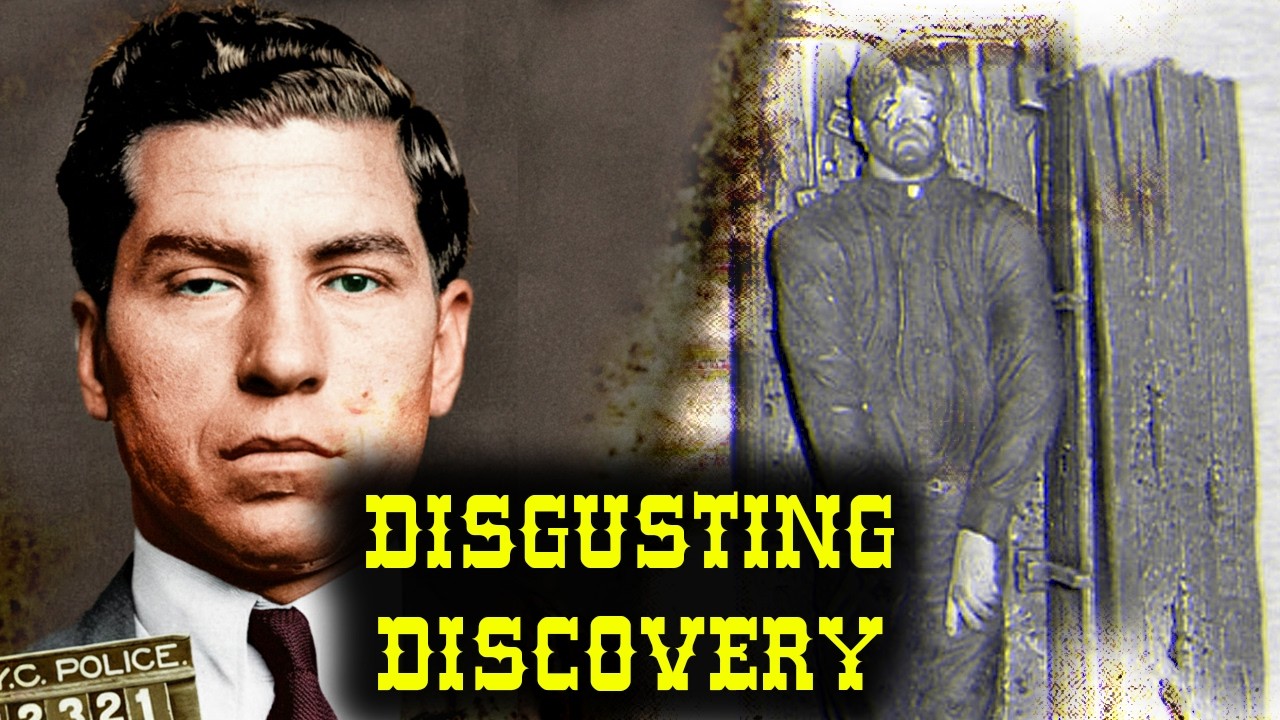
But his story did not end with his death. Months later, his body was exhumed from its temporary grave in Naples, placed on an aircraft, and flown back to the United States—a return journey he had spent 16 years of exile dreaming about. Born Salvatore Lucania in Sicily in 1897, he arrived in New York as a nine-year-old immigrant who spoke no English. He learned the streets before he learned the language, running a penny-a-day protection racket by age ten.
When one wiry boy refused to pay, Luciano beat him up. The boy, Meyer Lansky, came back the next day and still refused. That stubborn defiance became the foundation of a partnership that would define American crime for decades. By the late 1920s, the Italian underworld was tearing itself apart in the Castellammarese War.
Two rival bosses, Joe Masseria and Salvatore Maranzano, fought for control while bodies piled up across Brooklyn and the Bronx. Luciano, Masseria’s lieutenant, saw what neither old boss could: the future belonged to whoever could organize all the factions—Sicilians, Neapolitans, Calabrians, Jews, Irish—into a single machine. On April 15, 1931, Luciano arranged a lunch with Masseria at a Coney Island restaurant. After the meal, he excused himself to use the restroom.
Four gunmen entered through the front door and shot Masseria dead. When asked about his boss’s death, Luciano reportedly said, “He was a pig. He ate like a pig, and he died like a pig. ”
Five months later, Luciano eliminated Maranzano as well, sending killers disguised as IRS agents to his Park Avenue office.
In less than half a year, he had removed both kings and replaced the old feudal system with a commission—a ruling body of equals that settled disputes through consensus rather than war. The structure proved so durable that it outlasted him by more than half a century. In 1936, Special Prosecutor Thomas Dewey brought Luciano down on 62 counts of compulsory prostitution. Historians and legal scholars have since questioned the case.
The star witnesses were held in custody for weeks before trial, several later recanted, and Dewey’s tactics would likely constitute prosecutorial misconduct by modern standards. Luciano was guilty of many crimes, but the specific conviction that sent him to prison may have been built on coerced testimony. He was sentenced to 30 to 50 years and sent to Clinton Correctional Facility in Dannemora, known as “Siberia. ” Yet even from his cell, he continued to run his empire through coded letters and trusted visitors.
Then came Pearl Harbor, and a strange twist: in February 1942, the SS Normandie caught fire at a Manhattan pier, and naval intelligence suspected sabotage. With German submarines sinking ships off the East Coast, the Navy reached out to organized crime for help securing the waterfront. The project, called Operation Underworld, remains one of the most contested episodes in American criminal history. What appears to be true is that Luciano agreed to use his influence over dock workers’ unions and provided contacts in Sicily for the Allied invasion.
In exchange, on January 3, 1946, Governor Thomas Dewey—the same man who had prosecuted him—commuted his sentence on condition of permanent deportation to Italy. Luciano boarded the SS Laura Keene in February 1946, watching the New York skyline disappear. He would never see it again. Reporters captured a single exchange: when asked how it felt to leave, he reportedly answered, “They’re giving me a living death.
”
In Naples, Luciano lived under constant surveillance. He was a wealthy retiree in comfortable apartments, but he was a king without a kingdom. He tried to reclaim his throne in December 1946 by secretly traveling to Havana, Cuba, for a gathering of mafia leaders organized by Lansky, with a Frank Sinatra concert as cover. His message to the assembled bosses, according to multiple accounts, was blunt: “Tell them I ain’t dead yet.
” But U. S. officials learned of his presence, pressured Cuba with a pharmaceutical embargo, and he was expelled. It was the last time he set foot in the Western Hemisphere.
In Naples, Luciano found an unexpected tenderness with a dancer named Igea Lissoni, 20 years his junior. They lived together for years, and those who knew him said he softened in her presence. But she died of breast cancer in 1958, and Luciano was devastated. By then, his empire was slipping away.
In 1957, Vito Genovese orchestrated the attempted assassination of Frank Costello and seized control of the family—renaming it the Genovese family. Luciano could only watch from across the ocean. Of the 35 years between his rise and his death, Luciano spent only five as a free, active boss. The rest was prison cells and exile.
After his death, the question of where to bury him pulled in four directions. His family wanted him home in New York. The Italian government, eager to distance itself from a mafia icon, had every political incentive to encourage repatriation. The mob understood symbolism: leaving him in Naples would let the deportation have the last word.
And Luciano himself had said more than once that he wanted to return to America, alive if possible, dead if necessary. The bureaucratic process took months—petitions to Italian authorities, coordination with U. S. immigration officials, arrangements with the receiving cemetery.
Eventually, Luciano’s body was flown across the Atlantic and interred in a crypt at St. John’s Cemetery in Middle Village, Queens, alongside the men who defined the American mafia: Vito Genovese, Carlo Gambino, John Gotti. Martin Gosch, the producer Luciano was waiting to meet, later co-wrote “The Last Testament of Lucky Luciano,” published in 1975. Its accuracy is disputed, but it preserved the story Luciano wanted told—his version, in his voice.
Luciano’s true legacy was the structure he built. The commission functioned in recognizable form for decades after his death. The five-family system persisted into the 21st century. The organizational principles—hierarchical command, dispute resolution through consensus, separation of operations from leadership—were genuinely innovative in their criminal context.
The U. S. government deported his body, but it could not deport his blueprint. The deportation order that was supposed to end his influence did not.
And the trial that defined his life may have been built on a lie. Every domino that followed—the war collaboration, the commutation, the living death in Naples, the heart attack in the terminal, the coffin on the airplane—traces back to a prosecution that historians continue to question. In the end, Lucky Luciano got what he wanted: he went home.