LONDON — The voice of a young woman crackled through the headset, a calm counterpoint to the chaos unfolding in the skies above the Thames Estuary. In the filtered gloom of the operations room at Duxford, the air was thick with tension and the scent of sweat and tea. On the vast table map below, the tiny wooden blocks representing German formations were multiplying like a contagion, each one a spearhead aimed at the heart of London.
The controller, his eyes fixed on the colored arrows and the relentless sweep of the clock hand, had seconds to decide. Scramble. Climb.
 Intercept. The entire fate of a nation rested not on a lone pilot’s daring, but on the cold, efficient flow of information. This was the Dowding System in its first full, terrifying test.
And on this day, it did not fail.
By the summer of 1940, the maps of Europe were splashed with the colors of Nazi conquest. Poland, Norway, the Low Countries, and France had fallen in swift, brutal campaigns. Now, the German war machine stood on the French coast, just a short dash across the English Channel from a blockaded island.
Hitler’s audacious plan, Operation Sea Lion, was more than a military ambition; it was a prerequisite for conquest. But the invasion fleet, comprising thousands of barges and transports, was spectacularly vulnerable without one crucial asset: command of the skies. The Luftwaffe, the most battle-hardened and feared air force on the planet, was tasked with annihilating the Royal Air Force’s Fighter Command, turning the skies over Southern England into a German shooting gallery.
The air war that followed, fought from July through October 1940, would become known as the Battle of Britain, a monumental struggle not just for territory, but for the very principle of survival in a connected world.
At the outset, the odds looked overwhelmingly grim. Against them stood a small band of pilots, many fresh out of flight school, armed with Hurricanes and Spitfires. They were outnumbered by the Luftwaffe’s massed formations of bombers and swarms of escort fighters.
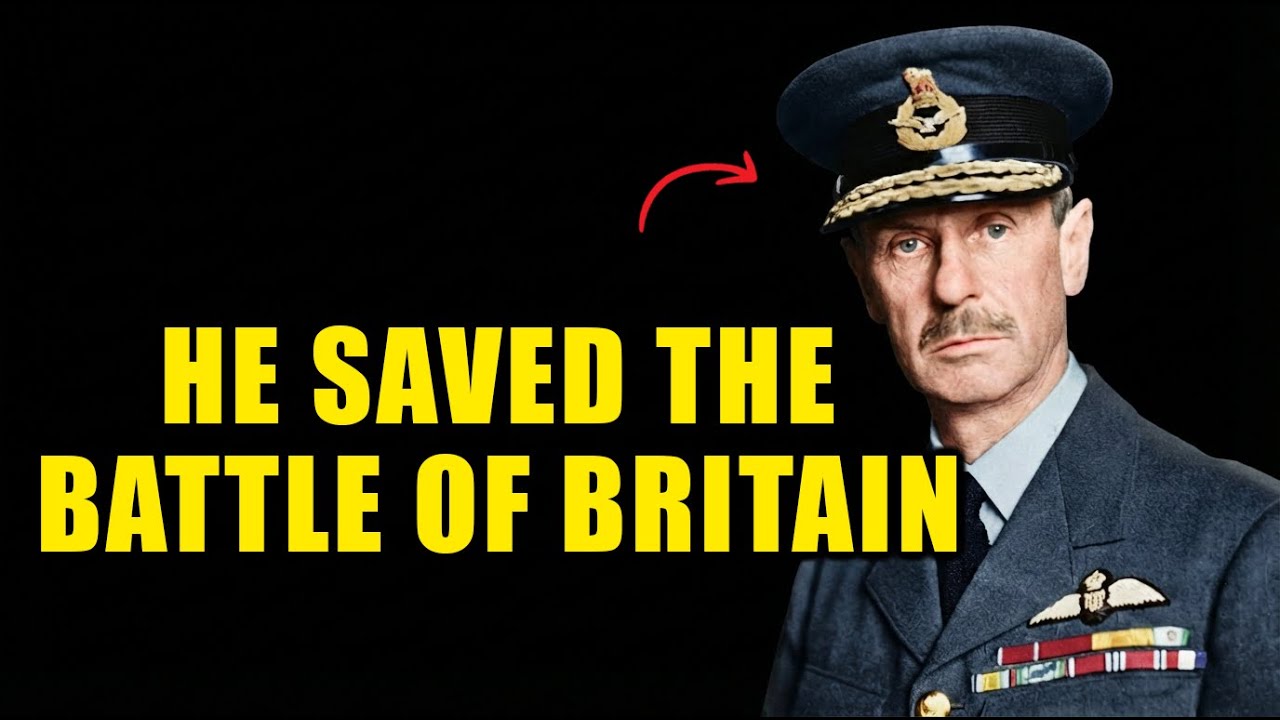
Yet behind the simple numbers of aircraft and pilots lay a profound, buried secret that the Luftwaffe’s intelligence services, with their overconfidence, had failed to grasp. That secret was not a miracle machine, but a new way of organizing air power. It was an architectural, human, technological chess game designed by a quiet, often aloof officer named Hugh Dowding.
His greatest weapon was not a new engine or a superior gun, but a system of linked eyes and ears—a radical departure from the way air defense had ever been conducted.
The intellectual seed of this system was planted during the Great War, with a brash officer named Edward Ashmore. Tasked with defending London from German airship and bomber raids, Ashmore built a rudimentary network: observer posts scattered across the countryside, a central plotting room in Whitehall, and a force of fighters and anti-aircraft guns. He discovered that the problem was not just interception but information management—how to find the enemy, translate that into a coherent picture, and then get the right forces to the right place at the right time.
He built a cigarette, an early form of command and control. Two decades later, Hugh Dowding took Ashmore’s principle and supercharged it with experimental new technology. It was called radar and it was the keystone of his entire architecture, giving Britain the gift of a warning.
On July 10th, 1940, the German’s first major assault opened. It began not with a single decisive blow, but with a grinding attrition aimed at coastal convoys and shipping. But it was not until August 13th, called Eagle Day, that the Luftwaffe’s main offensive began in earnest.
Day after day, the bombers came, targeting Fighter Command’s crucial sector stations in the south-east—the nodes of that ever—growing interdiction system—and the factories that produced the dwindling pocket of fighters. On August 12th, the Luftwaffe dealt a heavy blow by attacking the “Chain Home” radar stations, the exposed outer ring of the defense network, which were more like a scientific enclave than a military installations. Though sites like Ventnor on the Isle of Wight were knocked off the air for several days, the technicians worked feverishly to bypass the damage.
 The intricate grid remained perceptible to the plotters. Then, the German strategy made a fatal pivot. On September 7th, the main weight of assault switched from the crisis-ridden airfields to London itself.
The Blitz had begun. The drastic change of target gave the battered airfields and Fighter Command a breathing room just at the limit of their breaking point, while the Luftwaffe intelligence erroneously believed the RAF was on its last legs.
The key to Dowding’s strategy, the creation with which he is synonymous, was a network of delegated authority. The Chain Home radars, with their distinctive lattice masts, scanned the skies for approaching bombers over the Channel. Their information, along with hundreds of reports from the Royal Observer Corps’ almost 30,000 volunteers manning coastal and inland posts, was fed by telephone line into a central “Filter Room” at Fighter Command Headquarters in Bentley Priory.
There, human operators known as filter officers cross-referenced the high-speed data, struggled to eliminate all the false echoes and overlapping sightings from the approximate information, and set into a coherent synthesis. The purified picture of the incoming raid, its height, number, and track, was then passed to the group headquarters. And from there, the vital intelligence raced to the sector operations rooms dug into fields across Southern England, one such room being Duxford in Cambridgeshire.
Inside the Duxford’s operations room, the first layer of the defense met the second; radar met the WAAFs. Across the vast, flattened map of the southeast England, a group of ATS and WAAF plotters, wearing headsets, stood poised with long wooden croupier rakes. They were not just moving pieces; they were performing a ballet of data transfer.
As orders and calls were announced from the duty officer, they slid the tiny wooden blocks representing bomber formations across the map, tracking their every move. Above them, the controller looked down from his high desk on a graphical, yet living depiction of the aerial war. He was the commander, the conductor of this symphony of networked death.
To his ear, a radio, to another, a phone into the group. He had to calculate not just where the enemy was, but where they would be in 15 minutes, and how many of his precious squadrons would have the fuel and the altitude to find them. The colored arrows, which shifted every five minutes, kept the information, not just fresh, but a methodology for the battle.
It was here, in this environment, that a new and desperate improvisation took shape, often centered on Duxford. By the exigencies of war, British air marshal’s debated the tactics of employment. The resources available were still finite.
The man leading 12 Group, Air Vice Marshal Trafford Leigh-Mallory, and a charismatic legless pilot, Squadron Leader Douglas Bader, were fierce advocates of a “Big Wing” concept. Instead of sending individual squadrons in piecemeal, they wanted Duxford to pile on three, four, or even five squadrons into a single, massive formation. They argued that a bigger, concentrated assault had more firepower to smash a bomber fleet and better support their own pilots.
They saw it as the only way to bring maximum force. The problem was that the arithmetic of time was merciless. A large wing requires time to assemble and climb to an intercept.
For a 11 Group which was doing its own war, that time meant bombers slipping through the now-less crowded skies on their way to destroy targets. It was a fierce intra-rank battle between the ideal of size and the reality of speed.
 One of Duxford’s own squadron, a pilot born in a wheelchair, embodied this new strategy. Douglas Bader was a flashy, sometimes arrogant, leader, but an impeccable fighter pilot. He demanded his Duxford “Wing” be sent as a single mass.
A few times, his force did indeed arrive at the heart of a German bomber stream and tore it to shreds; but more often, the time it took to formate perfectly and descend meant his fighters arrived after the actual bombing had already started. It cost time, and time was the most valuable currency in that 1940 theater. But regardless of the controversies, it was the entire system that held the line.
The equation of production was a central battle, for example. Under the cabinet leadership of Lord Beaverbrook, Britain was turning out aircraft a pace that contradicted the enemy’s own intelligence.
Dowding’s leadership had its own internal critics. He was turned out to be a lonely, indecisive figure at times, but his brilliant tactical mind set the stage for Britain’s unique conditions. He understood that it was critical, not to constantly chase and fight the German formations over the Channel, where the safety of a damaged aircraft was a certainty.
He used his fighters as ammunition, preserving pilots as much as machines. He would sacrifice all to survive. The British tactics were simple: Hurricanes, the gangly workhorse of the fleet, were often sent the more lumbering bombers.
Spitfires, the glamour of the skies, were dispatched to take on the faster, more agile Messerschmitt Bf 109 escorts. It was a calculated exchange rate that worked in the RAF’s favor. Each pilot shot down in their own territory could bale out and come back to the fight, while the losing German airmen were captured or drowned.
Every. Every element, every pilot, every recovery of a damaged Stirling, was a small victory that was not just about aircraft production.
Again and again, throughout the late summer, the system was tested. It took the abuse. German intelligence spied bulletins were faulty, constantly overclaiming kills, they jumped the gun into the situation.
While the Luftwaffe’s own non-um, air crew losses were becoming a crisis. By mid-September the day of decision was at hand. On September 15th, the Luftwaffe launched its gigantic daylight raids, its largest and most threatening escalation.
The symbols on the table in Duxford’s operations room were for the highest tide. The din of phones called out clues of butters. He took a deep breath and gave the fateful command to start the Duxford overdue.
This was no longer a war of individual pilots; it was a war of controllers.
 In the main frame and two for rain, the RAF pounced the combined ram. The German bombers roar and the Master blitz. The scrabble of the I’m a battle.
The hurr the infrastructure on the south coast was set ablaze, the wave the resistance returned. In the Duxford operation room, the markers representing the biggest pushes began to fade from the great tall, as the enemy flew on their wings, throwing them into the sea or forced to retreat home. It was a culmination of a thousand unglamorous acts of coordination.
Communication, and thinking. The defeat was crushing. The Luftwaffe’s loss was beyond its ability to sustain for a longer sustained.
Operation Sea Lion, which had always been a fantasy, was postponed, then quietly shelved as the new battle of a winter turning grew.
Yet, the personal aftervalue of the story was bitter. Three months after this day of days, both Hugh Dowding and the man from southern Group, Keith Park, were removed. The bold, strategic whispers of the “Big Wing” advocates had won the inside politics game.
The men who built the capacity to save Britain were the ones who lost their command, replaced by the very ones they said were the argument’s most forceful. Their victory was too quiet to reward, and their enemies in the corridors of power, were relentless. But they had already left a permanent impact on history.
The remnants of the system Dowding built are still visible today. The plotters in a certain sense had no voices in their memories, still lean over a map of lonely. However, on that day, not alone.
The controller sees not a single hero, but the entire amalgam of a nation’s resolve, be it a man shoveling coal at the radar station or a walf plotting the enemy with a little wooden bar. The integration of information and action that ground the Luftwaffe’s was not a flash of individual genius, but the spirit of a will to fight as much as possible, too. As the weather turning for seven months to break the coastline, the dawning system that H Downing had created had not been a weapon.
It was a decision-making engine, a symbol of what an organized civil democracy could do when it faced the tyrannical weight of the war. It helped to buy Britain, that essentials of time, and since the rest of the United States and the Soviet Union were joined, the world to return.
Subsequent clairvoyant. The choice is all have been used here. The system was the United written soul of a empowered technician, and a touch) This will be a true peace meeting not between.