The legend of the Lone Ranger, a masked white hero of the Old West, is one of Hollywood’s most enduring stories. But historians argue that the real inspiration was Bass Reeves, a Black man born into slavery in 1838 who escaped during the Civil War and went on to become one of the most effective lawmen in American history. Reeves was appointed a federal deputy in 1875 in the Arkansas territory, a position that seemed impossible for a Black man at the time. Over the next three decades, he arrested more than 3,000 criminals in some of the most dangerous lands in the country.
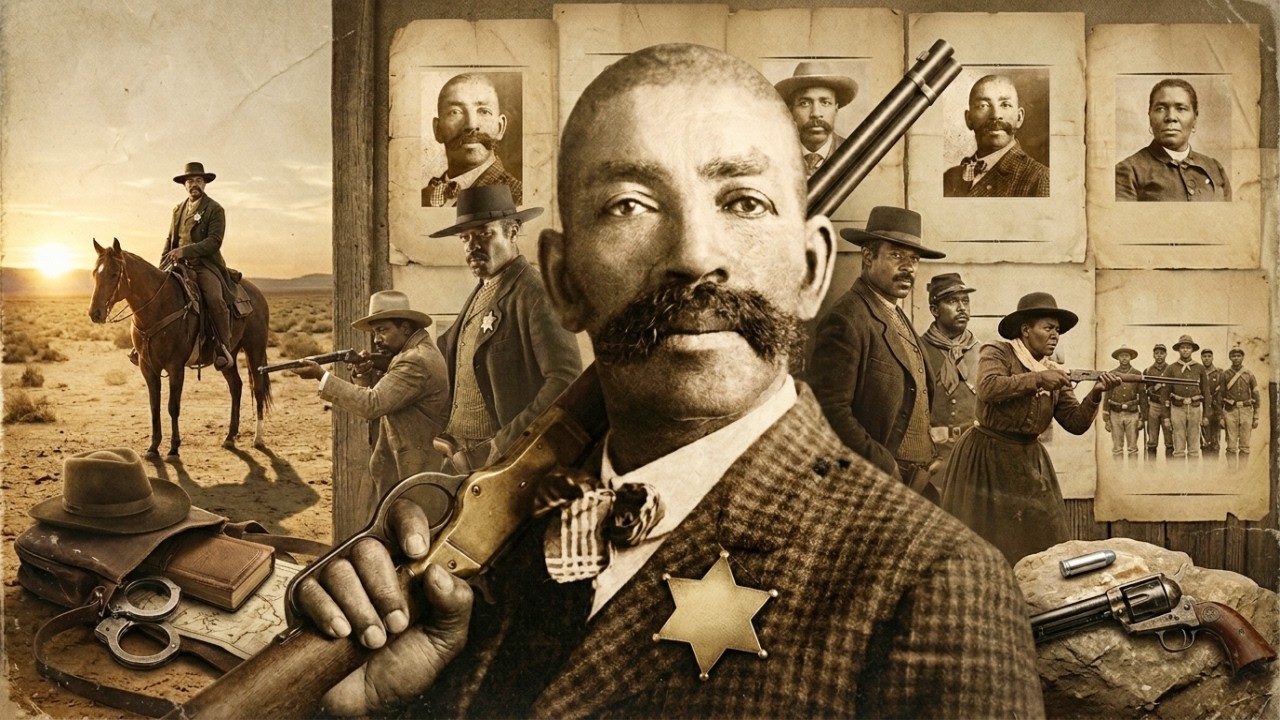
His methods were unconventional; he would disguise himself as a beggar or a preacher to get close to outlaws before capturing them. He spoke several Indigenous languages and was known for his remarkable aim. When he died in 1910 in Muskogee, Oklahoma, he was nearly broke, and his story was largely erased from history books for decades. Reeves is only one of many Black figures whose contributions to the American West have been overlooked or appropriated.
Bill Pickett, born in Texas in 1870 to formerly enslaved parents, invented the rodeo technique known as bulldogging, where a cowboy grabs a steer by the horns and bites its lip to bring it down. Pickett became a star in American rodeos and toured with Wild West shows across Europe and South America. Despite his fame, hotels refused to let him stay because of his skin color. In April 1932, at age 61, he was trampled by a wild stallion on a ranch in Oklahoma, dying doing the work he had done his entire life.
Nat Love was born enslaved in Tennessee in 1854 and was left with nothing when the Civil War ended. At 15, he traveled alone to Texas and began breaking wild horses. He survived shootouts and attacks, drove cattle thousands of miles, and in 1876 won every competition at a rodeo in Deadwood, South Dakota, earning the nickname Deadwood Dick. He wrote an autobiography recounting his adventures, but died in 1921 in Los Angeles working as a train porter, largely forgotten.
Bose Ikard was born enslaved in Mississippi in 1843 and later became the trusted right-hand man of Charles Goodnight, one of the largest ranchers in Texas. Goodnight relied on Ikard during dangerous cattle drives, where Ikard dealt with thieves, hostile encounters, and unknown terrain. On one occasion, he saved his boss’s life during an attack. Goodnight, a man of few words, said Ikard was better than any white cowboy he had ever known.
When Ikard died in 1929 at age 85, Goodnight paid for his headstone and wrote the epitaph himself. Mary Fields, known as Stagecoach Mary, was born enslaved in Tennessee around 1832. After the Civil War, she worked at a convent in Ohio until a nun friend became ill in Montana. Fields went to help and never returned.
At age 60, she became a stagecoach driver, the only applicant who could hitch six horses in record time. For eight years, she delivered mail through blizzards, theft attempts, and dangerous terrain. When the stagecoach got stuck in snow, she carried the mail on her back. She died in 1914 at age 82 in Cascade, Montana.
Crawford Goldsby, known as Cherokee Bill, was a mixed-race outlaw of Black and Cherokee heritage. At just 18, he was one of the most wanted men in Oklahoma territory, terrorizing trains and robbing stores between 1894 and 1895. Authorities attributed 13 killings to him, including a jail guard during an escape attempt. Judge Isaac Parker, famous for sentencing outlaws to death, handled his case.
In March 1896, at age 20, Goldsby was executed in Fort Smith, Arkansas. When asked for last words, he said, “I came here to die, not to make a speech. ”
Isom Dart was born enslaved around 1849 and after the Civil War headed to Wyoming, where he began stealing horses. He had the ability to change his name, alter his appearance, and disappear, evading bounty hunters for decades.
He lived among Native tribes and learned survival skills. In October 1900, at age 51, he was ambushed on Cold Spring Mountain by Tom Horn, a feared hired gun, who shot him twice. George McJunkin was born enslaved in Texas in 1851 and later worked as a cowboy in New Mexico. He was self-taught, learning to read, play violin, and study geology.
In 1908, after a flood, he noticed large bones mixed with human-made spear points near Folsom. He spent years trying to persuade scientists to investigate, but few took a formerly enslaved Black man seriously. He died in 1922 without recognition. Later research confirmed the site proved humans were in the Americas more than 10,000 years ago, rewriting the continent’s history.
Jim Beckwourth was born enslaved in Virginia in 1798, gained his freedom, and became a fur trapper in the western mountains. He discovered a key pass in the Sierras that helped thousands of pioneers reach California. He was adopted into the Crow nation and made a war chief, fighting alongside them and marrying Crow women. When he died in 1866 at age 68, some historians believe the Crow themselves may have poisoned him as an honor ritual to keep his spirit with the tribe forever.
York was the only Black man on the Lewis and Clark expedition between 1804 and 1806. Born enslaved and owned by William Clark, York hunted, explored, and risked his life alongside the others. Native tribes, who had never seen a dark-skinned man, often tried to rub his skin, believing it was paint. Upon returning, Clark refused for years to grant York his freedom.
After finally being freed, he attempted to run a freight business, but it failed. Historians believe he died of cholera around 1832 in St. Louis, largely forgotten. Biddy Mason was born enslaved in Georgia in 1818 and was forced to walk 1,700 miles barefoot behind a wagon train to California, caring for cattle and children.
Upon arrival, she discovered slavery was illegal in the state, though her owner had not told her. She took her case to court and won her freedom in 1856. She worked as a midwife, saved money, and bought land in downtown Los Angeles, building a fortune. She used her wealth to feed prisoners, found churches, and help families in need.
She died in 1891 at age 72. Clara Brown was born enslaved in Virginia in 1800. At age 56, after finally gaining her freedom, she traveled to Colorado during the gold rush. With no money, she washed clothes and cooked for miners, saving enough to buy property in Denver.
She spent much of her fortune searching for her family, who had been sold and scattered years earlier. After decades of searching, she found the daughter she thought she had lost forever. She died in October 1885 at age 85. In 1866, a formerly enslaved woman from Missouri named Cathay Williams disguised herself as a man and enlisted in the US Army under the name William Cathay.
She became the only documented woman to serve in the Buffalo Soldiers, the famed Black regiments of the West. For two years, she marched through the New Mexico desert without her secret being discovered, even during medical examinations. It was only when she became seriously ill in 1868 that the truth came out, and she was discharged. She spent her later years in poverty and died around 1893, nearly forgotten.
Louisa Marchbanks was born enslaved in Tennessee in 1833. After the Civil War, she settled in Wyoming and became one of the most sought-after cooks in the Old West, eventually cooking for US presidents. Miners in Deadwood called her Aunt Lou, and she was known for feeding anyone who showed up at her door hungry. She died in March 1911 at age 78, having built a reputation that crossed social classes.
Jesse Stahl, born around 1879, was one of the best wild horse breakers in rodeo history. Despite dominating competitions, the top prizes consistently went to white cowboys. In a silent protest, Stahl began riding the meanest horses backward to prove his skill. He traveled the American West for decades, drawing crowds who paid to see his feats.
He died in 1935 at age 56, and his story remained buried for generations. Henrietta Stewart was born in Canada in 1858 and became a doctor, practicing in New Mexico in the late 1800s, treating miners and Native American families despite facing daily prejudice. She lived until 1951, at age 93, witnessing the country change from the wagon era to the first steps of the space age. In 1982, Charlie Sampson became the first Black man to win a world rodeo championship in the Professional Rodeo Cowboys Association.
Growing up in Los Angeles, far from ranches, he was drawn to bulls and wild horses. He broke ribs and suffered repeated injuries, yet kept riding 2,000-pound animals. His win opened doors that had been closed for more than a century. Ben Hodges, born around 1840, was a Black cowboy from Kansas who conned ranchers by pretending to be Indigenous.
He stole cattle using disguises and elaborate stories, and was never arrested. He died of old age around 1929 in Dodge City. Willie Kennard took the marshal’s badge in Yankee Hill, Colorado, at a time when few Black men held positions of authority. The town was being terrorized by a gang that had run off previous sheriffs.
The outlaws dared Kennard to take the job, believing he would be easy prey. He faced the leaders in separate duels and killed both. The gang scattered, and the town found peace. What happened to Kennard afterward remains a mystery, as records from the 1880s stop mentioning him.
Addie Huddleston built a fortune in Cheyenne, Wyoming, running a brothel and becoming one of the richest women in the area. She operated openly, paid her taxes, and did business with the local elite. In a segregated society, her money and discretion opened doors that usually stayed shut. She died of natural causes in the 1880s.
These figures represent a wide range of experience in the Old West, from lawmen and cowboys to outlaws, explorers, and business owners. While many of their stories have been ignored, minimized, or reassigned to white characters in popular culture, their documented lives show that Black men and women were central to the making of the American West.


