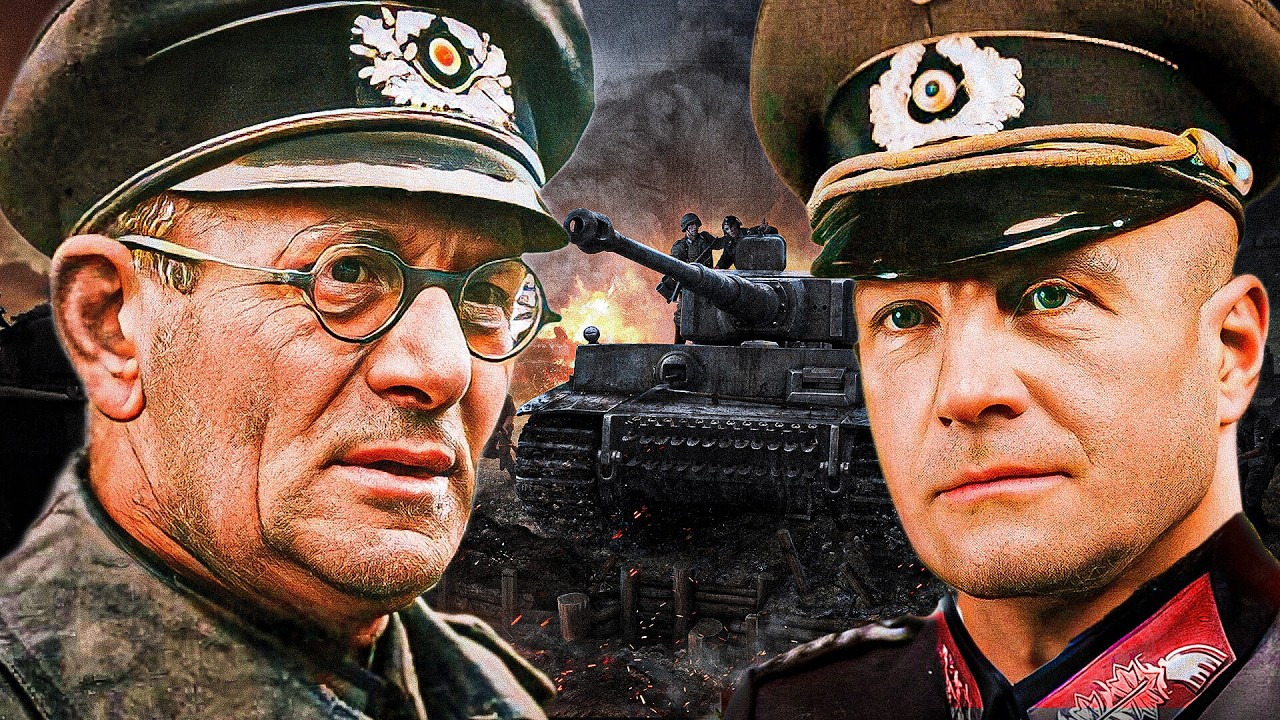
The gilded batons of the Third Reich, symbols of absolute military command and unwavering loyalty to Adolf Hitler, were stripped of their prestige in the ashes of 1945. The men who wielded them, the elite of the Nazi war machine, faced a fractured spectrum of justice, ranging from war crimes tribunals and Soviet prison cells to comfortable retirements and controversial acquittals. The fates of these field marshals, who orchestrated the Blitzkrieg and brutal occupations, reveal a complex and often deeply unsatisfying account of accountability in the post-war world, where the lines between soldier, criminal, and victim of circumstance were tragically blurred.
Among the highest-ranking officers of the Wehrmacht, Walther von Brauchitsch’s story is a stark example of how mortality could cheat the hangman. As the Commander-in-Chief of the German Army from 1938 to 1941, he masterminded the early, stunning victories in Poland and France. However, his relationship with Hitler was a toxic dance of dependence and frustration, as the Führer’s strategic meddling increasingly undermined his authority.
 The failure of Operation Barbarossa and the stalled advance on Moscow in 1941 broke him both physically and professionally. A heart attack in November, followed by Hitler’s cold dismissal in December, relegated him to a forced retirement at his estate. This private life was shattered in August 1945 when British forces arrested him on charges of war crimes.
The former commander was held in British custody for three long years, his fate hanging in the balance as the world grappled with how to prosecute aggressive war. The Nuremberg trials were designed to deliver justice, but Von Brauchitsch was set to face a separate tribunal. It was a moment of high tension, as the proceedings against him were about to begin, but fate intervened with a final, decisive blow.
On October 18, 1948, the man who had led Hitler’s armies into conquest died of pneumonia. He never had to answer for his strategies or his obedience, leaving a lingering question of whether his death was a failure of justice or a merciful end for a man already condemned by history.
Maximilian von Weichs presents a far more direct case of alleged war crimes, particularly in the brutal theater of the Balkans. A field marshal who commanded the 2nd Army in France and the Soviet Union, he was appointed to lead German forces in the Balkans in 1944. His command was defined by a ruthless campaign against partisan resistance, where he bore significant responsibility for widespread atrocities and brutal reprisals against civilians in Yugoslavia and Greece.
As the war ground to its inevitable conclusion, he retired in March 1945 but was quickly taken into custody by American troops just two months later. He was subsequently named as a defendant in the US Army’s Hostages Trial at Nuremberg, charged with the suppression of partisans and the associated brutal policies.
The trial was a landmark moment in the attempt to hold high-ranking officers responsible for the conduct of their subordinates. However, in a controversial and confounding twist, Von Weichs was removed from the proceedings before a verdict could be reached. The official justification cited was his poor health, a medical exemption that effectively absolved him of any legal responsibility.
The decision sparked outrage and serious ethical questions about the consistency of justice for war criminals, as a man allegedly involved in grave atrocities was allowed to walk free on a technicality. Fon Weichs lived out his remaining years in Bonn, quietly passing away in 1954, having escaped the judgment of the courtroom while remaining a subject of historical condemnation.
The fate of Georg von Küchler illustrates the selective memory and justifications often employed by the German High Command. Rising to command Army Group North during the invasion of the Soviet Union, his forces were involved in a brutal campaign that included harsh military policies and significant war crimes. He was dismissed by Hitler in early 1944 after failing to halt Soviet advances and retreated into retirement, even turning down an invitation to join the anti-Hitler resistance.
Following the war, the American Army arrested him, and he was forced to face the consequences in the High Command Trial. He was accused of war crimes and crimes against humanity, including the murder of mentally disabled individuals in occupied territories.
 During his trial, Von Küchler attempted to shift blame, admitting to harsh conditions in POW camps but attributing them to the “harsh fighting conditions” and the severe Russian winter, which he boldly described as an act of God. He also sought to downplay the severity of the mass casualties by claiming the Red Army exaggerated mortality figures to solicit more supplies from the German government. These desperate attempts at mitigation failed to convince the court.
He was found guilty and sentenced to 20 years in prison. However, the sentence was later reviewed and reduced to 12 years through a combination of international pressure and the shifting political climate of the Cold War. He was released in February 1953, serving less than a decade for his role in the death and suffering of millions, and lived quietly with his wife until his death in 1968, a man who never truly confronted the full horror of his command.
Few cases highlight the inconsistent application of post-war justice as starkly as that of Wilhelm Ritter von Leeb. A decorated officer from World War I, he was promoted to field marshal after his success in France in 1940. His legacy, however, was irrevocably tainted by his command of Army Group North during Operation Barbarossa.
His forces cooperated closely with the SS Einsatzgruppen, facilitating mass executions of Jews and other civilians, and he diligently transmitted the infamous Barbarossa Decree, which authorized the summary execution of Soviet political commissars. His command was a cog in the machine of annihilation, yet he was never personally implicated for the murder of civilians on a mass scale.
In the High Command Trial, Von Leeb’s defense painted him as a humane soldier, a man who was merely a victim of circumstance and military necessity. The court accepted this narrative, acknowledging that no criminal order bore his personal signature. In a decision that defied the very purpose of the trials, Von Leeb was convicted but received a shockingly lenient sentence: three years, which was deemed time served.
He walked free, having received secret gifts and an estate worth hundreds of thousands of Reichsmarks from Hitler, evidence of his deep complicity with the regime. He retreated to his Bavarian estate, passing away in 1956, a symbol of how the legal system struggled to hold the “good soldier” accountable within a criminal system he had served with devotion.
Similarly, Ewald von Kleist’s post-war life was a tragic story of capture and imprisonment in the Soviet Union, but his fate differed dramatically from the Western-imposed justice. A renowned panzer commander, he was a master of blitzkrieg warfare, leading the 1st Panzer Army through the Soviet Union and achieving a major encirclement at Kiev. His command was marked by a fast-moving, aggressive style that proved devastatingly effective.
However, his career reached a zenith and then a rapid decline. After being dismissed by Hitler in 1944 for his army’s retreat from the Caucasus, he was later arrested by the Gestapo due to his cousin’s involvement in the 20th July plot to assassinate Hitler. He was released, but his freedom was short-lived.
 At the war’s end, Von Kleist was captured by Allied forces and eventually handed over to Yugoslavia, where he was sentenced to 15 years for war crimes. He was then extradited to the Soviet Union for a separate trial. There, he was convicted of war crimes committed on the Eastern Front and sentenced to 25 years in a correctional labor camp.
This was a dramatic difference in severity compared to the Western allies. Instead of a comfortable retirement, Von Kleist spent his final years in Soviet captivity. He died of heart failure on November 13, 1954, at the Vladimir Central Prison, becoming one of the highest-ranking German officers to die in Soviet custody.
His fate was a direct reflection of the brutal reality of the Eastern Front and the Soviet Union’s more unforgiving approach to justice.
The case of Wilhelm List is another example of a light sentence that shocked observers and undermined the Nuremberg precedent. After commanding forces in Poland and the Balkans, his key assignment was leading Army Group A during the invasion of the Soviet Union in 1942. After the failure of Operation Blue and his dismissal by Hitler, he was arrested and tried in the Hostages Trial.
He was specifically charged with war crimes in the Balkans, where his command oversaw brutal reprisals and mass executions of civilians in retaliation for partisan attacks. He was sentenced to life imprisonment in 1948, a significant victory for the prosecution’s case that commanding officers were responsible for the conduct of their troops.
Yet, in a move that highlighted the political shifts of the early 1950s, List was released in 1953 due to “ill health.” His release was part of an amnesty for convicted war criminals, driven by the Western Allies’ desire to rearm West Germany as a bulwark against the Soviet Union. Despite his initial life sentence, List was a free man, living a remarkably long life.
He passed away in 1971 at the age of 91, having enjoyed nearly two decades of freedom after being convicted of complicity in the atrocities of the Balkans campaign. His case, like others, demonstrated that justice, in the post-war era, was often a flexible concept, heavily influenced by the pragmatic needs of the emerging Cold War.
The historical record of these men reveals a far more nuanced and troubling picture than a simple case of justice being served. The Nuremberg and subsequent trials were a revolutionary step in international law, but they were deeply flawed. The legal system’s focus on written, signed orders allowed many commanders to claim they were just following orders or that they were ignorant of the crimes being committed in their name.
 Field marshals like Von Leeb and Von Weichs were able to use their social standing, legal defense, and health concerns to evade meaningful punishment, while others, like Von Brauchitsch, escaped through death. The trials often failed to grasp the moral culpability of men who created the conditions for systematic murder, even if they didn’t personally pull the trigger.
In stark contrast, the Soviet Union and the Eastern European nations delivered a much harsher form of justice. Men like Von Kleist were given severe sentences and died in brutal conditions, reflecting the profound anger and desire for revenge against those who had caused immeasurable suffering on the Eastern Front. The discrepancy in punishments between the Eastern and Western judicial systems created a lasting sense of injustice and hypocrisy, as individuals guilty of similar grave offenses received wildly different fates based solely on which army had captured them.
This inconsistency remains one of the most debated aspects of the post-war prosecutions, leading many to question whether the pursuit of justice was ever truly the primary goal, or if it was always secondary to the political landscape of the Cold War.
The stories of these field marshals are not just a collection of biographies; they are a case study in the complexities of humanity under extreme circumstances. They represent a generation of military officers who were trained to serve their nation, but in doing so, they became willing tools of a genocidal regime. They demonstrated undeniable military competence and tactical brilliance in campaigns that were strategically audacious, yet they failed to retain their moral compass.
Their actions were not confined to the battlefield; they included the brutal occupation of lands and the facilitation of mass murder. Their careers were a testament to the dangerous seduction of power, ambition, and the intoxicating influence of an absolute leader like Hitler.
Moreover, their fates in the post-war years 𝓮𝔁𝓹𝓸𝓼𝓮𝓭 a profound fracture in the Western Allies’ stated commitment to justice. The “High Command Trials” were meant to establish a precedent that military leaders could not immunize themselves against criminal political orders. Instead, they often created a legal loophole that the defense could exploit.
The release of convicted war criminals like List in the 1950s was a direct result of the rapid geopolitical shifts, with West Germany becoming a crucial ally against the Soviet Union. This pragmatic move, while understandable from a strategic perspective, served as an explicit admission that the judicial process had been compromised by the very political expediencies it was meant to judge.
In the final analysis, the legacy of Germany’s field marshals after World War II is a cautionary tale. It is a story of how a nation’s military elite can be utterly corrupted by an authoritarian ideology, and how the subsequent attempt to atone for their crimes through legal means was a profoundly human and imperfect process. The pipe dream of a clean, universal justice system was corrupted by politics and the inequities of history.
Some of these men faced the full displeasure of the courts, while others died in obscurity, but they all shared a common thread: a career that began with the pursuit of military glory and ended with the profound ignominy of defeat and, for many, the accusation of being a war criminal. The legacy of their actions is a permanent stain on the history of Germany, and the outcome of their trials remains a lesson in the elusiveness of perfect justice in a chaotic world.