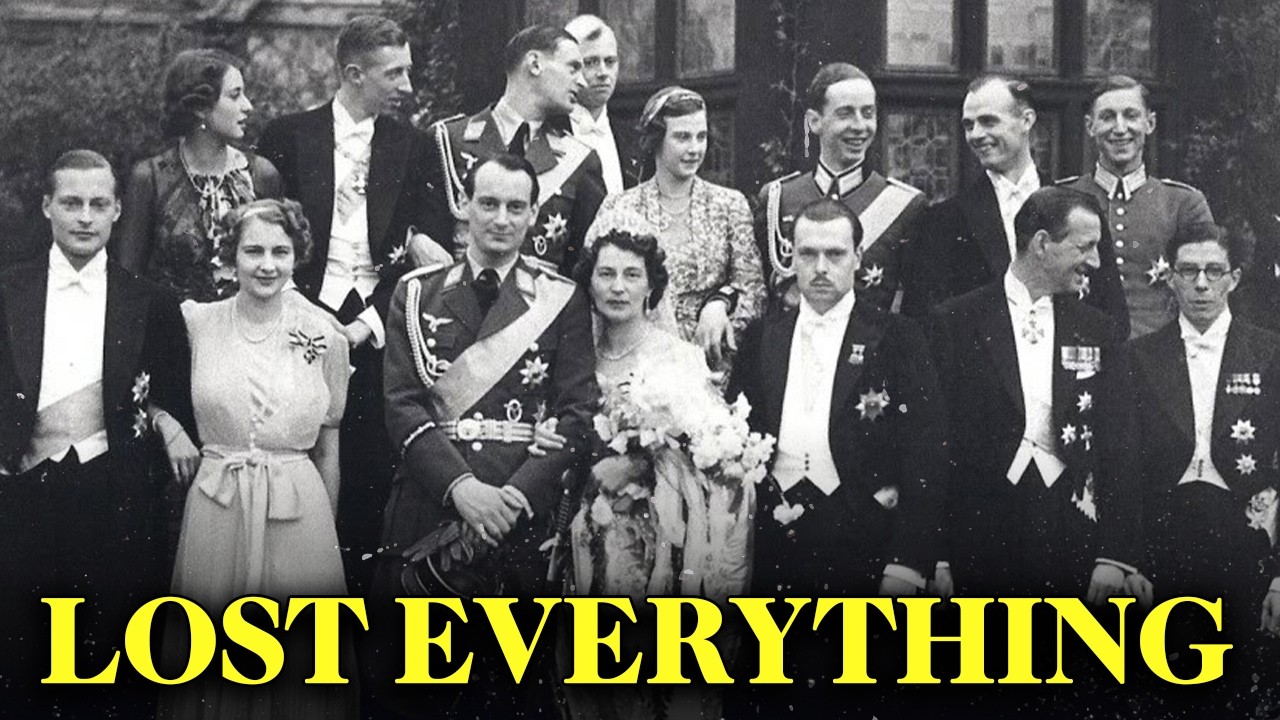
The ornamental facade of the Russian Empire has always obscured a more complex and tragic truth. While history has etched the brutal execution of Tsar Nicholas II, his wife, and their five children into the collective memory as the defining image of the Romanovs’ end, that single moment of violence in a Yekaterinburg cellar was not the final chapter. It was the prologue to a scattered, quieter, and decades-long afterlife of survival for the dozens of imperial relatives who escaped the carnage of the revolution.
On a gray April morning in 1919, that reality was made manifest on the dock at Yalta Harbor. The Dowager Empress Maria Feodorovna, a woman of formidable poise and 71 years of age, stood with the posture of a sovereign attending a state function, not a refugee fleeing a collapsing civilization. Before her loomed the HMS Marlborough, a 14,000-ton dreadnought of the British Royal Navy, its gun turrets angled toward a coastline that had already become lethally hostile.
 The woman had recently received word of her eldest son’s murder, along with his wife and all five children. As British sailors loaded her jewel cases and her servants stood with the foreign-issued certificates that now constituted their only right to leave, she did not weep. She boarded the warship and did not look back at the mist consuming the Crimean coast, carrying with her the title of an empire that no longer existed and the grief of a family that had been violently pruned.
The Romanovs were not merely a royal family; they were the state itself, a structure of immense wealth and political power that had ruled the largest country on Earth for 304 years. The men were trained for military command, the women for dynastic marriage and courtly presentation. Their identities were inseparable from the imperial apparatus.
When the February Revolution of 1917 forced Nicholas II’s abdication, the system that defined their existence evaporated overnight, leaving them not with skills for the modern world but with habits of absolute privilege, a few trunks of jewels, and a profound inability to function without a court to command them.
The internal dynamics of the family before the fall had been riven with contradictions. The murder of Grigori Rasputin in December 1916, orchestrated in part by Grand Duke Dmitri Pavlovich, was a desperate act of self-preservation that instead accelerated their doom. Dmitri’s banishment to the Persian front, a punishment for his involvement, inadvertently saved his life.
He survived the revolution to drift through Paris and London, finding temporary stability in a liaison with Coco Chanel and a marriage to an American heiress before dying of tuberculosis in a Swiss sanatorium in 1942. His sister, Grand Duchess Maria Pavlovna, known as Marie, responded to exile with a pragmatic industry that set her apart. After escaping through Ukraine and Romania, she found herself in Paris with no income.
 She began by knitting, then founded the Kitmir embroidery workshop, which successfully supplied the house of Chanel, proving that the aesthetic instinct of the old court could be monetized in the new world, even if the bread and milk prices remained a startling economic revelation.
The British connection, so intimate that Tsar Nicholas II and King George V were first cousins who looked nearly identical, proved a brittle lifeline. While George V provided shelter for the Dowager Empress and his cousin Xenia, her daughter, the offer of asylum for Nicholas and his immediate family was withdrawn due to political anxieties about establishing a deposed autocrat on British soil. This decision, a subject of historical debate, effectively sealed the fate of the Tsar and his children.
The survivors were left to navigate the charity of their European relatives, inhabiting grace-and-favor residences like Frogmore Cottage and Wilderness House at Hampton Court, where Xenia spent 41 years of quiet, dignified dependence under the British crown.
Throughout Western Europe, the diaspora was adapting to a world that had no formal place for them. Grand Duke Kirill Vladimirovich, a cousin who had famously worn a red ribbon to the Duma after the abdication, chose to view the revolution not as a personal tragedy but as a constitutional succession crisis. In 1924, he proclaimed himself Emperor in Exile, a claim that fractured the family and continues to divide descendants today.
 His brother, Grand Duke Andrei Vladimirovich, relied entirely on the formidable Matilda Kshesinskaya, the former prima ballerina and former mistress of Nicholas II, to keep their household afloat. She opened a ballet school in Paris, teaching the Vaganova technique and survival through sheer force of will until her death at the age of 99 in 1971, the last living link to the Imperial Ballet.
The fates of the younger generation illustrate the sheer randomness of the survival lottery. Prince Theodore Alexandrovich, Xenia’s son, drove a taxi in the streets of Paris to pay his rent before eventually training as an architect. Prince Vasili Alexandrovich traveled to America, working as a cabin boy, shipyard laborer, wine maker, and chicken farmer in California.
The quietest and most profound escape was that of Grand Duchess Olga Alexandrovna, the Tsar’s youngest sister. She had married a commoner she loved, lived on a dairy farm in Denmark, and eventually emigrated to Canada to avoid Soviet influence. She painted more than 2,000 watercolors of flowers and landscapes to support her family, living her final days in a modest flat above a barber shop in Toronto, where she died in 1960, just days after her sister Xenia passed away in London.
A century removed from the guns of the Marlborough, the Romanov narrative has entered the realm of legal and genealogical dispute. The Romanoff Family Association, uniting dozens of descendants across the globe, advocates for a collective approach to preserving the family’s legacy. In contrast, the self-styled legitimist branch, led by Grand Duchess Maria Vladimirovna and her son George, continues to claim the headship of the Russian Imperial House, maintaining a royal household in exile with active websites and public appearances.
 The story of the Romanovs who escaped is not a singular narrative of tragedy or triumph; it is a diverse collection of human responses to catastrophic displacement.
The cultural afterlife of the family has proven as potent as its political one, dominated by the mystery of Anna Anderson, a woman who claimed for decades to be the surviving Grand Duchess Anastasia, a claim eventually disproven by DNA analysis. The remains of the Tsar and his family were eventually exhumed, identified, and given a state funeral in 1998 in St. Petersburg, a powerful act of symbolic reparation.
The Russian Orthodox Church canonized them as passion-bearers in 2000, adding a spiritual dimension to a historical trauma. The survivors of that trauma, dispersed across the West, continued working, sewing, and adapting. The story of the Romanov relatives who escaped is not simply what happened then; it is what happened next, a long and unglamorous struggle for existence that lasted long after the headlines faded.