Field Marshal Friedrich Paulus, commander of the encircled German Sixth Army at Stalingrad, refused to order his remaining troops to surrender during his first formal interrogation by Soviet commanders on January 31, 1943, setting the stage for a tense intelligence battle in which a single translator would become the decisive instrument for ending the bloodiest confrontation of the Eastern Front.
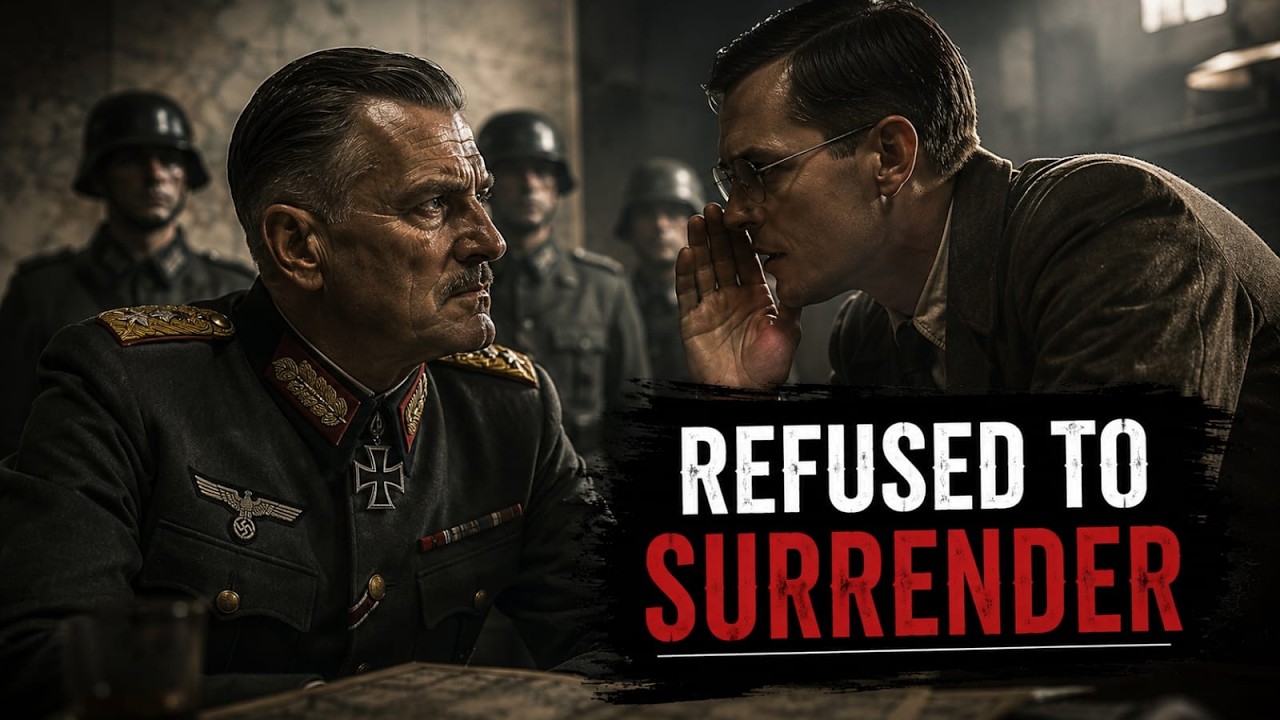
The meeting took place at the headquarters of the Soviet Don Front near Stalingrad, hours after Paulus had been captured in the southern part of the devastated city. The German commander had been promoted to field marshal by Adolf Hitler only two days earlier, a promotion intended to bind him to a fight-to-the-death doctrine. Instead, he was now a prisoner of the Soviet Union.
Soviet commanders faced an urgent problem that had nothing to do with recording the capture. Large numbers of German soldiers were still fighting in the northern part of the pocket, particularly around the industrial districts of the ruined city. Every additional day of resistance meant more casualties on both sides and further destruction inside a city already reduced to rubble by months of combat.
General Konstantin Rokossovsky, commander of the Don Front, Marshal of Artillery Nikolai Voronov, and Political Commissar Konstantin Telegin entered the meeting with a single objective: to persuade Paulus to issue an order that would stop the fighting. The task of making that persuasion possible fell to Captain Nikolai Dmitrievich Dyatlenko, a Soviet interpreter who had spent much of the war working with German prisoners and military intelligence.
Dyatlenko was not an accidental linguist. His responsibilities included interrogation and translation, tasks that demanded far more than vocabulary. Military language carried distinctions of rank, authority, intention, and circumstance that could vanish when words were translated too literally.
By the beginning of 1943, Soviet intelligence organizations had learned how valuable such distinctions could be.
The role was especially critical because the people being questioned were not ordinary prisoners. Senior German officers were trained to think carefully about what they said, and their answers often depended on formal military relationships. A translator therefore had to listen not only to the words but also to how an officer positioned himself within the German command structure.
Dyatlenko had already encountered that problem during the Stalingrad campaign. Earlier in January, he had been part of a Soviet delegation sent toward the German lines with an offer intended to persuade the encircled Sixth Army to surrender. The mission was conducted under difficult conditions and required the Soviet representatives to approach the German positions under a flag of truce.
Paulus did not personally receive them. The delegation returned without achieving its purpose.
That failed mission would later become important to Dyatlenko’s work. After the collapse of the German pocket, he questioned captured officers, including Colonel Wilhelm Adam, who had served as Paulus’s adjutant. During that interrogation, Adam provided information about who had actually made important decisions inside the German headquarters.
He indicated that General Arthur Schmidt, Paulus’s chief of staff, rather than Paulus himself, had been responsible for rejecting the Soviet envoys.
For Dyatlenko, this was more than an isolated detail. The distinction between Paulus and Schmidt mattered because the German headquarters was not functioning simply according to the formal hierarchy shown on an organizational chart. Paulus was the commander, but the practical exercise of authority inside the collapsing pocket could be influenced heavily by his chief of staff.
That made the upcoming meeting with Paulus an intelligence opportunity.
The meeting took place in an ordinary building rather than a formal military conference room. A Soviet documentary filmmaker, Roman Karmen, was also present to record the encounter. The famous photograph taken during the meeting would later become one of the most recognizable images of Paulus in captivity.
But the photograph did not reveal the central intelligence problem facing the Soviet officers.
When the meeting began, Voronov addressed Paulus formally. Dyatlenko translated the remarks into German. Paulus listened carefully.
His condition reflected the strain of the preceding weeks. He had been surrounded for months. His army had been cut off from reliable supplies, and the Soviet advance had destroyed any realistic prospect of relief.
Yet he remained conscious of his formal position.
One of the first corrections Paulus made concerned his rank. The Soviet officers knew that he had been promoted to field marshal shortly before his capture. Paulus pointed out that he was no longer merely a colonel general.
His promotion had been communicated to his headquarters and recorded in his military papers. It was a small exchange, but it established something important about the atmosphere of the interrogation.
Paulus was not approaching the meeting as a commander who had voluntarily decided to abandon his army. He continued to define his actions through the formal language of German military duty. That distinction became central when Voronov asked him to order the remaining German forces to surrender.
Paulus refused. His argument rested on military legitimacy. As a prisoner, he maintained that he could not issue an order that would bind German forces still fighting elsewhere in the pocket.
He also insisted that he had not surrendered in the ordinary sense. According to the account of the interrogation, he maintained that he had been taken by surprise rather than voluntarily capitulating.
The Soviet officers regarded the argument as unacceptable. For them, Paulus was the commander of the Sixth Army, and the continued resistance of his troops was directly connected to his authority. They wanted him to use that authority to end the fighting.
 Dyatlenko’s task was to translate each position without changing its meaning.
That sounds simple until the language of command becomes part of the intelligence itself. A single word could indicate whether an officer regarded another man as a superior, subordinate, colleague, or political authority. A choice of formal or familiar address could reveal a relationship that an organizational chart could conceal.
Dyatlenko had already learned to pay attention to such details.
During the first hours of Paulus’s captivity, another Soviet officer, Lieutenant Yevgeny Terebin, who spoke German, was close enough to hear Paulus speaking privately with Schmidt. Shortly before the meeting with the Soviet commanders, Paulus reportedly asked Schmidt what he should say. Schmidt reminded him that he was a field marshal of the German army.
The important detail was not the sentence itself. It was the form of address Schmidt used toward Paulus. He reportedly used the familiar German form “du” rather than the formal “Sie.”
Historian Antony Beevor later identified this as a significant observation because it suggested an unusual degree of familiarity between the two officers at a moment when formal military hierarchy would normally have favored greater distance. Beevor’s account draws on material from Dyatlenko and other participants in the Soviet interrogation process.
For intelligence personnel, such a distinction could matter. The Sixth Army’s command structure was already under pressure. Paulus remained the nominal commander, but Schmidt’s influence inside the headquarters had become increasingly important.
The difference between official authority and practical authority was therefore becoming one of the questions Soviet intelligence needed to understand.
Dyatlenko was in a position to notice those differences because translation forced him to listen closely to every exchange. He was not the senior officer in the room. He was not the commander deciding Soviet policy.
He was not the German field marshal being questioned. His responsibility was narrower. He had to make one side understood by the other.
Yet in an intelligence interrogation, that narrow responsibility could place the translator directly between military authority and the meaning of a statement. A commander might hear a sentence as a refusal, while an experienced interpreter recognized that the wording contained a qualification. An interrogator might focus on the answer itself, while the translator noticed the relationship implied by the language used to give it.
At Stalingrad, those distinctions were becoming increasingly important. The Soviet commanders wanted an immediate answer from Paulus. Would he order the remaining German forces to stop fighting?
Paulus would not give them one. The first meeting therefore produced no simple solution. But it established the conditions under which Dyatlenko’s linguistic knowledge would become useful.
The Soviet officers had captured the commander of the Sixth Army. Yet the interrogation was already showing that understanding the German command structure required more than identifying the highest-ranking prisoner in the room. For Dyatlenko, the work was only beginning.
The first interrogation of Friedrich Paulus did not give the Soviet commanders the answer they wanted. The German field marshal remained unwilling to order the surviving units of the Sixth Army to surrender. And the discussion showed that his formal position as commander did not necessarily explain how decisions had been made inside his headquarters.
For Soviet intelligence, that distinction had become increasingly important during the weeks before Paulus was captured. The German Sixth Army had not collapsed in a single moment. Its deterioration had developed gradually after the Soviet encirclement in November 1942.
German headquarters continued to issue orders, transmit reports, and maintain a chain of command. But the conditions under which those orders were being made had changed dramatically.
The army was isolated. Supplies depended largely on an airlift that could not provide what the encircled force required. Units were increasingly separated from one another, and the ability of headquarters to influence events at the front was becoming weaker.
Inside the headquarters, Paulus was still the commander. But Soviet interrogators were beginning to hear that another officer had acquired unusual influence.
That officer was Lieutenant General Arthur Schmidt, the Sixth Army’s chief of staff. Schmidt was not a field commander in the same sense as the generals commanding divisions and corps. His position was primarily concerned with the functioning of Army Headquarters: operations, communications, reports, orders, and coordination.
Yet in a headquarters under extreme pressure, the chief of staff could exercise considerable practical influence.
Captured German officers repeatedly described Schmidt as forceful and uncompromising. Their accounts suggested that he had become one of the strongest voices opposing any move toward surrender. Dyatlenko’s interrogations therefore began to focus on the relationship between Paulus and Schmidt.

One of the most useful witnesses was Colonel Wilhelm Adam, an officer who had served as Paulus’s adjutant. Adam knew the internal workings of the headquarters and had been close enough to observe how important decisions were handled. Dyatlenko questioned him without immediately revealing that he had been one of the Soviet envoys sent toward the German lines earlier in January.
That concealment mattered. If Adam had known that the man questioning him had personally participated in the failed attempt to deliver the Soviet surrender terms, his answers might have been affected. Dyatlenko instead approached the interrogation as an intelligence officer seeking information about what had happened inside the German command.
The subject of the January surrender proposal soon became important. On January 8, Soviet representatives had attempted to reach the German positions with an offer of surrender. The envoys carried the formal message from Soviet commanders, while Dyatlenko served as interpreter.
They were unable to establish contact and were driven back under German fire. A further attempt followed, but the mission again failed. Soviet aircraft subsequently dropped leaflets containing the surrender demand over German positions.
The failure of those missions had consequences that reached far beyond the immediate tactical situation. It meant that the Soviet command had to rely on other means to communicate with the encircled German forces, and it made the interrogation of captured officers an essential source of information about the internal dynamics of the German headquarters.
As the interrogations continued, a picture began to emerge of a command structure under extreme strain. Paulus, a career officer who had risen through the ranks of the German army, was described by those who knew him as meticulous, cautious, and deeply conscious of his obligations. Schmidt, by contrast, was seen as more aggressive and more determined to continue resistance regardless of the military reality.
The relationship between the two men became a central question for Soviet intelligence. If Schmidt had been the driving force behind the rejection of surrender offers, then understanding his influence over Paulus could be crucial to ending the fighting in the northern pocket. The translator’s ability to detect the nuances of that relationship became an intelligence asset in its own right.
Dyatlenko’s work was not limited to the interrogation room. He had to prepare for each meeting by studying the backgrounds of the officers he would question, the structure of the German command, and the specific language they used to describe their positions and decisions. The precision of his translations could determine whether a statement was understood as a refusal, a negotiation, or a conditional offer.
The stakes were enormous. Inside the northern pocket, German soldiers continued to fight in conditions of extreme deprivation. They lacked food, ammunition, fuel, and medical support.
The Soviet command wanted to end the resistance without further bloodshed, but Paulus’s refusal to issue an order meant that the fighting would continue.
In the days that followed the first interrogation, Soviet officers continued to press Paulus to reconsider his position. The discussions were conducted through Dyatlenko, whose translations had to convey not only the literal meaning of the words but also the tone and intent behind them. Every exchange was carefully monitored for signs that Paulus might be willing to change his mind.
The German field marshal remained resistant. He argued that his honor as a soldier prevented him from ordering his troops to surrender while they were still capable of resistance. He also maintained that his capture had been involuntary and that he could not be held responsible for the decisions of officers who were still fighting.
The Soviet commanders rejected those arguments. They pointed out that the military situation was hopeless and that continued resistance would only lead to further suffering. They emphasized that Paulus had a responsibility to his soldiers, many of whom were wounded, starving, and freezing in the ruins of Stalingrad.
As the discussions continued, the role of the translator became increasingly visible. Dyatlenko had to navigate between two very different military cultures, each with its own vocabulary of duty, honor, and authority. He had to ensure that the Soviet commanders understood the nuances of Paulus’s position and that Paulus understood the full weight of the Soviet demands.
The intelligence value of those exchanges was immense. Every word Paulus spoke, every hesitation, every choice of phrasing, provided clues about the state of mind of the German commander and the dynamics inside his headquarters. Dyatlenko’s careful listening allowed Soviet intelligence to build a more complete picture of the German command structure.

That picture would prove essential in the final days of the battle. As the Soviet forces tightened their grip on the northern pocket, the question of surrender became increasingly urgent. The German troops who continued to fight were exhausted and demoralized, and their resistance was becoming more sporadic and less organized.
The Soviet command eventually decided to use other means to communicate with the remaining German forces. Leaflets were dropped, loudspeakers were used, and captured German officers were enlisted to appeal to their comrades. But the groundwork for those efforts had been laid by the interrogations, and the information gathered through Dyatlenko’s translations helped shape the Soviet approach.
The final surrender of the northern pocket came on February 2, 1943, bringing an end to the Battle of Stalingrad. The German Sixth Army had been destroyed as a fighting force, and tens of thousands of German soldiers were taken prisoner. The battle that had begun months earlier with the German advance into the city had ended in a catastrophic defeat for the Wehrmacht.
For Dyatlenko, the end of the battle did not mean the end of his work. He continued to serve as an interpreter and intelligence officer, participating in interrogations of German prisoners and helping to process the vast amount of information that had been captured. His experience at Stalingrad had demonstrated the importance of linguistic precision in military intelligence.
The story of the German field marshal who refused to surrender until a translator spoke is a reminder of the critical role that language plays in warfare. In the interrogation rooms of Stalingrad, the ability to understand not just the words but the meaning behind them helped shape the course of events and brought an end to one of the most destructive battles in human history.
The legacy of those interrogations extends beyond the immediate military outcome. They revealed the complex dynamics of command and authority inside the German headquarters, and they demonstrated how intelligence can be gathered not only through documents and reconnaissance but also through careful listening and precise translation.
Dyatlenko’s contribution to the Soviet war effort was recognized by his superiors, and his work became a model for future intelligence operations. The lessons learned at Stalingrad about the importance of understanding the language and culture of the enemy would influence Soviet intelligence practices for years to come.
As the war continued, the techniques developed during the Stalingrad interrogations were refined and applied to other situations. Translators and interpreters became increasingly important assets for military intelligence, and their ability to bridge linguistic and cultural divides helped shape the outcome of numerous operations.
The capture of Paulus and the subsequent interrogations also had a profound impact on the German war effort. The loss of the Sixth Army was a psychological blow from which the Nazi regime never fully recovered. The fact that a field marshal had been taken prisoner, despite Hitler’s explicit expectation that he would fight to the death or take his own life, undermined the myth of German invincibility.
Paulus himself would eventually become a vocal critic of the Nazi regime. After his capture, he was used by the Soviets for propaganda purposes, and he later testified at the Nuremberg trials. His transformation from a loyal German officer to a critic of Hitler was a gradual process, but the seeds of that change may have been planted during the interrogations at Stalingrad.
The role of the translator in those interrogations was not merely technical. Dyatlenko was a participant in a complex human 𝒹𝓇𝒶𝓂𝒶, mediating between two hostile powers and helping to shape the terms of a surrender that would end the fighting. His ability to listen carefully and translate precisely made him an indispensable part of the Soviet intelligence effort.
The story of the German field marshal who refused to surrender until a translator spoke is ultimately a story about the power of language. In a world divided by ideology and violence, the ability to understand one another, even in the context of war, can be a decisive factor. The interrogations at Stalingrad demonstrated that truth in a way that continues to resonate today.
Historians continue to study the events surrounding the capture of Paulus and the interrogations that followed. The accounts provided by Dyatlenko and other participants offer valuable insights into the workings of military intelligence and the complexities of command during a major battle. The lessons learned from those events remain relevant to military professionals and historians alike.
The Battle of Stalingrad was a turning point in World War II, and the capture of Paulus was one of its most significant moments. The interrogations that followed, conducted with the help of a skilled translator, helped to bring the battle to a close and set the stage for the Soviet advance that would eventually lead to the defeat of Nazi Germany.
As the world remembers the events of Stalingrad, the role of the translator serves as a reminder that even in the midst of war, communication and understanding can be powerful tools. The German field marshal who refused to surrender until a translator spoke is a testament to the importance of language in shaping the course of history.