Queen Victoria once looked at her cousin and sighed, writing in her diary, “Her figure is really dreadful. It is a misfortune. ” The cousin was Princess Mary Adelaide of Cambridge, a woman who was tall, loud, and perpetually overdrawn. She was always late, and she always stayed too long.
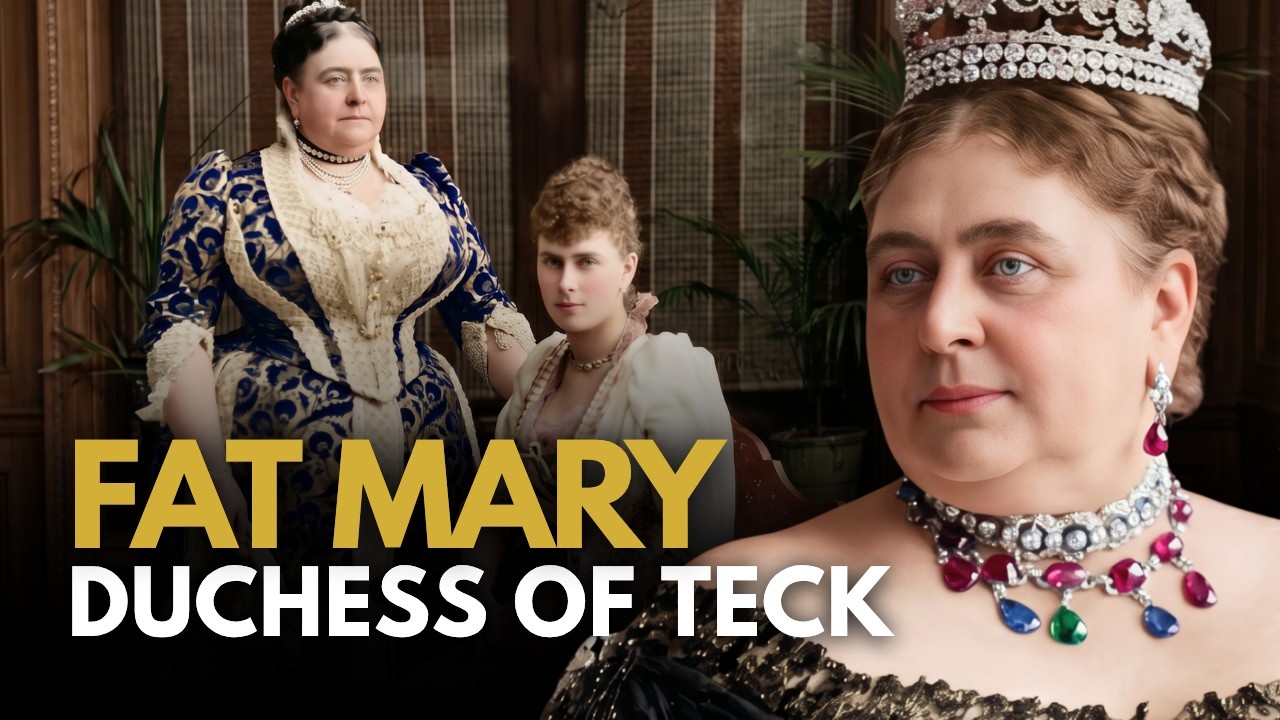
She spent her money on parties, dresses, holidays, and charity—sometimes in that order, often all at once. Yet, aside from the Queen herself, she was the most beloved member of the British royal family, and by a considerable margin. This is the story of a woman who was dismissed for her appearance, yet built a legacy that still resonates today. It involves the brutal marriage market of the Victorian era, a handsome but poor husband, a spectacular financial collapse, two years of exile in Italy, and a daughter who eventually became Queen of England.
It also involves a great deal of food. To understand why Mary Adelaide was so large, it helps to understand where she came from. Born on November 27, 1833, in Hanover, Germany, she was the youngest child of Prince Adolphus, Duke of Cambridge, the seventh son of King George III, and Princess Augusta of Hesse-Cassel. Her father was 59 at her birth; her mother was 36.
The family was known for its size. The sons of George III were generally obese, and the Prince Regent, later George IV, had grown so vast that caricaturists hardly needed to exaggerate. Mary Adelaide inherited this build fully, and it only grew over time. When she entered society as a teenager, contemporaries immediately noticed her size.
At eighteen, she visited Brussels with her mother, and King Leopold II of Belgium wrote to Queen Victoria with a distinctly unflattering assessment: “Poor Mary, such a pretty child, grown so fat that I deeply regret it. ” By her mid-twenties, she weighed around fifteen stone, or roughly 210 pounds, and she was heavier still in later years. She was, by all accounts, extremely beautiful in other respects. Tall and fair-haired with deep blue eyes and a complexion observers described as excellent, she moved with a natural grace that was often remarked upon.
She possessed a fine mezzo-soprano singing voice, sharp mimicry skills, and a love of opera and theater. None of this, however, made her thin, and in Victorian royal circles, that was considered a serious problem. Royal marriages at the time had strict rules. A spouse had to be of royal blood; British aristocrats, no matter how wealthy, did not qualify.
Candidates also had to meet certain standards of age, figure, and ideally, possess a stable income or the prospect of one. Mary Adelaide met the royal blood requirement. Almost nothing else. Her personal allowance was £3,000 a year, modest by royal standards.
She refused to consider any candidate who would require her to leave England. And in a world where a portly woman was considered unmarriageable, she was very large indeed. As the search for a suitable husband dragged on, she approached her thirtieth birthday. In 1856, Prince Oscar of Sweden came to visit with every intention of proposing.
He came several times. He never proposed, and he left. The King of Sardinia, recently widowed and seeking a Protestant wife, proposed. Mary Adelaide refused, saying she was a devout Protestant and had no interest in navigating the complexities of marrying an Italian Catholic king.
At twenty-five, facing a parade of unsuitable or uninterested candidates, she confessed to her brother, “I think with great anxiety of my being left to lead a dull and uninteresting life as an old maid. ”
Lord Clarendon, the British Foreign Secretary, summarized the diplomatic predicament with typical Victorian bluntness after another failed matchmaking attempt: “Alas! No German Prince will risk so large an undertaking. ” Queen Sophie of the Netherlands compared her situation unfavorably to the unmarried daughters of George III, saying, “Poor Princess Mary.
I pity her, no doubt her fate will be the same as her aunts—children without being married. ”
In short, it was a marriage market disaster. She was too highly born, which eliminated almost everyone; she was not thin enough, young enough, or rich enough to attract the rest. Finally, in 1865, the Prince of Wales and his wife, Princess Alexandra, found a solution while visiting Vienna.
There they met a young military officer, Prince Francis of Teck, a member of a morganatic branch of the House of Württemberg. Francis’s position was complicated. His father, Duke Alexander of Württemberg, had married beneath his station, meaning Francis had no claim to the Württemberg throne and held the lesser title of Serene Highness rather than Highness. In the hierarchy of European royalty, he ranked several levels below Mary Adelaide.
He was, however, according to multiple contemporary accounts, extraordinarily handsome, often described as the handsomest man at the Austrian court. The Prince of Wales invited him to England. Francis accepted. He met Mary Adelaide on March 7, 1866.
Less than a month later, he proposed at Kew Gardens. She accepted with enthusiasm. Her mother wrote, “I am happy to say that dear Mary is, I am sure, going to be very happy. ” Mary Adelaide wrote, “How happy I am!
I have such confidence in him and trust our future may be a bright one…”
They married on June 12, 1866, at St. Anne’s Church in Kew, Surrey. She was 33; he was 28. She was a granddaughter of George III; he was a minor prince with no inheritance.
Dynastically, it was a mismatch, but by all accounts, it was a genuinely happy marriage. Mary Adelaide immediately asked Queen Victoria to grant Francis the title of Highness. The Queen refused. It was only 21 years later, during the Golden Jubilee of 1887, that she granted the lesser title.
The Tecks initially settled in Kensington Palace, then moved to White Lodge in Richmond Park, a spacious country house lent to them permanently by Queen Victoria. Their family grew quickly. Their first child, Princess Victoria Mary of Teck, known as May, was born at Kensington Palace in 1867. Three sons followed: Adolphus in 1868, Francis in 1870, and Alexander in 1874, by which time Mary Adelaide was forty.
White Lodge became the center of family life, and observers were strikingly consistent in their descriptions: warm, chaotic, loving, and always overspending. Francis and Mary Adelaide genuinely adored one another. This was not a given in Victorian royal marriages, and it was not particularly helpful for their finances, as two people in love who both enjoyed spending money tended to spend even more than they would have separately. Francis was charming and handsome but had a difficult temperament.
He was prone to depression, which worsened with age, and he was as incapable of frugality as his wife. Their social life was naturally joyful rather than contrived, and their daughter May later recalled a childhood that, while not wealthy, was warm. May was the opposite of her mother in temperament: quiet, reserved, studious, and disciplined. Mary Adelaide shone wherever she went; May observed from the corner.
From her teenage years, May served as her mother’s unofficial secretary, helping with charity correspondence, drafting replies, and keeping ledgers of requests. She learned organization and responsibility from her mother, despite their contrasting personalities. After marriage, Mary Adelaide threw herself into the role of society hostess with an enthusiasm that proved catastrophic for her finances. White Lodge became one of the most active social centers in Victorian London.
Dinners, garden parties, and musical evenings were constant. Mary Adelaide loved music, with her fine voice and genuine appreciation, and her musical evenings attracted genuine performers. She loved theater and opera and attended frequently. She also loved food and knew how to enjoy it, and the table at White Lodge became famous, far beyond what their income could support.
She spent lavishly on everything: food, clothes, entertainment, hospitality, and charitable donations. The problem was that she could really only afford the charitable donations—and she did those too. The parties were frequent and grand, with long guest lists and enormous bills. What set her social life apart was not its scale but its nature.
Mary Adelaide genuinely cared about the people at her table. She was not performing hospitality; she was genuinely welcoming her guests. Observers consistently noted her remarkable ability to make everyone she spoke with feel like the most interesting person in the room. She was also chronically late.
This drove the punctual Queen Victoria to distraction. Mary Adelaide was late the way some people are always late: not out of carelessness, but because she was always doing seventeen things at once, and each one ran slightly over. She also regularly missed deadlines for letters, accounts, and correspondence. Once she arrived, however, her charm made up for it.
Contemporary accounts circle around the same qualities: warmth, humor, directness, and a genuine concern for ordinary people that went far beyond the usual royal condescension. She remembered names, she remembered stories, and she followed up. Mary Adelaide received an annual parliamentary grant of £5,000 as a working princess. Her mother, the Duchess of Cambridge, contributed an additional £4,000 per year from her own income.
That gave the Tecks roughly £9,000 a year. It was nowhere near enough. The household at White Lodge ran at a constant loss. Parties exceeded their budgets.
Clothing exceeded its budget. Food—the Tecks were always generous—exceeded its budget. Charitable donations, which were substantial, exceeded anything a reasonable budget could support. Francis had arrived in the marriage carrying debts.
For years, they avoided looking too closely, and creditors were patient. Royal connections helped. They asked Queen Victoria for additional funds, but she mostly refused—sympathetic but not generous, and with her own opinions on Teck family finances. By 1883, the situation had become untenable.
Creditors could no longer be ignored, and the debts could no longer be concealed. Queen Victoria, who had watched the slow financial catastrophe unfold for years, quietly but clearly indicated that the Tecks must leave England and live more cheaply elsewhere. The Tecks, with four children and a reduced household, departed for the continent. Initially, they traveled incognito as the Count and Countess of Hohenstein—a pretense that lasted until Mary Adelaide encountered a hotel that did not treat them accordingly.
She promptly revealed her true titles. The service improved. Florence in 1883 was already a popular destination for financially constrained British upper classes. The cost of living was lower, the artistic atmosphere was rich, and the society was international and tolerant of those whose situations were “complicated” in England.
The Tecks settled at Villa Chedi and later moved elsewhere. They toured European courts—Francis had family connections in Germany and Austria, and Mary Adelaide, as a granddaughter of George III and cousin of the reigning Queen, was welcomed widely. Despite the stated purpose of frugality, life in Florence was not exactly austere. Mary Adelaide’s lifestyle was reduced—she was managing a genuinely smaller household—but she was still Mary Adelaide: sociable, generous, active, and constitutionally incapable of doing nothing quietly.
In 1885, with the debts renegotiated sufficiently to allow a return, the family came home. They returned to White Lodge, to Kensington Palace, and to the social circle Mary Adelaide had always occupied. She was fifty-one, and there was no sign of slowing down. The return from Florence marked a shift.
Mary Adelaide remained a society hostess—that never changed—but from 1885 onward, charity became the center of everything she did. The scale deserves attention. She became patron of more than one hundred organizations. These were not honorary patronships, not simply a name on letterhead to lend credibility.
She personally reviewed all charity correspondence, personally assessed each request. With May, she maintained detailed ledgers, categorizing requests and recording how each was handled. She gave her name and her time, her energy, and her heart. One of her most significant patronages was Barnardo’s, the children’s charity founded by Dr.
Thomas Barnardo in 1866 to shelter, educate, and care for destitute children. It was a relatively new organization serving the most vulnerable in the toughest urban environments. Mary Adelaide lent her name to the hospital and was actively involved. She attended events, sold goods at bazaars, and drew crowds.
She was also a patron of the London Homoeopathic Hospital, a cause she had inherited from her mother, the Duchess of Cambridge, and continued throughout her life, attending fundraisers and lending her public influence to attract attention and donations. The British public was well aware of all this. Unlike the distant, ceremonial respect Victorians were expected to show royals, their affection for Mary Adelaide was warmer and more personal. Aside from Queen Victoria herself, she was the most popular member of the monarchy.
When she appeared in public, crowds gathered—not because they were supposed to, but because they genuinely wanted to see her. They called her “the People’s Princess. ” This was a full century before Diana. In 1891, Mary Adelaide turned her attention to her daughter’s future.
May was 24, intelligent, well-educated, and by all accounts suitable for a major marriage. Mary Adelaide had opinions on what her daughter should marry. Prince Albert Victor, known as Eddy, was the eldest son of the Prince of Wales and second in line to the throne. Queen Victoria approved May as a candidate: she was British-born, of royal descent, serious, and Eddy was somewhat wayward and causing worrying rumors, perhaps exactly what he needed.
The engagement was announced in December 1891. Mary Adelaide was ecstatic. Her daughter was engaged to the second-in-line to the British throne. Six weeks later, Eddy was dead.
He had caught a chill at Sandringham over Christmas. By early January, it was pneumonia. On January 14, 1892, he died at the age of 28. May’s wedding bouquet—a spray of orange blossom—was placed on his coffin.
Mary Adelaide had been at Sandringham and witnessed Eddy’s death. She stayed with her daughter through the initial shock. In the months and years that followed, she worked to maintain May’s connection with Eddy’s family. His brother George, now first in line rather than second, grieved alongside May.
On April 29, 1893, George proposed to May. Mary Adelaide had guided her daughter from a dead prince to a future king through judgment, patience, and a sharp social awareness that was sometimes mistaken for meddling. They married on July 6, 1893, becoming King George V and Queen Mary. Their granddaughter was Elizabeth II.
Through the mid-1890s, Mary Adelaide continued her charitable work, remained socially active, and stayed committed to every cause she believed in. Her weight was greater than ever, and her health was beginning to reflect the toll of her busy life. In October 1897, she fell critically ill and underwent emergency surgery at White Lodge. On October 27, 1897, the Duchess of Teck, Mary Adelaide, died in the home where she had lived for decades.
She was 63. Her death was met with genuine grief. Queen Victoria, who had been exasperated by her cousin for nearly three decades—her lateness, her debts, her loudness, her overwhelming presence—mourned her sincerely. So did the public.
So did the charities. Barnardo’s, which she had championed as its first royal patron, still operates today, with an unbroken line of patrons from Mary Adelaide to Queen Alexandra, Queen Mary, Queen Elizabeth II, Princess Diana, and Queen Camilla. The tradition she began in 1885 has never been interrupted. The woman known as “Fat Mary,” who was told by a foreign secretary that no German prince would take her, gave money she did not have to causes she believed in.
She was always late, but she made up for it with a charm that was impossible to ignore. She guided her daughter from the shock of a broken engagement to the British throne. She created the image of the People’s Princess, then faded in memory as later princesses took the title.
Her name was Mary Adelaide, of Cambridge, and the institutions she built are still standing.