Newly resurfaced historical accounts are reigniting one of the darkest and least examined chapters of Benito Mussolini’s brutal dictatorship, revealing that the Italian fascist leader allegedly ordered the systematic erasure and eventual killing of his own firstborn son, a boy named Benito Albino Mussolini, whose only crime was telling the truth about his parentage.
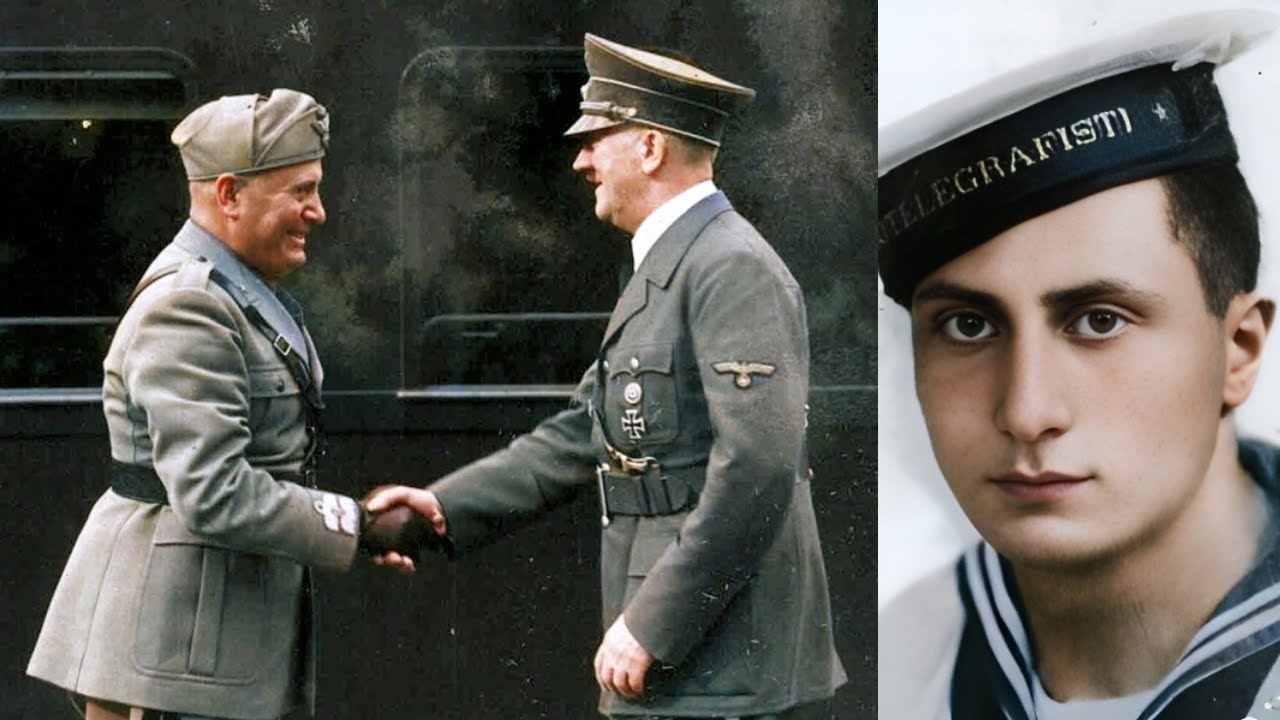
The story, pieced together from archival documents, police surveillance records, and testimony from the fascist era, describes a campaign of abduction, forced institutionalization, and what historians now characterize as a state-sanctioned execution carried out inside a Milan mental asylum in July 1942, when the younger Mussolini was just 26 years old.
According to the accounts, Mussolini fathered the child with Ida Dalser, a Milan beauty salon owner who sold her business and pawned her jewelry to bankroll his newspaper, Il Popolo d’Italia, in the years before he seized power. The couple are said to have married in 1914, and Dalser gave birth to a son in 1915 who was named after his father.
But Mussolini had already begun a relationship with Rachele Guidi, who would become his publicly acknowledged wife and the mother of five children. That left the dictator, by the standards of Italian law, a bigamist, a fact his regime treated as an existential threat to the carefully constructed image of a clean, powerful, and 𝒔𝒄𝒂𝓃𝒹𝒶𝓁-free leader.
When Mussolini became prime minister following the 1922 March on Rome, the machinery of the fascist state moved swiftly against Dalser and her son. Police placed both under close surveillance. Birth certificates and marriage records were destroyed.
The boy was trailed by officers and barred from using the Mussolini name, ordered instead to call himself Bernardi.
Dalser refused to stay silent. She publicly insisted she was the dictator’s rightful wife and accused him of betraying Italy by accepting money from the French government during the First World War to push for Italian intervention on France’s side. That accusation, historians note, would have branded Mussolini a traitor who took cash from an enemy power.

Her defiance sealed her fate. In 1926, Dalser was abducted, beaten, forced into a straitjacket, and declared insane by compliant doctors. She spent the remaining eleven years of her life shuttled between mental institutions, dying in 1937, reportedly of a brain hemorrhage.
Her son was told his mother was dead.
The younger Benito was shuffled through boarding schools and, at fifteen, handed over as an orphan to the former fascist police chief of Sopramonte, a household where the regime could monitor and control him. He nonetheless knew exactly who his father was and refused to stop saying so, a refusal that officials flagged as dangerous.
As a young man he enlisted in the Italian Royal Navy and served, according to the accounts, on warships during the Second World War, all while under constant government surveillance. His insistence on claiming the Mussolini name followed him onto his ship and into port, and it was not long before he was arrested and committed to a Milan asylum, the same fate his mother had suffered.
There was, by all indications, nothing psychiatrically wrong with him. He was simply telling the truth: that the leader of Italy had married his mother, abandoned her, and fathered a son he refused to acknowledge. For the regime, that truth was intolerable, and the solution was permanent silence.
Accounts of his death differ in method but not in intent. Some sources say he was killed in July 1942 with coma-inducing injections, a lethal dose of medication that put him to sleep forever. Others record that he was subjected to repeated electric shock treatments until his body gave out.
Either way, researchers conclude his death was organized, deliberate, and carried out on orders that could only have come from the top.

He was buried in an unmarked grave, his name struck from the record as thoroughly as the regime could manage. The parallels to an execution are difficult to ignore: abduction, forced confinement, medical personnel acting as instruments of state violence, and a burial designed to erase the victim from memory.
The timing of the killing has struck historians as grimly significant. Benito Albino Mussolini died in July 1942. One year later, in July 1943, his father was arrested and deposed, his regime collapsing as Allied forces closed in.
In April 1945, the dictator was captured by partisans, executed, and his body hung upside down at a service station in Milan, where crowds spat on, stoned, and abused the corpse.
That image became the defining symbol of Italy’s fury at the man who had dragged the nation into war alongside Adolf Hitler. But the story of Ida Dalser and Benito Albino Mussolini offers a different kind of reckoning, one that unfolded years earlier and in total secrecy, hidden from the public that would later celebrate the dictator’s death.
Legal records that survived the purge include a 1915 document in which Mussolini acknowledged Dalser as his wife and the child as his son, and a 1916 document in which he repeated the acknowledgment and promised financial support. Those papers, preserved despite the regime’s efforts, form the backbone of the case that the younger Mussolini was never delusional, only inconvenient.
Historians who have examined the case describe it as a textbook example of how authoritarian governments weaponize psychiatry against inconvenient individuals. Dalser was declared insane to discredit her claims. Her son was declared insane to discredit his.
In both cases, the diagnosis served a political purpose rather than a medical one.

The regime’s obsession with the secret marriage also reflected a broader fear. Mussolini had built his public identity on discipline, strength, and moral authority. Revelation that he had committed bigamy, abandoned a wife, and neglected a child could have shattered that image at the very moment he was consolidating power and courting the Catholic Church and conservative Italian society.
What makes the case especially chilling, researchers say, is the calculated patience of the persecution. The regime did not simply silence Dalser and her son once. It tracked them for years, destroyed documents incrementally, moved the boy between institutions, and waited until he was isolated and powerless before ordering his death.
The story has circulated in Italian historical literature and documentary research for years but remains far less known internationally than the broader narrative of Mussolini’s rise and fall. Advocates for the victims’ memory argue that Dalser and her son deserve recognition as forgotten casualties of fascism, killed not on a battlefield but in the quiet corridors of a state that viewed them as embarrassments to be eliminated.
For the families of other victims of the regime, the case illustrates how thoroughly the fascist government was willing to erase inconvenient people from history, using forged diagnoses, sealed records, and unmarked graves to ensure that the truth would not survive the men who buried it.
It did survive, in fragments and in testimony, and it now stands as one of the most disturbing indictments of Mussolini’s rule: a dictator who preached national greatness while ordering the death of his own firstborn son to protect a lie.