The family of Reinhard Heydrich, the Nazi official Adolf Hitler once called “the man with the iron heart,” spent the decades after World War II navigating a legacy of genocide, public denial, and quiet survival that historians say remains one of the most disturbing case studies of how the relatives of mass murderers reckon with their inheritance.
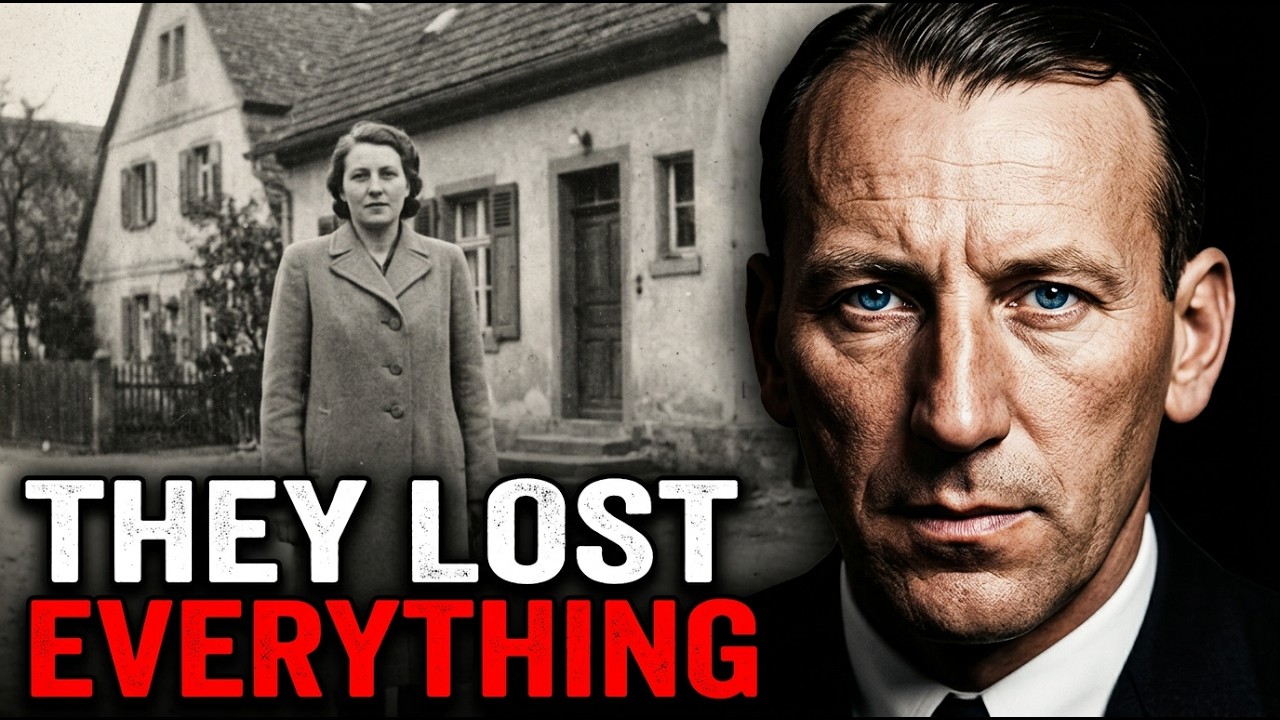
Heydrich, the head of the Reich Main Security Office and the presiding officer of the January 1942 Wannsee Conference that coordinated the murder of eleven million European Jews, died on June 4, 1942, eight days after Czechoslovak and British-trained paratroopers ambushed his open-top Mercedes in Prague during Operation Anthropoid.
He was 38 years old. He left behind a pregnant widow, three young children, a mother, a brother, and a sister. Their postwar fates, pieced together from court records, memoirs, and press accounts, trace a family that never fully confronted the crimes at its center.
His widow, Lina Heydrich, born Lina von Osten in 1911, was thirty years old and six weeks from giving birth when her husband died. She remained at Panenske Brezany, the Bohemian estate seized from the Jewish Bloch-Bauer family, until the collapse of the Third Reich.
In 1945 she was expelled from Czechoslovakia along with millions of ethnic Germans. Stripped of the estate, she resettled in Bavaria with her three surviving children and began a legal campaign that would last more than two decades.
She fought relentlessly for a widow’s pension based on her husband’s senior Nazi rank, arguing through West German courts from the late 1940s into the 1970s. The proceedings generated sustained press coverage and bitter public controversy.
Courts eventually granted partial pension entitlements in the early 1970s. Critics called the outcome grotesquely generous given that Heydrich’s official positions had been the instruments of genocide. Lina called it inadequate.
She also maintained close ties to networks of former SS members and their families, including the mutual-aid organization Stille Hilfe, which provided legal and financial support to accused Nazi perpetrators. Investigators documented her involvement but never charged her.
In 1976 she published a memoir whose publisher imposed the title “Leben mit einem Kriegsverbrecher,” or “Life with a War Criminal.” Lina was furious, insisting her husband had not been a war criminal in any meaningful sense.
The book, a vigorous defense of Heydrich and a rejection of the documented historical record, drew withering reviews from German historians and condemnation from survivor organizations. It sold well among revisionist circles and gave her a renewed public platform.
She gave interviews for years afterward, denying the consensus on her husband’s role and describing herself as the victim of politically motivated persecution. She died in August 1985, unrepentant to the end.
The couple’s eldest child, Klaus, born in 1933, was killed in October 1943 at age ten when his bicycle crossed the path of a German military truck near the family estate. He was the only child who had known his father well.
He was buried in Bohemia. His grave was left behind when the family fled westward in 1945, one of the last physical links between the Heydrichs and the years of their greatest power.
Heider Heydrich, born in December 1934, was seven when his father was assassinated and ten when Germany collapsed. He grew up in postwar Bavaria inside his mother’s unrepentant household and became a businessman in the German food industry.

Unlike Gudrun Himmler, who publicly defended her father’s memory for decades, Heider did not become an active apologist. Unlike Niklas Frank, who wrote books denouncing his father, he never issued a full public condemnation either.
In rare interviews he described the difficulty of reconciling the father he remembered with the historical figure the records revealed. He acknowledged the Holocaust without minimizing it, yet kept a certain distance from the harshest verdicts.
Historians and critics found that distance inadequate given the scale of Heydrich’s crimes. Supporters described it as the humanly understandable hesitation of a man who had loved a parent he never truly knew.
Heider died on December 24, 2020, one day after his 86th birthday, during the isolation of the COVID-19 pandemic. German press reports noted his parentage briefly and moved on. With him, the last living direct memory of Reinhard Heydrich effectively ended.
Silke Heydrich, born in April 1939, was three when her father was killed and six when the war ended. Of all the children, she retreated furthest from public view, granting virtually no interviews and making no public statements.
She appears to have structured her adult life around maximum privacy, avoiding contexts in which her surname might be recognized. Whether she ever changed her name is not documented in the public record.
Marte Heydrich, born on July 23, 1942, more than six weeks after her father’s death, never saw him at all. Her relationship to his legacy was mediated entirely through her mother’s stories and the historical record.
She grew up in the Federal Republic and, like her sister, chose anonymity over engagement. The historical record illuminates the outlines of her situation without detailing how she lived it.
Heydrich’s mother, Elisabeth, born in 1879 into a cultured musical household in Halle, died in 1943, before the liberation, the Nuremberg trials, and the full public accounting of what her son had organized.
She had lived to see him become one of the most feared men in Europe, to attend his state funeral in Berlin, and to mourn her grandson Klaus. She never faced the reckoning that consumed the rest of the family.
His father, Bruno Heydrich, a composer and conservatory founder, died in 1938. Persistent rumors that the family had Jewish ancestry had haunted Reinhard’s career and prompted genealogical investigations commissioned to disprove them.
Heydrich’s elder brother, Heinz Siegfried, served in the regular Wehrmacht rather than the SS elite and was killed in action on the Eastern Front in 1944. His death left the family without its two eldest males.
His sister, Maria, lived a largely obscure postwar existence and left little trace in the historical record beyond the name she carried.
 The reprisals that followed the assassination remain among the most catastrophic acts of collective punishment in occupied Europe. On June 10, 1942, SS and police units destroyed the village of Lidice.
All 173 men and boys over fifteen were shot. The 184 women were deported to Ravensbrück, where many died. Ninety children were taken; most were killed by carbon monoxide at Chelmno.
The village was burned and bulldozed flat.
A second village, Ležáky, was destroyed on June 24, 1942, its adult population executed. In total, roughly 5,000 Czechs died in the reprisals, a toll that Czech national memory has preserved with particular care.
The paratroopers who carried out the attack, Jozef Gabčík and Jan Kubiš, died on June 18, 1942, after SS troops besieged the Church of Saints Cyril and Methodius in Prague. They took their own lives rather than surrender.
The church still bears bullet marks from the battle. Its crypt is now a museum and memorial, one of the most visited historical sites in the Czech capital.
The rebuilt village of Lidice, funded by international donations, became a symbol of defiance against Nazi attempts at erasure. A bronze sculpture commemorates the 82 children who were murdered.
For the Heydrich children, the link between their father’s death and the destruction of Lidice was direct and documented. Even Lina Heydrich never publicly challenged the historical account of the massacre.
Legal accountability for the family remained limited. Lina was interrogated repeatedly by Allied investigators and underwent denazification proceedings, receiving a classification that carried financial penalties but no imprisonment.
Investigators concluded the available evidence was insufficient to support specific criminal charges against her personally. The major prosecutions focused on those who had planned and executed crimes rather than on relatives.
Karl Hermann Frank, Heydrich’s principal subordinate in the Protectorate and the coordinator of the Lidice reprisals, was tried in Prague in 1946, found guilty of war crimes, and hanged before thousands of witnesses on May 22, 1946.
Adolf Eichmann, who served as secretary at the Wannsee Conference and later organized the logistics of deportation, was captured in Argentina in 1960, tried in Jerusalem in 1961, and executed in 1962, repeatedly drawing Heydrich’s name back into global public discussion.
Each new trial, book, and film renewed attention on the family. Günter Deschner’s 1977 biography “Heydrich: The Pursuit of Total Power” systematically demolished any claim that Heydrich had been a mere functionary rather than a driving force behind the Holocaust.
The documentary record is unambiguous. The Wannsee Protocol, recorded by Eichmann, shows Heydrich convening and chairing the meeting at which the “final solution” was coordinated across German ministries.
Operational orders for the Einsatzgruppen, the mobile killing units that murdered more than half a million Soviet Jews by the time Heydrich died, were issued by his office. The Einsatzmeldungen, or event reports, were submitted directly to him.

At Babi Yar outside Kiev, more than 33,000 Jewish people were shot over two days in September 1941 by units under his operational authority. He received the reports. He signed off on the operations.
That this man played the violin, bounced his children on his knee at Panenske Brezany, and was mourned by his pregnant widow is a duality that the family’s postwar history never honestly engaged with or successfully obscured.
Lina Heydrich’s memoir and legal battles left an unintended legacy. Her persistent pension litigation contributed to subsequent changes in German law that made it harder for the families of Nazi perpetrators to claim benefits based on criminal official roles.
The property question intersected with the pension question. Panenske Brezany had belonged to the Bloch-Bauer family, prominent Jewish industrialists whose possessions were seized during the occupation.
Ferdinand Bloch-Bauer had been the patron and subject of Gustav Klimt’s famous 1907 portrait, “Portrait of Adele Bloch-Bauer I,” known as “Woman in Gold.” His niece, Maria Altmann, spent years fighting Austria for the return of the seized paintings.
Her eventual victory in a case that reached the United States Supreme Court resulted in the return of the artworks in 2006 and became the subject of a major film. The Panenske estate was a separate but parallel dimension of the same dispossession.
That Lina Heydrich managed a stolen estate while her husband’s administration coordinated deportations and executions is one of the historical ironies that underlines the interconnectedness of Nazi crimes and their long aftermath.
In the decades since, Germany has built one of the world’s most extensive cultures of memorial accountability: the Wannsee Conference House, the Holocaust Memorial in Berlin, mandatory Holocaust education, and billions in reparations.
Yet that national accountability has never compelled the individual families of perpetrators to reckon publicly with their relatives’ crimes. The choice of how to live with such a legacy remained, in the end, a private one.
The Heydrich family made its choices. Lina fought and denied until her death. Heider carried an ambivalence he never fully resolved.
Silke and Marte chose silence. Klaus and Heinz died before any reckoning could reach them.
What remains is the historical record itself, overwhelming and irrefutable, and the memorials that preserve the memory of the victims: the rose garden at Lidice, the bullet-scarred walls of a Prague church, the minutes of a ninety-minute meeting that sealed the fate of millions.
Those memorials exist not to remember Reinhard Heydrich, but to remember those he destroyed and those who died resisting him. They stand as permanent refutations of the denial his widow spent her life promoting.
The story of what happened to his family after the war is, in the end, a story about the long reach of evil and the incomplete, insufficient ways its aftermath is lived by those who bear the name but not the guilt.