Long before the Colt revolver became the symbol of the American West, frontier men relied on a variety of unusual weapons to hunt, protect themselves, and survive. These forgotten firearms and blades reveal a far more complex reality than the one depicted in classic Western films. The pepperbox pistol was among the earliest multi-shot handguns, using a rotating cluster of barrels instead of a fixed barrel and separate cylinder. Allen and Thurber of Massachusetts produced a well-known six-shot double-action model around 1847, and similar pistols remained popular from the 1830s through the 1860s.
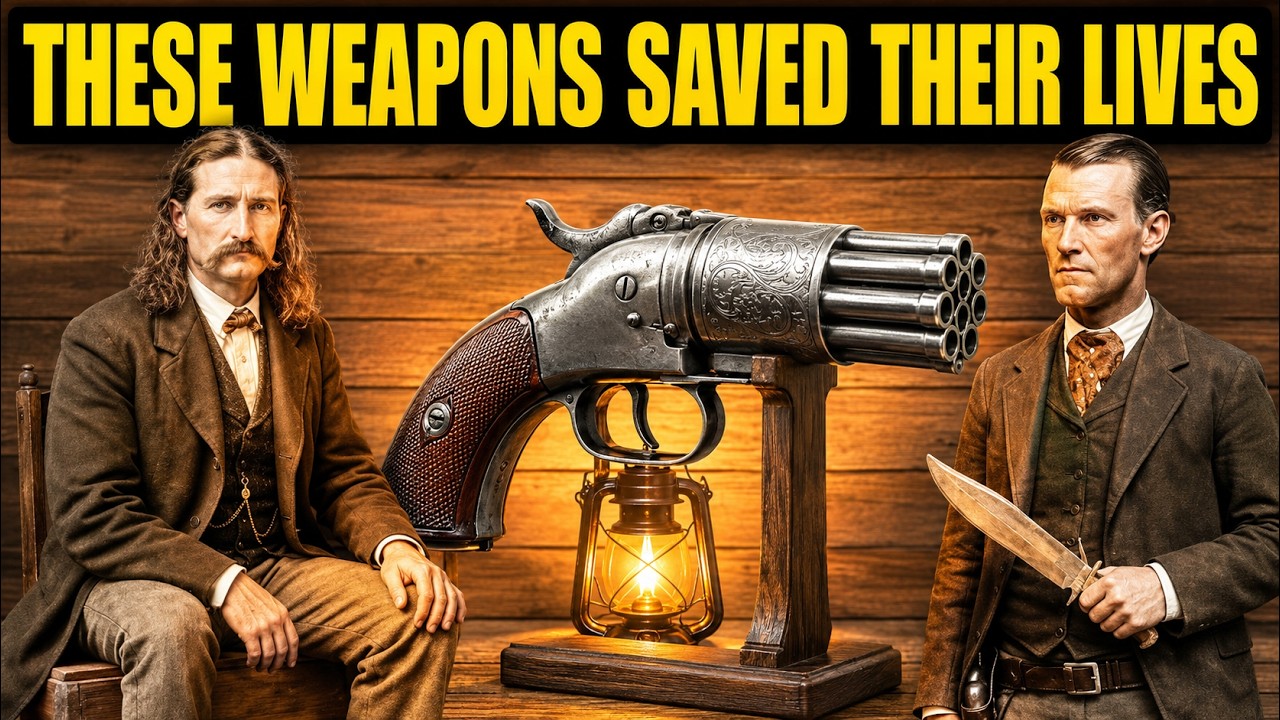
Frontier buyers valued the design because it offered several shots in a compact form when most small pistols could fire only once before reloading. The name came from the barrels’ resemblance to a household pepper container. The design had serious weaknesses, however. The cluster of steel barrels made the front heavy, accuracy was limited, and some short-barreled examples could discharge more than one barrel unexpectedly.
As Colt revolvers became more widely available, the pepperbox lost its position, but it demonstrated that the famous six-shooter did not appear in an empty market. The Colt Model 1855 revolving rifle attempted to adapt the revolver concept to a long gun, using a rotating cylinder behind the barrel. Smithsonian collections preserve both military and sporting versions. The idea seemed promising, offering a hunter, guard, soldier, or traveler several shots without returning to slow muzzle-loading after each one.
But turning a revolver into a shoulder-fired arm created serious problems. Hot gas escaped from the gap between the cylinder and barrel, a hazard worsened because that area sat close to the supporting hand. Percussion firearms also risked a chain fire, where more than one chamber ignited at once. Black powder residue accumulated around the moving parts, and the system was more complex than a plain single-shot rifle.
The Model 1855 was eventually overtaken by metallic cartridge repeaters that avoided these problems. The Spencer repeating carbine changed expectations about how quickly a long gun could provide another shot. It held seven metallic cartridges in a magazine inside the stock, and more than 90,000 were produced during the Civil War. After the war, surplus sales and westward movement brought Spencer rifles and carbines into the later frontier period.
The carbine’s shorter length suited cavalry use and work involving horses and wagons. Its self-contained metallic cartridges reduced the number of separate parts involved in each shot, though the weapon was not immune to moisture, poor storage, or ammunition shortages. The action still had to be deliberately operated, and rimfire ammunition was not always easy to replace in distant settlements. Native American men also encountered and used repeating firearms during this era, though access differed greatly by nation, region, and year.
National Park Service records connect Spencer carbines with Civil War cavalry and later frontier military posts. The Remington rolling block rifle was almost the opposite of a high-capacity repeater, usually firing one cartridge at a time. Its historical value came from a strong, simple breech mechanism with relatively few moving parts. Remington produced military and sporting versions during the second half of the 19th century, and the design was adopted in many countries.
In the American West, a rancher, hunter, or settler did not always choose a firearm because it had the largest magazine; cost, available ammunition, resistance to dirt, and access to repairs could matter more. The rifle earned a reputation for durability rather than speed. Most firearms in the Old West were ordinary working possessions connected to hunting, ranching, transportation, and protection from animals, not the weapons of famous lawmen and outlaws. The Evans repeating rifle was one of the most unusual high-capacity repeaters of the era.
Developed in Maine during the 1870s, it used a rotating magazine system inside the stock and could hold up to 34 cartridges in early versions. The Firearms Museum describes it as having the greatest capacity among antique repeating rifles that were mass-produced and marketed in the United States. Despite that impressive figure, the Evans demonstrates why one feature did not guarantee success. Its long internal magazine added mechanical complexity and affected balance.
More importantly, it depended on its own cartridge, and stores in remote communities were more likely to stock ammunition for popular models. The company also lacked the distribution network and name recognition of larger manufacturers, and production lasted only a few years. The Merwin Hulbert revolver once competed meaningfully with Colt, Smith & Wesson, and Remington. Museum collections preserve army and pocket versions, with revolvers generally manufactured by Hopkins & Allen while Merwin Hulbert handled design and marketing.
Its most recognizable feature was an unusual pull-forward unloading system that allowed spent cases to be separated while unfired cartridges remained in place. That was advanced engineering, but it required careful manufacturing and was harder for local repairmen to understand. Colt had stronger brand recognition and wider distribution, and Merwin Hulbert faced business and financial difficulties. Claims that a particular famous outlaw or lawman owned a specific surviving revolver should be treated carefully unless documentation exists, but the model’s surviving examples show that Old West revolver design included serious alternatives with unusual mechanical solutions.
The Smith & Wesson Schofield was a modified form of the company’s large Model 3 revolver, associated with Major George Schofield and manufactured from 1875 to 1878. Its most recognizable characteristic was the top-break frame, where opening the revolver caused the barrel and cylinder section to move downward while the extraction system lifted spent cases together. This differed from the Colt Single Action Army, whose cases were normally removed individually through a loading gate. Surplus examples later entered civilian circulation.
Ammunition standardization caused difficulties, however. The Army had both Colt and Smith & Wesson revolvers in service, and the cartridges associated with them were not fully interchangeable in both directions. The Schofield became important without becoming dominant, showing that a clever mechanical feature could not overcome issues involving contracts, ammunition, and existing equipment. The Remington Double Derringer was a small two-barrel pistol that appeared during the metallic cartridge era and remained in production for decades.
One barrel sat above the other, giving two shots in a compact frame. It belonged to the category of pocket arms associated with travelers, merchants, gamblers, and people working in town environments. Its short barrels restricted accuracy, its grip offered little control, and two shots gave far less capacity than a revolver. Popular culture later tied the Derringer closely to gamblers and secret weapons, but actual pocket pistol ownership was broader than that image.
A forgotten detail concerns the spelling: Henry Deringer became known for an earlier single-shot pocket pistol, and other manufacturers copied the idea, with the spelling using two “r”s eventually becoming a common label for small pistols from many companies. The Bowie knife became famous before the classic cattle town period, but large knives remained part of frontier equipment for decades. Smithsonian records describe Bowie knives as popular from the 1840s through the Civil War era. The term became a broad label for substantial knives rather than one exact factory pattern, with makers producing many blade lengths, handle shapes, guards, and points.
On the frontier, a large knife was also working equipment, appearing around camps, ranches, hunting parties, and military posts. Its reputation grew far beyond everyday use through newspaper reports, stage performances, dime novels, and later films. In many cases, owners likely used large knives for routine camp and livestock work far more often than for fighting. Native American men, Mexican vaqueros, black cowboys, immigrants, soldiers, hunters, and settlers carried different blade styles according to local trade, occupation, and tradition.
The Winchester Model 1887 was a lever-action repeating shotgun designed by John Browning. The Cody Firearms Museum describes it as one of the first truly successful repeating shotguns on the market, and Smithsonian collections preserve original examples. Traditional double-barrel shotguns offered two shots, while the Model 1887 used a repeating system with a larger ammunition supply. It entered historical roles already associated with shotguns, including hunting, ranch work, stage protection, and law enforcement.
The design had important drawbacks: its action was heavy, and the lever arrangement was less natural for many shotgun users than for rifle users. Winchester later introduced the Model 1901, while pump-action shotguns increasingly became the preferred repeating system. One preserved Model 1887 at the Cody Firearms Museum carries serial number one, which Winchester sold to Henry Ford when he was a young engineer.
Ford later presented it to Harvey Firestone, giving that particular piece a direct connection to two future figures in American industry.