The frozen basement of the Univermag department store in Stalingrad smelled of gangrene, diesel, and unburied death. Hundreds of German soldiers, hollow-eyed and wrapped in rags, pressed against the walls, many too weak to stand, some already dead where they had collapsed. It was the early morning of January 31, 1943, and a single candle flickered on a map table.
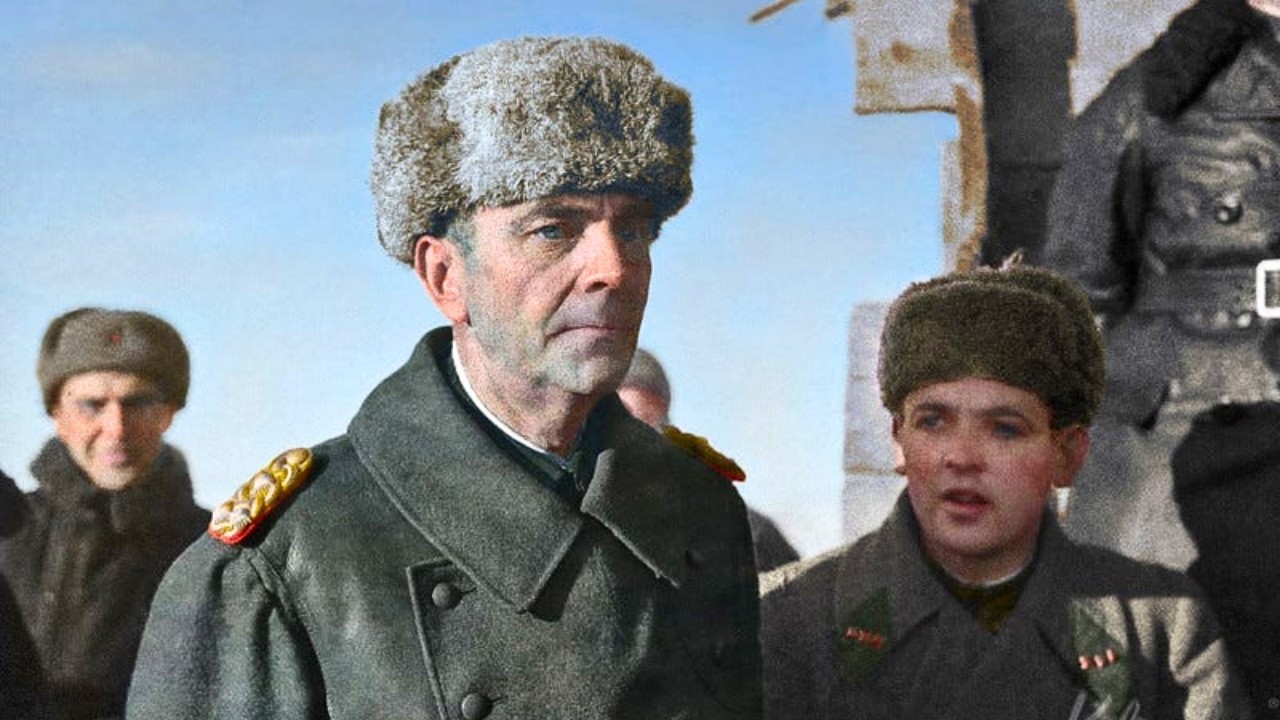
On an iron bed, in his shirtsleeves, lay Generaloberst Friedrich Paulus, the commander of the German Sixth Army. Two days earlier, he had commanded a force of nearly 300,000 men. The Red Army had now sealed the remnants of his once-mighty army into a shrinking cauldron of rubble.
 A radio crackled with static, and a final communiqué came through a failing signals net from a location over a thousand miles away. The German command in East Prussia had transmitted a message that would end the battle and define Paulus’s place in history.
The message, delivered by a staff officer, was simply a promotions order. Field Marshal Günther von Kluge’s title was not available, but the message was clear. Friedrich Paulus had been promoted to the rank of Generalfeldmarschall.
For a professional soldier raised in the Prussian tradition, this was the culmination of a career, the highest honor the German military could bestow. But in the context of the collapsing battle, the promotion was a death warrant. The officer who brought the message, Paulus’s adjutant, Colonel Wilhelm Adam, understood the weight of the gesture.
He looked at the document and told the newly promoted field marshal that this was not a reward. It was a directive, wrapped in velvet and edged with a razor. It was a clear instruction: a field marshal does not surrender.
The imperial tradition held that no German field marshal had ever survived a surrender. That tradition, German doctrine, and Hitler’s own expectations dictated a final act of defiance.
Paulus read the promotion, dropped the paper to the cold concrete floor, and looked at the officers around him. He uttered words that would reverberate through the German High Command and the ruins of Stalingrad. One cannot help feeling that this is an invitation to suicide, he reportedly said, in chillingly clear recognition of the implication.
He recognized the gesture not as an honor, but as a command to take his own life to avoid the shame of capture. All around Paulus, the Butcher’s bill of the Sixth Army was staggering. The men in the cellar were the wreckage of an entire field army.
They were starving, disease-ridden, and had been cut off for weeks. There was no artillery left to defend the perimeter, and the Soviet forces were systematically clearing the remaining buildings. In a matter of minutes, the door to the cellar would burst open, and Soviet infantrymen would fill the room with their rifle barrels leveled.
But before that door opened, Paulus did something extraordinary in those final ninety seconds of his command. He did not reach for his service pistol. He did not place the muzzle against his temple to deny the Red Army the prize of a captured field marshal.
Instead, Paulus dismissed the men, sat back on the bed, and waited. He rejected the suicide that Hitler so obviously desired. It was the coldest and most personal act of defiance in his career, yet a small, bitter gesture against the man who had ordered him to hold the city against impossible odds.
Hitler had once sent a pistol to a commander as an execution. Now, Paulus looked at the title of field marshal, understood the implicit order, and refused. The shame of the culmination, the thirty-six hours of dying, was not going to end in a bullet.
 He sat on the iron bed, unkempt, exhausted, his uniform tunic unbuttoned, and waited for the Soviet troops to claim him.
When the Soviet infantry of General Mikhail Shumilov’s 64th Army burst through the door moments later, they found not a resolute enemy, but a broken, arrogant, and humiliated commander. Paulus, the meticulous staff officer who had helped plan Operation Barbarossa, the ruthless creation of the Holocaust’s eastern front, was captured unarmed. He did not salute.
He did not reach for his gun. He offered the Soviet Lieutenant Colonel his baton, but not his life. The surrender was immediate.
The order for the northern pocket of the city to lay down arms was delayed, and hundreds more died pointlessly before the final surrender order was given. But the capture of a live field marshal was a propaganda triumph for the Soviet Union, and a humiliation for Hitler. The Fuhrer himself was incandescent with rage in his East Prussian headquarters when he learned that Paulus had not died in battle.
Around that moment, Hitler’s fury was recorded by stenographers. In an hour of hysteria, he screeched to his generals that a field marshal goes out and takes his own life, refuses to be taken alive. He said, it is poisoning, how can a man be such a coward.
Hitler then compared Paulus to a woman, ignoring the fact that he had effectively sent the entire army to die of starvation, and was the architect of the annihilation. Hitler ranted: “When a woman has the pride to lock herself away and shoot herself over a few insulting words, then he could have no respect for a soldier who was afraid to do the same and preferred captivity.” This was the Fuhrer’s ultimate, shallow assessment: the promotion had been a psychological mechanism to guarantee the death of his commander, and it had failed.
The significance of those 90 seconds cannot be overstated. The 6th Army’s commander did not just surrender; he chose life over a myth. It was a break from the glorified, romanticized code of a military that had been corrupted by its Fuhrer.
By refusing to pull the trigger, Paulus broke the myth of the immaculate soldier. He was not a tragic hero, but a man who, in one pale, shivering moment, decided to face the consequences of his actions. In the twenty-four hours before his capture, he had helped design a war of racial annihilation, but at the end, he refused to participate in his own martyrdom for that regime.
In the weeks following the surrender, Paulus was shipped under heavy guard to a Russian prison camp. Then, he was transported to a small holding facility. For the better part of the next 13 years, he lived in the Soviet Union.
He was eventually offered a comfortable life, a dacha, and his own medical staff, in exchange for his testimony against his own nation at Nuremberg, where he was estranged from his wife and daughters. He agreed to cooperate with the National Committee for a Free Germany, an organization for German soldiers willing to fight against Hitler. He was used by Soviet propaganda to exhort the German troops on the Eastern Front to surrender, suffering the wrath of the Nazi wise in East Germany.
 The decision to not commit suicide changed the timeline of the war’s close. Stalingrad was the turning point, but Paulus’s decision that day meant the destruction of the Sixth Army was complete, but had not ended with a glorious, honorable burial that Hitler wanted. Instead, Paulus spent the rest of the war in prison.
And in 1946, shocked the world by being a surprise witness at the Nuremberg Trials. There he testified against his former colleagues, admitting the criminal nature of Hitler’s orders and the defense of Barbarossa as a war of aggression. He faced a chilling array of accusations, but, in the middle of the trial, he was the living proof that the commanders of the Wehrmacht were not just soldiers following orders, but participants in the crimes.
Paulus and his remaining generals joined the anti-Nazi league, urging whatever remained of the Wehrmacht to surrender, save service, and kill Hitler. In a recorded statement, he renounced his oath and spoke of the tragedy on the Volga. He told the Soviet and Western reporters that the battle of Stalingrad is the lesson the German people will never forget.
The lesson, he said, was that they must have finally gotten a people’s army fabricated by the disastrous directives of the supreme command. He even signed leaflets that were dropped over to German lines, telling his former countrymen that the remnants of the once invincible Sixth Army were in the Russian steppes as a death warning.
Despite the life he chose, Paulus was sustained by the Soviets as a gloating trophy. The Steamer of the East German Stasi, 2000 years later in secret archives, showed that he was allowed to return to the Soviet occupation zone in East Germany, but lived under surveillance until his death in 1957. He was not a pathetic, broken shell, but a figure of bitterness—married the contempt of the old world, and the disavowal of the new.
Many West Germans that were loyal to the old code, rejected him as a traitor, even after the time Hitler’s death. He was shunned by his fellow generals who had survived the camps and returned to a old life and wrote memoirs of a clean war.
Yet, let us take away a brutal lesson from those 90 seconds. In the frigid cellar, the only moment of clarity in Paulus’s life was not a burst of courage, but a refusal of obedience. He recognized the trap of the honor that the promotion was a death sentence.
He chose to live, but he still had a million dead on his conscience. The film that faded to black was precisely the undoing of the German command. By refusing to end his life, Paulus gave hope to the other soldier in the entrapped.
His decision to break the code of the field marshal not by fighting to the last round, but by sitting still, was the ultimate denial of the Hitler’s realization. He removed any chance that the battle would be remembered as a Wagnerian funeral. The Ruins of Stalingrad were not a stage for a corpse, but the site of a capture.
A year later, after the German surrender was complete, Paulus was brought to the Nuremberg court as witness against the regime he had helped. His testimony was a decisive factor in pointing out Keitel and Jodl. When he finished his testimony and was returning to his seat, a female spectator shouted at him in the courtroom, “You are dead to Germany.”
 The truth did not soothe him. He had a body that was the legacy of Hitler’s conquest scheme. The Russian propaganda had described Paulus after Stalingrad as a German officer who had once modeled a key in the plot of an extermination war, and in the end, his refusal to die by the Fuhrer’s order was the last stand of a conscience.
It took a certain kind of psychological intimacy to understand what broke in the 90 seconds that escaped the personal legend. For a German officer, the surrender was a stain. For a field marshal, it was an incomprehensible failure.
Yet Paulus chose a trial of prison life rather than a quick death. He told a colleague, “I could have shot myself, but I was so tired. I wanted to live.
I wanted to be there witnesses of the end.” This statement is the true key to the meaning of the promotion. It wasn’t the Gold Knight’s Cross at his neck that brought him the high command.
It was a title. Looking back at history, the obsession with the Tenth Century noble was a lie, and the worst thing about the lie is that Paulus bought it for many years. Until the moment of the entrance of the Soviet soldiers, he had been a loyal bureaucrat of the Holocaust.
The stunning fact remains: he wasn’t the ideal figure, suffocated by liars. He was a formated, logical executioner of the planning phase. In the first days of his command, he had been responsible for turning over part of the Wehrmacht’s rule over to the SS’s brutal massacres.
In the German General Staff, Barbarossa was a war against an ideology, and he translated this into a war of survival. He was part of the planning from the summer of 1940, running the war games that tested the invasion. He was not innocent.
He was an organizer of death. The promotion was a gift from a Führer to the low key: He was marked for glory and targeted for death. What happened in the 90 Seconds is not a heroic tale.
It is a man with the cold, dark command to kill himself, deciding he would not oblige. It was a human, but not necessarily an honorable, response to the dictates of a madman. His name will be forever written in the Stalingrad.