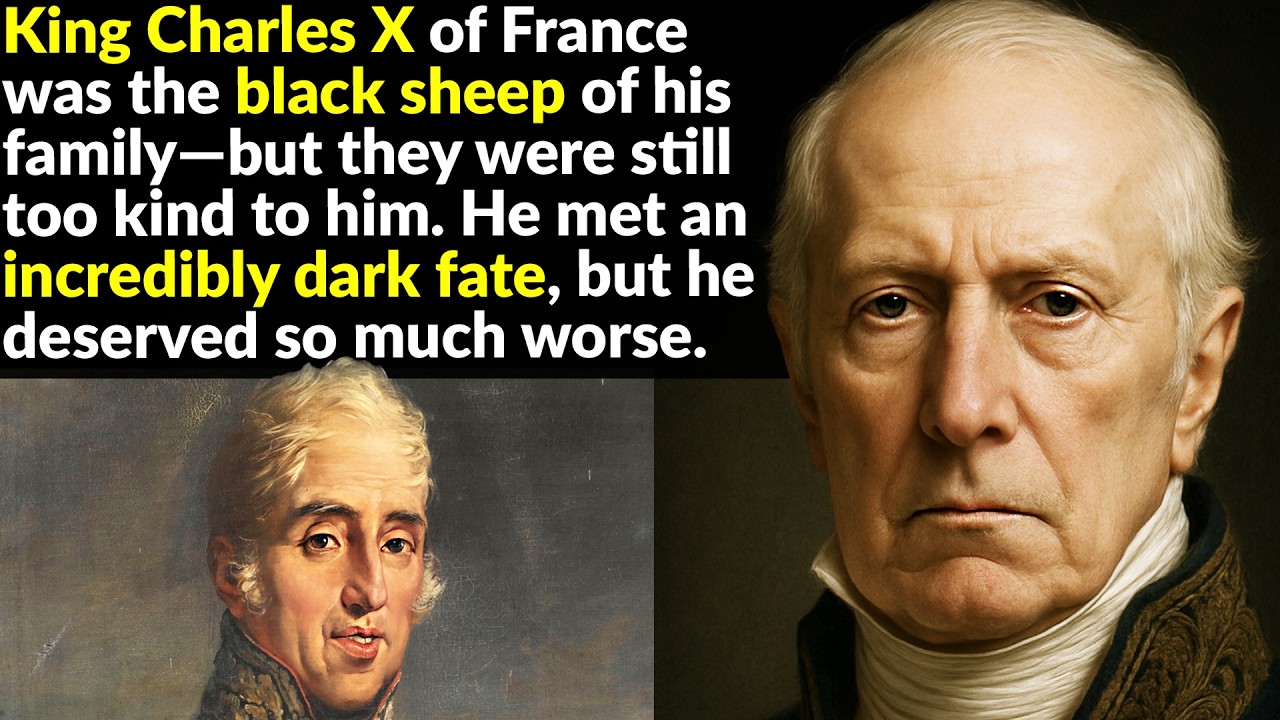
Charles X of France was the black sheep of his family—but according to historians, he met a dark fate that he deserved far worse than what he received. His reckless political maneuvering, hardline royalist beliefs, and disastrous decisions ultimately ended the Bourbon monarchy and triggered a revolution he had unintentionally helped ignite decades earlier. Born Charles Philippe in 1757 at the Palace of Versailles, he seemed to have no realistic path to the throne. As the youngest son of the Dauphin Louis and Dauphine Marie-Josèphe, he was given the title Count of Artois by his grandfather, King Louis XV.
But tragic deaths shifted the line of succession in his favor. In 1761, his eldest brother, the Duke of Burgundy, died of a sudden illness at just nine years old. Less than five years later, his father also passed away. Then, in 1767, his mother succumbed to tuberculosis, leaving Charles and his four surviving siblings orphans.
At 16, Charles performed his first royal duty by marrying Marie-Thérèse of Savoy. She was not well received at court. Contemporaries described her as diminutive, somewhat ill-shaped, clumsy, and with a long nose. The Holy Roman Emperor Joseph II, after visiting France shortly after the marriage, reportedly called her a complete idiot.
Charles, meanwhile, had a reputation for an insatiable appetite for romance. According to the Count of Hézecques, few beauties were cruel to him. His affairs included the opera singer and ballerina Anne Victoire Dervieux, but his greatest love was Louise de Polastron, a relationship that caused considerable scandal. Despite his preference for mistresses, Charles fulfilled his dynastic duty.
In 1775, his wife gave birth to their first son, Louis-Antoine, Duke of Angoulême, followed three years later by their second son, Charles-Ferdinand, Duke of Berry. By then, Charles had developed a reputation as King Louis XVI’s reckless younger brother—known for lavish spending and open affairs. But the most infamous scandal came in 1778. At a masked ball at Versailles during Mardi Gras, Charles attended in disguise with a new mistress, believing their masks would protect their identities.
The Duchess of Bourbon recognized him immediately—and worse, she recognized his companion: Anne-Michelle, a lady-in-waiting to Charles’s sister, Princess Elizabeth, who was also a married woman. The Duchess had particular reason to feel insulted. Anne had once been her lady-in-waiting, but the Duchess had thrown her out after Anne captured the affections of the Duchess’s husband. Seeing her again arm-in-arm with the king’s brother was a deliberate provocation.
As Charles sat down to recover from the tension of the evening, the Duchess sat beside him. After a few courteous words, she lunged for his mask and tore away his false beard. Enraged by her breach of etiquette, Charles grabbed her mask in return and crushed it against her face with such force that she burst into tears. Then he rose, turned his back on her, and left her humiliated in front of the entire Versailles elite.
But the scandal did not end there. The next evening, the Duchess of Bourbon hosted a lavish dinner and told her guests what had transpired, embellishing the story and painting herself as the victim of an unprovoked attack. The French aristocracy demanded revenge, and the public insisted that Charles and the Duchess’s husband, the Duke of Bourbon, settle the matter with a duel. Marie Antoinette intervened as an intermediary.
Rather than allow a real fight, she and Baron de Besenval arranged a staged duel. Charles and the Duke drew their swords, but their carefully choreographed fencing ensured neither man left with more than a scratch. Charles remained content with his frivolous lifestyle until 1786, when the monarchy faced financial ruin. France was drowning in debt from overseas commitments, and the government needed drastic reforms.
Charles supported taxing the aristocracy but refused to surrender the privileges of the nobility and the church. In his own words, it was time for repair, not demolition. In 1789, as the financial crisis deepened, King Louis XVI convened the Estates-General to push through reforms. Charles, a hardline conservative, opposed the Third Estate’s demands for greater power.
Even his brother accused him of being more royalist than the king himself. In July 1789, Charles conspired to oust the liberal finance minister Jacques Necker. He pulled the trigger on his scheme too early, forcing Necker’s dismissal on July 11. The timing could not have been worse.
The firing sparked public revolt, culminating in the storming of the Bastille on July 14. Charles had unwittingly helped ignite the French Revolution—and it would not be the last time. As the Revolution unfolded, Charles fled Paris with his family and a small group of close followers. Although many saw this as cowardice, some modern historians suggest Louis XVI had secretly approved the escape, fearing the monarchy’s future was already in jeopardy.
Charles sought refuge in Savoy, his wife’s homeland, before moving to Turin and then Trier, Germany. By 1791, he left without his wife, instructing Marie-Thérèse to remain in Savoy. It marked the beginning of their permanent separation. Charles refused to see her again, even forbidding her from attending their son’s wedding.
When she died in 1805, they had spent more than a decade apart, never reconciling. Charles devoted himself to one goal: restoring the monarchy. He gathered royalist forces for an invasion of France, but Marie Antoinette pleaded for a delay, fearing for her family’s safety while they were trapped in Paris. By the time Charles was ready to mobilize, it was too late.
Revolutionary forces had abolished the monarchy, and Louis XVI and Marie Antoinette were both dragged to the guillotine. Charles could do nothing from across the border. As revolutionary France descended into chaos, Charles fled again, this time finding refuge in Great Britain. King George III welcomed him, providing a lavish allowance.
Charles settled down with his longtime mistress Louise de Polastron, bouncing between Edinburgh and London. But Great Britain was never home. In January 1814, after more than two decades in exile, Charles saw his chance. He slipped away from London in secret to join coalition forces in southern France as they closed in on Napoleon.
With his older brother, the elderly Louis XVIII, too frail to lead, Charles took charge under a royal decree naming him Lieutenant General of France. By April, Napoleon had abdicated, paving the way for the Bourbon restoration. As Lieutenant General, Charles wasted no time shaping France in his own image. While Louis XVIII was still in England, Charles covertly established an ultra-royalist secret service operating without the king’s knowledge.
The network of informants spied on political opponents and crushed dissent for five years. By 1824, King Louis XVIII was dying. Gangrene had spread through his legs and spine. On September 16, 1824, he died, and Charles, at age 66, finally took the throne.
He knew he was ruling a fractured France. His coronation was designed as a compromise, blending old royal traditions with the new political reality. The writer Chateaubriand praised him, calling Charles affable like Louis XII and frank as Henry IV. But others remained unconvinced.
At first, Charles seemed to embrace liberal reforms, ending press censorship and touring the country to connect with the people. But behind the scenes, he installed ultra-royalists throughout his government, revealing where his true loyalties lay. His next moves left no doubt. On July 26, 1830, angry journalists gathered at Le National to denounce the king.
The next morning, the monarchist paper Le Moniteur Universel published a set of ordinances restricting press freedom and dissolving the Chamber of Deputies. Journalists responded with a call to arms: “Obedience ceases to be a duty. ” Paris exploded into unrest, and crowds flooded the streets chanting “Down with the Bourbons” and “Long live the Charter. ” Instead of backing down, Charles ordered a crackdown on protesters, leading to riots, looting, and clashes between authorities and the people.
A delegation of deputies begged Charles to revoke the ordinances, but he refused. By late July, it no longer mattered. The Chamber of Deputies declared his distant cousin Louis-Philippe d’Orléans the new king, plastering posters of the decision across Paris. Charles had lost everything.
By August 1830, Charles acknowledged the inevitable. He abdicated, signing a declaration that also forced his son to renounce his claim in favor of his grandson, Henry, Duke of Bordeaux. But the plan nearly collapsed when the Dauphin refused to sign away his rights. According to contemporary reports, father and son engaged in a furious shouting match before Charles convinced his son to sign.
Despite the maneuver, Louis-Philippe had no intention of recognizing the young duke as king. On August 9, 1830, the Chamber of Deputies officially crowned Louis-Philippe as King of the French. With that, the Bourbon monarchy was finished, and Charles was king without a kingdom. Stripped of power, Charles and his family fled as an angry mob of 14,000 closed in.
They escaped to Britain on steamships using fake names. When they arrived, the British greeted them coldly, mockingly waving the flag of the liberal movement in their faces. Seeking warmer climates, Charles settled along Austria’s Mediterranean coast, in what is now Slovenia, in October 1835. But his journey ended in tragedy.
Shortly after arriving in Gorizia, he contracted cholera and succumbed to the disease on November 6, 1836. Unlike his former French subjects, the townspeople mourned him, draping their windows in black cloth. He was laid to rest at the Franciscan Kostanjevica monastery, making him the only king of France buried outside his homeland.