Queen Wilhelmina of the Netherlands was raised as the nation’s last hope, but she was never expected to be loved. The mother who shaped her, Queen Regent Emma, was remembered as the “velvet” of the royal family—warm, diplomatic, and credited with saving the monarchy through kindness. Her daughter chose a completely different path. Born on August 31, 1880, Wilhelmina’s birth was a political event of enormous significance.
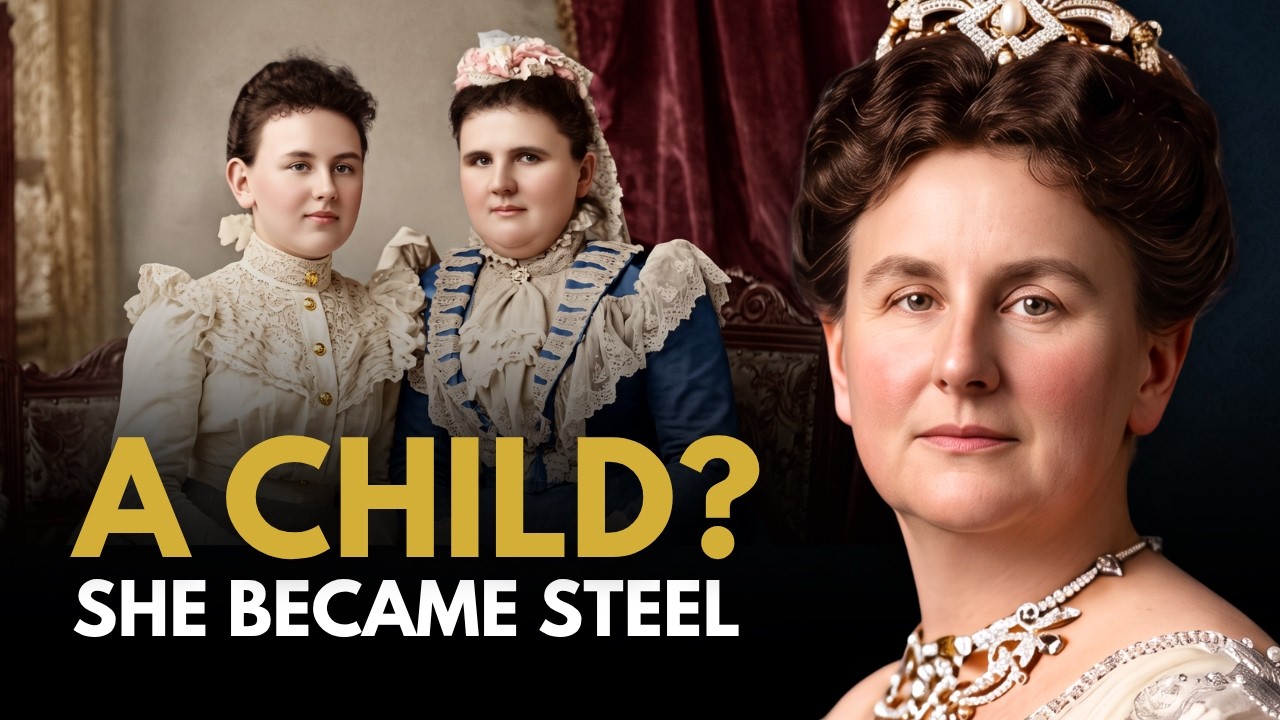
Her father, King William III, was elderly and had lost all his male heirs from his first marriage. Without her, the Dutch throne risked passing to a foreign branch of the family or disappearing entirely. She was the only chance to preserve the House of Orange. Her childhood was not a normal one.
William III was quick-tempered and distant, viewing his daughter mainly as an instrument for succession. It was Queen Emma who engineered her upbringing, fully aware that any mistake could cost the country its future. Wilhelmina grew up in near-total isolation, surrounded only by tutors, dolls, and a rigid daily schedule. From a very young age, she was drilled in history, theology, languages, and constitutional law.
She was taught that she was not an ordinary person—she was the Netherlands itself. This instilled a disciplined internal mask, and she learned to suppress personal emotions in favor of state duty. By age ten, she knew more about affairs of state than many adult ministers. She never knew play or friendship, only discipline.
In that isolation she learned to observe, analyze, and remain silent—skills that would later become the foundation of her political sharpness. She was a prisoner of her position, but within that position, she forged a personality far stronger than many of her crowned predecessors. When William III died in 1890, ten-year-old Wilhelmina became queen, and her mother’s regency became her primary school of power. Watching Emma manage cabinets and calm parliamentary conflicts, Wilhelmina drew conclusions very different from what one might expect.
She saw her mother’s diplomacy and willingness to compromise as weakness. She became convinced that ministers were obstacles to be overcome, not partners to be consulted. She believed the monarch should make decisions alone, based on the country’s supreme interest, which she felt was uniquely hers to define. When she ascended the throne in 1898 on her eighteenth birthday, the nation did not see a smiling young princess.
They saw a domineering young woman with a cold gaze, ready to rule firmly. From the first days, she made clear her authority was not nominal. She intervened actively in politics, demanding reports and summoning ministers for questioning, constantly irritating a political establishment used to a looser hand. She was a demanding ruler, contemptuous of court intrigue and hypocrisy, and she commanded loyalty from those around her.
In 1901, she married Prince Henry of Mecklenburg-Schwerin in a purely dynastic calculation to secure the succession. The marriage lacked warmth, and Wilhelmina threw herself even deeper into her work. During those years she proved herself a modernizing monarch, supporting industry, naval expansion, and economic ties with the colonies. World War I was her first real test.
The Netherlands found itself squeezed between warring blocs, and maintaining neutrality required precise diplomacy and nerves of steel. Wilhelmina proved skilled in foreign policy, using family connections to protect Dutch independence. She personally inspected troops and demanded reports from generals, keeping the army ready. In 1918, as revolution and the fall of monarchies swept across Europe, Wilhelmina did not flee.
She addressed the people, promising reforms, and showed a resolve that calmed unrest, cementing her place as protector of national unity. She understood that in times of crisis, people sought firm leadership, not democratic rhetoric. The interwar years deepened her isolation. The economic depression of the 1930s hit the Netherlands hard, and Wilhelmina, raised on the sacredness of royal authority, could not accept the rise of socialist sentiment.
Her relationship with her daughter Juliana was complicated—she tried to shape Juliana into another version of herself, blind to her daughter’s more open and less dogmatic nature. Wilhelmina was among the first to recognize the danger of Hitler, while many politicians favored appeasement. She saw Nazism as an existential threat and pushed for rearmament, feeling like a prophet nobody believed. Her isolation grew, but it was not weakness—it was awareness of what others chose to ignore.
World War II became the crucible that forged her legend. When the Nazis invaded the Netherlands on May 10, 1940, Wilhelmina was prepared to die in The Hague, refusing to abandon her post. Only pressure from the Allies and her own government forced her to evacuate; they understood that the queen’s capture would mean the end of legitimate state authority. Leaving on a destroyer was a terrible shock for her.
She felt like a traitor who had abandoned her people in their darkest hour. But once she reached London, she became anything but a silent guest. She established Radio Orange, which became her primary weapon. Every broadcast was an event.
She spoke directly to the Dutch in their hiding places and to those starving under occupation, writing her own speeches. She knew the Nazis could execute hostages for every word, so her words were measured and strong. In London she lived modestly, enduring bombing and severe cold, refusing royal luxury while her people suffered. She clashed with Winston Churchill, demanding that the Netherlands be respected as an equal ally, not a colony.
Churchill, initially skeptical, later admitted she was the only man in the Dutch government. She became a hub for the resistance, supporting them with money, equipment, and instructions. She bore personal responsibility for every life lost in the struggle. She was under constant threat, her car was attacked, but her will never broke.
For Hitler, she was the most dangerous enemy because she was an indestructible symbol. Even with the entire country occupied, she represented the Netherlands itself—the Netherlands in exile. Returning to the liberated country in 1945 was a victory, but a bitter one. She saw a devastated land where millions lived with hunger and poverty.
She visited ruined cities, and people saw that despite her harshness, she shared their grief. In the postwar period, Wilhelmina recognized that her authoritarian style no longer suited the new democratic reality being built on the ruins of the old world. She faced the painful decolonization of Indonesia, which felt to her like a personal collapse of the imperial greatness she had known for half a century. But then she made the greatest decision of her life.
In 1948, on the fiftieth anniversary of her reign, she abdicated in favor of her daughter Juliana. It was an act of profound political wisdom. She understood the monarchy needed new blood and new openness, and she stepped aside deliberately to ensure the dynasty’s survival. She did not want to die on the throne; she wanted the monarchy to continue after her.
She spent the last fourteen years of her life in seclusion at Het Loo. No longer queen, she became simply Princess of the Netherlands. During this period she wrote her memoirs, titled “Eenzaam maar niet alleen” (“Lonely but Not Alone”), which became a revelation for the entire country. For the first time, a monarch of her standing spoke honestly about her feelings.
She wrote about fear, loneliness, and how she was forced to suppress her femininity to remain a symbol of the nation. Wilhelmina died on November 28, 1962, and her death marked the end of an entire era. She was not a perfect person. She could be harsh, dogmatic, and self-righteous in her sense of duty.
But history does not judge rulers by their personal warmth—it judges them by their actions in moments of historical choice. In the greatest crisis of the twentieth century, she proved to be the leader her nation needed. She left behind a model of governance now known as the Dutch democratic monarchy, demonstrating that even in the age of democracy, the crown is not mere decoration. She was the fortress that saved the spirit of a nation when the world was collapsing around her, and that steadfastness is why she is remembered as the greatest queen in the modern history of the Netherlands.
Her legacy lives on in every Dutch person who understands that freedom is not a given—it is something to fight for, even when the whole world seems against you.