Somewhere in the high desert, there is a stretch of road the old people refuse to drive after dark. They will not say why until you have known them for a long time. The stories always begin at the bend where the land drops away. A man leaves a gathering.
He is careful. He knows the road. Yet somewhere past the bend, he becomes aware he is not alone. Nothing passes him.
Nothing is ahead of him. But behind him, matching his pace exactly, something keeps the same distance no matter how fast or slow he goes. It does not want him to stop, and it does not want him to look. The woman at the center of this account is not one person but a composite of grandmothers from that country.
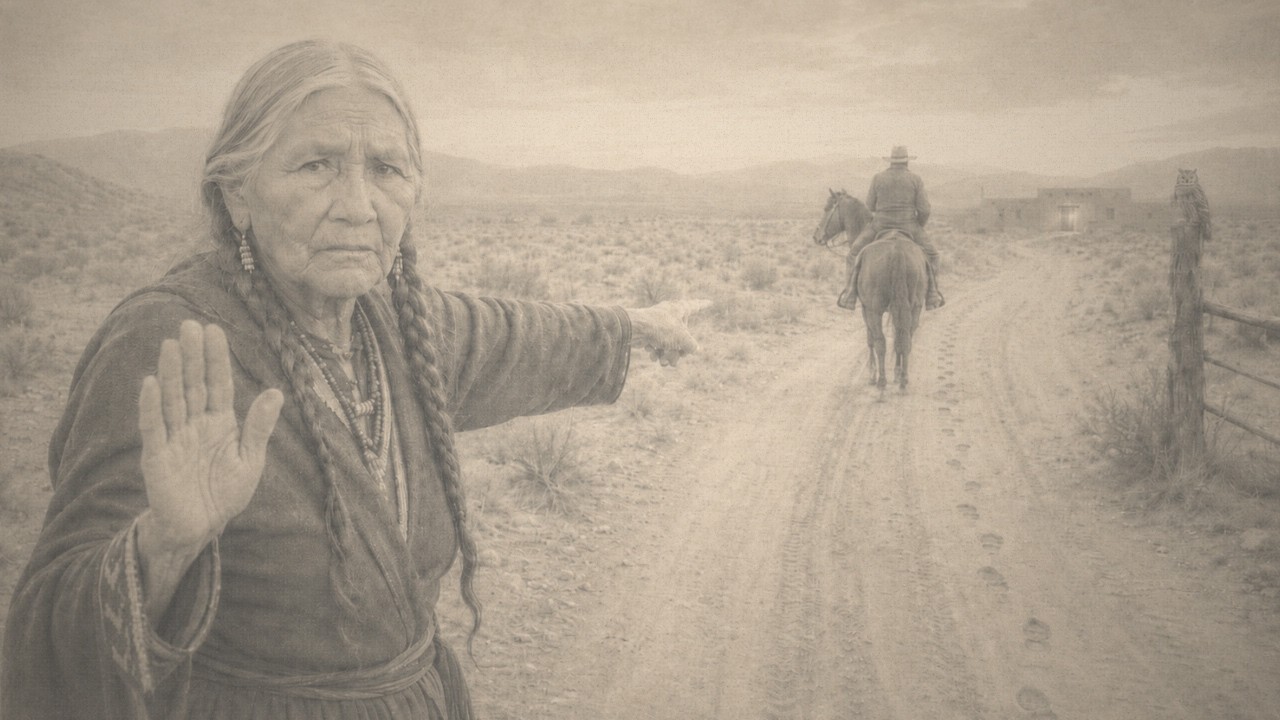
She is small, with hands like dry riverbed clay and a voice that never rose above the wind at the window. She lived at the end of a dirt track the county never paved, in a house added onto so many times it no longer had a shape. She kept the door facing east, because the east is where the morning comes from, and the morning is the only thing that reliably sends the night home. She did not tell this story to frighten anyone.
She told it plainly, the way you would tell a child not to touch the stove. She used no word for the thing that follows riders home that translates cleanly. The closest anyone came was to say it is the part of the dead that did not finish leaving. Not a ghost as the movies mean it.
Something more like a debt the living owe and forget they owe until the road reminds them. The land remembers longer than people do, she said. You can pave a road, but you cannot pave what the road runs over. Some of what it runs over was walked by feet gone a thousand years.
Those feet did not all leave willingly, and they did not all leave at all. When you travel at night, you move across the top of everything that ever happened on that ground. Most of it stays asleep. A little of it does not.
She had rules for the road, and she gave them to everyone who would sit still long enough to hear them. The rules are the whole point. The story without the rules is just a scary thing that happened to someone else. The story with the rules is a set of instructions for staying alive.
Her first rule was do not travel alone after dark if you can help it. A thing that follows one rider will not follow two. Two people fill the silence, and the silence is what the thing lives in. When you are alone, the silence gets very large very fast.
Into that largeness comes the sound of a second set of footsteps that is not an echo, because an echo stops when you stop. This does not. It keeps going for exactly one more step every time. Her second rule was do not look back, not once.
Not to check. Not to prove nothing is there. Not for any reason. The not knowing is unbearable, and the thing knows it is unbearable.
It wants you to turn. Turning is how it gets in front of you. As long as it is behind you, it can only follow, and following is survivable. But if you turn and see it, then it has been seen, and a thing that has been seen is no longer behind you.
It is with you. The third rule was the one she guarded most carefully. Do not speak to it. It will speak to you.
That is the part people are never ready for. The voice will be one you know. It will be your mother calling you in from the yard. It will be a brother who died, or a wife three years in the ground, saying your name the way only she ever said it.
Every fiber of what makes you human will want to answer, because answering is love, and the thing counts on your love, and your love is the door. A man who does not answer can walk all the way to his door with the thing a single step behind him, cross the threshold, turn on the light, and be alone. That man will be all right, mostly, though he will never drive that road again. But the man who answers even once, even to say stop, even to say who are you, even to say leave me be, has spoken across the distance and closed it.
The thing is no longer following him. It is walking beside him, and it will come inside. She was not describing a monster you could shoot or run from or lock out. She was describing a condition, a state you can slip into on a dark road the way you slip on ice.
Simply by being alone and warm and alive in a place that has more dead in it than living, and always has. The desert looks empty. That is its great lie. It is the most crowded place there is.
You just cannot see the crowd until the sun goes down, and you are the only one still breathing on that whole long stretch. There was a season, the tellers say, when three riders went out on that road in a single winter, and only the memory of them came back. It is that winter the story is really about. The first of them was a young man who thought the rules were for old people.
He had grown up on the story the way you grow up on a nursery rhyme, hearing it so many times it stopped meaning anything. There was a truck and a full tank and a girl on the other side of the county. The road past the bend cut two hours off the long way around. He left after midnight.
The tellers are specific about the hour, because she was specific about the hour. There is a stretch of the night the old people called the low tide. The deep middle where the dark is oldest and thinnest. Not midnight, not dawn.
The long flat hour between them, when the world has forgotten it is going to end, and the things that wake in it have not yet remembered they have to sleep. He hit the bend in the low tide. The radio went first, not to static but off. The lights on the dash stayed on, the engine kept running, but the radio simply stopped mid-song, and no button would bring it back.
In the sudden silence, he heard behind him another sound keeping pace. He checked his mirror without thinking, and the road behind him was empty. But the sound did not stop. When he sped up, the sound sped up.
When he slowed almost to a crawl, the sound slowed too, staying exactly as far behind him as it had always been. He did the thing she told everyone never to do. He turned in his seat at speed and looked out the rear window. The tellers say what he saw was not a face and not a shape and not anything he could ever describe.
Only that it was closer than the sound had made it seem, much closer, and that it was not walking anymore. It was keeping pace with a truck doing fifty miles an hour, and it was looking back at him. He does not remember the drive after that. The mind cannot hold what it saw, so it lets go and stitches the edges shut.
He woke in his own driveway with the engine off and the sun coming up, with no memory of how he got there, only the certainty that something had ridden the whole way with him and that he had looked at it. He was one of the lucky ones. He made it home. But the tellers say he was never entirely alone in a dark room again, and he kept a light burning in every window of his house until the day he died.
When people asked him why, he only ever said the same three words: “It knows me now. ”
The tellers say the old woman hated that question more than any other. Not because she did not know the answer, but because she knew a name makes a thing smaller, and this thing does not deserve to be made smaller. But she gave an answer anyway near the end to the ones she trusted.
It is not one thing, she said. It is anything that was left unfinished on that ground and had nowhere to go. Some of it is very old. Some of it is not old at all.
All of it is hungry in the particular way that only the unfinished can be hungry. It does not want to eat you. It wants to be you. It wants to walk in a warm body again and feel the road under real feet and come home to a lit window.
It cannot, and it knows it cannot, and the knowing is the whole of its rage. Most of what walks that road at night was once someone walking that road at night. Someone who was themselves followed home by something older. Someone who answered when they should not have.
The thing that follows you is doing to you exactly what was done to it. In that sense, she said, it is almost gentle. It is only trying to give you what it was given. It does not understand that this is not a gift.
The second of the three riders that winter understood the rules and broke them anyway, the worst kind of breaking, because ignorance can be forgiven and hers could not. She was a woman in middle age who had buried her husband the spring before and had not stopped grieving him. She knew the rules by heart. She could have recited them in her sleep.
She went out onto that road alone in the dead middle of a winter night because she could not sleep in a house that still smelled like a man who was gone. Driving was the only thing that made the ache bearable, and the road past the bend was the emptiest road she knew. It came the way it always comes. The radio dying.
The second sound starting behind her. The cold coming up through the floor of the car and up her spine. She gripped the wheel and stared straight ahead and said to herself the way the old woman taught: Do not look. Do not answer.
Drive. You are almost home. She did everything right for the first several miles. The grief had made her strong the way loss sometimes does.
She was going to reach her door with the thing one step behind her, step across, and be alive. Then it spoke to her in her husband’s voice. It said her name the way he used to say it, with the little catch on the second syllable that was his alone. And it was him.
It was exactly and perfectly him. It asked her to slow down. It said it had been trying to reach her. It said it had been so cold.
Why did you leave me out here in the cold? She knew it was not him. Some clear cold part of her that grief had not drowned knew exactly what was in the back seat and knew that the moment she answered she would be lost. She drove another mile with her jaw locked and tears running down her face.
She almost made it home. A mile from her own door, with the porch light she had left burning already visible as a small yellow point ahead, the voice stopped pleading and simply said, in the voice she loved more than her own life: Please don’t leave me alone again. She answered. She said his name back.
That is all. One word. They found her car the next morning half a mile from her house, stopped neatly on the shoulder, engine off, keys in the ignition, driver’s door standing open to the desert. Her footprints led away from the car and into the open ground and stopped in the middle of flat empty sand, as though she had taken one more step than the ground would hold, and the ground had let her through.
She was never found. The porch light was still burning when they got there. The highway is new. Under it, the dirt track is older.
The wagon route it followed is older still. The horse path that became the wagon route is older than that. Under the horse path is a foot trail people walked for so many centuries that no one alive can say when it began. Every road that country ever had ran along the same low easy places because the land only offers so many.
And the old woman said that is why the road is the way it is. It is not that the road is haunted. It is that the road is the one place where everyone who ever lived there walked, and the one place where everyone who ever died there died. The sheer weight of all those endings stacked along a single thin line is more than any ground was ever meant to hold.
In the older tellings there are no trucks and no radios, and the riders sit horses, and the thing follows them exactly the same way, at the same distance, with the same patience. The horseman in the oldest version knows the same three rules the trucker knows. The rules never change because the thing never change. Only the shape of the rider changes.
To it, a hundred years is nothing. It has been keeping pace behind travelers on that line of ground since before the first person thought to call it a road. The old woman used to say this is what the modern world gets most wrong about the desert. People think the emptiness means nothing happened there.
They drive into it with their windows down and their music playing as though they are the first people ever to pass through. The emptiness is not the absence of history. The emptiness is what a place looks like after so much history has happened that all the people who could remember it are gone. The desert is empty the way a house is empty after a funeral.
She said it is the newer dead you have to fear. The ones still close enough to their living to remember how it felt. Still able to shape a familiar voice. The thing that keeps pace behind you is almost never ancient.
Almost always it is recent. Almost always it is someone who died on that road or near it within a lifetime or two, who was themselves followed and answered and taken and taught. If you could see the whole chain of them stretching back, each one made by the one before, you would understand that the thing on the road is really a lineage. A line of the taken, each teaching the next.
Every time someone answers a voice in the dark, the line gets one link longer. The old woman spent her whole life trying to keep it from getting longer. One traveler at a time, one telling at a time, and mostly failing, because the pull of a loved voice in the dark is stronger than any warning, and she knew it, and she told the warning anyway. After the woman was lost, the old woman started telling the story more, not less.
A story that stays a story is entertainment. A story that comes true is a warning, and a warning has to be given over and over to everyone. She had just watched it fail to save someone she loved. So she started teaching the signs that come before the following, the small wrong things the desert sends ahead, the way a cold wind comes ahead of a storm.
“The land warns you,” she insisted. The desert is not cruel. It does not want you taken. It sends its warnings faithfully every single time.
The only reason anyone is ever taken is that they did not know how to read the warnings, or they read them and drove on anyway. The first sign was the owl. In that country, the owl is a messenger, and the message is not happy. When the old people saw an owl where an owl should not be, sitting on a fence post at the edge of the road at the wrong hour, they turned around.
They did not finish the trip. An owl on the post at the wrong hour means the road is awake tonight, and a road that is awake is a road you do not travel alone. If you see the owl and drive on, watch for the second sign. The second sign is the silence.
The desert at night is never truly quiet. There are insects and wind and the small movements of small living things, a floor of sound under everything. The second sign is when that floor drops away all at once. The desert holds its breath.
The insects stop. The wind dies. And you understand that everything alive out there has gone still, because everything alive out there knows what everything not alive is about to do. The third sign is the sound behind you.
The extra footstep. One more than there should be. By the time you hear that, the owl has already warned you, and the silence has already warned you, and you have driven past both. The only warning left is the thing itself, announcing that it has chosen you.
After that there are no more signs. The third rider of that winter heard all three signs and kept every rule and still did not walk away clean. His is the story the old woman told last and told most carefully, because it teaches the final and worst lesson: sometimes doing everything right is not enough. He was an older man, a widower long past the sharp part of his grief.
A careful, unhurried person who had lived on that land his whole life and respected it the way you respect a river you have seen drown people. When he had to travel that road at night, he traveled it the way she taught. He kept a light on the seat beside him because she said light is company and company is protection. He talked out loud the whole way to himself, to God, to his dead wife, because a talking man is a man filling the silence before the silence can be filled for him.
The night it came for him, the owl was on the post and he saw it, and he could not turn around because his brother was dying on the far side of the county and there was no other road that would get him there in time. He drove on into a waking road because love was pulling him. The silence fell, and he kept talking through it, louder, steadier, naming everything he could see. The footstep came, one more than there should be.
He heard it. He did not look back. He did not stop. He did not answer when the voice began.
The voice was his wife’s. It begged. It wept. He did not answer it.
He drove the whole way to his brother’s house with his dead wife sobbing in the back seat of his truck, and he never once said her name. He made it. His brother lived that night. And the old man believed he had won.
For a while he had. But his was different from the others, and worse. The others were taken on the road. His waited.
When he got out of his truck at his brother’s house, shaking, spent, weeping with relief, he said out loud to no one, to the cold night air: “Thank God. Thank God I made it. ” That was the mistake. Not answering the voice.
Answering the night. He had spoken out loud across the open dark a sentence full of feeling. The thing that had followed him did not need him to say a name. It only needed him to open his mouth freely into the dark.
That was enough, and it walked in on the sound of his own gratitude. He drove home the next morning. Life resumed. Then the wrongness moved in.
It started with the house feeling occupied when he came home to it. The air still stirred. A warmth on a chair no one had been sitting in. He told himself it was grief.
That is exactly what the thing wanted him to tell himself, because a man who blames his own grief will not fight what is actually there. Then came the voice again, but inside the house. A voice inside your own house is a violation of a kind the road can never manage. He heard his wife in the next room humming the way she used to when she cooked.
Once, he heard her laugh from the bedroom, that soft private laugh that had been his alone for forty years. He stood in his kitchen with his hand over his mouth, and he did not go and look, because he understood the thing had learned her so thoroughly it no longer needed the road. It lived in the walls now, and it wore her the way you would wear a coat. He held out longer than anyone the old woman ever knew of.
Every light in the house stayed burning, but it was not enough. He had let it inside, and no light is bright enough to make a house empty when the thing has already moved in. He stopped sleeping. A decade of age came onto him in a year.
The old woman sat with him some nights near the end in his lit kitchen, the two of them not talking, just keeping the dark company. She said the worst thing was not the sounds. The worst thing was that he wanted to answer. Every day the voice was a little more her, a little kinder.
Every day the loneliness of not answering got a little heavier. The thing does not break you with what you are afraid of. It breaks you with what you want. He answered in the end.
Everyone does, she said, if it has enough time, and time is the one thing it has without limit. One night the voice called him to bed the way she used to, and he said, “All right, I’m coming. ” Two words. In the morning his house was empty.
Every light was still burning. His bed had not been slept in. There was no sign of him. No footprints this time, because he had not gone out to the road.
He had gone somewhere the road does not reach. The old woman closed his door and turned off his lights one by one, and she did not tell the story again for a long time after that. That is when people started to say she had stopped telling it. She had watched it take three people in a single winter.
One who broke the rules and two who did not. Something in her decided the telling was not saving anyone. There is a question the old stories raise quietly, the one nobody likes to ask out loud: what if the story is how it travels? What if a thing that can wear a voice can also wear a story?
Every time the tale is told, somewhere on some dark road, someone is being taught not how to survive it, but how to expect it, how to listen for it, how to be ready to answer. She never resolved that question. She just stopped for a while and let the silence back in. But the road did not stop being awake just because she stopped talking about it.
The truckers who run those routes have their own version of all of this. They do not call it what she called it. They have their own words, the flat, unspooked language of people who drive through the dark for a living. But it is the same thing.
Ask any long-haul driver who runs the empty desert routes, and they will tell you there are stretches you do not stop on. Not for a hitchhiker. Not for a stalled car. Not for a figure standing at the edge of your headlights with its hand raised.
No matter how human it looks, because the ones that need help most are exactly the ones you cannot help. Stopping is a kind of answering, and answering is the door. There were protections, the old woman said, though she was careful never to call them cures. They were all things you did before.
The east-facing door was one, so that the first thing your house met each day was the morning. A light left burning was another. Not because light hurts the thing; it does not. But because light is company, and company fills the silence, and the silence is the medium the thing swims in.
Salt at the threshold in some tellings, ash from a particular kind of wood in others. None of it reliable, all of it better than nothing. She put more faith in the rules, because the rules cost nothing and worked every time they were kept. But the protection she trusted most was the one that cost the most: do not go out.
When the owl is on the post, and the hour is low, and the road is the only road, do not go. Even when love is pulling you, because the road will use that love against you. The hardest and wisest thing a person can do is sit still in a lit room while someone they love is out there in the night, and wait for morning, and trust that whatever is happening will still be happening in the daylight when the road is only a road again. She knew that was a terrible thing to ask.
She never once blamed the taken, because she was not sure she could have done it either. But she taught it anyway, the hardest rule: stay home, wait for the light, let the dark have the dark. She told one last small story to the children at the very end of her life. It was about a girl sent to fetch something from a neighbor’s house at dusk, later than she should have been sent.
On the way back she heard a footstep behind her that was one more than her own. She was very young, but she had been raised on the rules. She did not look back, and she did not answer. When a voice began behind her, a kind voice offering to walk her home so she would not be scared, she said nothing at all.
She looked at the light of her own house ahead of her and walked toward it, not running, because running is a kind of answering too. She stepped across her own door, turned, and shut the door on the dusk, and was safe. The old woman said to the children: “That girl was me. I was younger than you are now, and I have been walking toward the light and refusing to answer for ninety years, and that is the only reason I am here to tell you this.
Walk toward the light. Do not answer, and you will get to be old, and you will get to tell it, and the line of us who make it home will be one longer. ”
The truckers have their rules the same way she had hers, and the rules match across all the years. Do not stop on the dead stretches.
Do not pick anyone up after a certain hour. If your radio dies for no reason, do not fix it. Just drive. Do not turn around no matter what you think you hear in the sleeper cab behind you.
And the last one, the one they lower their voices for the same way the old tellers did: if something calls you by name out there on the CB or through the window or from the dark beyond your lights, do not answer it. The ones that call you by name are the ones that have already decided to follow you home. The truckers are not superstitious people. They are the opposite, the most practical workers there are, running on schedules and fuel logs and hard math.
And yet ask them about the dead stretches and watch how the practical ones go quiet. They have felt it. The radio that dies for no reason. The certainty that the sleeper cab is not empty.
They have their own map of the road, passed driver to driver at fuel stops. None of them can tell you why they know it. Only that the ones who ignored the map are the ones whose trucks got found on the shoulder in the morning with the doors open and the driver gone. The old woman came back to the story at the very end of her life, one last time, and she told it differently than she ever had before.
She gathered the young ones, the great-grandchildren, the ones most likely to think the desert had been tamed, and she told them the whole thing start to finish. When she was done, she said the thing on the road is not your enemy. That frightened them most, because they had been braced for a monster. Your enemy you can hate, and hating is easy, and hating keeps you safe, because you will not answer a thing you hate.
But this wears the voices of the ones you loved because it is made of the ones you loved. The unfinished part of them. When it calls you by their names, it is not entirely lying. Some real thread of them is in there.
You are not being hunted by a stranger in the dark. You are being called by everyone you ever lost, all at once, from just behind your shoulder. And then she said the part the young ones never forgot. The real dead, the finished ones, the ones who left the way they were supposed to, are ahead of you, always ahead.
They are at the door with the light on, waiting. Anything that calls you from behind, anything that follows, anything that keeps pace and begs you to slow down and stop and turn, is not them. It only sounds like them. The ones who love you are already home, ahead of you in the light.
Keep your eyes forward and keep driving toward the light, and do not turn around, because everything worth turning around for is in the direction you are already going. That was the last time she told it. She died not long after, facing east, toward the morning, toward the door with the light on. Whatever had walked that road all her long life, and tried surely more than once to call her by the names of her own dead, never got her, because she knew the one thing that keeps you.
Look forward. Drive toward the light. And no matter how much you loved them, no matter how much you ache to, do not answer the ones behind you. The road is still there.
The bend is still there. Go at night alone in the low tide, and you may find the radio dies where the land drops away. You may find the insects stop all at once and the silence comes down with a weight you can feel in your teeth. And you may hear under your own tires one more footfall than there should be, keeping pace, matching you, never closer and never farther.
The old woman was never telling a scary story. She was giving directions. Eyes forward. Toward the light.
Whatever calls you from behind, however much it sounds like coming home, keep driving. Do not answer. Do not turn around.
And do not, whatever you do, bring it home with you.


