Historians have long documented the crimes of the Third Reich, but a new line of inquiry is drawing intense attention by asking a deceptively simple question: what did Hermann Göring, the second most powerful man in Nazi Germany, actually do all day? The answer, according to a sweeping new examination of his daily routines, is both more fascinating and more damning than almost anything his prosecutors said at Nuremberg.
Göring held more official titles than perhaps any single individual in modern European history. He was commander-in-chief of the Luftwaffe, Reichsmarschall of the Greater German Reich, Prime Minister of Prussia, President of the Reichstag, Plenipotentiary of the Four Year Plan, and Reichmaster of the Hunt. At one point, he was Hitler’s officially designated successor.
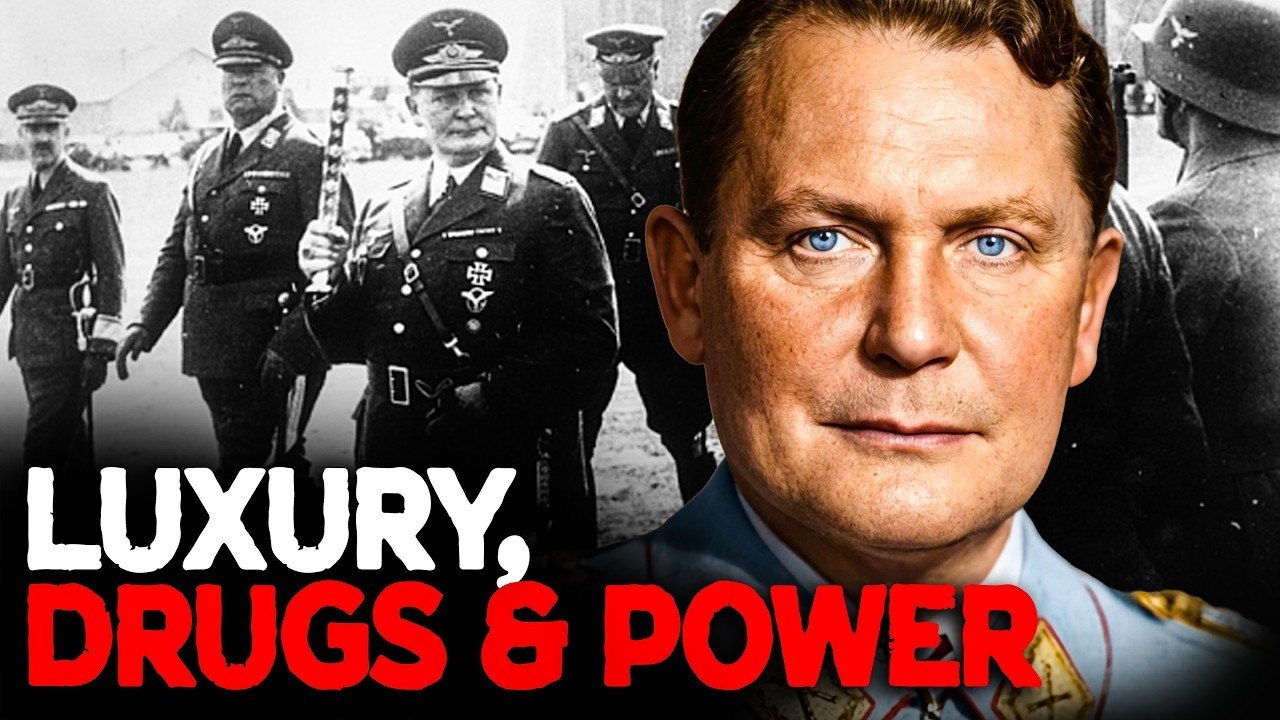 He commanded a personal fortune plundered from the art collections of Europe, lived in a palace he built from the ground up in a Brandenburg forest, and wore costumes so elaborate that even his own subordinates struggled to keep straight faces. Yet by the middle of the war, a persistent whispered question echoed through the German High Command and the barracks of the Luftwaffe itself.
What exactly was Hermann Göring doing? Not in the grand strategic sense, not in the historical ledger of his crimes, but literally, practically, on any given Tuesday in 1942. When did he rise?
What did he eat? How did he conduct the war from behind the walls of his fairy tale estate while the men of his air force froze to death on the Eastern Front?
The reconstructed record of his daily life, drawn from staff accounts, adjutant memoirs, and postwar testimony, reveals a man who slept until mid-morning, bathed at elaborate length, changed uniforms several times a day, and spent his afternoons with stolen art and model trains while his air force collapsed.
Göring generally did not wake before ten in the morning, according to consistent reports from his staff and adjutants. On some days, particularly in the later war years when morphine dosages were higher and the military situation grimmer, it was closer to eleven. On documented occasions, he did not emerge until midday.
For the commander of an air force in the middle of the most destructive air campaign in history, the habit of sleeping until mid-morning was, to put it mildly, a logistical complication. Generals waiting to brief him on overnight operations found themselves cooling their heels in his anterooms, clutching reports about losses and sortie rates.
When Göring finally emerged, the morning ritual was elaborate and time-consuming. He bathed at length with meticulous attention, using deep Roman-style tubs and extensive collections of bath oils and perfumes, some specially manufactured for him. His valet laid out the first uniform of the day, because there would be several.
His relationship with uniforms was extraordinary. He did not simply wear them; he designed them, obsessed over them, and changed them with a frequency that bewildered the officers around him. On a single day at Carinhall, he might appear at breakfast in a creamy white military tunic of his own invention.
After the morning meeting, he might change into what one adjutant described as a sort of Renaissance hunter’s outfit, complete with a large ornamental knife at his belt. At lunch, a different version of the Reichsmarschall’s uniform with the distinctive baton. For evening dinner, something more reminiscent of ancient Rome than 20th century Germany.
The breakfast itself was a production. Göring ate enormously throughout his life, and by the late 1930s his appetite had become legendary, and not in a flattering way. He ate multiple courses, meats and pastries and rich German dishes in quantities that shocked visitors accustomed to wartime rationing.
The irony was not lost on the German public, who faced increasingly severe shortages while official propaganda celebrated sacrifice and solidarity. Stories circulated, whispered at first and then more openly as the war went badly, about the Reichsmarschall’s table and its abundant hospitality while ordinary Germans thinned and shivered.
By 1943, Göring weighed somewhere between 260 and 300 pounds, depending on whose account you trust. The transformation from the lean, athletic fighter pilot of 1918 was so dramatic that photographs of the two periods barely seem to depict the same individual. His Luftwaffe subordinates had a private nickname: Der Dicker, the fat one.
The question of Göring’s 𝒹𝓇𝓊𝑔 use is central to any honest account of how he spent his days. After his morphine dependency began following the 1923 Beer Hall Putsch, when he was shot in the groin and thigh, he was treated for addiction on several occasions, most notably in 1925 at a mental hospital outside Stockholm.
By the time the war began in 1939, he had largely substituted raw morphine for paracodeine pills, a milder opioid he consumed in extraordinary quantities. By 1943, multiple sources, including his personal physician and several adjutants, reported he was taking as many as 40 to 100 paracodeine pills per day.
He carried the pills in a small leather case that went everywhere with him. His staff knew not to comment. The effect on his daily functioning was significant and cumulative.
He was slower, more prone to distraction, more given to grand, disconnected optimism that ignored inconvenient evidence.
The afternoons at Carinhall were the part of Göring’s day that most dramatically illustrated the gap between his official responsibilities and his actual preoccupations. After the morning briefing, the afternoon belonged to what he called his collections, intersecting with one of the great crimes of the Second World War.
Göring’s art collection, assembled through forced purchase, outright theft, and the coercive machinery of occupation, was estimated at his 1945 arrest to contain between 1,300 and 1,500 individual works. These included paintings by Rembrandt, Vermeer, Van Dyck, Rubens, Titian, and dozens of other masters.
He had an entire special unit working on his behalf, the Einsatzstab Reichsleiter Rosenberg, which was theoretically another official’s operation but which Göring used extensively with complete priority access to the best pieces. When the unit finished cataloging confiscated Jewish homes in Paris, Göring’s representatives were usually first in line.
The collecting consumed him in a very literal sense. His staff maintained detailed inventories of works stored at Carinhall, and Göring spent hours reviewing photographs and descriptions of new acquisitions, directing their placement, and planning future expeditions. He corresponded directly with dealers and curators in occupied countries.
Whatever else Göring was, he was not a careless or ignorant collector. He had studied art history with real seriousness. Several dealers who worked with him after the war noted, with uncomfortable admiration, that his eye was excellent.
 This made the theft more obscene, not less.
Carinhall itself was the physical expression of everything Göring wanted his daily life to be. He began building it in 1933 on a forested estate in the Schorfheide, a protected hunting area north of Berlin previously reserved for the Hohenzollern royal family. The name honored his first wife, Carin.
The estate grew over the years until by the early 1940s it was essentially a private palace complex of extraordinary size and opulence. There was a games room with billiard tables and model train sets he played with in the evenings with something approaching genuine childlike joy, plus an indoor swimming pool, cinema, stables, and aviaries.
In the forest surrounding the main buildings, Göring introduced herds of bison, moose, and various deer species, maintaining his own personal wildlife reserve. He was, after all, the Reich Master of the Hunt, and he took this designation with total seriousness. Hunting was a fundamental expression of his self-image.
The dinners at Carinhall were events unto themselves. He loved to entertain, and the guest list across the late 1930s and throughout the war read like a who’s who of the Third Reich, the diplomatic corps, and a rotating cast of artists, athletes, and celebrities whose presence wavered between court entertainment and propaganda performance.
Göring was, by universal account, a compelling host. He was funny in the blunt, aggressive way of a man who had spent his formative years in military messes, and he was a gifted raconteur who could hold a table’s attention for hours with stories from the First World War, embellished freely.
But there was another dimension to the evenings at Carinhall that formal diplomatic descriptions tended to leave out: the model trains. Göring’s model railway was not a private hobby kept discreetly in an attic. It occupied an entire room of the main house, large enough for a scale recreation of an entire railway network.
He played with this installation with the focused, unhurried absorption of a child on Christmas morning, operating the controls himself, rerouting trains, setting up elaborate scenarios. Senior officers waiting to discuss urgent matters were occasionally told, with complete seriousness, that he was not to be disturbed because he was in the train room.
It would be easy to dismiss Göring as simply a buffoon, the fat, 𝒹𝓇𝓊𝑔-addled dilettante who lounged about while the war went wrong. But this would be a profound historical mistake. The late 1930s saw Göring operating at a level of strategic competence that contradicts the later caricature.
He was the key figure in Germany’s economic rearmament, presiding over the Four Year Plan from 1936 with an energy and ruthlessness that genuinely accelerated war preparations. He was a critical architect of the 1938 Anschluss with Austria, personally conducting telephone negotiations with the Austrian government while Hitler hesitated.
On June 19th, 1940, the day after France requested an armistice, Göring received from Hitler perhaps the greatest honor of his career: promotion to the newly created rank of Reichsmarschall of the Greater German Reich, a rank specifically invented for him, placing him formally above every other military officer in Germany.
He was given a specially designed baton, a gilded weapon of almost comic splendor encrusted with platinum eagles and iron crosses, which he carried with evident satisfaction for the remainder of the war, including at Nuremberg, where the prosecution watched a man accused of crimes against humanity fondling a jeweled baton during the proceedings.
Then came Britain. Then came the Battle of Britain, and with it the beginning of the long unraveling that would eventually leave Göring discredited, isolated, and facing death in a Nuremberg courtroom. His decision in late August 1940 to shift the focus of German bombing from RAF airfields to London was perhaps the single most consequential command decision of the battle.
The RAF was closer to collapse in late August 1940 than most people at the time realized, and Göring’s decision to shift targets may well have saved it. This was not, it goes without saying, Göring’s intention. By September, it was clear the Luftwaffe would not achieve the air superiority necessary for invasion.
The Battle of Britain was a turning point in Göring’s relationship with Hitler. Before the battle, he had been Hitler’s favorite, his most publicly celebrated lieutenant. After the battle, something shifted.
Hitler’s confidence in him was shaken, though never quite broken until the very end of the war.
Göring was not one of the primary architects of the Final Solution in the way that Himmler and Heydrich were, but he was by no means an innocent bystander. Two documents in particular place him in direct involvement, and both were produced as evidence at Nuremberg.
The first is the authorization he gave Reinhard Heydrich on July 31st, 1941, a single page directing Heydrich to undertake all necessary preparations for a total solution of the Jewish question in the European sphere of German influence. It was one of the most damning pieces of evidence in the entire trial.
Göring’s defense was that the word translated as solution was ambiguous, that he had not intended murder. The prosecution’s response was that by July 1941, any senior Nazi official who claimed not to understand what total solution meant was either lying or had made a deliberate choice not to know.
The catastrophe of Stalingrad took shape through the autumn of 1942. Hitler asked whether the Luftwaffe could supply the trapped Sixth Army by air. The Sixth Army required a minimum of 300 tons of supplies per day.
 The Luftwaffe could realistically deliver perhaps 100 tons per day, optimistically.
Göring, presented with these numbers by his own logistics staff, made the promise anyway. He told Hitler the Luftwaffe could do it. Multiple accounts describe his certainty as something approaching derangement, an absolute refusal to accept the arithmetic.
The promise was made. The Luftwaffe tried. It failed catastrophically.
On its best days at the beginning of the airlift, it delivered perhaps 140 tons to the pocket. As Soviet defenses strengthened and winter weather worsened, daily deliveries fell to 60, 40, 30 tons. Men of the Sixth Army starved and froze.
Paulus surrendered on February 2nd, 1943. More than 200,000 German soldiers were taken prisoner.
In the aftermath of Stalingrad, the question of what Hermann Göring actually did all day became, for the first time, genuinely pressing to people outside his immediate circle. Before Stalingrad, his indolence was an open secret, tolerated in the way that powerful men’s eccentricities are tolerated when they are winning.
After Stalingrad, it became a political and military liability of the first order. The Luftwaffe had failed to supply the Sixth Army. Its fighter forces were struggling against both the RAF over Germany and the expanding Soviet Air Force.
Allied bombing raids on German cities were intensifying.
Göring had made another famous impossible promise: that no enemy aircraft would ever fly over German territory. He later refined this to say that if an Allied bomber ever reached Hamburg, his name was Meyer, a Jewish surname chosen for ironic purposes that was now causing him enormous embarrassment.
After the RAF’s thousand-bomber raid on Cologne in May 1942, after the firebombing of Hamburg in July 1943, ordinary Germans had begun calling him Meyer, loudly and in public. Gestapo reports on public morale recorded with increasing frequency that the Reichsmarschall was a subject of popular contempt.
How did Göring respond to this deterioration? He did not fundamentally change his behavior. He did not throw himself back into his work.
Instead, he retreated further. He spent more time at Carinhall and his other properties, traveling increasingly by his private train, a luxury composition that bore the grandiose name Asia.
His relationship with Hitler from 1943 onward was a slow, painful dissolution. The two men had known each other since 1922. Hitler had been best man at Göring’s second wedding to Emmy Sonnemann in 1935.
But the easy confidence of the pre-war years was gone, replaced by wary courtesy.
The other figures in Hitler’s inner circle, particularly Martin Bormann, who controlled access to Hitler and used that control with ruthless skill, pressed the advantage whenever they could. Bormann worked systematically to undermine Göring’s standing, feeding Hitler with accounts of his laziness, 𝒹𝓇𝓊𝑔 use, and absences.
In August 1944, as Allied armies advanced across France, Göring ordered a massive emergency shipment of his art collection from Paris to Carinhall. The operation involved dozens of railway cars and hundreds of staff, proceeding with a precise logistical efficiency that the Luftwaffe had rarely managed to demonstrate in actual military operations.
The juxtaposition was not lost on those around him. The Wehrmacht was retreating across France. The Luftwaffe was struggling to maintain air cover.
Allied bombers were reducing major industrial centers to rubble. And the Reichsmarschall was on the telephone discussing packing protocols for his Renoir collection.
By 1944, the daily rhythm at Carinhall had acquired a quality of theatrical unreality. The estate was still magnificent, still lavishly staffed, still producing elaborate meals and theatrical evenings. But around the edges of this preserved paradise, the war was closing in, perceptible in the sound of distant bombing raids.
There was one area in which Göring’s daily engagement remained genuinely technical and informed throughout much of the war: aircraft development. Whatever his failures as a strategic commander, he retained a genuine enthusiasm for and knowledge of aviation technology, and his interventions were at least engaged and informed.
 He was fascinated by the jet age that was clearly coming, intrigued by the Messerschmitt Me 262, the world’s first operational jet fighter. His catastrophically consequential intervention in the program, when he failed to oppose Hitler’s insistence that the aircraft be developed as a bomber rather than a fighter, was one of his worst decisions.
When his pilots reported that American P-51 Mustangs were appearing as escort fighters over Germany in the winter of 1943 to 1944, their range far exceeding what German intelligence had believed possible, Göring refused to accept it. He told his pilots they were suffering from hallucinations.
The last great 𝒹𝓇𝒶𝓂𝒶 of Göring’s Nazi career played out in April 1945. As Hitler retreated into the Führerbunker in Berlin and Soviet forces tightened the ring around the capital, Göring departed for his retreat at Obersalzberg in Bavaria. From there, on April 23rd, he sent Hitler a telegram.
It was one of the most ill-judged communications of the entire Third Reich. Based on a 1941 decree designating him as successor if Hitler became incapacitated, Göring asked Hitler to confirm that the succession clause was now operative, naming a specific time by which he would assume authority absent contrary instruction.
The telegram landed in the bunker and was immediately seized upon by Bormann as the evidence he had been waiting for. He presented it to Hitler not as a clumsy attempt at orderly succession but as a treasonous coup attempt. Hitler flew into a rage.
He ordered Göring’s arrest and stripped him of all offices and ranks.
On May 6th, 1945, Göring dismissed his SS guard, made contact with American military units, and surrendered himself to General Carl Spaatz. He arrived at American headquarters with his substantial household and an enormous quantity of luggage, including, according to multiple accounts, a suitcase full of paracodeine pills.
What is remarkable about Göring’s behavior in American captivity is the degree to which it represented a kind of character revelation. Without the drugs, without the costumes, without the art and the trains, stripped of everything except his intelligence and his willingness to perform, Göring was, by universal account, far more impressive than anyone had expected.
The International Military Tribunal at Nuremberg began its proceedings on November 20th, 1945, with 21 major defendants. Göring was the most prominent, listed first on the indictments, seated at the front of the defendants’ box, and treated from the first day as the de facto leader of the group.
His cross-examination by American Chief Prosecutor Robert Jackson became one of the most famous legal confrontations of the 20th century. Göring refused to be methodically demolished. He answered each question with counter-questions, qualifications, and historical context that turned the examination into something resembling a debate between equals.
The verdict, delivered on October 1st, 1946, found Göring guilty on all four counts of the indictment. The sentence was death by hanging. There is a particular cruelty in this for Göring, not because the verdict was unjust, but because the method of execution was one that, as a former military officer, he found deeply humiliating.
Where the cyanide capsule came from is one of the enduring mysteries of the Nuremberg proceedings. Multiple investigations were conducted into how a man held in maximum security with constant guard supervision managed to retain or obtain a small glass ampule of potassium cyanide sufficient to 𝓀𝒾𝓁𝓁 himself. The investigations concluded inconclusively.
What is known is that on the evening of October 15th, 1946, the night before his scheduled execution, Hermann Göring bit down on a cyanide capsule in his Nuremberg prison cell and died within minutes. He was 53 years old. The other condemned defendants were hanged the following day.
Their bodies, including Göring’s, were cremated and the ashes scattered in the Isar River, a deliberate decision by Allied authorities to ensure that no grave existed that could become a shrine. There would be no Carinhall for the dead, no mausoleum, no bronze marker, just ashes in a river and the historical record.
The specific question of what Hermann Göring actually did all day has an answer that is simultaneously mundane and monstrous. He rose late and bathed elaborately. He chose his costume with theatrical care.
He ate a breakfast of impressive scale. He received a briefing he half attended to.
He spent his afternoon with his art collection or his hunting or his model trains. He presided over his dinner with the warmth and humor of a gifted host. He took his pills and went to bed.
And in the margins of all of this, he signed the orders, authorized the operations, and maintained the silence that made the crimes of the Third Reich possible.
The daily life of Hermann Göring is not interesting because it was unusual. It is interesting because it was, in its physical rhythms and its human appetites, so recognizable. And because that recognizability makes the moral distance between his comfortable days and their catastrophic consequences more disturbing than any amount of theatrical villainy ever could.
He was not a monster who lived like a monster. He was a man who lived like a king and governed like a criminal. And the gap between those two things is where the history of the Third Reich has its most disturbing home, a cost that no amount of theatrical genius can ever sufficiently account for and that no passage of time has been sufficient to discharge.