
LONDON — She was born seventh in line to the British throne, into a household that was already cracking apart, and for most of her life the world barely noticed she existed at all. Lady Sarah Chatto, the daughter of Princess Margaret and the Earl of Snowdon, has quietly emerged as the most enduring figure of one of the most turbulent chapters in modern royal history, a woman who survived a childhood defined by cruelty, infidelity and public humiliation to build a life her mother never managed to find.
The story of Sarah’s survival is, in essence, the story of everything Princess Margaret was not. Where Margaret was loud, Sarah was silent. Where Margaret chased the spotlight, Sarah avoided it.
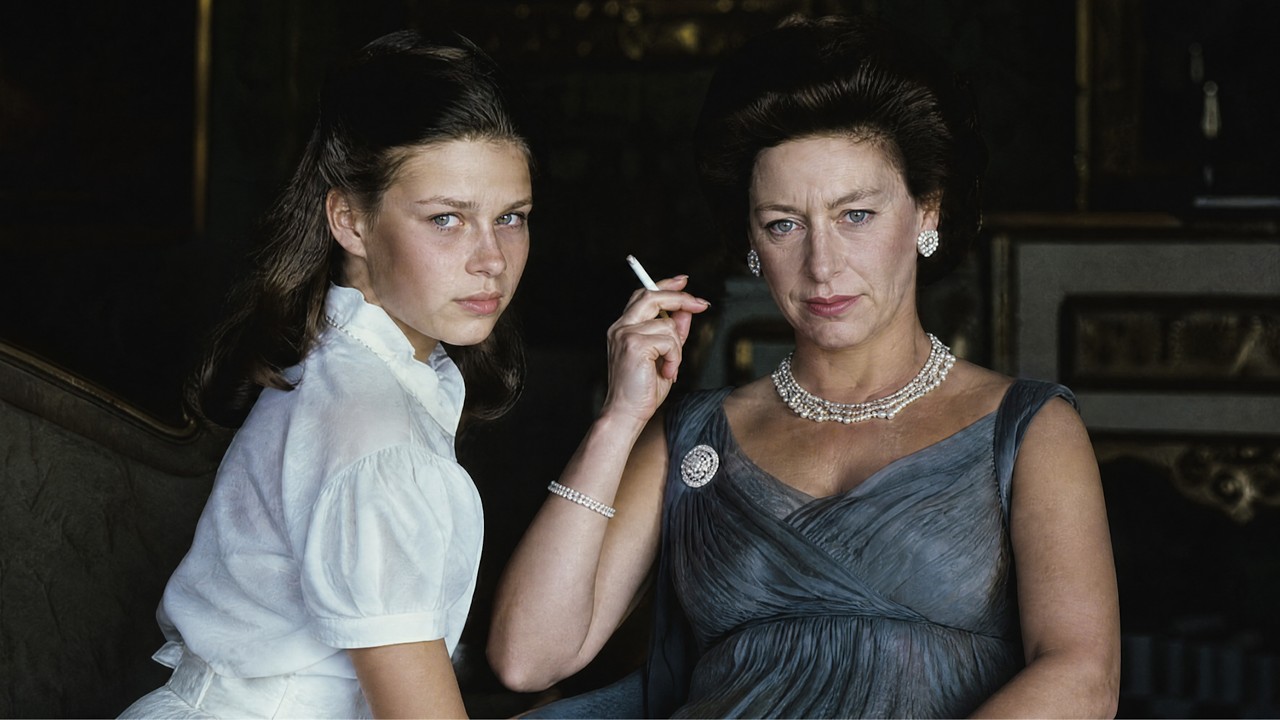 Where Margaret’s marriage collapsed in front of 300 million television viewers, Sarah’s has held for three decades. And where Margaret died at 71, partly blind and partly paralyzed after years of decline, her daughter has built something that looks remarkably like peace.
To understand how Sarah escaped, one must first understand the house she escaped from. Princess Margaret was born in 1930, the younger daughter of a man who never expected to be king. For six years she was simply the baby of a private family, adored, funny, gifted at mimicry and music.
Then came the abdication of 1936, when her uncle Edward VIII gave up the throne for Wallis Simpson, and everything changed overnight.
Her father became King George VI. Her sister Elizabeth became heir to an empire. Margaret became the spare — royal enough to be watched, not royal enough to matter.
She had wit, glamour, a face the cameras loved. What she did not have was a function. And in a family built entirely around function, that absence shaped everything she would ever do.
Then came Peter Townsend, the decorated Battle of Britain hero and royal equerry she loved, a divorced man sixteen years her senior. The Church of England would not bless the match. The government made its disapproval plain.
On October 31, 1955, Margaret gave him up in a public statement that remains one of the saddest documents in modern monarchy. She was 25. She had chosen the crown over the only man she had ever truly wanted.
The crown gave her almost nothing in return.
In 1960 she married the photographer Antony Armstrong-Jones at Westminster Abbey, the first royal wedding ever broadcast live on television, watched by an estimated 300 million people. The public exhaled, certain the unhappy princess had finally been saved. Anthony was created Earl of Snowdon.
For a brief, dazzling moment they were the most glamorous couple in Britain — a princess and an artist, tradition and modernity fused into one shining image.
It was a beautiful surface. Like most beautiful surfaces in that family, it was already hiding something underneath.
David was born in November 1961. Sarah Frances Elizabeth Armstrong-Jones arrived at Kensington Palace at 8:20 on the morning of May 1, 1964. At the moment she drew her first breath she stood seventh in line to the British throne — close enough to be royal in every way that mattered, far enough that the throne would never reach her.
Over the course of her life that number would only grow, a slow and gentle drift away from the center of the family and toward something that looked a great deal like freedom.
What she grew up inside was something else entirely. Lord Snowdon developed a private habit of extraordinary cruelty. He would write cold, careful lists of the things he hated about his wife and hide them between the pages of books he knew she would open alone.
The biographer Sarah Bradford recorded one such note: “You look like a Jewish manicurist and I hate you.”
This was not shouted in the heat of an argument. This was deliberate. He chose the words, folded the paper, selected the book, and waited for the wound to land at a time of his choosing.
That was the emotional weather of the home — not an occasional storm, but a constant, low, poisonous fog.
The infidelity ran in both directions. Margaret’s first 𝒶𝒻𝒻𝒶𝒾𝓇 came in 1966 with Anthony Barton, a Bordeaux wine producer who happened to be Sarah’s own godfather. A brief liaison with society pianist Robin Douglas-Home followed in 1967.
 Snowdon conducted a long series of affairs of his own, alongside punishing hours as art director of the Sunday Times, building a separate life in which Margaret had no part.
The household ran on alcohol, tobacco, bitterness and performance. Margaret was a famously heavy smoker, her habit estimated at its height at around 60 cigarettes a day. In public, the glamorous, witty, enviable couple.
In private, two people circling each other with knives.
For a watching child, this constant low hum of wrongness is the most disorienting thing of all. It is not one dramatic event that can be understood and put away. It is the daily sense that the smiles in the photographs are not the truth, that the people you love most are lying to the whole world and to each other all of the time, and that you are somehow expected to pretend along with them.
By every account, Sarah became the watcher. The quiet child. The observer who learned early that the brilliant, glittering adults around her could turn on each other without warning, and that the safest thing a small person could do was to watch, to listen, and to keep her own inner world carefully hidden away where it could not be hurt.
Then came Roddy Llewellyn. In the autumn of 1973, in a restaurant in Edinburgh, a 43-year-old princess met a 25-year-old landscape gardener. The 𝒶𝒻𝒻𝒶𝒾𝓇 would last on and off for around eight years.
For Margaret it was the great late romance of her life — the relationship in which she could finally allow herself to be the woman she had been forbidden to be at 25. The renunciation of 1955 and the 𝒶𝒻𝒻𝒶𝒾𝓇 of the 1970s were not two separate scandals. They were two halves of the same wound.
In February 1976, a long lens found them on the beach at Mustique. The photographs showed Margaret and Llewellyn in swimsuits, relaxed and intimate in the Caribbean sun. When they were published in the British tabloids, they detonated like a bomb beneath the royal family.
The coverage was vicious in a way rarely turned on a senior royal. Margaret was branded a cradle robber, attacked as a selfish woman squandering public money while ordinary Britons struggled through a decade of strikes and shortages. In the House of Commons, an MP stood and denounced her as a royal parasite.
David was 14. Sarah was 11. This was not distant history they would read about calmly years later.
This was happening to their mother in real time, that very week, on every newsstand in the country, in every overheard conversation, in the changed eyes of every adult who looked at them.
Imagine being 11 years old and seeing your own mother described as a parasite by a politician in the national parliament. Imagine walking into school. Imagine the way conversations stop when you enter a room.
Imagine knowing that the most private failures of your family have become the most public entertainment in the entire country and that there is absolutely nothing you can do to make it stop.
On March 19, 1976, just over a month after the photographs were published, Princess Margaret and Lord Snowdon announced that their marriage had irretrievably broken down. On July 11, 1978, the divorce was finalized. Margaret became the first senior royal to divorce since 1901.
The irony was almost too cruel to bear. In 1955 she had given up Peter Townsend precisely because he was a divorced man, told again and again that a royal princess so close to the throne could not marry someone whose marriage had been dissolved. She had sacrificed the love of her life on that altar and been praised for her sense of duty.
Now, 23 years later, she was herself the divorced royal.
She had obeyed the rule and lost her love. She had broken the rule and lost her marriage. The crown had taken from her either way.
 What is truly remarkable, looking back, is how completely differently the chaos settled into Sarah compared with how it might have. Many children of such homes go one of two ways. Some repeat the pattern, chasing the same intensity and the same disasters because at least they are familiar.
Others shatter quietly. Sarah did neither.
She did not become reckless. She did not chase attention or 𝒹𝓇𝒶𝓂𝒶 to fill the hole her childhood had left. Instead she watched what unrestrained appetite and public spectacle had done to her mother, and she began very slowly and very quietly to build her own life around everything Margaret’s life had so painfully lacked.
It began with art. Margaret, herself a passionate lover of music, theater and painting, had encouraged her daughter toward creativity and individuality — an approach seen at the time as unconventional for a royal. That gift would turn out to be the single most important thing her mother ever did for her.
The creative life Margaret encouraged in the good years became the very thing that would carry Sarah safely through the bad ones.
She trained seriously. Bedales School, Camberwell College of Arts, Middlesex Polytechnic, and finally the Royal Academy Schools. In 1988 she won the Windsor and Newton Prize for emerging artists in painting and drawing.
In 1990 she won the Creswick Landscape Prize. These were real awards, earned in genuine competition against serious young artists with no royal blood to recommend them.
From 1995 she exhibited at the Redfern Gallery. And she made one choice that tells you almost everything about who she had decided to be. She exhibited under her maiden name, Sarah Armstrong-Jones, not under any royal title.
The daughter of one of the most photographed women in the world chose to show her paintings under a name that quietly played down exactly who she was.
Then came love. She met the actor Daniel Chatto while working on the film Heat and Dust in India. He would later set aside acting to become a painter himself.
On July 14, 1994, she married him — not in a vast cathedral, not before a global television audience, but in a small City of London church called St Stephen Walbrook.
The service was conducted by the Reverend Chad Varah, founder of the Samaritans, the charity built entirely around quietly listening to people in their deepest despair. The daughter of so much private pain was married by the very man who had devoted his whole life to hearing and easing the private pain of others. She wore a gown by Jasper Conran, the Snowdon floral tiara, and her mother’s pearl earrings.
The marriage held. Samuel David Benedict Chatto was born in July 1996. Arthur Robert Nathaniel Chatto arrived in February 1999.
Sarah raised them as far from the cameras as a member of the royal family could manage, in something as close to a normal and loving family life as her position would allow.
Meanwhile, she watched her mother come apart. A mild stroke at Mustique in February 1998. A scalding accident in a bathroom on the island in 1999 that permanently and severely affected her mobility.
A hospital admission in January 2001. By March 2001, the strokes had left Margaret with only partial vision and paralysis down her entire left side.
The glamorous, sharp-tongued, quick-witted princess who had once been the most exciting woman in Britain was now partly blind, partly paralyzed, and dependent on others for the most basic tasks of daily life. Sarah did not turn away. The relationship between mother and daughter remained close, devoted and tender right to the very end.
 In the early hours of February 9, 2002, at 6 a. m. at King Edward VII’s Hospital in London, Princess Margaret died quietly in her sleep.
She was 71. Sarah was 37, just weeks short of her 38th birthday. She had lost the mother she had spent her entire life both surviving and loving.
After Margaret’s death, Sarah inherited her mother’s pearl earrings — the very ones she had worn on her own wedding day. And in the years that followed she wore them again and again, deliberately, visibly, as a quiet and unmistakable tribute. Her escape was never an escape from Margaret the woman.
It was an escape from the chaos, from the pattern, from the particular way of living that had destroyed so much around it.
She did not reject her mother. She rejected the destruction, and she held on tightly and tenderly to the love.
That loyalty did not go unnoticed. In the years after her sister’s death, Queen Elizabeth II drew one person closer than any other, and it was the quiet one. Those close to the royal household described the queen as adoring Sarah, seeking out her company as often as she possibly could.
One royal insider put it plainly: Sarah was the queen’s absolute favorite among the younger members of the entire family.
The queen was said to allow only Sarah to accompany her to Craigowan Lodge, the modest house on the Balmoral estate where the monarch went to be truly and completely away from the world. People who saw the two women together described the ease that flowed between them, the deep loyalty, the shared sense of duty, and above all the laughter. There was, they said, a great deal of giggling whenever the queen and Sarah were in a room together.
Of all the people in the vast royal family, the one person the queen most wanted beside her in her rarest and most private moments was the quiet daughter of her chaotic, scandalous sister. Margaret had spent her entire life chasing intensity, attention, freedom and love, and had been punished for the reaching at almost every turn. Sarah asked for none of those things.
And in the end it was Sarah, not Margaret, who held the one thing Margaret had wanted more than anything else in the world.
When Queen Elizabeth II died in September 2022, Sarah was visibly among the most grief-stricken figures in the entire family, her sorrow plain for the whole world to see. She had lost not only her aunt but her great friend.
The quiet inheritance of duty continued. In 2004 Sarah became vice president of the Royal Ballet, the organization her mother had once led as president. In 2024, she was named president of the Royal Ballet herself, stepping with grace into the role Margaret had filled before her — completing a soft and unbroken handing down of duty across a generation, and doing it without a single breath of 𝒔𝒄𝒂𝓃𝒹𝒶𝓁 attached to her name.
What the story of Lady Sarah Chatto reveals is that the single most powerful act available to a person born into that gilded trap may not be to seize power, or chase pleasure, or demand at the top of their voice to be seen and adored. It may be something far quieter. It may be the simple, stubborn, daily refusal to be destroyed.
Sarah was born seventh in line to a throne she would never reach, into a household already coming apart at the seams. She chose, deliberately, year after patient year, to build a life of calm in the very middle of all that noise. She did not inherit her mother’s chaos.
She inherited her mother’s earrings, and she wore them with love.