Adolf Hitler personally condemned more than 300,000 German soldiers to death or Soviet captivity by refusing to authorize a breakout from the Stalingrad encirclement in late November 1942, a decision that destroyed an entire army and marked the turning point of World War II in Europe.
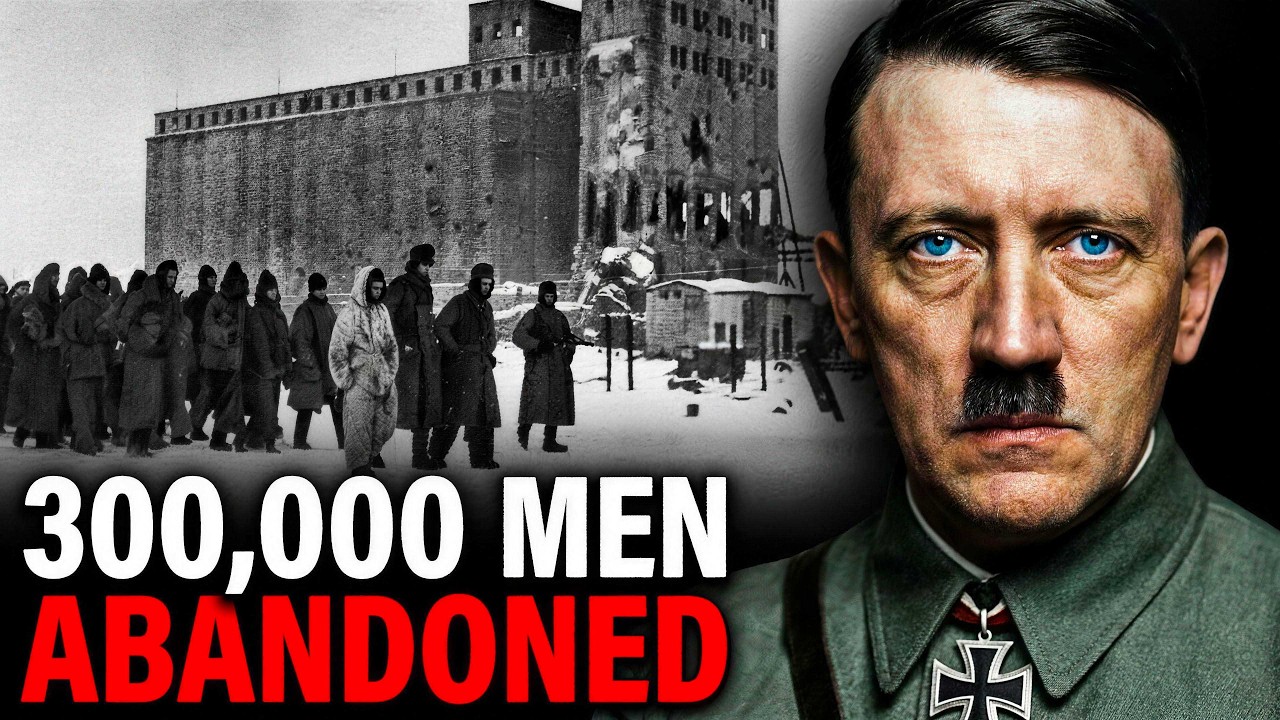
The order, issued in the final days of November 1942, rejected the urgent pleas of Field Marshal Friedrich Paulus and his senior commanders, who had requested permission to abandon the frozen ruins of the city on the Volga and fight their way westward while their forces still retained the mobility and strength to attempt an escape.
Hitler’s reply was absolute. The Sixth Army would hold its position, Stalingrad would be declared a fortress, and the encircled troops would be supplied by air until a relief force could break through. None of those promises would be kept.
The catastrophe unfolded inside a landscape of total destruction. Temperatures plunged to thirty degrees below zero Celsius. The city had been reduced to rubble so complete that the debris itself became the terrain over which soldiers fought hand to hand for individual rooms, staircases, and sewer lines.
Approximately 330,000 German and Axis troops were sealed inside the pocket when Soviet pincer armies linked up near Kalach on the Don River on November 23, 1942, completing the encirclement that German intelligence had failed to foresee.
The opportunity to escape was real but narrow. In the days immediately following the encirclement, the Soviet ring was thin, the Sixth Army remained organized, and its units still possessed fuel, ammunition, and fighting strength sufficient to attempt a breakout to the southwest.
Paulus understood the situation and began preparing requests for authorization to move. His subordinate commanders, including General Carl Strecker in the northern sector, pressed even harder for permission to act independently as the window began to close.
Hitler had already settled on a different plan. Reichsmarschall Hermann Goering, head of the Luftwaffe, had promised that his aircraft could supply the trapped army by air, delivering everything it needed to hold out until relief arrived.
Senior Luftwaffe commanders were appalled. General Wolfram von Richthofen, whose air fleet would carry out the operation, calculated that the Sixth Army required at least 500 tons of supplies per day and that available aircraft could not deliver more than about 100 tons even under ideal conditions.
The conditions at Stalingrad in the winter of 1942 and 1943 would be very far from ideal. Soviet fighters and anti-aircraft batteries were concentrated along the supply routes, the flying distances pushed transport aircraft to the edge of their range, and brutal weather grounded flights on many of the days when the pocket was most desperate.
Hitler accepted Goering’s promise anyway. On November 24, 1942, he issued a formal order declaring that the Sixth Army would take up a hedgehog defense and hold its position. Stalingrad was designated a fortress to be defended at all costs.
To remove any possibility that Paulus might act on his own initiative, Hitler promoted several senior commanders and made unmistakably clear that the directive to hold was non-negotiable. The Fuehrer had spoken, and in the Third Reich that was supposed to end the matter.
The roots of the decision reached back to the previous winter, when Soviet counteroffensives threatened to shatter the entire German front and panicked commanders wanted to withdraw westward. Hitler ordered his armies to stand fast, and by spring the line had stabilized.
From that experience Hitler drew a lesson that was partly true and became catastrophically overgeneralized. He concluded that his personal iron determination had saved the Wehrmacht from destruction, and he applied the same formula at Stalingrad without regard for profoundly different circumstances.
In 1941 the German army was retreating but not encircled. It remained connected to supply and reinforcement, and a tactical withdrawal to defensive positions made sense. In 1942 the Sixth Army was surrounded, cut off, and dependent on an airlift that could not meet its needs.
Standing fast in those conditions was not a stabilizing measure. It was a death sentence. Hitler could not or would not see the difference, and he applied a formula that had worked once with dogmatic certainty to a situation it could not possibly fit.
His ideology reinforced the error. Hitler believed fundamentally in the supremacy of will over circumstance, and he had constructed a gallery of historical examples, from Frederick the Great to Napoleon, that he believed supported this view. The examples were cherry-picked and ignored the many occasions when flexibility and retreat had preserved armies to fight another day.
His distrust of his own officer corps played an equally critical role. By late 1942 his relationship with the professional leadership of the Wehrmacht had deteriorated dramatically, and he had dismissed generals with increasing frequency throughout the war.
After the failure before Moscow he had personally assumed command of the army in addition to his role as supreme commander, meaning no professional commander-in-chief stood between him and operational decisions on the Eastern Front.
He regarded general staff officers as overly cautious, defeatist, and incapable of the bold offensive thinking that he believed had made Germany victorious in the early years of the war. When his generals told him the air supply was impossible, he heard defeatism. When they urged a breakout, he heard weakness.
General Kurt Zeitzler, who had replaced Franz Halder as chief of the general staff, argued strenuously for allowing Paulus to break out. He went so far as to dramatically cut his own food rations at headquarters to match what soldiers in the pocket were receiving, a gesture meant to force Hitler to confront reality.
Hitler was briefly moved by the display but did not change his order. The decision had been made, and in his mind changing it would be an admission of error, something his personality made almost impossible for a man who had staked his political legitimacy on visionary infallibility.
Field Marshal Erich von Manstein, arguably the most gifted operational commander in the German army, assembled a relief force built around the 57th Panzer Corps under General Hermann Hoth and launched Operation Winter Storm on December 12, 1942.
The operation made initial progress, advancing roughly sixty kilometers in the first week. At its closest point, Hoth’s forces came within about forty-eight kilometers of the Stalingrad pocket, and for a brief desperate moment it seemed a corridor might be opened.
But the relief force was never strong enough. Manstein had been promised additional divisions that never arrived, diverted to other crises on the collapsing front, and what he had was a fraction of what was needed to break through Soviet defenses that had been rapidly reinforced after the encirclement.
Crucially, the operation required the Sixth Army to fight its way south simultaneously to link up with Hoth’s advancing force. Manstein sent the prearranged code word Thunderclap, the signal for the breakout to begin. Paulus consulted Hitler and was refused.
He did not move.
Hoth’s force, unable to push through alone and now threatened by the Soviet Operation Little Saturn, which struck the Italian Eighth Army on the Middle Don and threatened to encircle Manstein’s entire army group, was eventually forced to withdraw. The last realistic chance to save the Sixth Army had been squandered.
Inside the pocket, the reality of Hitler’s decision played out in the most brutal possible terms. The air supply operation that was the cornerstone of his plan to keep the army alive failed almost completely. The promised 500 tons of daily supplies never materialized.
On most days the Luftwaffe delivered less than 100 tons, and on some days no deliveries reached the pocket at all. Transport aircraft were lost at alarming rates to Soviet fighters, anti-aircraft guns, and the terrible weather, and the airfields inside the pocket were gradually overrun as the perimeter compressed.
Over the course of the airlift the Luftwaffe lost approximately 500 transport aircraft along with the trained crews who flew them, losses that represented a significant portion of Germany’s overall air transport capability and compromised future operations for the rest of the war.
Winter temperatures dropped to thirty and forty degrees below zero. Rations were steadily reduced until soldiers were receiving a few hundred calories per day, a fraction of what a man needs to sustain himself even at rest, let alone in combat.
Horses were slaughtered for food. Frostbite claimed fingers, toes, ears, and noses. Soldiers wrapped themselves in strips of blanket, paper, and clothing stripped from the dead.
Hospitals filled with wounded men who could not be evacuated and who died in increasing numbers as disease spread through the weakened population.
By January 1943 an army that had entered the pocket with over 300,000 men had already lost tens of thousands to combat, cold, and starvation. And yet Hitler’s hold on the strategic situation remained absolute. Paulus continued to send his reports, continued to warn that his army was dying, and continued to request permission to act.

Hitler continued to send back orders to hold. The machinery of Nazi command, with its emphasis on the Fuehrer’s infallible will, its punishment of unauthorized initiative, and its conflation of obedience with virtue, ground on even as the Sixth Army ground down.
The final act began in January 1943 when Soviet forces launched Operation Ring, the final offensive to destroy the encircled German forces. By this point the Sixth Army was a shadow of the force that had driven to the Volga the previous summer.
Soviet forces broke through the western perimeter on January 10, and the pocket began to collapse rapidly. The southern pocket was overrun by January 26. On January 30, 1943, the tenth anniversary of Hitler’s coming to power, Paulus was promoted to the rank of field marshal in a gesture that was almost grotesque in its timing.
The message was clear. No German field marshal had ever surrendered. Hitler expected Paulus either to die fighting or to take his own life.
Paulus did neither. On January 31, 1943, he surrendered to the Soviets, a decision that would define his historical legacy and infuriate Hitler.
The northern pocket under General Strecker held out for two more days, finally surrendering on February 2, 1943. The Battle of Stalingrad was over, and the cost was staggering.
Of the approximately 330,000 German and Axis troops who had been encircled in November 1942, only about 90,000 survived to be taken prisoner, most of them already gravely weakened by cold, hunger, and disease. Of those 90,000, only about 6,000 would eventually return to Germany alive after the war. The rest died in Soviet captivity.
The Sixth Army had been destroyed, and with it a great deal of Germany’s remaining offensive capability on the Eastern Front. Hitler’s reaction to the defeat was a mixture of rage, disbelief, and the compulsive search for someone else to blame.
Paulus was denounced as a traitor and a coward. The Romanian allies were blamed for the collapse of the flanks. The Luftwaffe was blamed for failing to deliver the promised supplies.
Even Manstein’s relief operation was criticized, though Hitler himself had undermined it by refusing to authorize the breakout it required.
What Hitler could not do, because his entire persona and his political legitimacy depended on his image of infallible command, was admit that his own decisions had caused the catastrophe. He had ordered the Sixth Army to hold. He had refused the breakout.
He had accepted Goering’s impossible promise of air supply.
He had replaced capable generals who warned him of danger with more compliant subordinates who told him what he wanted to hear. Every link in the chain of causation led back to him, and acknowledging this was psychologically impossible for the man who had proclaimed himself the greatest commander in history.
The strategic consequences extended far beyond the loss of the Sixth Army. The defeat shattered the myth of German invincibility that had sustained the early years of the war and had been a significant tool of Nazi propaganda.
It demonstrated to the world, and crucially to Germany’s allies, that the Wehrmacht could be beaten. Romania, Hungary, and Italy, which had provided significant numbers of troops to the Eastern Front in part because they feared standing apart from what seemed an inevitable German victory, now had to recalculate their positions.
Finland, which had been a co-belligerent, began cautiously exploring diplomatic options. In North Africa, where German and Italian forces under Rommel were already in serious difficulty, the news from Stalingrad accelerated the crisis of confidence among Axis partners.
Domestically in Germany the effect was profound, though the full scale of the defeat was initially obscured by propaganda. Joseph Goebbels declared a period of national mourning and used the occasion to call for even greater sacrifice, framing the defeat as a heroic last stand.
The famous Sportpalast speech of February 18, 1943, in which Goebbels asked the crowd whether they wanted total war, was in part a response to the need to maintain morale after Stalingrad. But underneath the propaganda, the German population’s confidence in ultimate victory was permanently dented.
Security service reports noted a significant decline in public optimism following the defeat, and the letters soldiers wrote home from inside the pocket, many of which were censored and studied by Nazi authorities, showed a range of emotions from determination to despair.
The broader question of why Hitler made the decisions he made at Stalingrad has fascinated historians, psychologists, and military analysts for more than eighty years, and several major explanations have been advanced that reinforce each other.
The first is the rigid template of the 1941 stand-fast order. The second is the symbolic importance of the city’s name. Retreating from a place called Stalingrad in a battle the whole world was watching meant handing Stalin a personal triumph of immense propaganda value, and Hitler found this psychologically impossible to accept.
The third explanation focuses on the structural pathologies of the Nazi command system. Hitler had systematically dismantled or marginalized the professional officers who might have checked his worst impulses, replacing competent critics with compliant loyalists and centralizing all significant military decisions in his own hands.
By late 1942 there was no institutional mechanism capable of overriding Hitler’s decision and no individual willing to stake everything on the attempt. The result was a system that could produce catastrophic errors and then compound them by refusing to acknowledge or correct the initial mistake.
The fourth explanation is darker. Some historians have argued that by late 1942 Hitler had begun to calculate, perhaps not fully consciously, that a spectacular defeat was more useful to his political project than an inglorious retreat. A heroic last stand could be mythologized.
An army that retreated and saved itself offered no such propaganda value.
The fifth explanation is simply psychological. After years of unprecedented power and an unbroken record of early successes, Hitler had become genuinely unable to process the idea that his own decisions could be wrong. When reality contradicted his conviction that the Soviet Union was beaten, he doubled down rather than reassessing his assumptions.
The human dimension of the Stalingrad pocket in its final weeks is something that numbers and strategic analysis alone cannot capture. The German soldiers who wrote their last letters home before the postal service from the pocket was shut down left behind a remarkable record of what it meant to be inside that dying army.
Some letters expressed defiance and faith in the Fuehrer. Others were bitterly disillusioned. Many were simply saying goodbye, making peace with death, trying to express to wives, parents, and children what could not really be expressed in words.
The Nazi security services, which examined many of these letters before they were destroyed rather than delivered, noted privately that morale inside the pocket had collapsed, that soldiers were no longer expressing confidence in the promised relief, and that criticism of Hitler’s leadership was being voiced openly in correspondence from Stalingrad.
It was one of the first significant signs that Hitler’s personal authority over the army was beginning to crack under the weight of reality. Among the most haunting aspects of the story are the accounts of the men who were evacuated from the pocket in its final weeks, mainly the wounded who could still be moved and key officers whom Hitler ordered out to preserve their expertise.
These men boarded transport aircraft at the shrinking pocket airfields, looking back through the windows at the men they were leaving behind, men they knew were going to die. Some reported the looks on the faces of soldiers who watched the aircraft take off, men who understood that the planes carried other people’s hope while their own hope remained on the ground.
The Soviet commanders who defeated the German army at Stalingrad emerged from the battle with a sense of pride and accomplishment that was entirely justified. They had faced the German army at the height of its power, endured conditions of extraordinary hardship, and held a strip of ruined city against overwhelming pressure.
They had then executed one of the most technically demanding operations in military history, the double encirclement of a German army. Marshal Georgy Zhukov and Marshal Aleksandr Vasilevsky, who designed Operation Uranus, and General Vasily Chuikov, who commanded the 62nd Army through the darkest months, were elevated to hero status in the Soviet system.
The contrast between Soviet and German command at Stalingrad can be drawn finely by examining specific decisions. When Zhukov and Vasilevsky presented the plan for Operation Uranus to Stalin in September 1942, they did so with detailed intelligence assessments, carefully worked out logistics, and honest appraisals of the risks.
Stalin listened, asked questions, pushed back on specific points, and ultimately approved the plan. He did not insist that his own strategic intuitions replace the professional judgment of his military commanders, and he did not punish them for presenting him with a plan that acknowledged difficulties and uncertainties.
The result was an operation that was carefully planned, adequately resourced, and executed with a timing and secrecy that achieved complete strategic surprise. Compare this with Hitler’s process of decision-making at the same time, in which professional military advice was routinely ignored and intelligence that contradicted his preconceptions was dismissed.

The intelligence failure that allowed Operation Uranus to achieve complete surprise illustrates another dimension of the dysfunction at German headquarters. Individual intelligence officers produced accurate and timely assessments of Soviet capabilities and intentions in the weeks before the offensive.
Reports noted the buildup of Soviet forces on the flanks, the movement of fresh tank units into the area north of Stalingrad, and the increased traffic on Soviet transport networks that suggested a major operation was being prepared. These reports existed and made their way into intelligence summaries, but they did not change the fundamental assessment at the top.
The result was an intelligence system that told Hitler not what the enemy was doing, but what Hitler was willing to hear about what the enemy was doing. This is one of the most dangerous forms of systemic dysfunction in any command organization, and at Stalingrad it was fatal.
One of the more poignant aspects of the story involves the fate of the Romanian forces that were shattered in the initial Soviet encirclement. The Romanian Third and Fourth Armies were not militarily worthless formations, and they contained units that fought with real courage against impossible odds.
The problem was structural rather than individual. Romanian tanks were obsolete, their anti-tank guns inadequate against Soviet T-34s, their communication equipment inferior, and their divisions holding frontages too wide for their strength. When Soviet armor in divisional strength struck their positions, they were overwhelmed not because they were cowards but because the combination of numbers, equipment, and tactical surprise was too great to withstand.
The German attitude toward their Romanian allies throughout this period was often contemptuous, and this contempt contributed to the disaster in specific ways. German commanders were slow to reinforce Romanian positions that were clearly under threat, in part because they did not believe the threat was serious.
When Romanian commanders reported that their positions were dangerously stretched and that they were facing a major Soviet buildup, their warnings were given less weight than they would have received from a German source. This condescension had direct military consequences at Stalingrad.
The question of what German civilians knew about Stalingrad and when they knew it touches on the broader question of how the Nazi regime managed information during the war. The initial communiques were generally positive, and when the encirclement happened the first public announcement was carefully crafted to minimize the sense of catastrophe.
For several weeks the German public did not understand the full scale of what had happened. But information 𝓵𝓮𝓪𝓴𝓮𝓭, as it always does. By December 1942 there was a widespread sense among the German public that something serious had happened at Stalingrad, even if the full details were not available.
Stalingrad was not just a military defeat. It was the moment when a significant portion of the German population began to doubt that the war would end in victory. The news of the surrender itself, announced on February 3, 1943, was accompanied by a propaganda presentation that was simultaneously the most honest and the most dishonest thing the Nazi regime had done in years.
Goebbels ordered that the announcement be broadcast with full solemnity, surrounded by the slow movement of Beethoven’s Fifth Symphony and other pieces associated with mourning and sacrifice. The announcement acknowledged the fall of Stalingrad and the loss of the army there, presenting it as a heroic sacrifice.
This was, in the context of Nazi propaganda, remarkably candid, a departure from the usual practice of announcing defeats as planned retreats or regroupments. But it was candid in the service of a dishonest interpretation. The sacrifice of the Sixth Army was presented as a noble act rather than as the catastrophic result of catastrophic command decisions.
The truth that 300,000 men had died because Hitler refused to let them retreat was not announced. The reaction of the German public was predominantly grief, shock, and a pervasive anxiety about the future of the war that went far deeper than at any previous point in the conflict.
For the first time, large numbers of ordinary Germans began to seriously entertain the possibility that the war might not end in German victory, that the sacrifices being demanded of them might be for nothing, that the promises of the Fuehrer might not be redeemable. This was the psychological Stalingrad, the point at which the internal coherence of the Nazi war ideology began to crack under the weight of reality.
Among the military professionals who had witnessed the Stalingrad decisions from inside the command structure, the effect was different again. Some became more determined to find a way to end the war through whatever means were available, and the circle of officers involved in planning resistance to Hitler expanded significantly in the months following Stalingrad.
It is not coincidental that the conspiracy that produced the July 20, 1944, assassination attempt drew heavily on officers whose faith in Hitler’s leadership had been broken by Stalingrad and its aftermath. General Henning von Tresckow and Colonel Claus von Stauffenberg were both radicalized in their opposition by the pattern of catastrophic command failures of which Stalingrad was the most dramatic example.
The connection between Stalingrad and the July 20 conspiracy is real but should not be overstated. Most German officers, even those who recognized that Hitler’s command decisions were catastrophic, did not make the leap to active resistance. The culture of military obedience, the practical consequences of being discovered, and the psychological weight of the oath they had sworn to Hitler personally all combined to keep the vast majority within the bounds of loyal service.
The long-term legacy of Stalingrad in military history and thought is substantial and continues to shape how armies think about command, morale, logistics, and the relationship between military professionals and political authority. The battle has been studied extensively at military academies around the world.
The lessons drawn from it are consistently similar. The dangers of overextension, the importance of secure flanks, the impossibility of sustained air supply as a substitute for ground logistics, the need for command systems that can process accurate intelligence and respond flexibly to changing conditions, and above all the catastrophic consequences of command structures in which a single individual’s will can override all professional military judgment.
The specific question of Hitler’s refusal to allow the retreat from Stalingrad has served as a case study in the pathology of command for generations of military students. What it illustrates most fundamentally is that the greatest threat to an army in the field is often not the enemy it faces, but the command system under which it operates.
The Sixth Army was a formidable fighting force. Its soldiers were well-trained, its officers were experienced, and its equipment, though showing the strain of years of continuous combat, was still adequate for defensive operations. What destroyed it was not Soviet military power alone, but the combination of Soviet military power and a command system that prevented it from making the decisions its professional judgment required.
The Soviet trap was the proximate cause of the Sixth Army’s destruction. But Hitler’s refusal to let it escape was the enabling cause. Without that refusal, the trap need not have been fatal.
There is a bitter irony in the fact that Hitler’s stand-fast orders, which he credited with saving the German front in the winter of 1941 and 1942, were part of the same mental framework that produced the Stalingrad disaster. The lesson he had drawn from the earlier crisis was both too broad and too rigid, applied without discrimination to situations it did not fit.
An order to hold that saves a front is not the same as an order to hold that destroys an army. The difference between these situations requires exactly the kind of flexible, evidence-based judgment that Hitler’s command style had systematically eliminated.
He had built a military machine capable of extraordinary tactical flexibility and operational ingenuity, and then he had placed himself at the top of it in a way that prevented that flexibility and ingenuity from being applied to strategic decisions. The mismatch between the Wehrmacht’s operational capabilities and the strategic framework within which those capabilities were exercised was one of the defining contradictions of German military power in the Second World War.
The individual soldiers who died at Stalingrad deserve to be remembered not as abstractions or statistics, but as human beings who found themselves caught in a catastrophe not of their making. They were for the most part young men who had been told by their government and their culture that they were fighting for a great cause.
Many of them believed this even in the worst moments of the encirclement. Some continued to believe it even as they starved and froze. Others, as the letters home from the pocket reveal, came to a different understanding, a recognition that they had been betrayed not by fate or by an overwhelming enemy, but by decisions made by men who were wrong and who could not be told they were wrong.
The Soviet prisoners who survived Stalingrad carried their own scars. The march from the pocket to the prisoner of war camps was itself a death march, with thousands dying from exposure and exhaustion in the terrible cold. The camps were overcrowded and undersupplied, and disease was rampant.
The mortality rate among German prisoners from Stalingrad in the immediate post-battle period was staggering, with estimates suggesting that a large proportion of the men who surrendered died within weeks or months of the capitulation. The survivors faced years in Soviet captivity, some not returning to Germany until 1953 and 1955, a decade or more after the war ended. Some never returned at all.
One of the most remarkable human stories to emerge from the aftermath is that of Friedrich Paulus himself. In Soviet captivity he underwent a profound political transformation that remains controversial among historians. He initially refused to cooperate with Soviet propaganda efforts, maintaining his loyalty to Germany even as other captured officers began to collaborate.
But gradually, under the influence of captivity and of the news that filtered into the camps about Germany’s conduct of the war and the crimes committed in the name of the nation he had served, Paulus began to change. In August 1944 he made his first public radio broadcast on behalf of the National Committee for Free Germany, urging German soldiers to abandon a cause he now believed was both lost and wrong.
This transformation enraged Hitler and the surviving Nazi hierarchy. Paulus was denounced as a traitor, his name was struck from military records, and his family in Germany was subjected to harassment. He remained in Soviet custody until 1953, when he was released and chose to settle in Dresden in East Germany rather than returning to West Germany.
 He died in 1957.
His reputation in West Germany remained profoundly ambiguous. In East Germany he was rehabilitated as an anti-fascist hero, a convenient narrative for the communist state. The truth was, as usual, considerably more complex than either of these frameworks captured.
The historical memory of Stalingrad has evolved significantly in the decades since the battle ended, and it has evolved differently in different national contexts. In Russia and the post-Soviet states, Stalingrad remains one of the defining moments of the Great Patriotic War, commemorated with an intensity and reverence that reflects both the genuine horror of what was endured there and the degree to which the Soviet state invested the battle with symbolic significance.
The enormous memorial complex on Mamayev Kurgan, dominated by the iconic statue of Mother Russia Calling, which stands nearly eighty-five meters tall, speaks to the depth of the Russian investment in Stalingrad as a defining national experience.
In Germany, the memory of Stalingrad is equally powerful but freighted with a very different emotional and moral weight. For German society in the post-war decades, Stalingrad functioned as both a trauma and a reference point, the battle that most clearly illustrated the catastrophic consequences of the Nazi regime’s military adventurism.
German literature, film, and public discourse have returned to Stalingrad repeatedly, processing the experience from multiple angles: the personal stories of soldiers who survived, the question of responsibility for the disaster, the relationship between military obedience and moral agency, and the broader question of what Germany’s conduct of the war meant for its national identity.
The historiography of Stalingrad in Western academic circles has gone through several distinct phases. The immediate post-war period was dominated by the accounts of German commanders, particularly Manstein, who had strong professional and personal reasons to shape the narrative in ways that emphasized Hitler’s errors while minimizing their own.
Manstein’s memoirs, titled Lost Victories, were extraordinarily influential in establishing the clean Wehrmacht narrative, the idea that German professional soldiers had been competent and in some sense honorable men who had been betrayed by the political madness of the regime they served. This narrative was convenient for the West German military as it rebuilt its armed forces within NATO and gained wide circulation during the Cold War.
Subsequent generations of historians have subjected this narrative to serious challenge, examining the documentary record more carefully and reaching conclusions that are less flattering to the professional officer corps. The evidence that senior German commanders, including those who served at Stalingrad, were aware of and in varying degrees complicit in the war crimes committed throughout the Eastern Front is now much more thoroughly documented.
This revisionist scholarship does not diminish the military tragedy of Stalingrad or the genuine courage of individual soldiers who fought and died there without any personal responsibility for the larger crimes of the war. It does complicate the moral picture in ways that are important for understanding the full context of why the battle happened and why it ended as it did.
The army that was destroyed at Stalingrad was not simply a collection of professional soldiers caught in a madman’s trap. It was part of a war of conquest and extermination in which millions of civilians and prisoners had already died and which had been planned and executed with the participation of many of the same officers who are portrayed in post-war accounts as the victims of Hitler’s command failures.
The complexity of this situation, the way that professional military competence and human decency could coexist in the same individuals with complicity in enormous crimes, is one of the most disturbing aspects of the Stalingrad story and one that continues to demand serious historical engagement.
The tactical lessons of Stalingrad have been extensively analyzed in military education systems around the world and continue to inform military doctrine. The importance of maintaining adequate reserves to respond to encirclement threats, the dangers of overextension without secure logistics, the need for flexible command authority, and the critical importance of air supply being matched to actual logistics requirements rather than political promises are all taught in the context of Stalingrad.
The battle has become, in effect, a canonical case study in military failure, studied not as an example of defeat by a superior enemy but as an example of defeat by command dysfunction and strategic error.
The logistics dimension of Stalingrad is particularly instructive. The Sixth Army’s supply situation deteriorated rapidly after the encirclement, and the rate of deterioration was directly tied to the failure of the airlift to provide anywhere near the required tonnage. What this analysis reveals is that the decision to rely on air supply was not merely overoptimistic.
It was impossible given the resources available, and this was knowable before the decision was made.
The officers who made the calculations and came up with numbers that did not work were not making a difficult judgment call with limited information. They were identifying a straightforward fact. The aircraft available could not deliver the required tonnage, full stop.
When this fact was communicated to decision makers and overruled, the result was predetermined.
The men in the pocket would die not because they lacked courage or fighting spirit, but because they would run out of food, ammunition, and medicine. This is perhaps the starkest illustration of the principle that logistics is not a background consideration in warfare, but a fundamental determinant of combat power and survivability.
The timing question of when exactly the opportunity for a successful breakout closed has been analyzed by historians who have studied both the German records and the Soviet operational planning. The consensus view is that the window was roughly from November 22 to approximately December 10, 1942, perhaps extending somewhat beyond this in a degraded form.
During this period the Soviet encirclement ring was thin, the Sixth Army was still reasonably well supplied and mobile, and a coordinated thrust to the southwest, linking up with a relief force, had a genuine chance of succeeding. After December 10, as Soviet forces reinforced the encirclement and as the Sixth Army’s supply situation deteriorated and its physical condition weakened, the chances decreased rapidly.
By January 1943 the window had closed entirely. The men were too weak and the Soviet defenses too strong. The decision to hold, made in late November, had by January become irreversible in the worst possible sense.
Not because holding was working, but because the alternative of breaking out had become physically impossible.
This timeline is important because it clarifies the moral dimensions of Hitler’s decision. When he ordered the Sixth Army to hold in late November 1942, he was not simply making a military mistake in a situation where all options carried substantial risk. He was overriding a clear professional consensus that the breakout option was available and should be taken.
He was doing so in favor of an option, air supply and defensive holding, that his own Luftwaffe commanders had told him was impossible. The decision was not one reasonable man’s judgment against another reasonable man’s judgment. It was one man’s will against the professional judgment of the military experts who surrounded him, and that one man happened to be the one whose will could not be overruled within the command structure of the Third Reich.
The particular cruelty of Hitler’s decision was that it was made in full awareness on some level that the men he was condemning to death would die. He received the reports. He knew the supply figures.
He had heard his generals tell him that the air supply was insufficient and that the army was weakening.
He could read a map and see that the relief force had not reached the pocket and that the perimeter was shrinking. At some level, the information required to understand what his orders were doing to the Sixth Army was available to him. The decision to maintain those orders in the face of this information was not a decision made in ignorance.
It was a decision made in the face of knowledge, a choice to prioritize ideological conviction and personal prestige over the lives of the men in the pocket.
This is what makes the Stalingrad decision not merely a military error, but a moral failure of the first order. The question of whether any individual could have changed the outcome had they been willing to take sufficient personal risk is one that haunts the Stalingrad story.
The short answer is probably not, because the command system was so thoroughly organized around Hitler’s will that no single individual acting alone could have changed the fundamental dynamic. But collective action by the senior commanders, a coordinated refusal to execute orders they knew were destroying the army, was theoretically possible. It did not happen.
The reasons it did not happen tell us something important about how totalitarian command systems work. Fear of personal consequences, the weight of institutional loyalty, genuine uncertainty about whether disobedience could improve the situation, and the individualistic nature of military command, which made coordinated refusal organizationally difficult, all combined to prevent the kind of collective professional judgment that might have altered the outcome.
The absence of such collective judgment was itself a product of the years Hitler had spent systematically eliminating commanders capable of exercising it.
Stalingrad stands as one of history’s most consequential reminders of what happens when military command is organized around a single individual’s conviction that they cannot be wrong. The Sixth Army was not defeated by Soviet military prowess alone, formidable as that prowess was. It was defeated by the combination of Soviet military skill and German command dysfunction, a dysfunction that was built into the structure of the Third Reich from its very beginning.
The men who died there paid the highest possible price for the decisions of a man who was convinced of his own infallibility and who had created around himself a system that reinforced that conviction until reality, in the form of Soviet tanks and Russian winter and the simple arithmetic of supply and demand, finally made the contradiction between conviction and reality impossible to sustain.
Their sacrifice, whatever political leadership demanded of it and whatever ideological framework was imposed upon it, was in the end the sacrifice of human beings who found themselves in an impossible situation not of their making, caught between a determined enemy and an irrationalist command structure.
The men who survived, who came home decades later to a changed world, carried the Stalingrad experience with them as a kind of wound that never fully healed, a reminder of what had been asked of them and what it had cost. The men who did not survive are present only in the records, the letters, the photographs, the names on memorials, and in the soil of a city on the Volga that still gives up their remains after more than eighty years.
Their story, and the story of the decisions that put them there and kept them there until the end, is one that history cannot afford to forget.