Washington has never confirmed it, and the Navy has never explained it, but the record of the Pacific War points to one of the most quietly consequential command decisions of the twentieth century: the officer who commanded American carriers at the turning point of the war was moved out of the fight, not for losing, but for refusing to spend the future to buy the present.
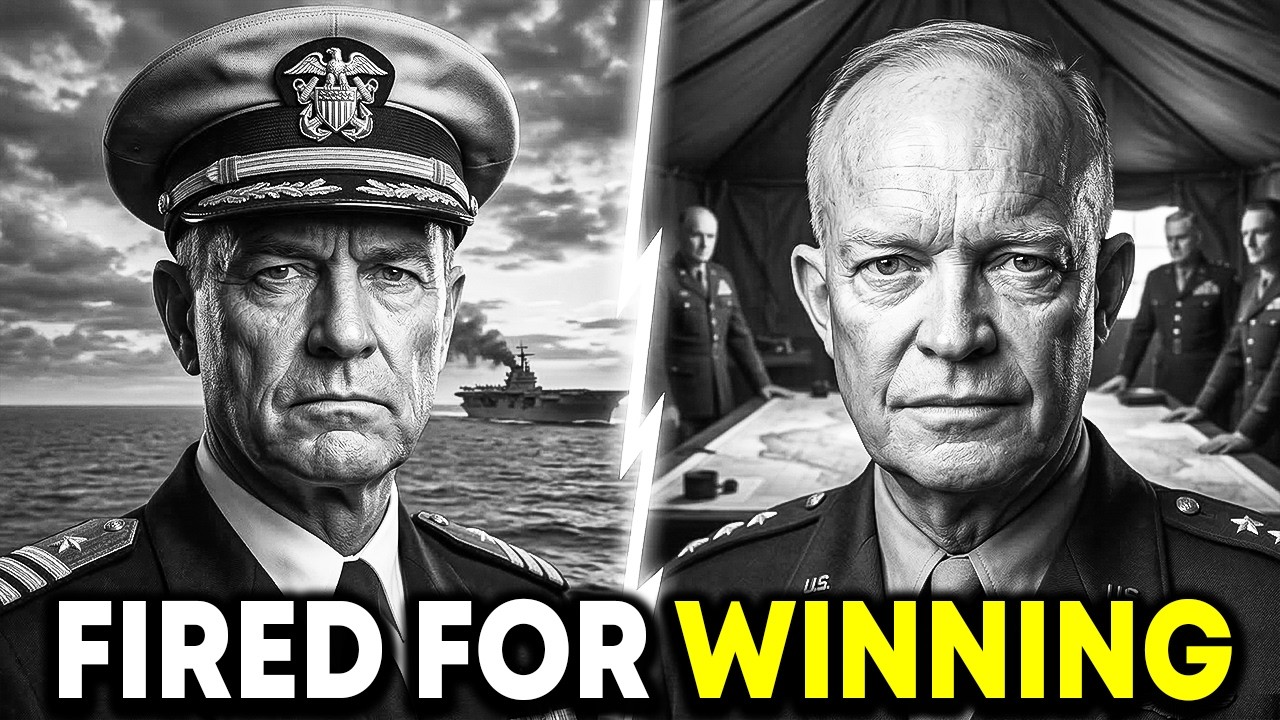
His name was Frank Jack Fletcher, and in the first eight months of 1942 he held the fate of the entire American war effort in the Pacific in his hands. He was not an aviator. He came up through surface ships, guns and steel and the old ways of war.
He was handed a fleet of aircraft carriers in a new kind of conflict that nobody fully understood yet, including him, and he was told to win with it.
What he understood, with absolute clarity, was that those ships were not his to spend. They belonged to the future of the war. His job, the only thing that mattered, was to keep them alive.
Three thousand miles away, in Washington, Fleet Admiral Ernest King saw the war differently. King did not do patience. He did not do caution.
He viewed hesitation as a character flaw and believed the cure for every problem was to hit harder and faster and keep hitting until something broke. He wanted action, forward momentum, and results visible from the capital.
The problem was that King was reading about the Pacific from a desk. Fletcher was living it on the water. Out there, fuel ran low faster than projections.
Crews went days without sleep. The enemy fleet was experienced, disciplined, and holding the advantage.
Against all of it, Fletcher delivered. In the Coral Sea, his forces turned back an enemy advance that would have opened the door to Australia. For the first time in the war, the opposing momentum stopped, not through overwhelming force but through patience, positioning, and a refusal to be baited into a fight he could not win.
Then came Midway, the engagement history calls the turning point. Fletcher was there, in command, threading the needle between catastrophic risk and decisive action. Four enemy carriers were rendered combat ineffective.
 The tide turned.
By any honest accounting, the man should have been untouchable. But King and the rising generation of aviation admirals saw something different. They did not see a man who won.
They saw a man who did not attack more, who pulled back when they wanted fire. They wanted a brawler. They wanted theater.
Fletcher did not look like what victory was supposed to look like, and in the Navy of 1942 that began to matter more than the record.
The reckoning arrived in August 1942 at Guadalcanal, America’s first major ground offensive of the war. Thousands of soldiers pushed onto a remote island in the South Pacific, needing everything the Navy could give them: supplies, support, and above all, air cover. Fletcher was given the assignment.
Keep the carriers close. Keep the skies protected. Keep the Marines alive.
For two days, he did exactly that. Then the numbers arrived. Twenty percent of his fighter aircraft were gone, destroyed or damaged.
The fuel situation was becoming critical. Intelligence reports pointed to enemy land-based aircraft in range, hunting for exactly the kind of stationary targets his carriers would become if he stayed.
Fletcher made the call. He pulled the carriers back. He did not do it because he wanted to, or because it was easy, or because it was politically comfortable.
He did it because the math was brutal and unambiguous. Stationary carriers with depleted fighter cover, in range of enemy aircraft, against an opposing fleet still looking for a decisive blow, was not a battle. It was an avoidable disaster.
 The Marines on those beaches watched the carriers disappear over the horizon. They felt what it feels like to be left. Some of them would carry that feeling for the rest of their lives.
And back in Washington, the phones started ringing. Fletcher’s enemies had exactly what they needed.
A few weeks later, Fletcher’s flagship took a torpedo. He was wounded and sidelined. Just like that, quietly, efficiently, and without ceremony, he was reassigned to the North Pacific.
The North Pacific in 1942 was where careers went to disappear. No major engagements, no strategic significance, no headlines. In the language of navies, it was a place to park someone until the war was over and the question of what to do with them became irrelevant.
King did not fire him. That would have required a conversation. It would have required acknowledging what Fletcher actually did.
Instead, he was simply moved to the margin, and the war went on without him.
When the war ended, the men who won the public history were the men who stayed in the center of the frame. Admiral Halsey became a legend: brilliant, loud, seemingly fearless, the kind of admiral journalists could build a story around. His blunders got footnotes.
His victories got monuments. In the final year of the war, Halsey sailed his fleet into a typhoon, not once but twice. Significant losses were sustained, ships were damaged, official inquiries were convened.
But history written by the men who admired him keeps those stories small.
Fletcher got the opposite treatment. His wins became qualifications. His decisions became evidence of timidity rather than calculation.
He became the cautionary tale instead of the standard to meet. The men who write the history are the men who survived it with their reputations intact, and reputations, it turns out, are not always built on accuracy.
 Here is what is true. The carriers Frank Jack Fletcher protected at Coral Sea, at Midway, and off the coast of Guadalcanal stayed in the fight. They went on to carry the weight of the entire Pacific campaign: the operations against fortified positions, the island-hopping advance, the slow, grinding, inevitable push toward an ending.
Every victory that followed was built in some part on the foundation he refused to sacrifice.
There is a version of courage the world loves to celebrate. The man who charges without flinching, who risks everything on instinct, who would rather go down swinging than live to fight another day. That version photographs well.
It makes for extraordinary stories.
Then there is the other version, the one history treats less kindly. The version that knows exactly how much something is worth and refuses to spend it carelessly. The version that absorbs the criticism, carries the blame, and makes the call that protects the future even when the present demands something easier.
Fletcher never campaigned for his legacy. He never wrote a memoir to set the record straight. He never called a journalist or gave an interview designed to rehabilitate his image.
He did his job, and when the job was taken from him, he stepped away without spectacle.
Maybe that is the final irony. The very quality that made him invaluable, the absence of ego, the refusal to prioritize his own story, is precisely what allowed everyone else to write that story for him.
Some men are remembered for how loudly they fought. Frank Jack Fletcher will be remembered by those paying attention for what he refused to let die.