Historians examining the daily routines of Adolf Hitler have concluded that the Nazi dictator spent the majority of his waking hours engaged in leisure activities, personal obsessions, and lengthy monologues rather than the actual administration of the Third Reich, according to a comprehensive analysis of surviving testimony, memoirs, and archival records that paints a portrait of a leader profoundly disconnected from the machinery of governance he ostensibly controlled.
The findings, drawn from the accounts of valets, secretaries, military adjutants, and physicians who witnessed Hitler’s private life, reveal that the Führer routinely slept until noon or later, refused to read detailed reports, watched multiple films every night, and consumed alarming quantities of cake and chocolate while lecturing captive dinner guests on subjects ranging from dog breeding to architectural theory.
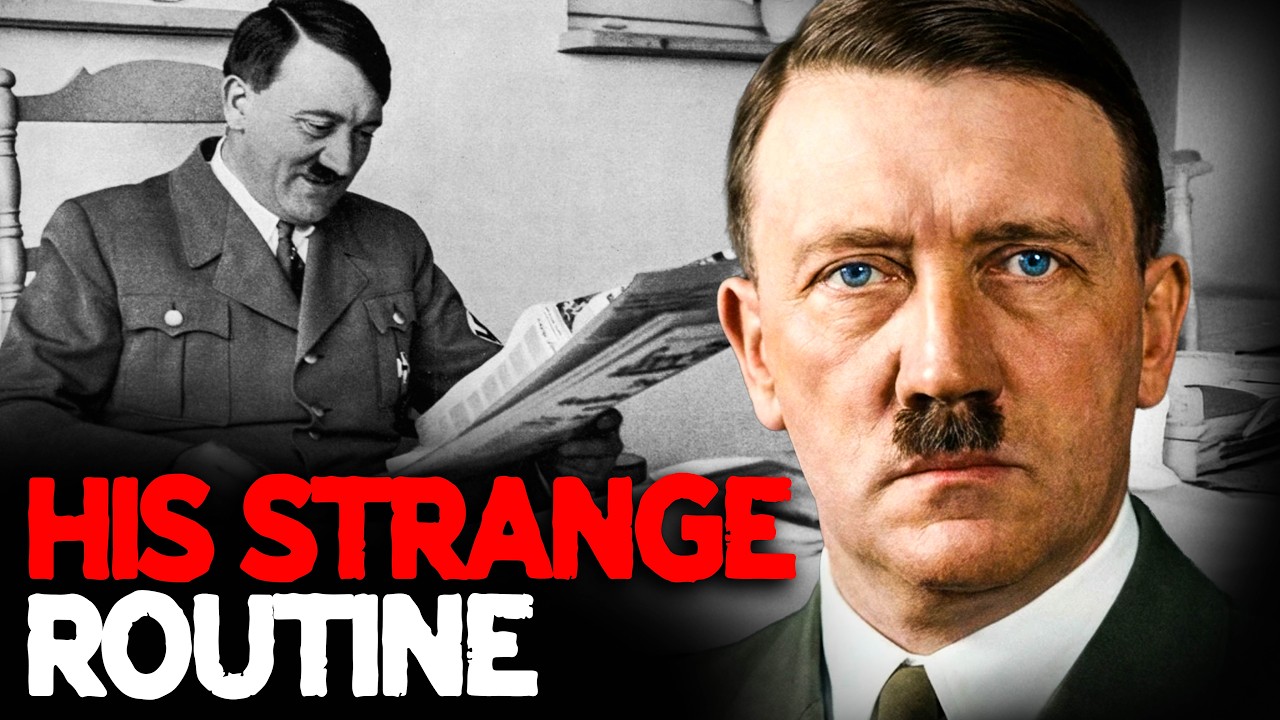 This bizarre schedule, which remained remarkably consistent from the triumphant early years of the war through the final desperate weeks in a Berlin bunker, created systemic dysfunction throughout the Nazi state and contributed directly to catastrophic military decisions that ultimately sealed Germany’s defeat, according to historians who have studied the period in exhaustive detail.
The most striking revelation concerns Hitler’s complete rejection of conventional working hours. While Winston Churchill dictated memos late into the night and Franklin Roosevelt maintained a rigorous schedule of meetings and correspondence, Hitler rarely saw a sunrise by choice, beginning his day between eleven in the morning and one in the afternoon regardless of the military situation facing his armies.
His valet, Heinz Linge, would enter the bedroom before noon, drawing back heavy curtains that had blocked all light for the previous twelve hours. Hitler would rise slowly, frequently complaining of insufficient sleep despite having retired only hours before dawn, attributing his exhaustion to the burden of leadership even though his schedule was entirely self-imposed.
The morning routine that followed was meticulous in its own peculiar way. Hitler was fastidious about personal hygiene, spending considerable time bathing and grooming. His valet would lay out his uniform, always the same simple brown party uniform or later a military-style gray tunic, which Hitler believed projected the image of a soldier-leader rather than a distant politician.
He checked himself repeatedly in the mirror, adjusting his hair with careful attention to the positioning of his famous forelock. Despite leading a nation at war, Hitler devoted surprising amounts of time to these grooming rituals, seeing them as essential to maintaining the image of the infallible Führer that propaganda had constructed around him.
His bathroom cabinet contained numerous medications and supplements, a collection that grew more extensive as the war progressed and his health deteriorated. By the final years, Hitler was consuming a cocktail of drugs administered by his personal physician, Dr. Theodor Morell, including vitamins, stimulants, and various dubious concoctions that Morell claimed would maintain Hitler’s energy and health.
These medications became an integral part of Hitler’s morning routine, with Morell often present to administer injections that Hitler believed were essential to his ability to function. Whether these treatments actually helped or harmed Hitler remains debated, but there is no question that by the war’s end, he had become psychologically and possibly physically dependent on them.
After dressing and taking his medications, Hitler would finally emerge from his private quarters, typically around noon or early afternoon. His first substantial activity was breakfast, though calling it breakfast seemed almost absurd given the hour. His dietary habits were among his most well-known eccentricities, having been a vegetarian since the early 1930s.
His breakfast typically consisted of milk, sometimes with oats or other grains, accompanied by various fruits and vegetables. He particularly enjoyed apples and would eat several throughout the day. Despite his vegetarianism, Hitler had a legendary sweet tooth, consuming vast quantities of cakes, pastries, and chocolates that would horrify modern nutritionists.
His preference for sweet foods was so extreme that he would often have cake and hot chocolate for breakfast, a meal that perfectly suited his indulgent nature. Following this late breakfast, Hitler would finally begin what might loosely be termed his working day, though the concept of work as understood by most leaders bore little resemblance to his approach.
Unlike Churchill, who maintained detailed schedules and worked through mountains of papers, or Stalin, who held marathon meetings in his Kremlin office, Hitler had an almost pathological aversion to paperwork and formal administrative work. He rarely read detailed reports, instead demanding that information be presented to him verbally in the shortest possible form.
His attention span for written materials was notoriously short, and his aides learned to condense everything into single-page summaries or brief oral briefings. This meant that much of the detailed work of governing the Third Reich fell to his subordinates, who often operated with minimal guidance and filled the vacuum with their own interpretations of what the Führer wanted.
Hitler’s government style was based on the principle of charismatic authority rather than bureaucratic efficiency. He believed in surrounding himself with strong personalities who would compete for his favor, a system that created overlapping jurisdictions and constant infighting among Nazi officials, but which Hitler believed produced the best results through a kind of social Darwinism.
The early afternoon hours were typically devoted to receiving reports and holding audiences with various officials, generals, and party leaders. These meetings were rarely scheduled with any precision, operating instead on Hitler’s whim and availability. Military commanders might wait for days at one of Hitler’s headquarters hoping for a brief audience to discuss critical operational matters.
When meetings did occur, they followed a pattern that became increasingly pronounced as the war continued. Hitler would dominate the conversation, speaking at length about his theories on military strategy, race, history, architecture, or whatever topic seized his interest at that moment. Those present were expected to listen attentively and agree.
Any dissent or contradiction was liable to trigger an explosive outburst. General Heinz Guderian later recalled that presenting contrary views to Hitler was like striking a match in a gasoline-soaked room, as the Führer’s temper could ignite with terrifying speed. These one-sided conversations meant that genuine strategic discussions became increasingly rare.
The military briefings themselves, when they did occur, were extraordinary affairs that revealed much about how Hitler actually spent his time during the war years. These briefings typically took place in the afternoon or early evening depending on when Hitler had finally roused himself and completed his morning routine.
The location varied depending on which of his various headquarters Hitler was occupying at the time. In the early war years, he often conducted these meetings at the Reich Chancellery in Berlin, but as the war expanded, he moved between the Berghof, his mountain retreat at Obersalzberg, the Wolf’s Lair in East Prussia, and various other field headquarters.
What made these briefings particularly remarkable was Hitler’s encyclopedic, almost obsessive knowledge of minor technical details, combined with his complete disregard for broader strategic realities. He could recite from memory the exact specifications of various tank models, the precise number of guns in a division, or the production figures of specific weapons.
However, this fascination with details masked a fundamental inability or unwillingness to grasp larger strategic truths. As the war turned against Germany, Hitler refused to acknowledge setbacks, instead blaming his generals for lacking willpower and determination. He would explode in rage when presented with unfavorable news.
These briefings could last for hours with Hitler delivering lengthy speeches about how battles would be won through sheer determination and ideological strength rather than through realistic assessment of resources and capabilities. Generals learned to present information in ways that would not trigger these outbursts, often sugarcoating bad news.
This created a feedback loop where Hitler received increasingly distorted information, making his already questionable strategic decisions even more divorced from reality. Between these sporadic military briefings and official meetings, Hitler would often retreat to his private quarters or wander through whichever residence or headquarters he was occupying.
He had a habit of taking his German Shepherd, Blondi, for walks around the grounds when at the Berghof or other locations that allowed for such exercise. Hitler’s affection for Blondi was genuine and provided one of the few moments when those around him saw something approaching normal human emotion.
He would play with the dog, teach her tricks, and seem genuinely relaxed in her company in a way he rarely did with people. This relationship with his dog stood in stark contrast to his indifference toward human suffering. He could order actions that would result in the deaths of millions while tenderly caring for his pet.
As afternoon transitioned into evening, Hitler’s day would begin in earnest, reflecting his nocturnal nature. Dinner was the social centerpiece of Hitler’s daily routine, though social is perhaps a generous description for what amounted to forced attendance at Hitler’s extended monologues that could last for hours.
Dinner would typically be served sometime between eight and nine in the evening, though the exact timing varied based on Hitler’s mood and schedule. The meal would be held in whichever dining room was available at his current location, with a carefully selected group of guests who formed his inner circle.
This group typically included his secretaries, adjutants, personal physician Dr. Morell, architect Albert Speer when available, and various other Nazi officials and military officers who happened to be present. Martin Bormann, Hitler’s personal secretary and one of the most powerful men in the Third Reich, was almost always in attendance.
The seating arrangement at these dinners was carefully orchestrated with Hitler at the head of the table and his most favored companions seated closest to him. Women were often present at these gatherings, including his secretaries and later Eva Braun, as Hitler claimed their presence had a civilizing effect on the conversation.
The food served at these dinners reflected Hitler’s vegetarian preferences, though meat dishes were available for other guests who had not adopted the Führer’s dietary restrictions. Hitler would eat his vegetable dishes while eyeing the meat-eaters with poorly concealed disgust, often launching into graphic descriptions of animal slaughter.
His favorite vegetables included cauliflower and peas prepared in the simplest possible ways, as Hitler distrusted elaborate sauces and seasonings. He drank mineral water or occasionally weak beer, having given up alcohol years earlier. However, his main consumption at these dinners was not food but conversation, specifically his own voice.
Once the meal began, Hitler would start talking, and he wouldn’t stop for hours. These monologues covered an astounding range of topics from his early years in Vienna and Munich to his theories about architecture and urban planning to lengthy dissertations on history, race, politics, and military strategy.
Those present were expected to listen with rapt attention, nodding in agreement, and occasionally offering brief comments that supported whatever point Hitler was making. These dinner monologues revealed both Hitler’s genuine interests and his profound self-absorption that made genuine conversation impossible.
He could speak knowledgeably and passionately about architecture, a field that had fascinated him since his youth. He had dreamed of being a great architect or artist before entering politics, and this unrealized ambition manifested in hours of discussion about his plans to rebuild German cities into monumental showcases of Nazi power.
He would sketch building designs on napkins or have architectural models brought to the table, becoming animated in a way that few other topics could inspire. His knowledge of European architecture was extensive, and he could discourse at length about buildings he admired and those he despised with equal passion.
However, these architectural discussions would invariably blend into his racial theories, as Hitler believed that great architecture reflected the racial superiority of its creators. The decline of civilization in Hitler’s view could be traced through architectural styles, with modern buildings representing racial degeneration and classical structures embodying Aryan perfection.
Another frequent topic of Hitler’s dinner monologues was history, particularly military history and the careers of great leaders whom he admired or wished to emulate. He had read extensively about Frederick the Great of Prussia, Napoleon Bonaparte, and various other historical figures, and he would recount their campaigns in exhaustive detail.
These historical discussions served to reinforce Hitler’s image of himself as a great leader in the mold of these past conquerors, continuing their work of shaping Europe through military might and force of will. He would draw parallels between his own campaigns and those of Napoleon, conveniently ignoring how many of these figures had ultimately failed.
His secretaries noted that Hitler’s historical knowledge was impressive in its breadth but selective in its application, focusing on examples that confirmed his existing beliefs while dismissing counter-examples as aberrations or the result of betrayal. This selective reading of history reinforced Hitler’s conviction that willpower could overcome any obstacle.
The dinner conversations would often extend well past midnight, turning into what might generously be called evening receptions but were really captive audiences for Hitler’s endless talking. Coffee and tea would be served along with the cakes and pastries that Hitler consumed in alarming quantities despite his otherwise austere eating habits.
His sweet tooth was legendary and he would eat multiple pieces of cake while continuing his monologues, washing them down with sweet tea or hot chocolate. Those who attended these dinners regularly learned to pace themselves, eating slowly and drinking coffee to stay alert through the long hours of listening.
Some attendees developed strategies to avoid drawing Hitler’s direct attention as any question or comment could trigger an even longer discourse on whatever topic had been raised. Albert Speer later recalled that these evenings were simultaneously fascinating and exhausting, providing insights into Hitler’s thinking but consuming enormous amounts of time.
As the evening wore on and the dinner conversation finally wound down, typically well after midnight, Hitler would transition to what he considered one of the most important parts of his day: watching films. This nightly ritual was so integral to Hitler’s routine that projection rooms were installed at all his major residences and headquarters.
His taste in films was eclectic and often surprising. While one might expect the dictator of Nazi Germany to watch only propaganda films and military documentaries, Hitler’s actual viewing preferences were far more varied. He loved American films, particularly those featuring Mickey Mouse, which he found hilarious and watched repeatedly.
He enjoyed German films as well, especially those starring his favorite actresses, and he had a particular fondness for operettas and light entertainment that allowed him to escape, however briefly, from the pressures of leadership. Hitler would typically watch two or three films per night, consuming several hours.
He had strong opinions about film and would offer running commentary throughout the screening, critiquing acting performances, cinematography, and storylines. His staff and guests were expected to attend these film screenings unless specifically excused, meaning that even those who had no interest in watching movies found themselves sitting through multiple films night after night.
The films served multiple purposes for Hitler beyond simple entertainment. They were a way to relax and escape the mounting pressures of the war, particularly as Germany’s situation deteriorated. They also reinforced his sense of living in a kind of alternate reality where he could control the narrative and outcome.
Some observers noted that Hitler seemed more engaged and present during these film screenings than during military briefings, suggesting that escapism had become more appealing to him than confronting harsh realities. The selection of films shown to Hitler was carefully curated by his staff, who understood his preferences and sensibilities.
Films that were too dark or depressing were avoided, as were those that might contain themes or content that could upset the Führer or put him in a bad mood. Joseph Goebbels, Hitler’s propaganda minister and himself a film enthusiast, would sometimes recommend specific movies, understanding that Hitler’s approval could make or break a film’s success.
If Hitler enjoyed a particular movie, it would be heavily promoted and distributed throughout the Reich. Conversely, if he disliked something, it could be quietly shelved or even banned. This gave Hitler’s personal viewing habits significant influence over the entire German film industry as producers learned to create content appealing to the Führer.
Following the film screenings, which could last until three or four in the morning, Hitler would finally begin to wind down for bed. However, even at this late hour, he was rarely ready to sleep immediately. He would often return to his private rooms and spend additional time reading, though his reading material was selective.
He enjoyed adventure novels, especially those by Karl May, a German author who wrote Western stories despite never having visited America. Hitler had loved these books since childhood and continued to reread them throughout his life, finding comfort in their simple adventure narratives and clear divisions between heroes and villains.
He also read military histories, architectural books, and various works that confirmed his racial and political theories. However, he had little patience for serious literature or philosophy, preferring works that entertained or reinforced his existing beliefs rather than challenge them. His personal library contained thousands of books.
Hitler’s reading habits revealed another aspect of his intellectual character. He was an autodidact with significant gaps in his knowledge despite his claims to being well-read and cultured. He had left school early and never received formal higher education, cobbling together his worldview from selective reading and fringe thinkers.
This self-education gave him confidence in his own intellectual abilities but also left him vulnerable to pseudo-scientific theories and simplistic explanations for complex phenomena. He believed himself to be an expert on numerous subjects, from breeding dogs to designing cities to conducting military campaigns.
His position as Führer meant that few dared to contradict his claims to expertise. This intellectual arrogance, combined with his erratic schedule and preference for monologue over dialogue, created a leadership style that was fundamentally dysfunctional even as it projected an image of strength and decisiveness to the German public.
The final part of Hitler’s nightly routine before sleep often involved taking various medications and sleeping pills. As the war progressed and the stress mounted, Hitler found it increasingly difficult to fall asleep despite his late hours. Dr.
Morell prescribed a range of substances to help Hitler sleep.
These included barbiturates and other sedatives that contributed to his growing dependency on pharmaceuticals. Hitler would also drink warm milk before bed, a habit from his youth that he maintained throughout his life. His bedroom had to meet specific requirements for Hitler to sleep comfortably, including complete darkness.
The room had to be quiet with guards instructed to prevent any noise that might disturb the Führer’s rest. The temperature had to be cool but not cold, as Hitler was particular about his sleeping environment and would complain if conditions were not to his liking, requiring significant effort from staff at each location.
Hitler would finally fall asleep somewhere between four and six in the morning, having been awake for most of the night. This schedule meant that he was effectively operating on a different timeline than most of his government and military, creating coordination problems that worsened as the war intensified.
Critical decisions would be delayed for hours because Hitler was asleep when urgent matters arose. Military operations would be planned around Hitler’s availability rather than tactical necessity. The entire machinery of the Third Reich was forced to adapt to the Führer’s nocturnal schedule, with meetings scheduled for afternoon or evening.
Subordinates learned to work around Hitler’s peculiar hours or risk his anger. This arrangement might have been merely eccentric in peacetime, but during a world war requiring rapid decision-making and efficient coordination, Hitler’s refusal to maintain normal working hours created serious operational problems that contributed to German strategic failures.
The daily routine described so far was most characteristic of the early and middle war years, from roughly 1939 through 1943, when Hitler moved between his various headquarters and residences with relative frequency. However, as the war turned decisively against Germany, Hitler’s routine began to change in significant ways.
The confident leader who had watched films and delivered dinner monologues about his architectural visions was increasingly replaced by a paranoid, deteriorating figure who spent more time raging against betrayal and less time engaging with external reality. The change was gradual but unmistakable to those who saw Hitler regularly.
His health, which had never been robust despite propaganda images of vigorous leadership, declined sharply. The cocktail of medications administered by Dr. Morell expanded to include more powerful stimulants to keep Hitler functioning during the day and stronger sedatives to allow him to sleep at night.
His hand tremor, possibly due to Parkinson’s disease or the side effects of his medications, became more pronounced. His posture deteriorated, and he began to move with difficulty, shuffling rather than walking with the purposeful stride shown in earlier propaganda footage that had been carefully staged for public consumption.
As Germany’s military situation worsened, Hitler’s daily routine became increasingly dominated by military briefings, though these grew more detached from reality with each passing month. The briefings that had once been merely overly detailed and dominated by Hitler’s monologues became exercises in delusion.
Hitler moved non-existent divisions and ordered counterattacks by units that had been destroyed weeks earlier. His refusal to acknowledge setbacks reached pathological levels. When presented with news of disasters on the Eastern Front or the successful Allied invasion of Normandy, Hitler would explode in rage.
He blamed his generals for incompetence and cowardice rather than facing the reality that Germany was losing the war. These rages became more frequent and more intense, creating an atmosphere of fear among those who had to brief him. Officers would carefully prepare their presentations to minimize the likelihood of triggering outbursts.
Some critical information was simply not reported to Hitler because his staff feared his reaction, further isolating him from reality and making informed decision-making impossible. The social aspects of Hitler’s routine also changed as the war progressed, with dinner parties becoming less frequent and less elaborate.
Eva Braun, who had been Hitler’s companion for years but was kept hidden from public view, became more visible within his private circle. She had lived a strange half-life, officially not acknowledged as Hitler’s partner but present at many social functions at the Berghof and occasionally at other locations.
As the war situation deteriorated, Hitler seemed to appreciate her presence more, perhaps because she represented a connection to the simpler times before the war turned against Germany. However, even Eva could not lift the increasingly dark mood that pervaded Hitler’s daily life as military defeats mounted.
The optimistic discussions of post-war architectural projects were replaced by bitter recriminations about betrayal and failure. The film screenings continued but became less enjoyable as Hitler would often leave in the middle of a movie to attend to military matters or simply because he could no longer concentrate on entertainment.
The changing nature of the war also forced changes in Hitler’s location, which in turn affected his daily routine. The Berghof, his beloved mountain retreat where he had spent so much time in the early war years, became too vulnerable to Allied bombing as the war progressed and enemy aircraft ranged freely over Germany.
Hitler spent more time at the Wolf’s Lair in East Prussia, a fortified headquarters that was decidedly less comfortable but more secure. The concrete bunkers and fortifications of the Wolf’s Lair created a claustrophobic environment very different from the spacious rooms and mountain views of the Berghof.
This physical confinement mirrored Hitler’s psychological state as he became increasingly isolated not just from the German people but from the outside world in general. The daily walks with Blondi that had provided brief respites became less frequent as security concerns mounted and Hitler’s health declined further.
He spent more time indoors pouring over maps and demanding updates on battles that were already lost by the time the reports reached him. By 1944, with Soviet forces advancing from the east and Allied forces pushing through France after the D-Day invasion, Hitler’s daily routine had become almost entirely consumed by military matters.
However, his handling of these matters grew increasingly divorced from reality. The briefings that had once taken up a portion of his afternoon now dominated entire days, stretching for hours as Hitler poured over maps showing front lines that shifted backward with each update and each new report of defeat.
The content of these briefings revealed a man who had lost touch with the actual situation. Hitler would order divisions that existed only on paper to launch counterattacks, would refuse to allow retreats even when continuing to hold positions meant certain destruction, and would fly into rages when informed his orders were impossible.
His generals found themselves in an impossible position. Obeying Hitler’s orders meant sacrificing their men pointlessly, but disobeying meant risking execution for insubordination as Hitler had become increasingly willing to execute officers who failed to show sufficient determination in carrying out his directives.
The attempted assassination of Hitler on July 20th, 1944, marked another turning point in his daily routine and mental state. Colonel Claus von Stauffenberg had planted a bomb at the Wolf’s Lair during a military briefing, an attack that killed several people but left Hitler alive, though injured.
The explosion damaged Hitler’s hearing in one ear and exacerbated his hand tremor. But the psychological impact was even more profound than the physical injuries. Hitler became convinced that he had been saved by providence, that fate had preserved him to complete his mission of leading Germany to victory.
This conviction reinforced his belief that his instincts were superior to military expertise, and that doubters and defeatists, not strategic reality, were responsible for Germany’s setbacks. In the aftermath of the assassination attempt, Hitler became even more paranoid and isolated, trusting fewer people and seeing betrayal everywhere.
His daily routine now included time spent reviewing reports from the Gestapo and SS about suspected conspirators and traitors within the military and government. He personally approved death sentences for officers implicated in the plot, and the subsequent purge removed many of the last voices willing to present dissenting views.
Following the assassination attempt, Hitler spent less time at the Wolf’s Lair, ultimately moving to the Reich Chancellery in Berlin as Soviet forces approached from the east. By January 1945, with the Red Army pushing into German territory and Allied forces advancing from the west, Hitler had descended into the Führerbunker.
It was here that his final daily routine took shape. The bunker was a claustrophobic maze of concrete corridors and small rooms divided into two levels. The upper level housed various staff members, communication equipment, and meeting rooms, while the lower level contained Hitler’s personal quarters and the most secure spaces.
The bunker was perpetually lit by harsh electric lights since there were no windows to provide natural illumination. The air was stale despite ventilation systems and the constant hum of generators and the occasional tremor from bombing above created an oppressive atmosphere that weighed on everyone who lived there.
In this underground world, Hitler spent his final months, and his daily routine in the bunker revealed a man who had completely retreated from reality while still maintaining the pretense of command. Hitler’s days in the bunker maintained some elements of his earlier routine, but in a grimmer, more desperate form.
He still woke late, often not emerging from his rooms until early afternoon. His physical appearance had deteriorated shockingly by this point. The man who had once been particular about his grooming now appeared disheveled and aged far beyond his 56 years, with a pale, puffy face and glazed eyes.
His hands shook constantly, making it difficult for him to eat or sign documents. He walked with a pronounced stoop, shuffling along the bunker corridors with one hand often touching the wall for support. Despite his obvious physical decline, Hitler refused to acknowledge weakness, still attempting to project authority.
The military briefings in the bunker followed the same pattern as before, but with even more surreal quality. Hitler would gather his remaining generals in the small conference room and demand updates on battles that were already lost. He moved phantom armies on maps, ordering counter-offensives by units that had been destroyed.
When told that certain operations were impossible due to lack of men, equipment, or fuel, Hitler would rage against defeatism and cowardice. He insisted that willpower alone could reverse the situation, that Germany’s enemies would collapse if only his orders were followed with sufficient determination by his commanders.
 These briefings were exercises in collective delusion, with everyone in the room aware that the war was lost, but unable or unwilling to state this obvious truth directly to Hitler. Some generals tried to hint at the reality through careful phrasing, suggesting strategic withdrawals or last-ditch defensive positions.
But Hitler would hear none of it. To the very end, he demanded offensive action and predicted imminent victory through weapons that existed only in propaganda or through political collapses among the allies that showed no sign of occurring. Between these military briefings, Hitler’s time in the bunker was filled with a strange mixture.
He still took his meals, though his appetite had diminished significantly. The vegetarian dishes served to him were often left barely touched as Hitler picked at his food while chain-smoking and drinking weak tea. His famous sweet tooth remained, and he continued to consume cakes and chocolates.
The meals in the bunker lacked the social atmosphere of his earlier dinner parties. Those present were a shrinking circle of the most fanatically loyal. Goebbels, who had moved his entire family into the bunker, Martin Bormann, still taking notes and executing Hitler’s orders, a few secretaries and adjutants, and Eva Braun.
Eva had insisted on joining Hitler in the bunker despite his attempts to convince her to flee to safety. The conversations at these meals were dark and fatalistic, lacking the bombastic confidence of earlier years. Hitler would reminisce about past victories, blame others for current disasters, and speak of betrayal.
The evenings in the bunker no longer featured film screenings as the situation had deteriorated beyond the point where such entertainment seemed appropriate even to Hitler. Instead, the nights were filled with more briefings, more rage-filled monologues, and increasing doses of medication that further degraded his health.
Dr. Morell had been dismissed in the final weeks, and Hitler was now receiving injections from Dr. Ludwig Stumpfegger, though the exact nature of these medications remained unclear.
Hitler was consuming a significant quantity of pills daily, including stimulants to keep him functional and sedatives to allow him to sleep.
The combination of these drugs, along with the extreme stress and the physical effects of living underground without fresh air or exercise, created a toxic brew that further degraded Hitler’s health and mental state. His sleep became increasingly erratic, with nightmares waking him after only a few hours of rest.
He would emerge from his bedroom in the middle of the night and wander the bunker corridors, sometimes calling for impromptu meetings or simply unable to rest. As April 1945 arrived and Soviet forces began their final assault on Berlin, Hitler’s daily routine became almost impossible to distinguish from madness.
He celebrated his 56th birthday on April 20th with a grim party in the bunker, receiving congratulations from the dwindling circle of loyalists while Soviet artillery pounded the city above. This birthday party exemplified the surreal quality of life in the bunker, with people going through motions of normalcy while the world collapsed.
After the birthday, many of Hitler’s remaining staff urged him to flee Berlin, to escape south to the Alpine fortress where propaganda claimed a last stand could be made. Hitler refused, declaring that he would remain in Berlin and personally direct the defense of the capital, a decision that sealed his fate.
This was partly a matter of pride and partly an acknowledgement that there was nowhere left to go. The thousand-year Reich had lasted twelve years and its Führer would not live to see the thirteenth. In the final days of April, Hitler’s routine consisted almost entirely of military briefings about battles already lost.
The briefings had become almost farcical with Hitler demanding to know the positions of battalions that had ceased to exist days earlier and ordering relief forces that had no possibility of reaching Berlin. The reports brought to him grew increasingly desperate as Soviet forces reached the city center.
Street fighting was taking place blocks from the Reich Chancellery, ammunition and fuel were exhausted, and the situation was clearly hopeless. Hitler responded to each piece of bad news with the same mixture of rage and denial, blaming treachery and cowardice for failures that were the inevitable result of his catastrophic decisions.
What little sleep he managed was interrupted by the constant sound of artillery fire and the trembling of the bunker as shells impacted nearby. The electric lights would flicker when bombs hit particularly close and dust would fall from the concrete ceiling, coating everything in a fine gray powder.
During these final days, Hitler’s personal preparations for the end took on a ritualistic quality that revealed his state of mind. He had long declared that he would never be taken alive, that he would not allow himself to be captured and paraded as a trophy by the Soviets.
To ensure this, he had obtained cyanide capsules from the SS and he had his dog handler test one of these capsules on Blondi to verify their effectiveness. The fact that Hitler was willing to 𝓀𝒾𝓁𝓁 his beloved dog as a test subject demonstrated how far he had descended into darkness.
After Blondi’s death from the cyanide, Hitler seemed to retreat even further, speaking less and appearing more distracted when he did speak. The dog’s death had removed one of the last connections to his earlier life, one of the few living things for which Hitler had shown genuine affection.
On April 29th, 1945, with Soviet forces literally fighting in the streets above the bunker, and capture or death imminent within hours or days at most, Hitler took time from his military briefings to marry Eva Braun in a brief civil ceremony conducted in the bunker.
This marriage, kept secret throughout their relationship, was finally acknowledged in the last possible moment. The ceremony was brief and perfunctory, conducted by a minor official hastily brought to the bunker for the purpose. After the ceremony, Hitler and his new wife attended a small wedding breakfast.
The mood was somber despite the occasion, as everyone present knew that this marriage would last only hours. Following the wedding breakfast, Hitler retreated to his private room and dictated his personal and political testaments, documents that blamed the Jews for the war and his generals for losing it.
These final statements revealed a man who had learned nothing and regretted nothing, who remained convinced of his righteousness even as his empire burned around him. The next day, April 30th, 1945, Hitler followed his final daily routine, waking late as always and emerging for a last briefing.
The news was universally catastrophic. Soviet forces were blocks away, no relief was possible, the end was hours away at most. Hitler received this information calmly, having already decided on his course of action.
He ate a light lunch with his secretaries and Eva, making awkward small talk about inconsequential matters.
After lunch, he said goodbye to those present, shaking hands and speaking briefly with each person. Then, sometime in the mid-afternoon of April 30th, Hitler and Eva Braun retreated to his private sitting room. What happened next was witnessed only indirectly by those waiting outside.
The evidence suggests that Eva took cyanide while Hitler shot himself in the head, having apparently decided to use both methods to ensure death. Their bodies were discovered by Hitler’s valet and others who entered the room after hearing the gunshot. Following Hitler’s earlier orders, the bodies were carried up to the garden.
There they were doused with gasoline and burned while Soviet shells continued to fall on Berlin. The attempted cremation was incomplete due to limited fuel and the ongoing artillery fire, but it was sufficient to prevent the Soviets from displaying Hitler’s corpse as a trophy of their victory.
With Hitler’s death, his peculiar daily routine ended along with the Third Reich itself. The man who had dominated Europe through force and terror, whose decisions had led to the deaths of tens of millions, spent his final months in a concrete bunker, maintaining a pretense of control while reality crumbled.
His daily habits, from his late rising to his vegetarianism, to his film watching, to his endless monologues, had shaped the operation of the Nazi state in ways both profound and absurd. The fact that a world war was conducted around the schedule of one insomniac dictator with particular dietary requirements speaks volumes.
It speaks to the fundamentally personal and irrational nature of Nazi governance. Hitler’s daily routine was not that of a normal head of state, but rather that of an eccentric autocrat whose personal whims became state policy, and whose refusal to maintain regular working hours created dysfunction that contributed to Germany’s defeat.
Looking at Hitler’s daily routine across the entire period of his rule reveals several consistent patterns that help explain both his initial successes and ultimate failure. His late rising habit and nocturnal schedule created an inner circle that operated on his timetable, binding them to him through shared abnormality.
His vegetarianism and dietary restrictions became part of his image as the ascetic leader devoted to Germany rather than personal pleasure, though this was contradicted by his massive consumption of sweets. His preference for verbal reports over written documents allowed him to avoid tedious administrative work while maintaining the illusion of being informed.
His hours-long monologues at dinner established his intellectual dominance over his circle and prevented genuine discussion that might have challenged his views. His nightly film watching provided escape from the burdens of leadership, but also represented time not spent on actual governance during a period of total war.
What did Hitler actually do all day? The answer varied depending on the period in question, but certain themes remained constant throughout. He avoided traditional administrative work preferring to operate through personal authority and charisma rather than bureaucratic procedure.
He maintained irregular hours that forced the entire government to adapt.
He indulged his personal interests from architecture to film to dog breeding, often at the expense of more pressing matters. He delivered lengthy monologues that prevented genuine dialogue or dissent. He surrounded himself with people who would listen rather than challenge, flatter rather than contradict, and obey rather than advise.
He made snap decisions based on intuition and ideology rather than careful analysis. He became increasingly isolated from reality, receiving filtered information that confirmed his existing beliefs rather than accurate assessments that might have forced him to confront uncomfortable truths about the war and his own failures.
The evolution of Hitler’s daily routine from the confident early war years to the desperate final days in the bunker also tracks the trajectory of Nazi Germany itself. In the beginning, there was bombast and grandiosity, with Hitler holding court at the Berghof and planning architectural transformations of entire cities.
The dinners were social occasions where Hitler could display his supposed breadth of knowledge. The film screenings were leisure activities of a leader secure in his power. The military briefings dealt with advances and victories.
But as the war turned against Germany, the routine became darker and more desperate.
The dinners became grim affairs. The films were abandoned. The military briefings became exercises in delusion.
The architectural plans were forgotten. The secure mountaintop retreats were exchanged for underground bunkers. The confident monologues became paranoid rants about betrayal and conspiracy.
The leader who had risen late because he could afford to was now sleeping poorly due to stress and medication. Hitler’s daily habits also revealed the degree to which personal eccentricity shaped the Third Reich’s governance. The fact that major policy decisions had to wait until Hitler woke up created bottlenecks.
The fact that he refused to read detailed reports meant that complex issues were oversimplified. The fact that he surrounded himself with yes-men meant that bad policies went unchallenged. The fact that he valued loyalty over competence meant that incompetent followers retained positions of authority.
The fact that he trusted his own instincts over expert advice meant that strategic errors were repeated and compounded. All of these tendencies were reinforced by Hitler’s daily routine, which structured his interactions with subordinates in ways that prevented effective governance even as they maintained his personal authority.
The specific ways Hitler spent his time also illuminates his priorities and values. He devoted hours to discussing architecture and urban planning, revealing that aesthetic concerns and grandiose construction projects mattered to him as much as or more than actual governance of a nation at war.
He spent enormous amounts of time watching entertainment films rather than reviewing intelligence reports or meeting with economic advisers. He allowed his personal comfort and preferences to dictate when and how official business was conducted. He treated military operations as extensions of his will rather than complex undertakings.
All of these choices reflected a fundamental narcissism and detachment from reality that would prove fatal to Nazi Germany’s war effort. One particularly revealing aspect of Hitler’s daily routine was how he spent his time relative to other world leaders during the same period of global conflict.
While Winston Churchill was famous for his prodigious work ethic, dictating memos late into the night and personally following countless details of Britain’s war effort, Hitler was watching Mickey Mouse cartoons. While Franklin Roosevelt was holding fireside chats to maintain public morale, Hitler was delivering monologues about dog breeding.
While Stalin was conducting marathon sessions in the Kremlin, going over production figures and military dispositions with a level of detail that impressed and intimidated his generals, Hitler was sleeping until noon and refusing to read detailed reports about the situation at the front.
This comparison is not meant to glorify other dictators or overlook Churchill and Roosevelt’s own flaws, but simply to illustrate that even by the standards of wartime leadership, Hitler’s use of time was remarkably inefficient and self-indulgent in ways that had catastrophic consequences.
The question naturally arises, how did Hitler manage to accumulate and maintain power with such a dysfunctional daily routine? The answer lies partly in the charisma and personal magnetism that he undeniably possessed, at least for those predisposed to his message of national revival and racial purity.
His ability to deliver stirring speeches, his absolute certainty in his mission, and his willingness to act decisively when others hesitated all contributed to his rise. Once in power, he maintained control through a combination of terror, propaganda, and a governance structure that deliberately created overlapping authorities.
This system did not require Hitler to be an efficient administrator because he had no interest in being one. Instead, it allowed him to rule through personal authority while others handled the actual work of running the state, albeit in ways shaped by their understanding of Hitler’s wishes.
Hitler’s daily routine also benefited from the enabling behavior of those around him. His staff members, from his valets to his secretaries to his generals, all adapted to his schedule and catered to his preferences. They protected him from information he did not want to hear.
They arranged his environment to suit his requirements and participated in the collective fiction that his eccentric habits were the legitimate prerogatives of genius rather than the self-indulgence of an autocrat. Martin Bormann, in particular, served as a gatekeeper, controlling access to Hitler and accumulating enormous power.
By managing Hitler’s calendar and filtering what information reached him, Bormann effectively shaped much of the Third Reich’s policy while allowing Hitler to believe he was making all important decisions personally. This dynamic meant that Hitler’s daily routine was not just a personal quirk.
It was a structural feature of Nazi governance, one that empowered intermediaries and created opportunities for manipulation. The role of Dr. Theodor Morell in Hitler’s daily routine deserves particular attention, as the medications administered by this physician became an increasingly important part of how Hitler functioned.
Morell began treating Hitler in the late 1930s and quickly became indispensable, seeing the Führer nearly every day and administering a bewildering array of injections and pills. The exact contents of many of these medications remain controversial, but they likely included vitamins, glucose, hormones, and various stimulants.
Morell’s treatments became part of Hitler’s morning routine, with the doctor arriving to give injections that Hitler believed were essential to his health and energy. Whether these medications actually helped or harmed Hitler is debated, but there is no question that by the war’s end, Hitler had become dependent on them.
This dependency gave Morell extraordinary access and influence, and it also meant that Hitler’s mood, energy, and decision-making were all potentially affected by whatever chemical cocktail he had received that day. The impact of Hitler’s health on his daily routine also increased as the war progressed.
Beyond the medications, Hitler suffered from various ailments that affected how he spent his time. His digestive problems, which he attributed to nerves and treated with various special diets and medications, caused him discomfort and may have contributed to his irritability and explosive temper.
His hand tremor, which became increasingly pronounced in the war’s final years, made simple tasks like eating and signing documents difficult and embarrassing. His probable Parkinson’s disease, along with general physical deterioration from stress, poor diet, and lack of exercise, meant that activities that had once been easy became challenging.
The energetic leader who had once enjoyed mountain walks now shuffled through underground bunker corridors. The man who had delivered hours-long speeches now sometimes struggled to maintain the thread of his thoughts. These physical changes shaped his daily activities, making him less mobile and more dependent on medications.
Hitler’s relationship with Eva Braun, which became more visible in his final years, also affected his daily routine in subtle ways. Eva had been part of Hitler’s life since the early 1930s, but he had kept their relationship largely hidden from the public, believing that his image as a leader married to Germany would be undermined.
Within his private circle, however, Eva was a regular presence, particularly at the Berghof, where she acted as hostess for social gatherings. Her presence seemed to have a humanizing effect on Hitler, at least in the limited sense that he was slightly less prone to lengthy political monologues when she was nearby.
She would try to steer conversations toward lighter topics, organize social activities, and generally maintain a pretense of normalcy. However, her influence was strictly limited to the social sphere. Hitler never consulted her on political or military matters, and she wisely avoided trying to insert herself into such discussions.
Her role in Hitler’s daily routine was that of companion and occasional refuge from the pressures of leadership, not advisor or confidant on substantive matters. The film viewings that were such a prominent part of Hitler’s nightly routine deserve deeper examination, as they reveal much about his psychology and escapist tendencies.
Hitler did not just watch films, he studied them, commenting on technical aspects, acting performances, and narrative choices. He saw himself as something of an expert on cinema, just as he considered himself an expert on architecture, military strategy, and numerous other fields where his knowledge was actually superficial.
His opinions on films carried weight because he was Hitler, meaning that a casual comment of approval or disapproval could make or break a film’s commercial prospects in Germany. This gave him a sense of cultural authority that extended beyond politics into the arts, feeding his ego and sense of himself as a Renaissance man.
The films he chose to watch were often escapist entertainment rather than serious dramatic works, suggesting that he used cinema to retreat from reality rather than engage with it. The fact that he continued watching films even as Germany faced military catastrophe indicates that this escapism became more important as his situation deteriorated.
Hitler’s choice of films also reflected his contradictory relationship with modernity and mass culture. He was in many ways a product of modern media, using radio and film brilliantly for propaganda purposes and understanding the power of images and carefully staged spectacle to shape public opinion.
Yet his personal taste in film ran toward conventional entertainment and operettas rather than the experimental or avant-garde. He enjoyed American films despite his hostility to American culture and politics, another contradiction that he seemed not to recognize or care about in his private viewing habits.
His favorite German films were often sentimental or melodramatic, allowing him to indulge emotions that he otherwise suppressed in his public persona as the iron-willed Führer. These viewing choices suggest a man who, despite his pretensions to being a revolutionary transforming European civilization, had fundamentally bourgeois tastes in entertainment.
The revolutionary leader who promised to overturn the existing order spent his evenings watching conventional romantic comedies and light musical numbers. Another aspect of Hitler’s daily routine that bears examination is his relationship with food beyond his well-known vegetarianism, which was peculiar and restrictive in ways that went beyond diet.
Meal times were important social occasions in Hitler’s schedule, but his actual eating habits were peculiar and restrictive. He was not just a vegetarian but a fussy eater who had strong opinions about food preparation and presentation. He avoided spices and rich sauces, preferring simple preparations that he believed were easier to digest.
His chronic stomach problems, whether psychosomatic or genuine gastrointestinal disease, led him to be cautious about what he ate and when. He would often complain about digestive discomfort after meals, leading to adjustments in recipes and ingredients by his frustrated cooks who struggled to satisfy his demands.
Despite these restrictions on savory foods, his consumption of sweets was immoderate, suggesting that his dietary concerns were selective rather than comprehensive. The mealtimes also served as venues for Hitler to expound on his theories about nutrition and health, which were a mixture of legitimate concerns and complete pseudoscience.
He believed that meat consumption led to various ailments and moral degradation, a view that had some scientific basis, but which he extended into absurd claims about the superiority of vegetarian societies. He would lecture his dinner companions about how ancient civilizations had been vegetarian, ignoring historical evidence to the contrary.
He would predict that future generations would look back on meat-eating as barbaric. These nutritional monologues were yet another way Hitler filled his evenings, holding forth on topics where his knowledge was superficial but his confidence absolute. Hitler’s architectural interests consumed significant portions of his daily time.
They were among his most deeply held passions and reveal much about his grandiose vision for Germany and Europe. Unlike his military interests, which developed primarily after he took power, Hitler’s fascination with architecture dated back to his youth in Vienna, where he had dreamed of becoming an architect.
His rejection by the Vienna Academy of Fine Arts had been one of the formative disappointments of his early life, and he never completely abandoned his artistic ambitions even as he pursued political power. Once he became Führer, Hitler finally had the resources and authority to realize his architectural visions.
He devoted considerable time and energy to planning massive construction projects that would transform German cities and create monuments to Nazi power. These architectural projects were not merely practical concerns about housing or infrastructure, but were central to Hitler’s vision of what the Third Reich should be.
During his daily routine, Hitler would frequently spend hours examining architectural plans and models. His favorite architect was Albert Speer, a talented designer who shared Hitler’s taste for monumental neoclassical architecture and who had the technical skills to translate Hitler’s grandiose visions into concrete plans.
Speer became one of the few people in Hitler’s inner circle who could engage him in substantive conversations about topics other than military matters or party politics. The two would spend evenings at the Berghof or other locations studying scale models of proposed buildings and discussing proportions and materials.
Hitler took an active role in these design sessions, sketching his own ideas and insisting on specific features or dimensions. He had strong opinions about architectural styles, favoring the classical architecture of ancient Greece and Rome, while detesting modern styles that he associated with cultural decline and racial degeneracy.
The centerpiece of Hitler’s architectural ambitions was the transformation of Berlin into Germania, a world capital that would reflect Germany’s status as the dominant power in Europe. The plans for Germania were staggering in scope and megalomania, including a great hall over 600 feet high.
The dome would be large enough to hold over 150,000 people, dwarfing St. Peter’s Basilica in Rome. A grand boulevard would stretch through the center of the city, lined with massive government buildings, monuments, and cultural institutions.
Entire neighborhoods would be demolished to make way for these projects.
Hundreds of thousands of residents would be displaced and historical buildings destroyed. Hitler would study the models of Germania with obvious satisfaction, imagining the completed city as his ultimate legacy. He believed these structures would endure for thousands of years, providing future generations with physical evidence of Nazi greatness.
 The irony that the Third Reich would collapse before these buildings could be constructed apparently never occurred to Hitler. Or if it did, he refused to acknowledge the possibility. The time Hitler devoted to these architectural fantasies increased even as Germany’s military situation deteriorated.
While German cities were being reduced to rubble by Allied bombing, Hitler was examining models of the grand buildings he planned to construct after victory. While resources were desperately needed for war production, materials were allocated to architectural projects that served no military purpose whatsoever.
This misallocation of resources and attention was characteristic of Hitler’s leadership style. He was more interested in creating monuments to himself than in the practical necessities of winning the war. The architectural discussions provided an escape from the increasingly grim military briefings, allowing Hitler to imagine a victorious future.
Speer later reflected that these architectural sessions had an almost therapeutic quality for Hitler, calming him in ways that nothing else could. In the world of architectural models and grand plans, Hitler could still be the triumphant leader transforming civilization rather than the desperate dictator watching his empire collapse.
Beyond architecture, Hitler’s daily routine included other personal interests that consumed time and revealed his character. He had a genuine love of music, particularly German opera, especially the works of Richard Wagner. Wagner’s operas, with their Germanic mythology, heroic themes, and epic scope appealed perfectly to Hitler’s romantic nationalism.
Hitler had attended Wagner performances since his youth in Vienna, and he maintained this interest throughout his life. The annual Wagner Festival at Bayreuth was one of the few cultural events that Hitler would make time to attend personally, even during the war when his schedule was dominated by military matters.
He was friendly with the Wagner family and provided state support for the festival, seeing it as an important cultural institution that embodied the German spirit. During his daily routine, Hitler would sometimes listen to Wagner recordings, particularly in the evening when he was winding down from the day’s activities.
The music provided another form of escapism, transporting him to mythological worlds of gods and heroes far removed from the practical problems of governance and military strategy. Hitler’s reading habits, beyond the newspapers and reports he glanced at, also consumed portions of his daily time and revealed his intellectual limitations.
He had a particular fondness for the adventure novels of Karl May, especially May’s stories of the American West featuring the character of Old Shatterhand and his Native American companion Winnetou. Hitler had read these books as a boy and continued to reread them as an adult.
He found comfort in their simple adventure narratives and clear divisions between heroes and villains. The fact that Karl May had never actually visited America and that his depictions of the American West were largely fantasy apparently did not bother Hitler, who praised the books for their understanding of human nature.
He would recommend these novels to his generals, claiming they contained valuable lessons about leadership and strategy. This enthusiasm for pulp adventure novels revealed Hitler’s fundamentally adolescent psychology despite his position as leader of a great power. Hitler also read widely in certain areas that interested him.
Particularly military history and racial theory. His knowledge of historical military campaigns was extensive, though selective and often distorted to fit his preconceptions. He could discuss Napoleon’s invasion of Russia or Frederick the Great’s military innovations in considerable detail, drawing parallels to his own strategic situation.
However, he consistently ignored or dismissed the lessons from these historical examples when they contradicted his plans. When advisers would point out that Napoleon’s Russian campaign had ended in disaster, Hitler would insist that he would succeed where Napoleon had failed because of superior German racial qualities.
This selective reading of history reinforced Hitler’s existing beliefs rather than challenging them, making his extensive historical knowledge more of a liability than an asset since it gave him false confidence in decisions that were fundamentally flawed. The racial and anti-Semitic literature that Hitler consumed shaped his worldview.
It provided ideological justification for his policies. He had read extensively from the canon of racist pseudoscience and anti-Semitic conspiracy theories, including works that claimed to prove Jewish conspiracies to control the world or that argued for the superiority of the Aryan race over all others.
These books, along with Hitler’s own twisted interpretation of Darwinian evolution as applied to human societies, formed the core of his belief system. He would reference these works in his monologues, citing them as evidence for his theories about race and history to audiences who dared not challenge him.
The fact that much of this literature was demonstrably false and based on fabrications did not matter to Hitler. He believed it because it confirmed what he wanted to believe, and his position as Führer meant he was surrounded by people who either shared these beliefs or were too intimidated to challenge them.
The time Hitler spent absorbing and regurgitating this toxic ideology was not incidental to his daily routine but central to understanding how he spent his time and how he saw the world. Another regular feature of Hitler’s daily life was reviewing propaganda materials and concerning himself with how he was portrayed.
Hitler understood the power of propaganda and took a personal interest in ensuring that the Nazi message was communicated effectively. Joseph Goebbels, as propaganda minister, would regularly brief Hitler on propaganda campaigns, showing him newsreels, posters, and other materials for approval. Hitler would comment on these materials.
He was particularly concerned with how he himself was portrayed, insisting on seeing and approving photographs before they were published. Images that showed him in unflattering poses or expressions would be suppressed, while those that conveyed strength, determination, and leadership would be widely distributed.
This careful curation of his public image consumed time, but was something Hitler considered essential to maintaining his authority and mystique. The propaganda Hitler approved and helped create contributed to the gap between his public image and private reality that persisted throughout his rule.
The German people saw carefully staged photographs of Hitler examining maps with his generals, conveying an impression of a hands-on, detail-oriented military leader. They did not see the reality of Hitler watching multiple films every night or sleeping until noon while his generals waited anxiously for decisions.
They saw images of Hitler among cheering crowds or standing stoically at memorials, not the paranoid, 𝒹𝓇𝓊𝑔-dependent figure raging in private meetings. They heard speeches about German discipline and efficiency, not knowing that the leader delivering those speeches maintained a chaotic schedule that created inefficiency throughout the government.
This disconnect between image and reality was maintained through Hitler’s personal involvement in propaganda, as he devoted portions of his daily routine to ensuring that the carefully crafted myth of the Führer was preserved while his actual behavior remained hidden from public view.
Hitler’s relationships with his immediate staff and servants also shaped his daily routine in important ways. He was surrounded by a small group of people who managed his daily life, his valets who dressed him and managed his quarters, his secretaries who took dictation and managed correspondence.
His adjutants organized his schedule and facilitated meetings, and various servants who cooked his meals and maintained his residences. These individuals spent more time with Hitler than almost anyone else and saw aspects of his personality and behavior that were hidden from public view.
Their memoirs and testimony after the war provide valuable insights into Hitler’s actual daily life. They described him as demanding and particular about small details, requiring that things be done exactly according to his preferences. His moods were unpredictable and staff learned to read signals about whether he was approachable.
He could be charming and solicitous to his secretaries then turn around and berate a general in the cruelest terms. This inconsistency kept those around him constantly on edge, never quite sure which version of Hitler they would encounter. The staff’s observations also highlighted how Hitler’s daily routine changed over time.
In the early years, he could be jovial and relaxed at times, particularly at the Berghof where the atmosphere was less formal than at other locations. He would joke with his secretaries, discuss films he had watched, and generally behave in ways that seemed almost normal despite the enormous crimes he was ordering.
As the war turned against Germany, these moments of relative normalcy became rarer. Hitler became more withdrawn, more prone to anger, and more isolated. The staff noticed his physical deterioration, his increasing dependence on medications, and his growing detachment from reality as military defeats mounted.
By the final months in the bunker, the man they had known had been replaced by a hollow figure who seemed to be going through motions of leadership while the substance had drained away. The daily routine continued in its broad outlines, but the energy and purpose had evaporated.
One aspect of Hitler’s routine that deserves attention is how little time he actually spent directly governing Germany in any conventional sense. He rarely attended cabinet meetings, which became increasingly infrequent and eventually stopped altogether as Hitler preferred to make decisions through direct conversations with individual ministers.
He did not engage with detailed policy formation in areas like economics, education, or civil administration. Instead, these areas were left to various Nazi officials who competed for power and implemented policies based on their understanding of Hitler’s wishes or their own agendas.
This created a situation where the Third Reich operated less as a coherent state and more as a collection of fiefdoms and competing power centers, all theoretically loyal to Hitler, but often working at cross-purposes with each other and against each other.
Hitler’s daily routine facilitated this dysfunctional system by keeping him removed from the actual work of governance while maintaining the fiction that he was in total control. He would make occasional dramatic interventions when something caught his attention, but the day-to-day administration of Germany happened largely without his direct involvement.
This governance through absence and occasional intervention created opportunities for subordinates to exercise enormous power while shielding themselves from responsibility by claiming to be following the Führer’s wishes. Martin Bormann exploited this dynamic masterfully, using his control over access to Hitler to accumulate power.
Bormann would sit in on meetings, take notes on Hitler’s pronouncements, and then issue directives claiming to represent Hitler’s orders. Whether these directives actually reflected what Hitler wanted or were Bormann’s own interpretations or inventions was often unclear, but challenging them meant challenging Hitler himself.
This system meant that Hitler’s actual daily activity or lack thereof had outsized effects on how Nazi Germany functioned. The hours he spent watching films or monologuing about architecture were hours when critical decisions were being made by others in his name, for better or worse.
Hitler’s daily routine also included periodic public appearances, though these became less frequent as the war progressed. In the early years of Nazi rule and during the initial victories of World War II, Hitler would give major public speeches several times a year, carefully stage-managed events.
These speeches required preparation time, though Hitler worked from notes rather than fully written texts, preferring to improvise and feed off the energy of the crowd. The preparation for these speeches would disrupt Hitler’s normal routine for several days beforehand, as he would think about themes and key points.
The speeches themselves were exhausting affairs that would leave Hitler drained afterward, requiring recovery time before he could return to his normal activities. As the war situation deteriorated and there was less good news to report, these public speeches became rarer and eventually stopped entirely.
Hitler’s last major public speech was in January 1945, by which point he was largely hiding from the German people, conducting the war from bunkers and headquarters far from public view. The contrast between Hitler’s careful public image and his private daily reality was stark.
The public saw a vigorous leader who embodied German strength and determination. The private reality was a man who maintained bizarre hours, indulged personal obsessions at the expense of state business, and became increasingly detached from reality as his empire crumbled around him in the final years.
This gap between image and reality was maintained through constant effort by those around Hitler, and through the totalitarian control over information that prevented Germans from knowing the truth about their Führer. The few who did know the truth were either complicit in maintaining the deception.
They were powerless to reveal it without risking their lives. This meant that Hitler could continue his dysfunctional daily routine with minimal accountability, surrounded by people who enabled his worst tendencies rather than checking them. The physical locations where Hitler spent his days also shaped his routine.
In the early years of the war, Hitler divided his time between several key locations, each with its own character, and each affecting how he spent his day. The Reich Chancellery in Berlin was the official seat of government, a massive building that Hitler had commissioned Albert Speer to design and build.
When at the Chancellery, Hitler maintained a somewhat more formal routine, as this was where he received foreign dignitaries and where official state business was most likely to occur. However, even at the Chancellery, his eccentric habits persisted with important visitors often kept waiting for hours while Hitler slept.
The Berghof was Hitler’s personal retreat on the Obersalzberg mountain near Berchtesgaden in the Bavarian Alps. This was where Hitler was most relaxed, and where the social aspects of his routine were most prominent. The Berghof had spectacular mountain views and was furnished more comfortably than his other residences.
Hitler loved the Berghof and spent as much time there as circumstances allowed, particularly in the early war years when he could afford to be away from the immediate oversight of military operations. At the Berghof, his routine took on a more leisurely character with longer social gatherings and more time spent on architectural discussions.
The Wolf’s Lair in East Prussia became Hitler’s primary military headquarters during the invasion of the Soviet Union and remained an important location throughout the Eastern Front campaigns. This installation was a complex of bunkers, barracks, and fortifications hidden in the forest, built to withstand air attack and provide secure command facilities.
Life at the Wolf’s Lair was more austere than at the Berghof, with military necessity taking precedence over comfort. The buildings were functional rather than aesthetically pleasing, and the environment was oppressive, surrounded by barbed wire, minefields, and guard towers. Hitler’s routine at the Wolf’s Lair was more dominated by military briefings.
The assassination attempt in July 1944 occurred at the Wolf’s Lair during one of the daily military briefings, and after that event, Hitler trusted the place less and spent less time there, though he continued to use it until the Soviet advance made it untenable in late 1944.
Each location imposed its own constraints and possibilities on his daily routine, but the fundamental patterns remained consistent. Wherever Hitler was, he woke late, demanded vegetarian meals, held lengthy military briefings dominated by his own voice, delivered monologues to captive audiences, watched films in the evening, and went to bed in the early morning hours.
The locations changed, the military situation deteriorated, but the basic structure of Hitler’s day remained remarkably consistent until the very end. This consistency reveals both Hitler’s stubborn commitment to his personal preferences and his detachment from the practical requirements of effective leadership during a total war.
The question of how Hitler’s daily routine affected his military decision-making is crucial to understanding Germany’s conduct of World War II. Hitler’s refusal to maintain normal working hours meant that urgent military matters were often delayed until he woke up in the afternoon, missing opportunities for timely responses to developing situations.
His preference for verbal briefings over written reports meant that complex operational plans were often oversimplified or misunderstood. His dominance of military conferences meant that alternative strategies were not seriously considered and that professional military advice was frequently ignored in favor of Hitler’s intuitive decisions.
His habit of watching films until the early morning meant that he was often fatigued during crucial briefings, making snap decisions without full consideration of their implications. All of these factors, direct results of how Hitler chose to spend his time, contributed to strategic errors that cost Germany the war.
Some specific examples illustrate how Hitler’s routine affected military outcomes. His late rising meant that the initial response to the D-Day invasion on June 6th, 1944 was delayed for hours because Hitler was asleep and his staff was afraid to wake him without explicit orders.
By the time Hitler was briefed and made decisions about how to respond, critical hours had been lost. His refusal to allow tactical retreats meant that German armies were repeatedly encircled and destroyed when they could have withdrawn to better positions if Hitler had responded to reports quickly rather than delivering hours-long monologues.
His insistence on offensive operations when Germany lacked the resources for them wasted men and equipment that could have been used for defense. His paranoia after the July 20th assassination attempt led him to distrust his most competent generals and replace them with yes-men whose primary qualification was loyalty.
All of these problems stemmed at least partly from the dysfunctional daily routine that isolated Hitler from reality and prevented effective military leadership. The toll that Hitler’s routine took on those around him should not be underestimated. His staff from secretaries to generals were forced to adapt to his schedule.
They stayed up until the early morning hours to attend his film screenings or listen to his monologues, then having to wake at reasonable hours to attend to their other duties. This created a perpetual state of exhaustion among those closest to Hitler which could not have helped their judgment.
Some observers noted that the inner circle around Hitler seemed to exist in a kind of twilight zone, disconnected from normal rhythms of day and night, seasons, and time itself. This disconnection from natural cycles mirrored their disconnection from moral and ethical norms.
The late nights, the constant availability required by Hitler’s whims, the need to always agree and never contradict all contributed to a psychological state where normal thinking and independent judgment were eroded. The daily routine thus became a tool of control binding Hitler’s subordinates to him.
Hitler’s routine also reveals his relationship to work and his conception of leadership. Unlike leaders who saw governance as requiring discipline and sustained effort, Hitler seemed to view leadership as an extension of his personal will rather than as a job requiring specific skills and consistent application.
He worked when he felt like it, on topics that interested him in ways that suited his preferences. This approach could not have succeeded in a conventional bureaucratic organization, but the Nazi state was structured specifically to accommodate Hitler’s leadership style. The competing fiefdoms of different Nazi organizations meant that work got done despite Hitler’s erratic involvement.
This allowed Hitler to indulge his preferences while still exercising real power, though the effectiveness of that power diminished as the war progressed and the consequences of dysfunctional leadership became impossible to ignore or deny. The personal habits that filled Hitler’s days also provide insight into his psychology.
His vegetarianism, whether motivated by health concerns or ethical conviction or simple personal preference, was something he took seriously and discussed frequently. His love of dogs, particularly Blondi, represented one of the few relationships where Hitler seemed capable of genuine affection rather than manipulation or domination.
His interest in architecture reflected both his frustrated artistic ambitions and his desire to leave a permanent mark on the physical world. His film watching was an escape from pressure and a way to relax that most people could understand, even if the quantity and frequency were excessive.
These relatively normal human interests existed alongside and intertwined with his monstrous crimes, revealing the disturbing truth that even the architects of enormous evil are still human in their daily habits and personal preferences. Hitler ate meals, watched movies, played with his dog, and discussed buildings he wanted to construct.
All while ordering and overseeing genocide and wars of aggression that killed tens of millions of people. The contradiction between Hitler’s mundane daily habits and his historical crimes is jarring, but important to confront. It would be easier to imagine Hitler as spending every waking moment plotting atrocities.
The reality that he spent hours watching light-hearted entertainment, that he enjoyed cream cakes and hot chocolate, that he played with his dog and discussed architectural details, makes the horror of his regime somehow more disturbing, rather than less. It demonstrates that genocide and aggressive war do not require every moment to be devoted to their execution.
They can coexist with afternoons spent looking at building models and evenings spent watching romantic comedies. The banality of evil, as Hannah Arendt would later term it, was exemplified in Hitler’s daily life. The man who ordered the Holocaust also had favorite pastries.
The dictator who launched wars that killed tens of millions also enjoyed Karl May Westerns. Understanding this does not excuse or diminish his crimes, but rather forces us to recognize that even the perpetrators of the greatest evils in history were human beings with ordinary habits and preferences.
Hitler’s use of time also reflects his fundamental narcissism and inability to see beyond his own perspective. A leader concerned with Germany’s welfare would have structured his day around the practical necessities of governance and military command. Hitler instead structured his day around his personal preferences and comfort.
A leader committed to victory would have disciplined himself to wake early, read detailed intelligence reports, consult with experts, and make informed decisions. Hitler instead trusted his instincts, dismissed expertise, and made decisions based on ideology and intuition. A leader who truly loved Germany would have spent his time differently.
Hitler instead devoted enormous time to architectural fantasies, film watching, and monologues that served his ego rather than any practical purpose. The daily routine reveals that for all Hitler’s rhetoric about sacrifice for the greater good, his actual behavior was fundamentally selfish and self-indulgent.
The legacy of Hitler’s daily routine extends beyond historical curiosity to providing lessons about leadership and governance. The importance of accountability and oversight becomes clear when examining how Hitler’s unchecked power allowed him to maintain such a dysfunctional schedule. The necessity of institutional checks on executive authority is illustrated by what happens when one person can reshape an entire government around their personal habits.
The danger of surrounding oneself with yes-men rather than honest advisers is demonstrated by the feedback loop that developed around Hitler, where his errors were reinforced rather than corrected. The value of expertise and professional advice becomes apparent when we see the consequences of rejecting both in favor of ideological conviction.
These lessons remain relevant today as leaders in various contexts make choices about how to structure their time and decision-making processes. Hitler’s daily routine also matters for how we remember and understand World War II and the Holocaust. The popular image of Hitler as a dynamic leader personally directing every aspect of Nazi Germany is contradicted by reality.
Understanding that Hitler spent more time watching films than reading intelligence reports, that he structured major military operations around his sleep schedule, that he devoted enormous energy to projects like planning Germania while actual German cities were being destroyed, all helps explain both the initial successes and ultimate failure of the Third Reich.
The early successes came partly from momentum and partly from the efforts of competent subordinates working within the framework Hitler provided. The ultimate failure came from strategic errors that Hitler made or approved, errors that might have been avoided if he had engaged more seriously with the responsibilities of leadership.
The final weeks of Hitler’s life in the Führerbunker brought all the contradictions and dysfunctions of his daily routine into sharp focus. As Soviet forces fought their way through Berlin street by street, Hitler maintained his late rising schedule, emerging from his bedroom well into the afternoon as if the desperate situation allowed for such luxury.
The military briefings continued, now twice daily as the situation demanded more frequent updates, but they had descended fully into fantasy. Hitler would move around pieces representing divisions that had been destroyed, order counterattacks by armies that no longer existed, and plan operations with resources that were simply not available.
The generals and officers presenting these briefings found themselves in an impossible situation, knowing that telling Hitler the truth would trigger explosive rage while participating in the delusion felt like a betrayal of the soldiers dying in the streets above them.
Some tried to gently introduce reality into the discussions using carefully chosen words to hint at the hopelessness of the situation. Others simply went along with the charade, presenting information in ways they knew Hitler wanted to hear, figuring that nothing they said mattered anyway at this point.
The atmosphere in the bunker during these final days was surreal and nightmarish. Above ground, Berlin was being systematically destroyed with Soviet artillery reducing neighborhoods to rubble and street fighting killing soldiers and civilians alike. Below ground in the bunker, the routines continued with an increasingly desperate quality.
Hitler still took his meals at the same late hours, still consumed his vegetarian dishes and sweets, though his appetite had diminished to the point where he barely ate. The social gatherings that had once been evening entertainment now resembled grim vigils with the handful of people remaining in the bunker gathering more out of inertia.
Eva Braun, now Hitler’s wife, tried to maintain some semblance of normalcy, dressing carefully and attempting to keep spirits up, though even her determined cheerfulness could not overcome the oppressive atmosphere of impending doom. Joseph Goebbels and his wife Magda had brought their six children into the bunker.
This was a decision that would end in tragedy as they chose to murder their children rather than allow them to live in a world without National Socialism. Hitler’s physical condition in these final days was 𝓈𝒽𝓸𝒸𝓀𝒾𝓃𝑔 to those who had known him in better times.
The man who had once stood before massive rallies projecting strength and confidence was now a shuffling wreck. His left hand trembled constantly, making simple tasks difficult. His posture was bent and he moved with painful slowness, often touching the wall for support as he navigated the bunker corridors.
 His face was pale and bloated with dark circles under his eyes. His voice, once capable of holding audiences spellbound, was now often weak and uncertain. The medications that Dr.
Stumpfegger administered seemed to provide less relief than before, or perhaps the dosages had been increased to dangerous levels.
Hitler’s mental state fluctuated between moments of seeming clarity where he would discuss practical matters calmly, and periods of rage and fantasy, where he would rant about betrayal and predict miraculous reversals of fortune. These mood swings kept everyone around him on edge, never knowing which version of Hitler they would encounter.
The daily routine in the bunker was also shaped by the physical constraints of the space and the military situation. The bunker had no windows, so day and night were distinguished only by watches and the patterns of activity, rather than by natural light. The constant hum of ventilation systems provided an unnerving background noise.
The tremors from artillery impacts above would occasionally shake the bunker, a reminder of how close the Soviet forces were getting. The air was stuffy despite the ventilation, and the recycled atmosphere contributed to a sense of suffocation and claustrophobia. In this underground world, time seemed to lose meaning.
The staff and guards who remained in the bunker operated in shifts, but for Hitler, there was no shift change, no relief, no escape. This was his world now, these concrete corridors and small rooms, and he would not leave them alive. Hitler’s conversations in these final days reveal a man who had learned nothing.
He continued to blame others for Germany’s defeat, rather than acknowledging his own role. He blamed his generals for incompetence and cowardice, ignoring that he had removed or executed many of his most capable commanders. He blamed the German people for proving unworthy of his vision.
He blamed the Jews for orchestrating the war against Germany, maintaining his anti-Semitic conspiracy theories even as his regime collapsed around him. He blamed the Allies for refusing to recognize that Bolshevism was the real threat, unable to acknowledge that his own aggression had united them against Germany.
This refusal to accept responsibility or learn from failure characterized Hitler to the very end, as consistent a part of his daily behavior as his late rising or his vegetarianism. The decision to marry Eva Braun on April 29th represented one of the few significant deviations from Hitler’s normal routine.
Marriage had never been part of his public image as he had cultivated the persona of a leader married only to Germany. Eva had lived in the shadows for years, known to the inner circle but hidden from public view. Now, with death imminent and public image no longer relevant, Hitler finally married the woman who had chosen to die with him.
The ceremony itself was brief and bureaucratic, conducted by a minor official in the bunker’s small conference room. Hitler and Eva signed the marriage certificate along with Goebbels and Bormann as witnesses. Following the ceremony, there was a small wedding breakfast, a pathetic echo of the grand social gatherings Hitler had once hosted.
The participants made awkward toasts and tried to find appropriate words for a wedding celebrated in a bunker while the bride and groom’s nation crumbled above them. After the breakfast, Hitler retreated to dictate his final political testament, a document that blamed everyone but himself and predicted future vindication of his ideas.
Hitler’s final full day alive, April 30th, 1945, followed a routine that mixed the familiar patterns of his life with preparations for death. He woke late as always, though perhaps earlier than his norm given the circumstances. He attended a final military briefing where he was told that Soviet forces had advanced to within blocks.
He took lunch with his secretaries and Eva, making stilted conversation about trivial matters. He said farewell to staff members who had served him throughout the years, shaking hands and offering brief words of thanks. His manner was calm, almost detached, as if he had already mentally left the world.
In the early afternoon, he and Eva retreated to his private sitting room. The exact sequence of events in that room can only be reconstructed from evidence, since no one witnessed it directly, but the outcome was clear. Both Hitler and Eva died.
She by cyanide poison and he by a combination of poison and a gunshot to the head. The disposal of Hitler’s body, following his orders to prevent the Soviets from displaying his corpse, was the last task his loyal followers performed. His body and Eva’s were carried up to the Reich Chancellery garden.
This was a difficult and dangerous task given the ongoing artillery bombardment. They were placed in a shallow crater created by a shell, doused with gasoline, and set alight. The cremation was hasty and incomplete, interrupted by Soviet fire.
The remains were buried in the garden, only to be discovered by Soviet forces days later.
The Soviets kept the discovery secret for years, conducting autopsies and investigation, while publicly claiming uncertainty about Hitler’s fate. The remains were eventually destroyed completely decades later, ensuring that there would be no shrine for future extremists to venerate.
Thus ended the physical presence of a man whose daily routine had shaped the course of history for more than a decade, though his legacy of destruction and horror would persist far beyond his death. The immediate aftermath of Hitler’s death saw the collapse of the delusional world he had created in the bunker.
Within hours of his suicide, the remaining occupants began attempting to escape or surrender. Some succeeded in breaking through Soviet lines and fleeing westward. Others were captured, including many who would later face trial for war crimes.
Goebbels, who briefly succeeded Hitler as Reich Chancellor, followed Hitler in death the next day.
Martin Bormann attempted to escape, but was apparently killed in the attempt, though his fate remained uncertain for years. The bunker was captured by Soviet forces on May 2nd, who found the burned remains of Hitler and Eva, along with the bodies of Goebbels and his family.
The Reich that Hitler had boasted would last a thousand years survived him by only about a week, with German military forces surrendering unconditionally on May 8th, 1945. Understanding Hitler’s daily routine helps explain both the rise and fall of Nazi Germany in ways that conventional historical analysis sometimes overlooks.
The rise was facilitated by Hitler’s ability to project strength and decisiveness, his charismatic appeal to those who heard his speeches, and his willingness to act boldly while more conventional politicians hesitated. His unusual schedule and governance style created a sense of him being above ordinary rules and constraints.
The fall was hastened by the same factors that had contributed to his rise. The autocratic leadership that had seemed so effective in the early years proved disastrous when making complex military and strategic decisions. The refusal to accept advice or acknowledge errors led to repeated strategic blunders that cost Germany dearly.
The preference for intuition over expertise resulted in catastrophic miscalculations. The creation of a government structure that depended entirely on his personal authority meant that everything was vulnerable to his poor judgment and declining capabilities. Hitler’s daily habits also had direct effects on specific military and political outcomes.
His late rising on June 6th, 1944 meant that critical decisions about responding to the Allied invasion at Normandy were delayed. His refusal to allow retreat from Stalingrad turned a military setback into a catastrophic defeat that cost Germany an entire army and marked a turning point in the war.
His insistence on holding every inch of ground on the Eastern Front prevented strategic withdrawals that could have preserved German forces for defensive operations. His decision to declare war on the United States after Pearl Harbor, made without apparent serious consultation with advisers, brought another major power into the war against Germany.
His determination to continue the Holocaust, even as it diverted resources from the war effort, demonstrated that his ideological obsessions took precedence over military necessity. All of these decisions and many others were made by a man whose daily routine isolated him from reality and surrounded him with people too afraid to offer genuine counsel.
The contrast between Hitler’s daily life and those of other world leaders during the same period is instructive. Winston Churchill worked punishing hours, often late into the night, but also rising at reasonable times to attend to business. He read extensively, including detailed intelligence reports and strategic assessments of the war.
He met regularly with military commanders, cabinet ministers, and advisers, engaging in genuine discussions rather than monologues. He traveled to meet with Allied leaders and visit troops, maintaining connection with both the political leadership and military forces. Franklin Roosevelt similarly maintained an active schedule of meetings, correspondence, and public appearances.
He held regular press conferences, met with Congress members, and stayed informed about both military operations and domestic affairs. Even Joseph Stalin, another dictator whose leadership style had many problems, maintained more regular working hours than Hitler and engaged more seriously with the details of military and industrial production.
The comparison suggests that Hitler’s unusual routine was not merely an eccentricity, but a genuine handicap that undermined his effectiveness as a wartime leader. The question remains whether Hitler could have achieved his goals with a different daily routine, and the answer is almost certainly no.
A more disciplined schedule and more engagement with details might have made Nazi Germany more militarily effective in the short term, potentially extending the war or changing specific outcomes. However, Hitler’s fundamental goals, the creation of a racial empire through conquest and genocide, were both morally abhorrent and practically unachievable.
No amount of more efficient time management could have made the Holocaust anything other than an enormous crime. No degree of greater attention to military details could have ultimately overcome the combined resources of the Soviet Union, United States, and British Empire once they were committed to Germany’s defeat.
A different daily routine might have changed the timeline or some specific details of World War II, but it could not have changed the fundamental moral bankruptcy of Nazi ideology or the ultimate impossibility of Hitler’s imperial ambitions. What Hitler’s daily routine does reveal is how a dysfunctional leader can maintain power.
The enabling structures around Hitler, from his personal staff who catered to his every whim to his political subordinates who competed for his favor by implementing what they thought he wanted, allowed him to indulge his preferences while still exercising real authority over the German state.
The totalitarian system he created meant that no institutions existed that could check his power or force him to change his behavior. The personality cult surrounding him meant that criticism was equated with treason. The atmosphere of fear created by the SS and Gestapo meant that even those who saw problems were afraid to speak up.
All of these factors combined to protect Hitler’s dysfunctional routine from the accountability that would have modified or ended it in a different political system. The historical significance of understanding Hitler’s daily routine extends beyond World War II scholarship to broader questions about leadership, power, and governance in any era.
It demonstrates that the daily habits and personal choices of leaders in positions of great power can have enormous consequences for millions of people. It shows that charisma and decisiveness, often celebrated as leadership qualities, can be dangerous when combined with poor judgment and ideology.
It illustrates how systems that concentrate power in one individual are vulnerable to that individual’s personal failings and eccentricities. It reveals that efficiency and effectiveness require more than just strong leadership, but depend on institutions, expertise, and accountability mechanisms that function regardless of who happens to be in charge.
These lessons remain relevant for evaluating leaders and political systems today. For those interested in World War II history, understanding Hitler’s actual daily activities provides important context for the decisions and events of that period. Knowing that Hitler typically woke up around noon helps explain why certain decisions were delayed.
Knowing that he refused to read detailed reports helps explain why he sometimes operated with incomplete or incorrect information. Knowing that he valued loyalty over competence helps explain some of his personnel decisions. Knowing that he spent hours watching films helps explain why certain matters that should have received attention were neglected.
This knowledge does not excuse or justify Hitler’s crimes, but it does help make sense of how the Nazi regime actually functioned as opposed to how it portrayed itself in propaganda. The reality was often messier, more chaotic, and more dependent on Hitler’s personal whims than the image of ruthless efficiency suggested.
The daily routine also matters for understanding Hitler as a historical figure rather than as a symbol or abstraction. It is tempting to think of Hitler as uniquely evil, as if he were qualitatively different from other human beings. While his actions were indeed monstrous, his daily habits were often quite ordinary.
He had breakfast preferences, he enjoyed certain films, he loved his dog. These mundane details coexisted with his role as architect of genocide and aggression. Recognizing this is uncomfortable but necessary.
It forces us to acknowledge that great evil can be perpetrated by people who are recognizably human in their personal habits.
That someone can eat cake and watch movies and also order the murder of millions. This recognition makes the lesson more rather than less important because it means that the capacity for evil is not limited to people who are obviously monsters in every aspect of their lives.
The legacy of Hitler’s daily routine continues to be studied and debated by historians, biographers, and scholars from various disciplines. Psychologists have analyzed his habits for what they reveal about his personality and mental state. Military historians have examined how his schedule affected decision-making and strategy.
Political scientists have studied how his leadership style shaped Nazi governance. The various memoirs and testimonies from those who knew him, from generals to secretaries to servants, provide different perspectives on his daily activities and behavior. These sources sometimes contradict each other on details, but the overall picture is consistent.
A leader whose daily routine was marked by late hours, personal indulgence, and increasing detachment from reality as his empire crumbled. This picture has been refined and elaborated as more evidence has become available, but the fundamental understanding has remained stable across decades of research.
In considering how Hitler actually spent his days, we are forced to confront the gap between power and responsibility, between image and reality, between the grandiose visions leaders project and the mundane reality of how they actually live and work.
Hitler projected an image of tireless dedication to Germany, of superhuman energy and commitment, of a leader who had sacrificed everything, including personal happiness, for the nation. The reality was a man who indulged his personal preferences at the expense of effective governance, who surrounded himself with yes-men rather than competent advisers.
He preferred fantasy to reality, and ultimately chose suicide over accountability for his catastrophic decisions. This gap between image and reality was maintained through propaganda, secrecy, and the complicity of those around him. Only after his death, through the testimony of survivors and the examination of records, did the full picture emerge.
Understanding what Hitler actually did all day also helps us appreciate the role of chance and contingency in history. If Hitler had maintained a more conventional schedule, certain decisions might have been made differently. If he had been more willing to delegate and trust his military commanders, some strategic errors might have been avoided.
If he had spent more time reading reports and less time watching films, he might have been better informed. However, these are all counterfactuals that cannot be proven, and they risk suggesting that Nazi Germany’s defeat was somehow accidental or that Hitler’s regime could have succeeded with better time management.
The reality is that the fundamental nature of the Nazi regime, its reliance on conquest and genocide, made its ultimate defeat both morally necessary and strategically likely once the major powers united against it. Hitler’s daily routine was a contributing factor to how and when that defeat occurred.
The final assessment of Hitler’s daily routine must acknowledge both its historical importance and its limitations as a tool for understanding World War II and the Holocaust. Knowing how Hitler spent his time illuminates aspects of how the Third Reich functioned and helps explain some specific decisions and outcomes.
It provides insight into Hitler’s character and psychology, revealing a man whose grandiose ambitions coexisted with petty personal habits and increasing detachment from reality. It demonstrates the dangers of concentrating power in a single individual whose daily behavior is protected from accountability by the structures of totalitarian governance.
However, understanding Hitler’s daily routine does not explain why millions of Germans supported the Nazi regime, why the Holocaust happened, or why World War II unfolded as it did. These larger questions require examination of economic, social, political, and cultural factors far beyond one man’s personal schedule.
Hitler’s daily routine matters, but it is only one piece of a much larger and more complex historical puzzle. The study of Hitler’s daily routine has evolved significantly since the end of World War II. In the immediate post-war period, information came primarily from interrogations of captured Nazi officials.
As time passed, more sources became available. Memoirs from those who had been part of Hitler’s inner circle, diaries and letters that had been hidden or lost during the war, and transcripts from various war crimes trials where witnesses testified about Hitler’s behavior and decision-making processes.
Each new source added details and nuance to the picture of Hitler’s daily life, though the basic outline remained consistent. Modern historians have access to a wealth of material that early researchers did not, allowing for increasingly detailed and accurate reconstruction of how Hitler actually spent his time.
The various accounts from people who were part of Hitler’s daily life provide fascinating, if sometimes disturbing, glimpses into his routine. His secretaries, Traudl Junge and Christa Schroeder among others, left memoirs describing the social atmosphere around Hitler, the dinner conversations, the film screenings, and his moods.
They portrayed a man who could be charming and considerate in social settings while ordering atrocities with apparent indifference. His military adjutants provided details about the military briefings and Hitler’s handling of operational matters, describing his micromanagement tendencies and his explosive reactions to bad news.
His valets and servants described his personal habits, his fastidiousness about clothing and grooming, his dietary restrictions, and his health problems. Albert Speer’s memoir, while self-serving in many respects, provided detailed accounts of Hitler’s architectural obsessions and the hours spent discussing building projects.
These various testimonies, when taken together and cross-referenced against each other and against documentary evidence, create a rich picture of Hitler’s daily existence. The impact of Hitler’s routine on the broader functioning of Nazi Germany extended far beyond his immediate circle.
Because Hitler worked such unusual hours, the entire government had to adapt to his schedule. Important meetings might be scheduled for late evening or even midnight, forcing ministers and officials to rearrange their own schedules. Documents requiring Hitler’s signature might sit for days waiting for him to review them.
Military operations would be delayed while waiting for Hitler to wake up and make decisions. This created inefficiency throughout the system and meant that time-sensitive matters often could not be handled promptly. The chaos of Hitler’s schedule contributed to the chaos of Nazi governance more broadly.
Clear lines of authority were deliberately blurred and different organizations competed for influence and resources. This administrative chaos was not accidental, but reflected Hitler’s preference for divide and rule tactics, and his personal schedule reinforced this dysfunctional approach to government.
The changes in Hitler’s routine over time also track the broader trajectory of his health and mental state. The confident leader of the early war years who maintained at least some semblance of a schedule, even if it wasn’t an unusual one, gradually deteriorated into the trembling wreck of the bunker period.
The medications that Dr. Morell administered increased in number and potency, potentially contributing to Hitler’s decline rather than alleviating it. His hand tremor became so pronounced that signing his name became difficult.
His gait became increasingly unsteady, requiring him to use walls and furniture for support.
His digestive problems, never minor, became more severe. His sleep became more disrupted, with nightmares waking him and making it difficult to rest even when he did go to bed. These physical changes were accompanied by psychological deterioration, with his rages becoming more frequent and intense.
His paranoia deepened, and his detachment from reality became more pronounced. The final bunker routine, with its twice-daily briefings about non-existent armies and impossible operations, represented the end point of this decline. The role of ideology in shaping Hitler’s use of time also deserves attention.
Hitler spent hours discussing racial theory, anti-Semitic conspiracy theories, and his visions for reorganizing European society along racial lines. These discussions were not idle talk, but reflected his genuine beliefs and motivated his policies. The time devoted to these ideological discussions competed with time that could have been spent on practical matters.
However, from Hitler’s perspective, these ideological matters were not distractions from his real work, but were in fact the core of what he was trying to achieve. The conquest of territory and the winning of battles were means to the end of creating a racial empire, not ends in themselves.
Understanding this helps explain why Hitler made decisions that seem militarily irrational, but made sense from the perspective of his ideological goals. The resources devoted to the Holocaust, the insistence on holding conquered territories that had no strategic value, the refusal to compromise with enemies, all reflected ideological commitments.
The comparison between Hitler’s public image and private reality is one of the most striking aspects of studying his daily routine. The German public saw propaganda images of Hitler as a dynamic, engaged leader, a man totally dedicated to Germany’s revival and willing to sacrifice everything, including personal happiness, for the nation.
They saw photographs of him examining maps, talking with soldiers, reviewing troops, and giving speeches. They heard about his vegetarianism and simple lifestyle as evidence of his ascetic dedication. What they did not see was the reality of a man who slept until noon and refused to read reports.
A man who spent hours watching entertainment films and indulged in cakes and chocolates while lecturing others about discipline and sacrifice. This gap between image and reality was carefully maintained through censorship and propaganda with any information that might undermine Hitler’s mystique being suppressed by the regime.
The regime controlled what Germans could know about their Führer, ensuring that the carefully constructed image remained intact even as the reality diverged increasingly far from it. The fate of those who participated in Hitler’s daily routine varied widely after the war. Some, like Martin Bormann, apparently died in the chaos of Berlin’s fall.
Others, like Albert Speer, survived to face trial at Nuremberg, where Speer received 20 years imprisonment for his role in the regime. Many of Hitler’s military commanders who survived the war were tried in various proceedings with some executed and others imprisoned for their roles in atrocities.
His secretaries and personal staff members were generally not prosecuted for war crimes as their roles were considered administrative rather than criminal, though they all had to grapple with their complicity in serving a monstrous regime. Their memoirs, written in many cases decades after the war, show varying degrees of reflection.
Some attempted to distance themselves from Hitler’s crimes, claiming they had not known about the Holocaust or had been powerless to do anything about it. Others acknowledge their moral failure in serving Hitler even if they had not personally committed specific crimes. These testimonies provide valuable historical information.
The question of how much difference Hitler’s personal routine made to the outcome of World War II has been debated by historians. Some argue that a more competent and disciplined leader might have made better strategic decisions that could have prolonged the war or changed specific outcomes.
Others contend that Germany’s fundamental strategic position, surrounded by more powerful enemies and lacking the resources for a prolonged conflict, made defeat inevitable regardless of Hitler’s personal habits. The truth likely lies somewhere in between. Hitler’s dysfunctional routine and poor decision-making certainly contributed to Germany’s defeat.
However, these factors operated within constraints that limited what even a more capable leader could have achieved. A different German leader might have fought the war differently, but given the fundamental goals of territorial expansion and racial reorganization that drove German policy, conflict with the major powers and ultimate defeat were likely unavoidable.
Hitler’s daily routine affected the timing and specifics of how that defeat occurred, but probably not whether it would occur. The enduring fascination with Hitler’s daily life reflects broader questions about how we understand historical figures and events. There is something compelling about the mundane details of how even the most consequential people spent their days.
What they ate, when they slept, what small habits they maintained. For Hitler specifically, these details are both humanizing and disturbing, reminding us that even the perpetrators of enormous crimes were human beings with ordinary preferences and habits. This recognition is important because it resists the temptation to see Hitler as fundamentally different.
The uncomfortable truth is that people who seem normal in many ways, who have conventional tastes in food and entertainment, who love their pets and have artistic interests, can also commit or enable monstrous crimes. Understanding this is essential to learning the lessons of history and guarding against future repetitions of such horrors.