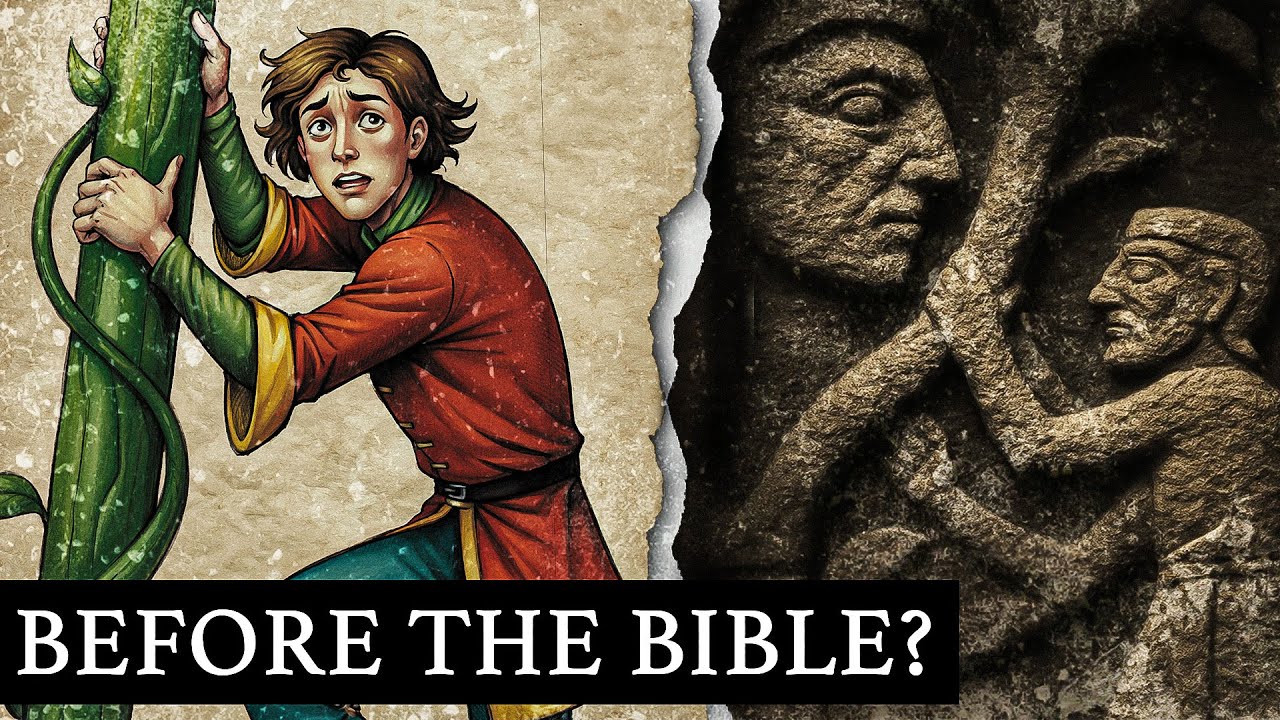
Jack may never have been climbing toward a giant.
He may have been climbing toward the dead.
A boy trades away his family’s last source of food.
He receives beans.
That night, something impossible erupts from the earth beside his home—
a living column twisting upward until it disappears into the sky.
Jack climbs it.
He leaves the human world behind.
At the top waits a monstrous guardian.
Beside him are objects that should not exist:
gold without end—
a creature producing endless wealth—
a harp that sings with its own voice.
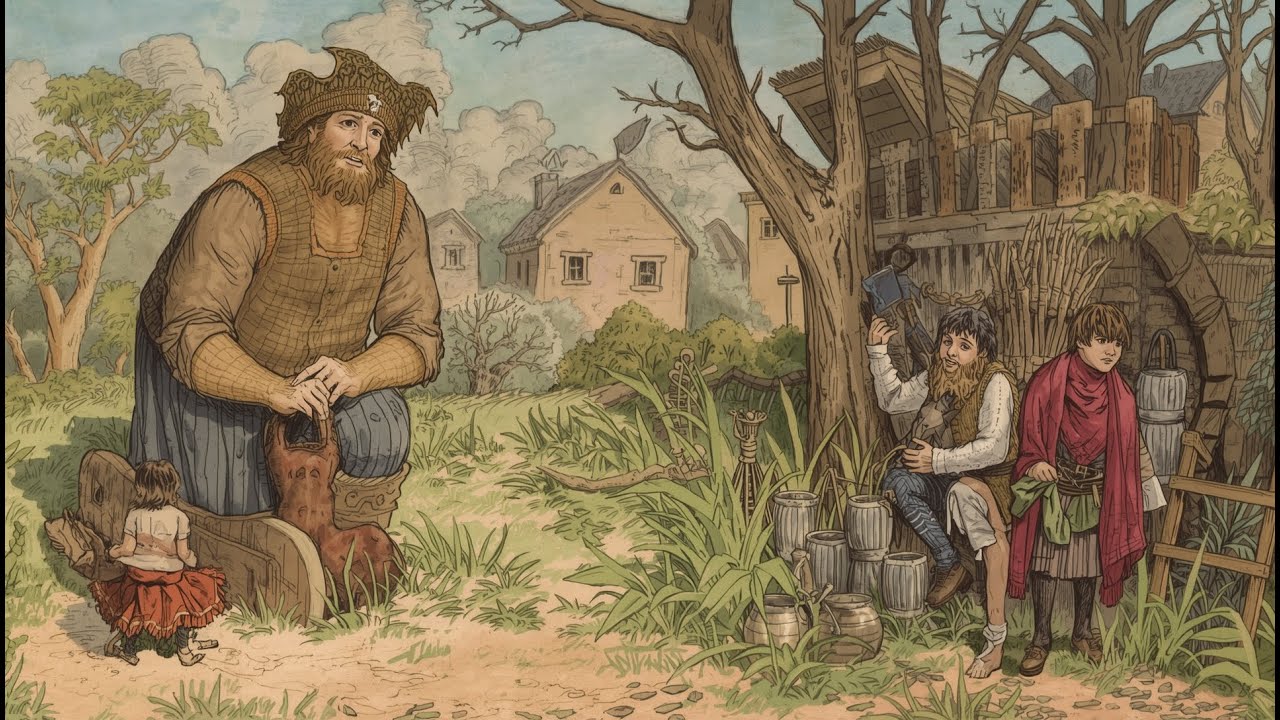
Jack steals them.
The guardian chases him.
Jack escapes back to Earth—
then takes an axe and destroys the only bridge connecting the two worlds.
Read as a children’s story, it is Jack and the Beanstalk.
But strip away the nursery-book illustrations—
and something much older begins to appear.
A mortal entering a forbidden realm.
A supernatural guardian.
Sacred treasure.
A journey between worlds.
A return.
And the destruction of the path behind him.
Even stranger—
research into the family of folktales to which Jack’s story belongs has suggested that its underlying narrative tradition may reach back thousands of years.
Long before Joseph Jacobs.
Long before Shakespeare.
Potentially long before anyone wrote Jack’s story down.
Which raises a disturbing possibility.
Maybe generations of parents have been telling children a fragmented echo of something ancient—
without remembering what it originally meant.
To find out, we first have to remove everything we think we know about Jack.
The familiar story begins with hunger.
Jack lives with his widowed mother.
They are desperately poor.
Their last valuable possession is a cow.
When there is little food left, Jack’s mother sends him to market.
Sell the cow.
Bring back money.
Instead, Jack encounters a stranger.
The stranger offers him beans.
Not ordinary beans.
Magic beans.
Jack accepts.
When he returns home, his mother sees catastrophe.
Their last economic lifeline—
gone.
In exchange:
beans.
She throws them outside.
Jack goes to bed hungry.
Then night comes.
Something begins growing.
By morning, a gigantic stalk has erupted beside the house.
It rises past the roof.
Past the trees.
Into the clouds.
Jack does what almost nobody sensible would do.
He climbs.
Higher.
Higher.
Until his own world disappears beneath him.
Then he reaches another land.
There is a castle.
Inside lives a giant and his wife.
The wife warns Jack that her husband is dangerous.
But she feeds the starving boy and hides him when the giant returns.
Then comes one of the most famous lines in English folklore:
“Fee-fi-fo-fum…”
The giant smells a human.
Jack remains hidden.
Eventually the giant settles down.
And Jack sees the treasure.
Gold.
He takes it.
Then escapes.
But Jack returns.
On another journey, he takes a hen associated with golden eggs.
Then he returns yet again.
This time he steals a magical harp.
But the harp can speak.
It cries out.
The giant awakens.
Now Jack runs.
Down the stalk.
The giant follows.
Jack reaches Earth.
Calls for an axe.
Swings.
Again.
Again.
The stalk begins to break.
The giant is still descending.
Then the beanstalk gives way.
The connection between the two worlds collapses.
The giant falls.
Jack survives.
And the story gives us the ending fairy tales love:
Jack and his mother prosper.
Happily ever after.
Except there is a problem.
Jack is not obviously the hero.
Look at what he actually does.
He enters someone else’s home.
Accepts food and protection from the giant’s wife.
Steals property.
Returns.
Steals again.
Returns again.
Steals a third time.
Then kills the owner while escaping.
Modern retellings often soften that problem.
Some versions explain that the giant had previously stolen wealth belonging to Jack’s family.
Now Jack is not a thief.
He is recovering what was rightfully his.
But that justification does not appear in every telling.
And when we move backward through the history of the tale—
Jack becomes stranger.
The comfortable morality begins to disappear.
Joseph Jacobs published one of the best-known versions in English Fairy Tales in 1890.
Jacobs was collecting stories that had circulated orally.
His Jack is much closer to the unpredictable folk trickster than the sanitized hero of later children’s adaptations.
But Jacobs did not invent the story.
More than eighty years earlier, in 1807, Benjamin Tabart published The History of Jack and the Bean-Stalk.
That version gives Jack a moral justification.
A fairy reveals that the giant had wronged Jack’s family.
The treasures become restoration.
The killing becomes revenge or justice.
But go farther back.
A printed work called Jack Spriggins and the Enchanted Bean was already making fun of elements of the story.
And that detail is important.
Parody depends on recognition.
A joke works only if the audience understands what is being mocked.
If an eighteenth-century publication could parody the basic idea—
then some form of the tale was already circulating.
Possibly for generations.
Then there is the giant’s chant.
“Fee-fi-fo-fum.”
It feels inseparable from Jack.
But versions of this kind of giant’s rhyme existed independently of the familiar nineteenth-century printed tale.

A similar formula appears in Shakespeare’s King Lear in the early seventeenth century:
“Fie, foh, and fum…”
Shakespeare did not invent Jack and the Beanstalk.
The phrase appears to draw upon an older tradition involving giants or threatening figures detecting human prey.
So by the time Jack reached the printed page—
pieces of his world were already old.
But how old?
That question eventually moved beyond literary history.
Researchers began comparing folktales across cultures.
And they noticed something remarkable.
Jack’s adventure belongs to a much larger international story family.
Folklorists classify the tale type as ATU 328—
“The Boy Steals the Ogre’s Treasure.”
The names change.
The landscape changes.
The treasure changes.
The monster changes.
But the skeleton survives.
A young protagonist.
A dangerous supernatural being.
A forbidden place.
Treasure.
Theft.
Escape.
Versions appear across multiple Indo-European storytelling traditions.
And in 2016, researchers published a study attempting something ambitious:
Instead of treating folktales simply as literature—
they analyzed their relationships using methods inspired by evolutionary biology.
Think of languages as branches.
English.
German.
Norse languages.
Latin descendants.
Greek.
Indo-Iranian languages.
Trace those branches backward—
and they converge toward older ancestral languages.
Stories can travel with languages.
So if related populations possess related versions of the same tale—
researchers can attempt to estimate how far back the common narrative might extend.
The results attracted enormous attention.
Several fairy-tale families appeared potentially ancient.
Thousands of years old.
And ATU 328—
the family containing Jack and the Beanstalk—
was among the tales discussed as having very deep roots.
That does NOT mean someone was telling the exact modern story of “Jack” five thousand years ago.
There was no evidence of a prehistoric English boy named Jack climbing the exact beanstalk we know today.
No ancient manuscript contains the complete modern story.
The claim is subtler—
and much more fascinating.
The underlying narrative pattern may preserve elements inherited from extremely old Indo-European oral traditions.
Stories passed mouth to mouth.
Parent to child.
Village to village.
Generation to generation.
Long before printing.
Long before English existed.
Potentially before writing recorded the tale at all.
Imagine what that requires.
One storyteller remembers it.
Then another.
A migration begins.
The language changes.
The gods change.
The monster changes.
The landscape changes.
Centuries pass.
Empires rise.
Empires disappear.
Religions change.
Another storyteller tells it beside another fire.
The details mutate.
But something survives.
The climb.
The monster.
The treasure.
The escape.
If that reconstruction is broadly correct—
Jack is not simply an English fairy-tale character.
He is the latest face worn by a much older narrative.
And that opens a more unsettling question.
What did the original story mean?
Start with the giant.
Giants appear almost everywhere in mythology.
Goliath.
The Cyclops Polyphemus.
The Norse jötnar.
Titanic beings.
Ogres.
Ancient inhabitants.
Guardians.
Enemies of gods.
Enemies of heroes.
They are frequently associated with an older order of the world.
Something powerful that existed before the hero arrived.
Then the hero defeats it.
This pattern has encouraged some interpreters to wonder whether legendary giants can sometimes preserve cultural memories of earlier peoples—
rivals transformed through storytelling into monsters.
That is an intriguing idea.
But it is not something we can prove for Jack’s giant.
There is no evidence demonstrating that his giant represents one specific defeated historical tribe.
Still, the moral problem remains.
Jack climbs into the giant’s world.

The giant does not invade Jack’s village.
Jack invades his.
Jack takes his wealth.
Then kills him.
Change the perspective—
and the fairy tale becomes uncomfortable very quickly.
Imagine the same story told by the giant’s wife.
A starving stranger appears at her door.
She feeds him.
Protects him.
Hides him from her husband.
The stranger steals from them.
Then returns.
She helps him again.
He steals again.
Then he returns a third time.
Her husband pursues the thief—
and is killed.
Suddenly “happily ever after” belongs only to Jack.
That ambiguity is exactly what we should expect from very old folklore.
Folk heroes were not always moral role models.
They survived through cunning.
They tricked stronger enemies.
They crossed boundaries.
They stole.
Jack belongs naturally beside the trickster.
But there is another ancient pattern hiding inside his adventure.
The theft of something sacred.
Prometheus enters the divine order and steals fire for humanity.
Odin ventures into the realm of giants and steals the Mead of Poetry.
Gilgamesh and Enkidu enter the Cedar Forest and confront its guardian, Humbaba.
Different cultures.
Different meanings.
But a recurring structure appears:
Enter forbidden territory.
Defeat or deceive the guardian.
Take something powerful.
Bring it back.
Jack does exactly that.
He climbs out of the human world.
Enters a supernatural domain.
Takes extraordinary objects.
Returns with them.
Gold.
The golden hen.
The singing harp.
Wealth.
Sustenance.
Music.
The gifts of civilization condensed into fairy-tale objects.
Was Jack consciously derived from Prometheus?
There is no evidence for that.
Was his beanstalk secretly copied from Norse mythology?
Again—
no.
But stories can share ancient symbolic structures without one being a direct copy of another.
And the beanstalk itself may be the strangest symbol of all.
Because humanity has imagined vertical pathways between worlds for thousands of years.
Sacred mountains.
Ladders.
Pillars.
Vines.
Trees.
The axis mundi.
A central structure connecting Earth to another realm.
Norse mythology gives us Yggdrasil—
the enormous tree associated with multiple worlds.
Hindu traditions contain sacred cosmic-tree imagery.
Shamanic traditions across parts of Eurasia have used trees or poles symbolically in journeys between earthly and spiritual realms.
In other traditions—
mountains connect humanity to gods.
And Jack?
He wakes to discover a living structure growing directly from the earth—
through the clouds—
into another world.
Not a road.
Not a bridge built by humans.
A plant.
Rooted in soil.
Reaching toward heaven.
That image is so simple that children accept it immediately.
But symbolically—
it is enormous.
Then we come to the beans.
And this is where the interpretation becomes much darker.
Beans carried unusual religious associations in parts of the ancient Mediterranean world.
The Pythagoreans famously avoided beans.
Exactly why remains debated.
Ancient explanations vary wildly.
Some associated beans with death.
Some with souls.
Some with bodily impurity.
Some explanations were symbolic.
Others ritual.
Others probably invented later to explain an old taboo.
So we cannot simply say:
“Ancient people believed beans were literally souls of the dead.”
The evidence is more complicated than that.
But beans undeniably accumulated strange associations with life, death and ritual.
Now place that symbolism beside Jack’s story.
Jack begins with a cow.
Milk.
Food.
Economic survival.
His family’s last material security.
He exchanges it for beans.
His mother rejects them.
They enter the earth.
Night falls.
Then something grows.
A living path into another realm.
And Jack climbs it.
What if the climb is not simply upward?
What if symbolically—
it is a crossing?
That possibility has inspired a much darker reading of the fairy tale.
Jack goes to sleep hungry.
The beans enter the earth.
The impossible plant appears.
Jack ascends beyond the ordinary human world.
At the top—
he finds beings who do not belong below.
A giant.
A supernatural household.
Objects capable of producing endless abundance.
Gold.
Music that exists almost as a living thing.
Then Jack returns.
In mythic terms, this resembles a journey to an Otherworld.
And stories of entering the realm of the dead or supernatural and returning are extraordinarily ancient.
Inanna descends.
Orpheus enters Hades.
Heroes cross boundaries ordinary humans cannot.
Shamans symbolically ascend.
Gods die and return.
Jack’s movement is upward rather than downward—
but the direction of the Otherworld has never been universal.
Heaven can be above.
The dead can travel along celestial paths.
A cosmic tree can connect multiple levels of existence.
So here is the disturbing interpretation.
Not the historical fact.
The interpretation.
What if Jack’s beanstalk represents the boundary between life and death?
What if the giant is not simply a monster—
but a guardian?
What if the treasures are not household valuables—
but supernatural gifts brought back from the other side?
And what if Jack’s final act is the most important one of all?
He cuts the stalk.
He destroys the bridge.
The connection closes.
Jack returns permanently to the human world.
Whatever exists above—
can no longer follow.
Read that way, the story stops resembling a comic adventure.
It begins resembling initiation.
Death.
Journey.
Return.
But we can push the interpretation one step further.
What if Jack never physically climbed anything at all?
What if the ancient narrative beneath the fairy tale once represented a visionary journey—
a ritual passage—
or a symbolic encounter with death?
There is no evidence that allows us to declare:
“Jack died that night.”
That would turn speculation into history.
But as a mythic reading—
the idea explains something fascinating.
Why does the story feel so much larger than its logic?
A plant grows infinitely high overnight.
A boy enters another world without surprise.
A giant smells human blood.
Animals produce endless treasure.
A harp possesses a voice.
A vertical bridge connects worlds.
Then the bridge is destroyed.
Children accept all of this because fairy tales train us not to ask what the images originally meant.
But ancient audiences may have heard symbols where we hear nonsense.
And after thousands of years—
the symbols can survive even after their explanation disappears.
That may be what makes Jack and the Beanstalk genuinely eerie.
We know the modern story.
We can trace printed versions backward several centuries.
Comparative folklore may take elements of its story family much farther into the past.
But eventually—
the paper trail ends.
Writing disappears.
Authors disappear.
Titles disappear.
Jack himself disappears.
Beyond that point there are only reconstructed relationships between stories—
and the possibility of oral traditions moving through prehistoric communities whose storytellers left no names behind.
Imagine one of those nights.
Thousands of years ago.
No England.
No English language.
No printed books.
No “Jack.”
A fire burning somewhere in prehistoric Eurasia.
Children listening.
An elder begins telling a story.
A young figure leaves the ordinary world.
He reaches another realm.
There is a terrifying guardian.
There is treasure.
The hero steals it.
He escapes.
Everybody around that fire understands what the story means.
Then the storyteller dies.
The children remember.
One of them tells it decades later.
A detail changes.
Another generation.
Another language.
Another migration.
The sacred object becomes treasure.
The guardian becomes an ogre.
The path becomes a magical plant.
The hero eventually becomes Jack.
Five thousand years pass.
And one night—
a parent opens a children’s book.
“Once upon a time…”
The child hears about magic beans.
A beanstalk.
A giant.
A golden harp.
Nobody in the room realizes that some part of the story may have traveled farther through human history than the kingdom that printed the book.
That is the real mystery of Jack and the Beanstalk.
Not whether magic beans existed.
Not whether giants once lived above the clouds.
But how a story can outlive almost everything that created it.
Languages die.
Religions disappear.
Kingdoms collapse.
Borders vanish.
The names of storytellers are forgotten.
Yet the boy keeps climbing.
Generation after generation.
Higher.
Higher.
Toward a world beyond the clouds.
And perhaps that is why the final image matters so much.
Jack reaches the bottom.
The giant follows.
Jack lifts the axe.
He cuts the stalk.
The bridge falls.
The ancient world above disappears forever.
Except it doesn’t.
Because every time someone tells the story—
the beanstalk grows again.