Mary Curzon was once celebrated as one of the most captivating figures in high society, a woman who rose from Chicago wealth to become the wife of a powerful British statesman. But years of sacrificing her own health and happiness for her husband’s relentless ambition left her broken, and when she nearly died, his response revealed exactly where her devotion had led her. Born Mary Victoria Leiter in 1870 to one of Chicago’s wealthiest families, she was raised under intense pressure to be perfect, prim, and presentable. Her mother dreamed of climbing even higher on the social ladder, ideally by securing a titled husband for her daughter.
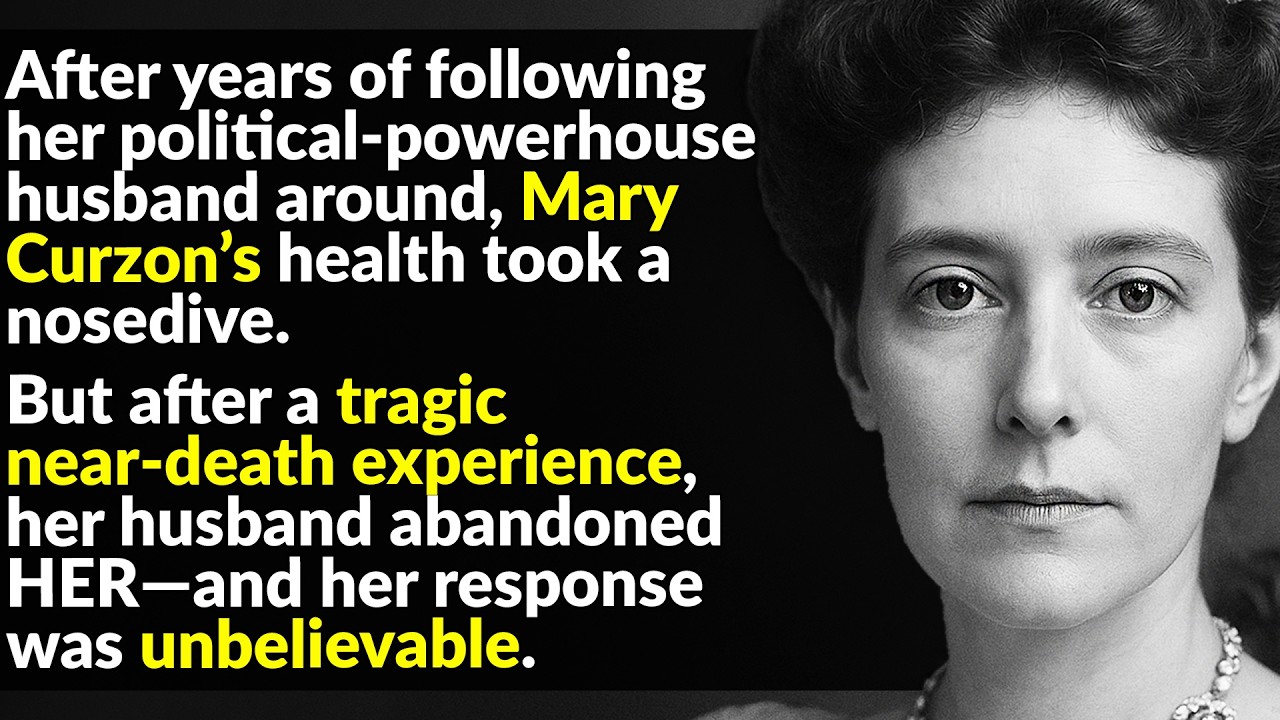
From an early age, Mary was known as a striking beauty, serious and earnest rather than flashy, with an oval face, pale skin, and dark hair that drew attention wherever she went. The Leiters frequently traveled to Europe, particularly Paris, to expose Mary to culture and introduce her to society. During one trip, she caught the eye of a man named Edward Morrell, but since he held no aristocratic title, he was considered only a trial run. When Mary made her official debut, she dazzled the room; tall and slender at around 5 foot 8, she seemed to float through ballrooms with impeccable posture.
Her social conquests soon included powerful friends. She became fast friends with Frances Cleveland, who happened to be married to President Grover Cleveland. McAllister Ward, a confidant of Caroline Astor, the ultimate doyenne of New York society, named Mary one of his favorites and invited her to the exclusive Patriarch Ball. Yet Mary remained notably humble, once spending an entire dance persuading a man to ask another young woman who had been waiting for a partner.
Despite her popularity, Mary resisted her family’s and suitors’ pressure to marry, enjoying her freedom for a while. Then she met George Curzon, the eldest son of a baron and a prominent member of British Parliament, at one of the endless balls she attended. She was immediately love-struck, and he later admitted he had never loved her more than the moment he saw her walk into the great assembly. They met again at an English manor house, where George confessed he had a strong inclination to kiss her and had to struggle mightily against the strict propriety of the age to stop himself.
Soon they were exchanging fevered letters and trinkets. But George was hiding a painful secret. Due to an incorrect curvature of his spine, he suffered from debilitating agony and wore a steel corset with leather padding, which often made his temper short. There were other red flags from the start.
George was eleven years older than Mary, a sharp, severe, and ambitious man who worked himself to the bone and was often away on parliamentary engagements. He was also far more experienced in romance, and he had gained a reputation for waylaying society girls in corridors, woods, and trains. Despite all this, Mary knew what she wanted. Three years after their first meeting, she organized a meeting with George and confessed everything, essentially telling him it was him or no one.
His passions inflamed, George told her he felt the same way, but he had reservations. He was due to make several long trips in the coming year and did not think it appropriate to travel while married. So they made a scandalous plan: a secret engagement, on the understanding that George would be at liberty to complete his tasks before they took the final step. Mary pledged that if George did not make it back from his travels, she would never marry.
In a trend that would follow them for the rest of their lives, George was getting the better end of the deal. George explicitly expected Mary to always take a backseat to him. As he once said, “Give me a girl who knows a woman’s place and does not yearn for trousers. Give me in fact Mary.
” Mary was happy to concede, but she would pay for it. Their engagement meant two more years with almost no contact, and by the eve of their wedding, they had met for only two days and a handful of hours. The wedding took place just across from the White House on Lafayette Square, with the First Lady in attendance. Mary wore lace-trimmed white satin, a glittering coronet of diamonds, and a veil that fell across her dark hair.
She was a picture-perfect bride, but she was about to realize she did not have a picture-perfect marriage. Mary was soon pregnant, and on Christmas Eve 1895, she began having labor symptoms. The newlyweds were certain the baby would come prematurely and likely perish, but a doctor managed to avert the crisis. Her eldest daughter, Mary Irene, was born several weeks later in January.
Mary was soon pregnant again, but the child was another daughter, Cynthia, which put George in a difficult position. As a traditional man, he desperately wanted a male heir. In 1898, three years into their marriage, George Curzon became the Viceroy of India, an extremely high-ranking position in colonial imperialist Britain. Suddenly, Mary’s quiet life was torn to shreds as she became one of the most watched women in the country.
“We begin to be treated like grandees,” she wrote. “Stationmasters always meet us. Carriages are reserved. ”
But the grandeur came with strict protocols and isolation.
Mary was exposed to painfully few people, mostly her husband’s employees and their families. At formal dinners, the seating rules were so rigid that she often had to sit beside the same man night after night. She was soon deeply unhappy with the isolation and cultural differences in India. Mary fell pregnant again, and she and George planned for her to return to England to have the child.
But George’s ambition threw a wrench into that plan. Although his term as Viceroy was up, he insisted on a second term, something no Viceroy before him had ever done. Mary went back to England in January 1904, while George joined her in May, but they were due back in India that September. Amidst the stress, she gave birth to yet another girl, named Alexandra, whom everyone called Baba, for Viceroy’s baby.
Just weeks after giving birth, Mary suffered from a series of illnesses and one acute tragedy. She was intermittently sick and plagued with headaches. That summer, she got pregnant again, likely still in search of that boy, but she had a miscarriage quickly after. None of this deterred the plan to head back to India, regardless of what Mary’s body was saying.
Days before they were due to leave, Mary underwent a shocking transformation. After a drive along the country one day, she fell into such dire illness that she was slipping in and out of a coma within hours and was near death by nightfall. Operations only seemed to make matters worse, and doctors began telling George he should expect to bury his wife very shortly. Against all odds, Mary pulled through, but she required intense rest and was liable to relapse at any moment.
Throughout Mary’s long illness, George still had his position in India to think about. Now that she was no longer dying, he made a chilling choice. Once more putting his work above everything else, even the woman he loved, he took his post back up in India and left Mary to convalesce alone. And that was not the worst part.
George likely believed Mary would understand his duty to abandon her, and he was right. Mary did not just accept his leaving; she took it one unbelievable step further. When she was barely able to move around and only with help, she wrote to George and told him she would join him in India shortly. It would be one of the final grand gestures in her life.
Mary and George were supposed to remain in India until 1906, but fate had crueler plans. After unrest, rightful protests of British rule by Indian citizens, and George’s allies in Parliament turning away from him, it became clear he had to resign. He did so in the summer of 1905, and by December they were on their way back to England. When they landed, not one government official came to meet them.
Mary was more ragged and disillusioned than ever. Writing to her mother, she called returning to India a great mistake for both her and George, and confessed, “I shall go out of my mind if I have to bear much more strain and worry. ”
Tragically, she could not bear it. Mary never completely healed, and illness hit her again and again in 1906.
Influenza caused a cough that shook her bones, and other ailments caused her heart trouble. That summer she wrote to her brother, “I sometimes fear and feel I shall never be well again. ” And sadly, she was right. After years of illness and a prolonged near-fatal infection, Mary’s end came swiftly.
On July 18, 1906, after a restless night, she suffered a fatal heart attack at 6:00 p. m. Her husband was finally by her side. Although Mary perished at the rock bottom of her husband’s career, she would likely have been delighted to know how he powered on without her.
George went on to claw back his career, becoming foreign secretary, and remarrying society beauty Grace Duggan. In 1921, he even became a marquis.