Calamity Jane remains one of the most famous figures of the American Old West, celebrated through dime novels, Hollywood films, and an Academy Award-winning television series, yet much of the legend surrounding her was fabricated, often by Calamity herself. . One of the most iconic frontier women in American history was, in reality, largely a product of myth-making that she actively encouraged throughout her life.
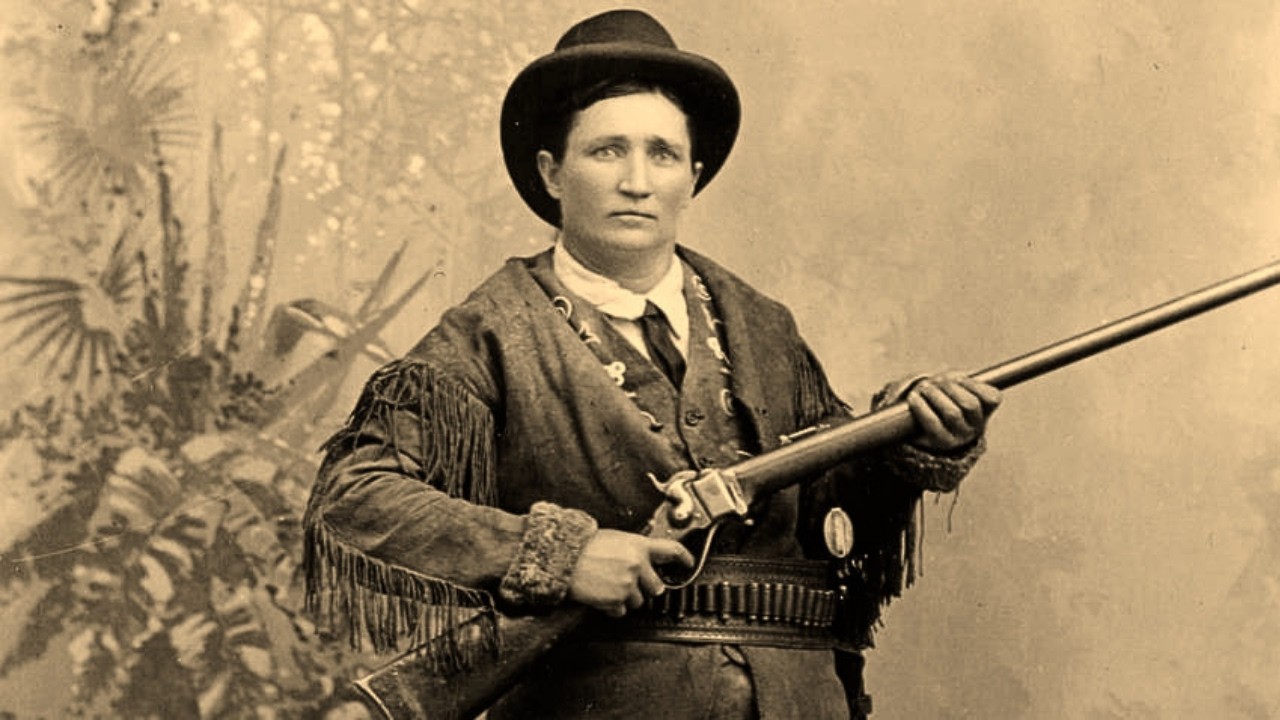
Born Martha Jane Cannary near Princeton, Missouri, around 1856—not 1852 as she later claimed—she lost her mother to pneumonia in 1865 and her father, a farmer and gambler, likely the following year in Utah, leaving Martha an orphan with five younger siblings before she reached her teens
By 1869, the territorial census placed her in the Wyoming railroad town of Piedmont, and the next five years of her life remain almost entirely undocumented
When she reappeared, she was working as what was then called a camp follower—a term that could cover cooking, nursing, laundry work, or prostitution around army posts
Historians note Jane briefly worked near Fort Laramie, including at establishments widely regarded as brothels, though evidence suggests she worked intermittently and also formed longer relationships instead of living permanently in a house of prostitution
Independent accounts from the period conflict, with one contemporary describing her as a prostitute while another recalled her as a skilled wagon driver
Her famous nickname emerged in May 1875, when an army surgeon at Fort Laramie spotted a woman striding across the parade grounds dressed in spurs, chaps, and a sombrero
A lieutenant colonel identified her as a regimental mascot who, in his words, did not know the meaning of the word morals
Weeks later, on the Newton-Jenney Expedition into the Black Hills, a correspondent for the Chicago Tribune spotted a young private riding with the civilian teamsters dressed head to toe in a full U
S
soldier’s uniform
She was Calam, the correspondent wrote, describing her as riding a mule “equal to any professional black snake swinger in the army
” That dispatch marked the first known written reference to the name Calamity
As for how she actually got the nickname, Jane’s own autobiography claimed she earned it after rescuing a wounded army captain from hostile Indians, who then pronounced her the“heroine of the plains”
Historians have found no evidence this rescue ever occurred, and friends who knew her told a far different story
A longtime friend, who later served as pallbearer at her funeral, told the Washington Post in 1906 she acquired the name around 1875 in Cheyenne simply by being a walking disaster—wrecking rented buggies and getting bucked off fence rails so often that a local newspaper editor began calling her Calamity Jane“
As to whether she scouted for General George Custer or rode for the Pony Express, as she also claimed in her autobiography, no evidence supports either assertion, and Custer was never even stationed at the fort where she claimed to have joined his command
Soon after the Newton-Jenney Expedition, Jane attached herself to a wagon train heading to the Black Hills, and she did so under circumstances entirely typical of her behavior
According to a fellow traveler, Jane had consumed herself into a state the army found intolerable and had been locked up in the Fort Laramie guard house, drunk and nearly naked
The army essentially asked the wagon train to take her off their hands
Fortunately for Jane, the wagon train included a newly famous passenger: Wild Bill Hickok
Their introduction was hardly toward and the relationship that followed was far less romantic than later legend would suggest
Hickok had married a circus owner named Agnes Lake just months earlier, and contemporaries reported genuine affection between Bill and Agnes
As for Jane, historians note Hickok seemed to regard her as a traveling companion at best and an embarrassment at worst
He was killed in Deadwood just a few weeks later, meaning the two had known each other for perhaps six weeks at most
Yet Jane spent the next 27 years cultivating a supposed closeness that people who actually knew Hickok would later deny
The most dramatic attempt to cement that legend came in 1941, years after Jane’s death, when a woman appeared on a national radio program announcing she was the secret daughter of Wild Bill Hickok and Calamity Jane, supposedly conceived during an alleged earlier marriage between them
She produced a diary and letters she claimed were Jane’s
The documents were taken seriously by writers and Hollywood for decades
Researchers finally dismantled them inthe 1990s, noting the letters were far too well-written from a woman who was effectively illiterate,and that the diary even described Jane meeting Jesse James after his death, and hearing him sing atop his own coffin—an impossibility even before considering whether the notorious outlaw sang at his own funeral
There was no secret marriage, and the woman was not Jane’s daughter
Jane did have at least one real child, however: a daughter named Jessie, born in October 1887
She also legally married once, in Ohio in 1888, to a railroad brakeman named William Steers
The marriage was violent—Steers beat her often,and Jane had him jailed on at least three occasions for abuse—and did not last even a year
She later took the name Clinton Burke, a man she lived with for years despite no official marriage records
Burke reportedly disappeared after robbing his employer in Deadwood and skipping town
As for how she made her living, Jane worked over the years as a bullwhacker, cook, waitress, laundress, ox team driver, and dance hall girl
In Deadwood, she very likely worked for Al Swearengen, the infamous brothel keeper later dramatized on television, though evidence indicates she danced there only briefly during the summer of 1876
By the 1890s, she ran her own restaurant in Montana, and later made her living off her own name, selling copies of her autobiography and photographs
Jane gave birth to another child before Jessie: a boy born in November 1882, nicknamed Little Calamity by local papers
He is believed to have died in infancy
Jessie, though, survived, and Jane dragged her around the West for more than a decade
In 1895, Jane returned to Deadwood claiming she needed money to enroll her daughter in a convent school
She stayed brief, and by the end of the benefit organized for her, most of the proceeds were spent buying drinks for the crowd
She eventually did scrape together the fee, enrolling Jessie inthe school by January 1896
A writer who interviewed Jane around that time described Jessie as neatly dressed, shy, with a bright face and good manners
Jane told him, “She’s all I got to live for She’s my only comfort
” The relationship would not last, however,and Jessie eventually went to live with the mother of one of Jane’s later companions
On her deathbed, Jane admitted she and her daughter had become estranged
Jessie grew so disconnected that she briefly believed Calamity Jane was her grandmother, not her mother
Not all of Jane’s legend was false, however
She was, by multiple accounts, genuinely generous to a fault
When smallpox tore through Deadwood in 1878, most residents refused to go near the sick, but Jane nursed prospectors through the outbreak with little thanks or compensation
Years later, when a miner lay alone with a broken leg, Jane went to every dance hall in town asking patrons to give her money instead of buying her drinks, then purchased supplies and nursed him back to health
A writer who knew her late in life recalled, “She was poor all of her life from giving things away,and I have heard her last illness was contracted in nursing some poor sot that she found in the gutter
” There is at least a possibility, historians note, that her final illness came from one last act of charity
By her final decade, Jane was living largely off her celebrity, and her attempts to monetize it were not always successful
In 1901, a newspaper writer tracked her down and brought her east to appear at the Pan-American Exposition in Buffalo
It was less a rescue mission than a exploitation scheme, with the writer reportedly keeping most of her earnings while Jane received pennies
Jane responded by drinking up her wages, jumping to a rival outfit—which also featured the famous Apache leader Geronimo—and getting arrested for public drunkenness
When Buffalo Bill Cody’s Wild West Show arrived in town, Jane burst into the showman’s tent begging him to stake her a railroad ticket home
Cody had known her for years, having recently contributed to a fund to get her out of a Montana poorhouse
He gave her train fare and meal money, later remarking she was no more tired of Buffalo than the Buffalo police were tired of her
Jane allegedly drank up her meal money before she even left Chicago
By 1903, she returned to the Dakotas, where an old friend, a successful brothel madam named Dora DuFran, took her in and put her to work cooking and doing laundry for her employees
It was the most stable stretch of Jane’s final years, but it did not last long
On August ist, 1903, at a hotel room inhale South Dakota mining town just outside Deadwood, Martha Jane Cannary died at approximately age 46
Contemporary reports blamed inflammation of the bowels and pneumonia, but three decades of heavy drinking was almost certainly the underlying cause
Her burial, however, would create one of the most enduring myths of the American West
Calamity Jane really is buried beside Wild Bill Hickok at Mount Moriah Cemetery overlooking Deadwood
But this was not, as generations assumed, the fulfillment of a dying frontier romance
According to statements from four of the very men who planned her funeral, Hickok had had no use for her whatsoever
Burying her beside him for all eternity, they said, was a practical joke
One of the most romanticized grave sites in the American West was, in all likelihood, a prank
As for how history should remember her, a contemporary who actually did scout for the army under General George Crook—and who knew Jane personally—offered perhaps the most honest summaryin1904
She never scouted for anybodyand she never fought Indians, he said
She was simply a notorious character, dissolute and devilish, but one who possessed a generous streak that made her popular
Dora DuFran, the madam who took her in at the end, later said Jane“knew better than anyone where she made her mistakes,and she didn’t rate her virtues as highly as her friends did
” The myth turned her into a buckskin heroine, but the evidence paints a far more interesting picture: a real, flesh-and-blood human being, drunk and illiterate, generous and kind, abused and at times abusive
She wasn’t Joan of Arc or Florence Nightingale
She was Martha Jane Cannary from Princeton, Missouri, an orphan who was dealt a terrible hand at age eleven and played it out for another thirty-five years with far more nerve than sense