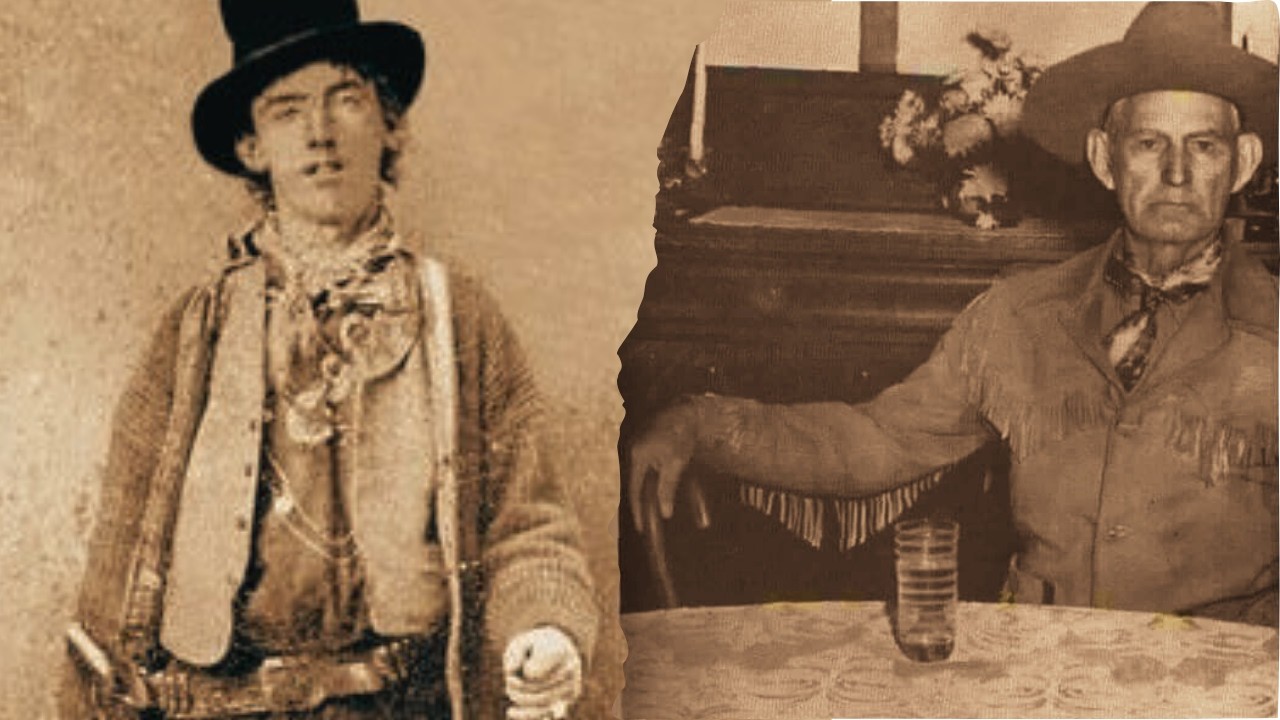
John Wesley Hardin is remembered as one of the most lethal gunmen of the American Old West, but the reality of his career looks very different from the Hollywood version. He did not build his record through a long series of fair, noon-day street duels against famous fast-draw rivals. Instead, his survival depended on speed, reputation, timing, and a willingness to use violence before a situation ever became a formal contest. Most of the men who crossed him were not legendary gunfighters.

They were deputies, policemen, soldiers, trail hands, feud enemies, and local men pulled into sudden violence. In the world Hardin inhabited, arguments turned deadly fast, arrests could become shootouts in seconds, and fear did as much work as a loaded revolver. He expected violence, accepted it earlier than most, and was prepared to fire before a conflict settled into anything resembling a fair fight. Hardin was born in Bonham, Texas, in 1853, the son of a Methodist preacher, schoolteacher, and lawyer.
He came of age during Reconstruction, one of the most unstable periods in Texas history. The Civil War had ended, communities were being torn apart by political divisions, old Confederate loyalties still burned, and racial violence was widespread. The Texas State Historical Association records that his violent career began with a schoolyard stabbing in 1867 and that he shot and killed a Black man after an argument when he was 15. Britannica describes Hardin as violently anti-Black and anti-Yankee, placing his first killing in the wider atmosphere of Reconstruction.
That political context matters. Hardin was not simply a reckless teenager with a gun. He was formed inside a culture where personal grievance, race hatred, local loyalty, and armed force were all mixed together. That helps explain why he never fit neatly into one box.
He was feared as a killer, admired by some for defying Reconstruction authorities, and later remembered as a gunslinger because the culture around him kept turning real violence into legend. Hardin’s reputation as a gunman was genuine. Britannica says he killed at least 21 men in duels and ambushes between 1868 and 1877. The key phrase is “duels and ambushes.
” He was fast, but he also did not limit himself to clean encounters. He could function in confusion, at close range, during pursuit, while escaping, while cornered, or when a quarrel suddenly broke open. He was mentally prepared to go from talk to gunfire in an instant. That readiness mattered more than style.
Men who might have stood their ground against another outlaw often backed away from Hardin because they knew he could turn a tense moment into a killing before they were fully committed. Even the stories that are hard to verify show the same pattern. Whether every claim in his later autobiography was true or not, the image that spread was always the same: Hardin was the man who got dangerous first. In 1871, Hardin went up the Chisholm Trail as a cowboy, a stage of his life that mattered almost as much as the killings themselves.
According to the Texas State Historical Association, he killed seven people on the trail and three more in Abilene. That turned a local Texas killer into a frontier name. Abilene is where the legend really starts to sound like a Western, especially because Wild Bill Hickok enters the story there. TSHA says Hardin allegedly backed down Hickok and may have been called Little Arkansas.
The word “allegedly” carries real weight. Even one of Hardin’s most famous moments comes to us with uncertainty attached. What he left behind was not proof of a clean Main Street victory over Hickok. He left behind a story that made people believe such a thing could have happened, and that alone boosted his status.
There is also the famous story of Hardin firing through a wall at a man in the next room in Abilene. However later generations retold it, the core fact remained ugly and simple: Hardin was dangerous in random, private, badly lit situations, not just in staged showdowns. He was a fighter in motion, not a performer waiting for the crowd to gather. After Kansas, Hardin returned to Texas and moved deeper into the violent politics of the period.
His main enemies were often not celebrity shooters looking for fame. They were officers, deputies, state policemen, and men tied to local power struggles. TSHA says he got into trouble with Governor Edmund J. Davis’s state police and then aligned himself with Jim Taylor during the Sutton-Taylor feud, described by TSHA as the longest and bloodiest in Texas.
It grew out of the post-war period and pulled together law enforcement, family alliances, politics, revenge, and open violence. Hardin killed Jack Helm, a former state police captain, and later killed Charles Webb, a deputy sheriff of Brown County. Those killings show why lawmen stopped treating him like a loud young outlaw who might eventually cool off. By the mid-1870s, he was a proven killer of officers.
A regular lawman might bluff a drunk cowboy or disarm a gambler, but any move against Hardin could become a final move. A deputy who heard his name was not asking whether he could outdraw him fairly. He was asking whether the street, saloon, or porch was about to become a trap. By the time Hardin had stacked up enough killings and enough stories, his reputation was doing work before any gun came out.
The frontier ran on information, rumor, exaggeration, and newspaper talk. A killer did not need every story to be true. He only needed enough men to believe the worst version. Britannica gives him at least 21 killings.
TSHA is careful in places to describe one death as certain and others as possible. The exact number can be argued, but the fear was real either way. Hardin’s own posthumously published autobiography only fed that cycle. It advertised his career even after his death and kept the hardest version of him alive.
That is why the idea that no gunslinger survived him works better as psychology than as arithmetic. It is not that every possible rival lined up and died. It is that Hardin reached a level where most serious men had no interest in finding out exactly how good he was. Some tried to arrest him, some crossed him by accident, some were drawn into local feuds.
But very few sensible people wanted the kind of direct personal proving match that later Western stories loved. The real American Old West did produce famous gunfighters, lawmen, cowboys, and outlaws, but it rarely gave them the perfectly balanced duels that later movies made famous. A lot of actual violence happened in saloons, hotel rooms, alleys, on horseback, during arrests, inside feuds, or in moments where one side never even knew the fight had fully started. Britannica’s phrasing, “duels and ambushes,” may be the cleanest short description of Hardin’s whole career.
He could survive in both worlds, and that made him unusually hard to beat. Speed matters in a gunfight, but so do position, timing, and willingness. If one man is still deciding whether this is going to become a shooting, and the other man has already decided, the second man has a huge advantage. Hardin kept living inside that advantage, and lawmen learned from it.
They did not keep looking for noble single combat. They wanted warrants, numbers, information, surprise, and better odds. The people trying to stop Hardin slowly began to fight him the way the real West worked, not the way later fiction worked. Hardin’s run as a fugitive ended the way the state usually ends a truly dangerous outlaw’s run: with planning, pursuit, and numbers.
TSHA says that after killing Charles Webb, he was constantly pursued in Texas, fled with his wife and children to Florida and Alabama, and was eventually captured in Pensacola in 1877. The Texas Ranger Hall of Fame timeline describes that capture as a shootout in a passenger train car and credits Ranger John B. Armstrong. Hardin was not finally brought down by one brave marshal stepping into the street and proving he was the better man.
He was taken by coordinated officers who moved when they had position and support. Hardin was then tried for the murder of Charles Webb and sentenced to 25 years in prison. The man who seemed unbeatable in scattered violent encounters was not disproved by a superior gunslinger. He was contained by organization.
The frontier could look lawless, but when government finally focused hard enough, it relied on persistence, informants, transportation networks, and multiple armed men. The fact that it took so much effort only strengthened his legend. Hardin’s prison years are one of the most surprising parts of the story. TSHA says that during his sentence, he made repeated escape efforts, read theological books, became superintendent of the prison Sunday school, and studied law.
After his pardon in 1894, he was admitted to the bar. Gonzales County history notes that after his pardon, he practiced law there. John Wesley Hardin, the feared outlaw, came out of prison and entered the legal profession. On paper, that should have opened a second life.
In reality, a reputation like his does not fade quietly. He could study law and speak as an attorney, but he was still moving through Texas as John Wesley Hardin. Everyone who heard the name also heard the old record. A former killer becoming a lawyer was almost too perfect for frontier folklore.
The same society that feared him also helped keep the myth alive because the contrast was so sharp. When Hardin moved to El Paso in 1895 to work around a murder case and establish himself there, he stepped into another rough border city where gambling, vice, armed personalities, and overlapping lines between crime and law were still part of daily life. He was trying to outrun a legend in a place that fed legends. That was never likely to end quietly.
Hardin’s death is the cleanest answer to the whole question because it destroys the last piece of the Hollywood version. TSHA says that after he became involved with the wife of one of his clients, Martin Mroz, and after rumors tied Hardin to Mroz’s death, Constable John Selman shot Hardin in the Acme Saloon on August 19, 1895. The TSHA entry on Selman says Hardin was killed there while rolling dice. Britannica also places Hardin’s death in the Acme Saloon at El Paso.
He was not finished off in a grand public duel where two legends faced each other on equal terms. He was killed in the kind of setting that had always defined the real West: indoors, close, sudden, and shaped by timing more than ceremony. The man who had spent years winning in confusion, pressure, and split-second violence was finally beaten by that same environment. That does not make his earlier reputation fake.
It makes it more understandable. Hardin survived so many encounters because he belonged to a violent world that rewarded anticipation, nerve, and unfair advantage. Men did not survive him because he rarely let a conflict settle into something clean enough to survive. In the end, he did not survive for the exact same reason.
Selman did not need to prove himself as the faster draw in a movie street. He only needed the moment. Hardin’s story had always been about the moment arriving before the other man was ready.
In El Paso, for once, the moment belonged to somebody else.