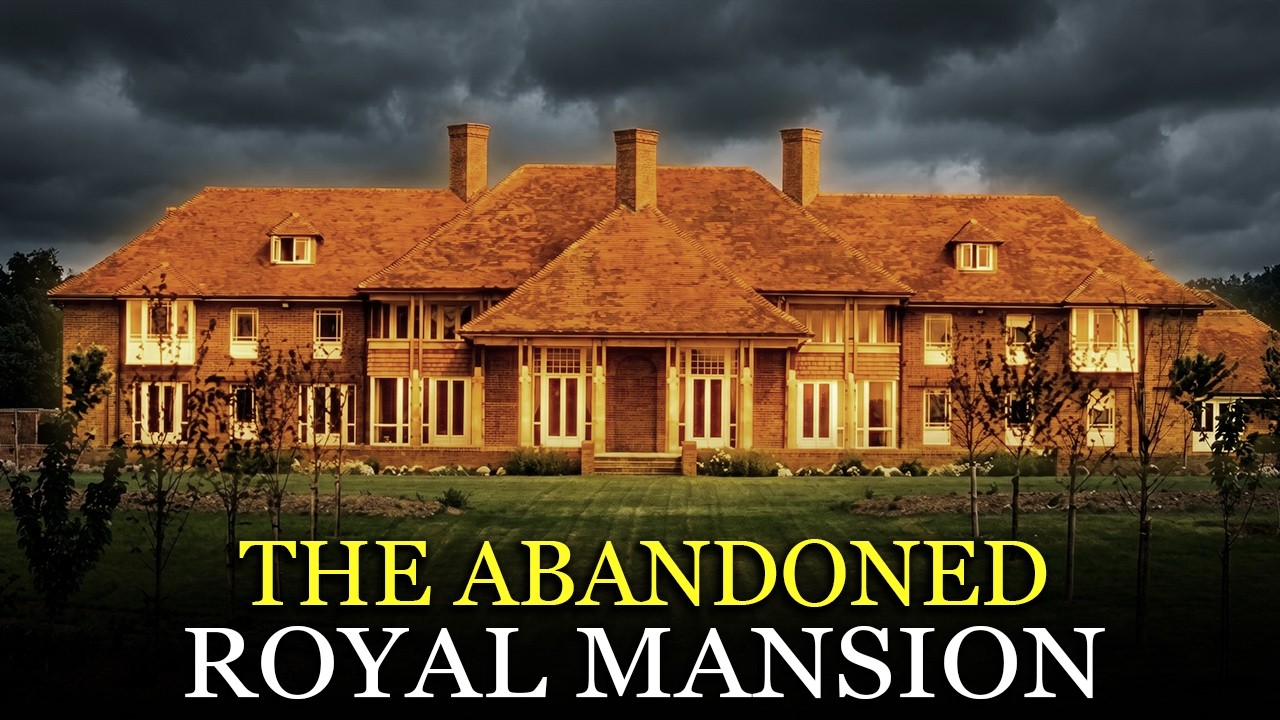
Sunninghill Park is gone, reduced to rubble and hauled away in pieces, but the ground it stood on has already swallowed another house whole.
The 15 million-pound mansion, built as a royal wedding gift for Prince Andrew and Sarah Ferguson, mocked as “Southyork,” sold to a Kazakh billionaire who never spent a single night inside, and left to rot behind the walls of Windsor Forest for nearly a decade, was demolished in 2016. The site did not stay empty for long. A replacement mansion, larger than the original, has risen on the same five acres of crown land that has carried the name Sunninghill for five centuries.
 And if recent reporting is accurate, that new house sits as empty as its predecessor.
The story of Sunninghill is not a story of one failed building. It is a story of a pattern so consistent it begins to feel like a curse — a sequence of grand intentions, royal arrivals that never happened, marriages that collapsed, and owners who vanished, all absorbed by a parcel of land that gives nothing back.
The first house on this ground was prepared for a princess in 1527. Gallion Hone, a glazier, was paid from crown accounts to fit windows in a royal property in the forest, readying it for the visit of Princess Mary, eldest daughter of Henry VIII. There is no record she ever stayed.
That is the first thing to know about Sunninghill. It has been preparing itself for royal arrivals that do not go to plan since the reign of the Tudors.
The name persisted through centuries while the buildings themselves did not. Houses rose, fell into disrepair, and were replaced. The forest shrank.
The land was carved into smaller parcels as the Great Windsor Woodland gave way to commuter settlements. But the site retained its identity, and it retained something else — a particular relationship with the crown that resurfaced whenever the monarchy needed somewhere to put a domestic problem.
In the 18th century, Jeremiah Crutchley bought the estate in 1769 and commissioned the fashionable architect James Wyatt to build a gentleman’s seat, classical in proportion, designed to demonstrate that its owner belonged to the landscape as naturally as the oaks that surrounded it. Crutchley had not inherited the estate. He had purchased it.
The building was not the organic product of centuries of family occupation. It was a stage set assembled in a matter of years by an architect who specialized in making the new look ancient.
That pattern, constructing an image of settled domestic life on ground that had never sustained one, would repeat itself generation after generation. The Tudor house prepared for a princess who left no record of staying. The Georgian house built by a purchaser performing inheritance he did not possess.
And the house that would come next, the one the world would remember, would be built to stage a marriage that was already, by the time the mortar dried, beginning to fail.
Wyatt’s Sunninghill survived into the 19th century but deteriorated through the 20th. War took its toll, then requisition, then neglect. By 1945, the fabric was failing.
The Crown Estate Commissioners purchased Sunninghill Park that year with a specific purpose in mind. Princess Elizabeth, the heir presumptive, was 21 years old, expected to marry, and would need a home. Not a palace, but a house near Windsor, private enough to allow the illusion of ordinary family life the post-war public craved.
The plan was modest by royal standards. The old house, battered but still standing, could be restored, adapted, made ready for the future queen to begin her married life in a house in the forest. The engagement to Prince Philip of Greece and Denmark was announced on the 9th of July, 1947.
The country responded with an enthusiasm that surprised even the palace. On the 30th of August, 1947, the house burned down.
The fire consumed the main building. The precise cause was never established. Wartime neglect, aging electrical systems, the vulnerability of a large house left under-maintained for a decade.
The details mattered less than the totality of the outcome. The house meant to carry a royal marriage into the future was destroyed before the marriage had taken place. Elizabeth and Philip leased Windlesham Moor instead.
Sunninghill had failed its first modern royal assignment, not through scandal, but through fire.
The ground remained. The trees remained. The name remained.
But the house was gone, and for nearly four decades, nothing replaced it. The site existed as an architectural pause, crown land holding its shape without holding a building. When the next future came, it arrived with a brass band and a tabloid nickname.
In 1986, approximately five acres of the Sunninghill estate were acquired from the Crown Estate on behalf of Queen Elizabeth II. The acquisition was a wedding gift for Prince Andrew, the Duke of York, and Sarah Ferguson, married at Westminster Abbey on the 23rd of July that year before an estimated global television audience of 500 million. The choice carried weight.
The monarchy was enjoying relative public warmth. Andrew, the Falklands war hero, was a national favorite. Sarah was energetic, red-haired, outspoken.
The house was meant to match that energy.
The architect was Sir James Dunbar Naismith, a conservation architect of serious professional standing who had worked on Balmoral. The brief was straightforward on paper. Design a substantial family house suitable for a working member of the royal family, his wife, and their future children.
The specifications told a different story. Six reception rooms, 12 bedrooms, 12 bathrooms, staff quarters, a swimming pool, tennis courts, extensive landscaped gardens within the old walled enclosure, security infrastructure appropriate to a royal residence.
 Construction began in 1987 and was completed in 1990. The house was the first newly built royal residence in Britain since Bagshot Park was constructed for Prince Arthur, Duke of Connaught, in 1879. More than a century had passed since the monarchy had built a house from scratch.
The institutions that prided themselves on tradition had broken their own pattern. Sunninghill was not inherited. It was not adapted.
It was new. And the newness was precisely the problem.
Dunbar Naismith designed the house in red brick at a scale and in a horizontal style that invited comparison no royal building should ever invite. The press landed on the nickname almost before the scaffolding came down. Southfork.
A play on the ranch from the American television series Dallas, international shorthand for ostentatious, televised, fundamentally unserious wealth. Others compared the building to a supermarket, or to a provincial leisure center. The assessments were ungenerous, sometimes cruel, and not entirely wrong.
The deeper cruelty was that the brief itself contained a contradiction no architect could have resolved. The house needed to be large enough to function as a working royal residence with all the operational infrastructure that implied, and simultaneously small enough in feeling to look like a private family home. Those two requirements, at the scale the Duke and Duchess needed, were mutually exclusive.
The operational requirement won. The domestic illusion lost.
Andrew and Sarah moved in. Princesses Beatrice and Eugenie were born, Beatrice in 1988 during construction, Eugenie in 1990, the year the house was completed. For a brief period, months rather than years, Sunninghill functioned as what it was supposed to be.
A family home occupied by a married couple with two small daughters, set behind high walls. The official photographs showed exactly what the palace press operation wanted the public to see. The performance was convincing, but the audience had already made up its mind.
Sarah Ferguson had become, by the early 1990s, one of the most publicly scrutinized women in Britain. Her spending habits, her weight, her friendships, her holidays, everything was material for a tabloid press that had decided she was excessive. Sunninghill became the stage on which this narrative was performed.
The house’s size was evidence. Its cost was evidence. Its nickname was evidence.
The swimming pool, the tennis courts, the 12 bathrooms, every amenity Dunbar Naismith had included because the brief required it, became proof of extravagance.
Andrew was frequently away, first on naval duties, then on trade envoy engagements. The absences left Sarah alone in a 12-bedroom house designed for a couple. The corridors were long.
The reception rooms were sized for official entertaining, not for an evening with the television. The scale that had been meant to impress visitors now impressed upon the sole occupant the fact that the house was built for a version of life that was not being lived.
By 1992, the marriage was visibly failing. In August, photographs showed the Duchess on holiday in the South of France with John Bryan, a Texas financial manager, in circumstances that eliminated any remaining ambiguity. The formal separation was announced shortly afterwards.
Sunninghill’s meaning shifted permanently. It was no longer the home of a young royal family. It was the scene of a marriage that had collapsed in the most humiliating terms the British press could construct.
Sarah did not leave immediately. She continued to live there at least part of the time in an arrangement that was financially tangled and publicly uncomfortable. The house built to celebrate a union now contained its wreckage.
The divorce was finalized in May 1996. Sarah’s debts were widely reported to run into several million pounds. She would spend the next decade attempting to rebuild her finances through book deals, television appearances, and commercial endorsements that often created more tabloid coverage than revenue.
Andrew remained. He continued to use Sunninghill as his principal residence, though the house built for a family of four now housed a man whose public role was contracting. The building’s operational demands did not contract to match.
Twelve bedrooms. Twelve bathrooms. Six reception rooms.
A swimming pool. Grounds that needed mowing, hedges that needed cutting, gutters that needed clearing. The bills arrived.
Then, in 2002, the Queen Mother died at Royal Lodge, Windsor Great Park, at the age of 101. Her death triggered a sequence of property decisions within the royal estate. Royal Lodge, a substantial residence with its own extensive grounds, became available.
Prince Andrew expressed his wish to move there. The royal household confirmed that the Duke of York planned to dispose of his lease at Sunninghill Park and relocate.
 That word, dispose. Not relinquish. Not sell with regret.
Not even vacate, which would at least acknowledge that the place had been lived in. Dispose. The language of a liability, not a home.
The building presented to the nation as a wedding gift, as a symbol of modern royal domesticity, as the first purpose-built royal house in more than a century, was now openly treated as something to be got rid of so that a better property could be obtained.
Sunninghill sat empty. The house vacated began the long transition from residence to liability to ruin. Without daily occupation, without heating, without the constant small maintenance that keeps a large building alive, the fabric started its slow surrender to the climate.
Berkshire is not a harsh county, but it is a wet one. Moisture is patient. It finds every crack, every failing joint, every place where the maintenance has stopped.
The grounds deteriorated in parallel. The lawns grew long, then rough, then wild. The swimming pool drained, collected rainwater, and the slow organic debris of seasons passing without intervention.
The tennis courts cracked. The hedges began to lose the geometric formality that had once distinguished them. The building was not collapsing.
It was simply ceasing to be maintained.
The asking price was 12 million pounds. The buyer paid 15 million, three million above asking, through a chain of offshore companies and trust structures registered in jurisdictions designed for exactly this kind of opacity. The purchaser was Timur Kulibayev, the son-in-law of Nursultan Nazarbayev, then president of Kazakhstan, a man who would never, not once, not for a single night, sleep in the house he had bought.
Kulibayev’s purchase removed even pretense. The house was not bought to be lived in. It was not bought to be admired.
It was not bought to be restored or demolished or reimagined. It was bought, and then it was held. The distinction between a home and a holding is the distinction between a building that serves the people inside it and a building that serves a balance sheet somewhere else.
Sunninghill, in its Kazakh phase, served the balance sheet.
The house had become the hidden thing, a building no one could see into, owned by entities no one could trace, purchased with money no one could fully account for. The domestic facade that Dunbar Naismith had built in red brick was now wrapped in a legal facade far more impenetrable. And behind both, there was nothing.
The photographs began to circulate within two years of the sale. By 2009, images showed a building in visible decline. Doors stood open to the elements.
Windows were cracked or broken, some with panes missing entirely. The swimming pool sat empty, its basin collecting rainwater, weeds pushing through the cracked tiles. The lawns had become meadow.
The residue of what had been a working royal residence was decay, pure and simple.
Inside, water damage was extensive. Damp bloomed across walls in dark patches. Plaster softened and flaked.
The particular smell of a large house left unoccupied, mildew, stillness, the cold exhalation of rooms that no one enters and no one airs, would have been present in every corridor.
The local authority was aware of the property’s condition but had little power to act. The owner, or rather the offshore structure that held the ownership, was under no obligation to maintain the building. The legal framework that governs property maintenance in England is built on the assumption that owners occupy or let their buildings, that the self-interest of habitation provides a natural incentive for upkeep.
When that assumption fails, when a building is held as an asset rather than used as a shelter, the framework has almost nothing to say.
The bats had colonized parts of the structure. In British conservation law, bat roosts are protected. Any proposal to demolish a building containing a bat roost requires a license from Natural England.
The bats did not know they were living in a former royal residence. They knew only that the building was dark, undisturbed, and structurally hospitable to roosting. Which is to say, it was falling apart in exactly the ways that suit a bat colony.
Demolition permission was eventually sought and granted. The process was not swift. Planning applications, bat surveys, environmental impact assessments, consultations with Natural England.
 All of it took time. The house that had been built in three years took considerably longer to be approved for removal.
When the demolition finally came, it was conducted without ceremony. No member of the royal family attended or commented. No heritage organization intervened to save a building that no one regarded as worth saving.
The red brick walls that had been mocked as Southyork were taken down piece by piece and carted away. The swimming pool was filled in. The foundations were cleared.
The ground was leveled. By 2016, the building was gone.
Permission was granted for a new house on the site. The planning application described a substantial modern mansion, larger than the building it would replace, designed to contemporary standards, occupying the same walled enclosure. Construction began.
And the site, which had been bare ground for the second time in its modern history, received its third purpose-built house in fewer than three centuries.
The replacement mansion is, by most accounts, an impressive structure. It is larger than the house it replaced, finished to a high specification. It lacks the emotional charge of a royal wedding gift or the reputational contamination of a royal divorce.
It looks like what it is, an expensive house in the commuter belt built for a wealthy owner, screened from public view by the same mature trees and high walls that have always defined the site.
And according to recent reporting, the replacement mansion has itself sat empty. If the reporting is accurate, and multiple outlets have repeated the claim without contradiction, the pattern is complete. A new house built on the site of the old house, standing in the same grounds, behind the same walls, and occupied by no one.
The site has consumed another building.
The public cannot visit. There is no heritage trail, no blue plaque, no guided tour. The private road is not accessible.
The walls are high. The trees are dense. The screening that was originally designed to give a royal household its privacy now gives an offshore-owned property its anonymity.
Whatever the replacement house looks like from the inside, the public will not know unless reporting penetrates the perimeter.
Stand back from the detail and look at the site across its full span. Five centuries of recorded history. Multiple buildings, multiple owners, royal and private, Georgian and modern, cherished and abandoned.
And through all of it, a single pattern repeating with a consistency that begins to feel less like coincidence and more like the logic of the ground itself. Every owner arrived at Sunninghill with a domestic intention. Each time, the outcome was vacancy, embarrassment, or absence.
No one who entered the story of Sunninghill left it enhanced. Everyone left it diminished, embarrassed, or simply erased. What Sunninghill reveals is how royal domesticity functions as a financial instrument.
The house was conceived as a gift. It was experienced as a stage set. It was maintained as an obligation.
It was sold as an asset. At each stage, the emotional language, wedding, home, family, marriage, was wrapped around a transaction that operated by entirely different rules.
The domestic surface was always temporary. The financial infrastructure was permanent. And when the surface cracked, as it always did, what showed through was the revelation that the house was never really a house.
It was a position in a portfolio, held in different forms by different entities across different centuries.
Sunninghill Park is gone. The replacement stands in its place, behind the same walls, among the same trees, on the same ancient ground. Whether it is occupied or empty, the site continues to do what it has always done.
It holds its shape. It carries a name. It waits with the patience of land that has outlasted every building placed upon it for the next intention that will not be fulfilled, the next domestic future that will not arrive, the next owner who will discover what every owner before them discovered.
That Sunninghill does not give back what is put into it. It absorbs ambition. It absorbs money.
It absorbs hope. And it persists, indifferent, enclosed, and quiet, long after the people who brought those things have gone.