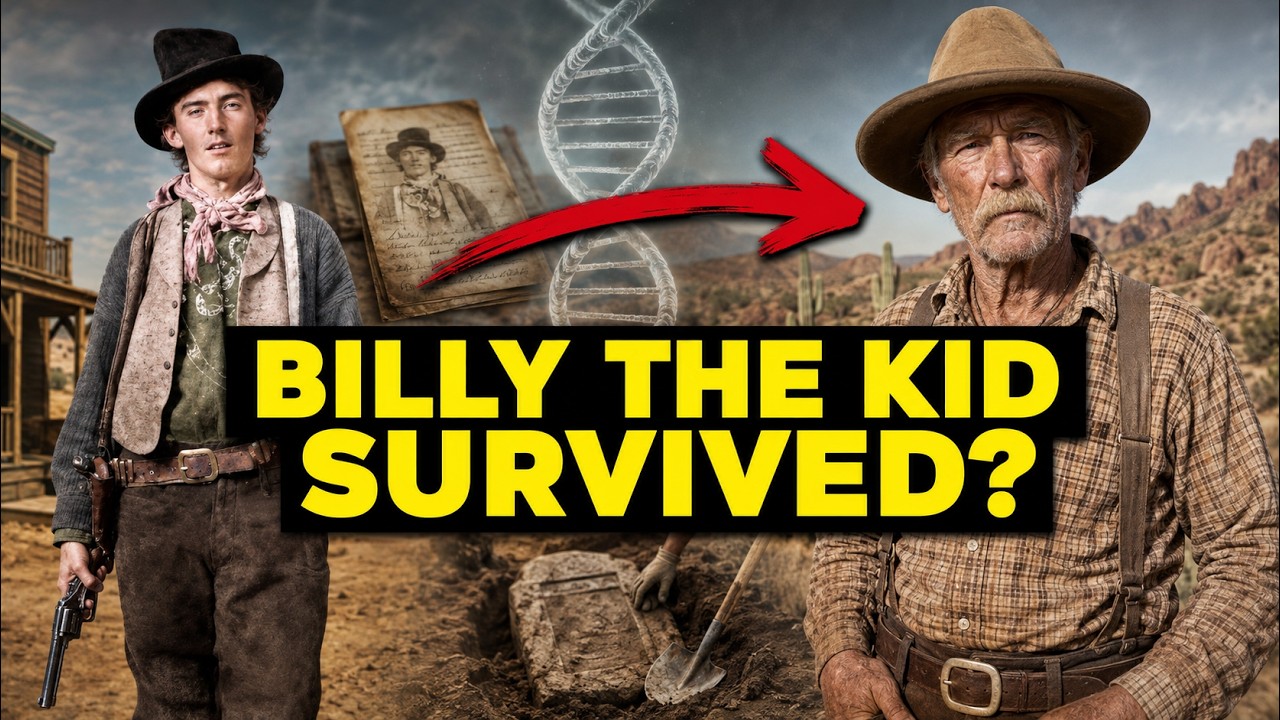
Investigators exhumed the remains of a man named John Miller in 2005, hoping DNA testing could prove he was actually Billy the Kid, the infamous Old West outlaw believed to have been shot dead by Sheriff Pat Garrett in 1881. The scientific examination, however, did not settle the question. The accepted historical account places Billy’s death at Fort Sumner, New Mexico, on July 14, 1881. Garrett said he was inside Pete Maxwell’s darkened bedroom when Billy entered, and that Maxwell identified the intruder before Garrett fired twice, killing him.
Reports of the death appeared immediately, and Garrett reported the killing to territorial authorities. The strongest evidence for Billy’s death is not Garrett’s later book, but documentation created at the time. A coroner’s jury identified the dead man as William H. Bonney and concluded he died from a gunshot fired by Garrett while the sheriff was performing his duties.
The territorial government also approved the reward payment to Garrett for the killing. Despite that official record, Billy the Kid is almost perfectly suited to generate survival stories. Large parts of his early life remain poorly documented, and he used several names, including Henry McCarty and William H. Bonney.
Flooding later damaged the old cemetery at Fort Sumner, and grave markers were moved or lost, making it difficult for modern investigators to identify remains with confidence. John Miller is different from many later claimants because he did not build a public career around claiming to be Billy the Kid. He lived for years as a rancher in New Mexico and later Arizona, eventually entering the Arizona Pioneers Home in Prescott, where he died in 1937. The Pioneers Home now lists Miller among its notable residents under the description “possibly Billy the Kid.
”
Supporters say Miller privately admitted his identity to friends or family, and that his wife, Isidora, told acquaintances her husband was really Billy. But these statements were recorded long after the supposed conversations. There is no known contemporary document in which Miller says he is Billy the Kid. One frequently repeated detail involves Miller’s marriage to Isidora in Las Vegas, New Mexico Territory, on August 8, 1881, only weeks after Garrett reported killing Billy.
Later versions describe Miller as pale, weak, and recovering from a recent chest wound. Researchers sympathetic to the claim have acknowledged that parts of this story have not been conclusively documented. Census records place John and Isidora Miller in New Mexico by the beginning of the 20th century, where Miller worked with horses and cattle. People who remembered him described him as skilled with firearms, fluent in Spanish, and knowledgeable about Billy the Kid and the Lincoln County War.
Those traits fit the historical Billy, but none is unique to him. Physical resemblance also drew attention. Photographs of the older Miller and the famous tintype of Billy show similarities in the shape of the face and prominent front teeth. During the 2005 exhumation, one skeleton had prominent front teeth and healed shoulder trauma, while another showed a hip injury that investigators thought better matched Miller’s known condition near the end of his life.
A major problem for the theory is age. Records held by the Arizona Pioneers Home reportedly listed Miller as born in 1850, making him about nine years older than Billy. The same records reportedly gave Miller a childhood history that does not match Billy’s known biography, including that his parents had been killed and he was adopted as an infant. Researcher Helen Ary developed the Miller case in detail in her book “Whatever Happened to Billy the Kid,” first published in the 1990s.
She collected recollections from people whose families had known Miller and connected the 1881 marriage, the chest wound story, and claims of private admissions. Historian Robert Utley rejected the survival claim and emphasized the absence of credible documentary evidence showing Billy survived 1881. In 2003, law enforcement officers in New Mexico reopened the case. Lincoln County Sheriff Tom Sullivan and investigator Steve Sederwall considered whether modern forensic methods could settle the issue.
The original plan was to take DNA from remains believed to be Billy and from Catherine Antrim, Billy’s mother, but forensic anthropologist Deborah Comer found that the exact location of Billy’s remains was uncertain. Investigators instead located an old carpenter’s workbench associated with descendants of the Maxwell family. According to the story attached to the object, Billy’s body had been placed on the bench after Garrett shot him. Forensic scientist Dr.
Henry Lee examined material from the bench, and samples were sent for DNA work. Court records later confirmed the bench was part of the investigation and that samples were processed for DNA analysis. On May 19, 2005, investigators went to the Arizona Pioneers Home Cemetery in Prescott to exhumed John Miller. The grave was unmarked, and the old coffins had deteriorated and collapsed.
Investigators discovered two sets of human remains in nearby graves, the second man identified as William Hudspeth, a cattleman buried close to Miller. Forensic anthropologist Dr. Laura Fulginiti examined the bones. One skeleton had prominent front teeth and healed trauma to a shoulder blade, which some investigators characterized as consistent with a bullet injury.
Fulginiti was more cautious, saying she could see evidence of trauma but could not determine it was caused by a gunshot. The second skeleton did not have the same shoulder damage but showed a hip injury still healing at the time of death. Fulginiti considered the skeleton with the hip injury the more likely candidate for Miller. Some investigators favored the other skeleton, creating disagreement about which body was actually John Miller.
Dr. Rick Staub of Orchid Cellmark Laboratories was connected with the DNA work. A usable DNA sample was reportedly obtained from the skeleton with the shoulder trauma, while usable DNA could not initially be extracted from the skeleton with the hip injury. This created an obvious difficulty: if the hip injury skeleton was actually Miller, the usable DNA might have come from Hudspeth instead.
Court filings documented the intended comparisons. DNA from the Arizona remains was to be tested against DNA associated with the carpenter’s bench. But even a perfect laboratory match would face two identity questions: did the Arizona DNA definitely belong to John Miller, and did the DNA from the bench definitely belong to Billy the Kid? The public expected a simple answer about whether the DNA matched.
That answer never developed into the definitive result the headlines had promised. In 2006, Sederwall declined to publicly disclose the result, saying what he had learned differed from the accepted history. Other reports said no results had been publicly released. Later court filings connected with a public records dispute stated that investigators had claimed to have obtained a matching result.
But a claim inside litigation is not the same as a published forensic report. PBS later summarized the situation by noting Miller’s bones had been tested against blood believed to be Billy’s, but that the results had not been made public. The exhumation also produced a legal dispute. Arizona authorities investigated whether investigators had proper authority to remove remains and disturb Hudspeth’s grave.
Prosecutors decided not to bring charges, explaining that facility officials had given permission and those collecting samples believed they were authorized. A second dispute developed over the forensic records. Gail Cooper and others sought documents involving the investigation, including Dr. Henry Lee’s bench work and reports from Orchid Cellmark.
The dispute dragged on for years because different sides disagreed over whether the work was official law enforcement activity or a privately supported historical investigation. For John Miller to have been Billy the Kid, several pieces of established history would need to be reinterpreted. Garrett would have had to kill someone else, Maxwell would have had to identify the wrong man, the body would have had to survive inspection by people who knew Billy, the coroner’s jury would have had to accept a false identification, and the territorial government would have had to approve a reward based on that mistake. The Miller theory can create explanations for each problem, but those explanations require additional assumptions for which independent contemporary evidence is limited.
What the theory lacks is a continuous documentary bridge connecting the outlaw known as William Bonney before July 1881 to the rancher known as John Miller after that date. What has never been established through publicly accepted forensic evidence is the crucial identity chain. The shoulder trauma was not scientifically confirmed as Billy’s gunshot wound. The skeleton producing useful DNA was not unquestionably established as Miller.
The biological material on the bench was not unquestionably established as Billy’s. No verified comparison with Catherine Antrim or another properly authenticated reference has identified John Miller as Henry McCarty. The Arizona Pioneers Home still recognizes Miller’s connection to the mystery, describing him as possibly Billy the Kid. Historical institutions such as the Library of Congress and New Mexico State Records continue to present Pat Garrett’s 1881 killing of Billy as the documented historical account.
John Miller’s bones were exhumed, DNA was taken, and the comparison was attempted. No authenticated DNA result has established that the outlaw who disappeared from history in July 1881 continued living under the name John Miller.